
SLIDE 1
Linear Programming CISC5835, Algorithms for Big Data CIS, Fordham Univ.
Instructor: X. Zhang
Linear Programming
- In a linear programming problem, there is a set of
variables, and we want to assign real values to them so as to
- satisfy a set of linear equations and/or linear
inequalities involving these variables, and
- maximize or minimize a given linear objective function.
2
Example: profit maximization
- A boutique chocolatier has two products:
- its flagship assortment of triangular chocolates, called Pyramide,
- and the more decadent and deluxe Pyramide Nuit.
- How much of each should it produce to maximize profits?
- Every box of Pyramide has a a profit of $1.
- Every box of Nuit has a profit of $6.
- The daily demand is limited to at most 200 boxes of Pyramide and 300
boxes of Nuit.
- The current workforce can produce a total of at most 400 boxes of
chocolate per day.
- Let x1 be # of boxes of Pyramide, x2 be # of boxes of Nuit
3
LP formulation
4
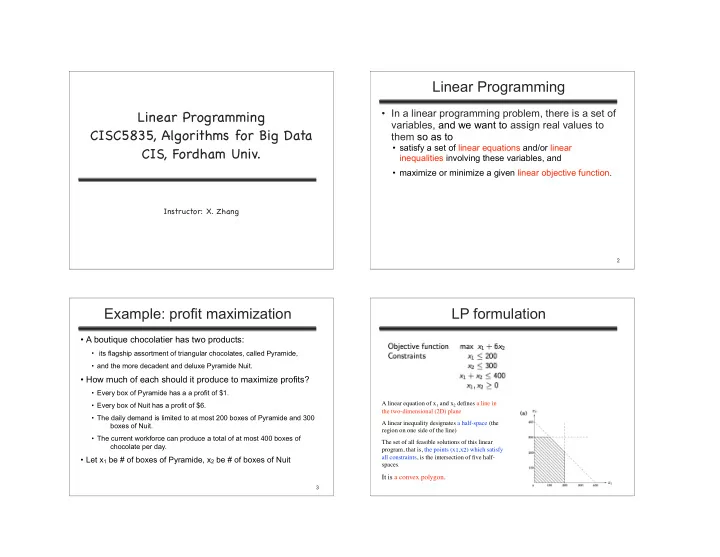
A linear equation of x1 and x2 defines a line in the two-dimensional (2D) plane A linear inequality designates a half-space (the region on one side of the line) The set of all feasible solutions of this linear program, that is, the points (x1,x2) which satisfy all constraints, is the intersection of five half- spaces.
It is a convex polygon.