
SLIDE 1
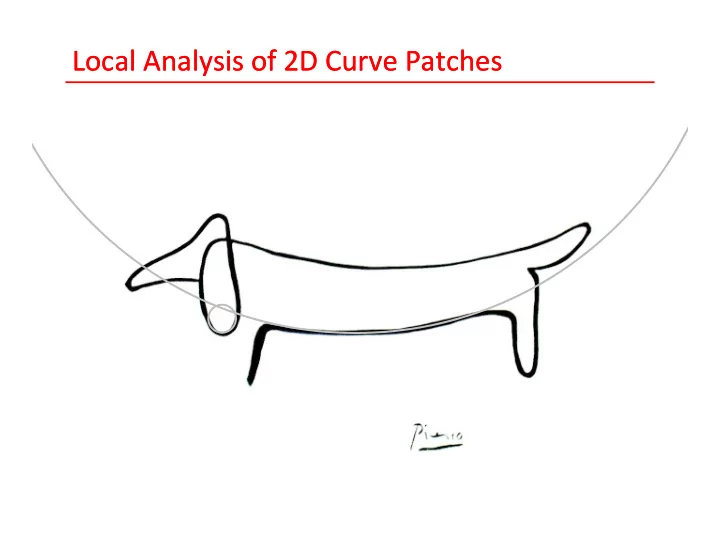
Local Analysis of 2D Curve Patches Local Analysis of 2D Curve - - PowerPoint PPT Presentation
Local Analysis of 2D Curve Patches Local Analysis of 2D Curve Patches Topic 4.2: Topic 4.2: Local analysis of 2D curve Local analysis of 2D curve patches patches patches patches Representing 2D image curves Representing 2D image
Representing 2D image curves
Estimating differential properties of 2D curves
As graph in 2D As graph in 2D As curve in 2D As curve in 2D As surface in 3D As surface in 3D
As graph in 2D As graph in 2D As curve in 2D As curve in 2D As surface in 3D As surface in 3D
Don’t go, or you’ll miss out!
Don’t go, or you’ll miss out!
intensity)
Math is our friend:
representation
useful properties
A parametric 2D curve is a continuous mapping γ : (a,b) -> R2 where t -> (x(t), y(t))
Example: a boundary curve t = pixel # along the boundary x(t) = x coordinate of the tth pixel y(t) = y coordinate of the tth pixel
To fully describe a curve we need the two functions x(t) and y(t), called the Coordinate Functions.
A closed 2D curve is a continuous mapping γ : (a,b) -> R2
where t -> (x(t), y(t)) such that (x(a), y(a)) = (x(b), y(b)).
A curve is smooth when...
A curve is smooth when all the derivatives of the Coordinate Functions exist
The 1st and 2nd derivatives of x(t), y(t) are extremely informative about the shape of a curve. curve.
Representing 2D image curves
Estimating differential properties of 2D curves
Tangent & normal vectors
Notation:
point (x(t), y(t)). γ(t) = (x(t), y(t))
a vector-valued function.
Suppose we know γ(0). How can we approximate γ(t)? γ(0) = (x(0), y(0)) γ(t)
Suppose we know γ(0). How can we approximate γ(t)? γ(0) = (x(0), y(0)) γ(t) hint?
Suppose we know γ(0). How can we approximate γ(t)? Using the derivative (tangent)! γ(0) = (x(0), y(0)) γ(t) Using the derivative (tangent)!
γ(0) = (x(0), y(0)) γ(t) Suppose we know γ(0). How can we approximate γ(t)? Using the derivative (tangent)! Using the derivative (tangent)!
γ(0) = (x(0), y(0)) γ(t) Good! But not great. Can we do any better? If so, how? Prediction of γ(t) If so, how?
γ(0) = (x(0), y(0)) γ(t) Good! But not great. Add more information about the curve, like the 2nd, 3rd,… or the nth Prediction of γ(t) 2nd, 3rd,… or the nth derivative! Familiar?
γ(0) = (x(0), y(0)) γ(t) Good! But not great. Add more information about the curve, like the 2nd, 3rd,… or the nth Prediction of γ(t) 2nd, 3rd,… or the nth derivative! This is a Taylor-Series approximation
γ(0) = (x(0), y(0)) γ(t) Formally: the 1st order Taylor-Series approximation to γ(t) near γ(0) is: , so
γ(0) γ(t) Definition. The tangent vector at γ(t) is equal to the first derivative of the function, at that point. In this case:
1st order Taylor- Series approximation
γ(0) γ(t) In general, the derivative of a vector valued function is the derivative of the n coordinate functions, so if The derivative of f at (t) is:
We can parameterize a curve γ in (infinitely) many different ways, for instance:
between γ(0) and γ(t)
curve between γ(0) and γ(t), in meters (or inches, or light-years).
We can parameterize a curve γ in (infinitely) many different ways, for instance:
between γ(0) and γ(t)
curve between γ(0) and γ(t), in meters (or inches, or light-years). But the key property is that the direction of the tangent remains unchanged, regardless of the scale of the parameter.
The direction of the tangent remains unchanged, regardless of the scale of the parameter. Really? Really? Can we prove it?
Proof: Let’s parameterize the curve γ in two ways:
differentiable function.
Proof: Let’s parameterize the curve γ in two ways:
differentiable function. In 1, we know the derivative of γ is simply
In 1, we know the derivative of γ is simply
Proof: Let’s parameterize the curve γ in two ways:
differentiable function. In 1, we know the derivative of γ is simply
In 1, we know the derivative of γ is simply In 2, the chain rule tells us that if s=f(t) and γ(s) then: which correspond to
Proof: Let’s parameterize the curve γ in two ways:
differentiable function. In 1, we know the derivative of γ is simply
In 1, we know the derivative of γ is simply In 2, the chain rule tells us that if s=f(t) and γ(s) then:
The unit tangent vector does not depend on the choice of the parameter t
How can we approximate the length of a curve?
Take small enough steps (of size ∆t) and add!
Take small enough steps (of size ∆t) and add!
This is called a piece-wise-linear length approximation. And what if we make the steps smaller and smaller? ∆t -> 0
Then we get the following definition! The arc-length s(t) of the curve γ(t) is given by:
For example, lets think about the circle What do we expect
For example, lets think about the circle Proportional to the radius and the number of pixels in the circle
Example: The arc length of a circle with radius r, whose curve equation can be written as: γ(t) = r ( cos(t), sin(t) ) then unit vectors unit vectors so
Example: The arc length of a circle with radius r, whose curve equation can be written as: γ(t) = r ( cos(t), sin(t) ) Now, substituting on the definition, we get:
Example: The arc length of a circle with radius r, whose curve equation can be written as: γ(t) = r ( cos(t), sin(t) ) Proportional to the radius… yes! Proportional to the number of pixels in the circle… yes! Now, substituting on the definition, we get:
Now, can we parameterize the function γ(t) using the arc-length function itself?
Yes! Now, can we parameterize the function γ(t) using the arc-length function itself?
Yes! Now, can we parameterize the function γ(t) using the arc-length function itself? A parameterization γ(s) where the curve parameter is the arc- length is (thoughtfully and originally) named the arc-length parameterization.
Yes! Lets use the circle again as an example. We know that the arc- Now, can we parameterize the function γ(t) using the arc-length function itself? Lets use the circle again as an example. We know that the arc- length of a circle is s(t) = rt, or for short s = rt. Which means that , so the arc-length parameterization is:
Arc-length parameterization of the circle. Using the following holds: γ(s) = γ(t) = (x(t), y(t)) t γ(t) = (x(t), y(t))
Now, we know that the arc-length is We also know that an arc-length parameterization γ(s) is one where the curve parameter is the arc-length γ Knowing these two facts, a property we can derive is that γ(s) is an arc-length parameterization of a curve if and only if
γ(s) is an arc-length parameterization of a curve if and only if
γ(s) is an arc-length parameterization of a curve if and only if This is a very useful property of arc-length parameterized curves, because the tangent -estimated because the tangent -estimated as the derivative of the curve- is always a unit-tangent!
Let’s look at the normal vector now
Today we learnt that the unit tangent is How do we estimate the Unit Normal?
Today we learnt that the unit tangent is As the orthogonal vector to T(t). As the orthogonal vector to T(t). The (unit) normal vector N(t) is the counter-clockwise rotation of T(t) by 90 degrees.
Today we learnt that the unit tangent is As the orthogonal vector to T(t). As the orthogonal vector to T(t). The (unit) normal vector N(t) is the counter-clockwise rotation of T(t) by 90 degrees.
Aside: what are orthogonal vectors? Vectors a and b are orthogonal if and only if their dot product is zero. So if a = [ax, ay], and b = [bx, by], then a and b are orthogonal if and only if: ax ay bx = axbx + ayby = 0 by
Putting the unit Tangent and the unit Normal together we get: The Moving Frame, defined as the pair The Moving Frame, defined as the pair
For example, the circle
Noteworthy:
moving frame rotates
more “curved” the curve is
frame is rotating can be estimated frame is rotating can be estimated using a 1st order Taylor-series near t=0.
Representing 2D image curves
Estimating differential properties of 2D curves
We know that: The unit tangent is: And that the unit normal is the 90-deg counter-clockwise rotation: Note that we use ”s” as the parameter to denote arc-length parameterizations. And we arc-length parameterizations because the expressions are simpler (see last slide of this lecture for comparison).
If s is the arc-length of a curve, then
The traditional way of writing the 1st order Taylor approximation of the moving frame is: But if we use the curvature k(s), it becomes
The 1st order Taylor-series approximation becomes:
The 1st order Taylor-series approximation becomes:
The 1st order Taylor-series approximation becomes:
The 1st order Taylor-series approximation becomes:
The 1st order Taylor-series approximation becomes:
The 1st order Taylor-series approximation becomes:
The 1st order Taylor-series approximation becomes:
The 1st order Taylor-series approximation becomes:
The 1st order Taylor-series approximation becomes: And the scaling constant is k(s)
The 1st order Taylor-series approximation becomes: And the scaling constant is k(s) What is this constant saying?
The 1st order Taylor-series approximation becomes: And the scaling constant is k(s) What is this constant saying? How much of the Normal do we need to add to the Tangent T(0) to approximate the tangent at T(t).
What is the intuition of the above equation then? The equation is saying, look we can approximate γ(s) (by approximating the Tangent and the Normal) using a circle that:
Example: the curvature of a circle of radius r. Parametric equation: g(t) = r (cos t, sin t). Arc-length parameterization First derivative First derivative Second derivative