The California Ground Squirrel Royce Larsen March 21, 2016 UC - - PowerPoint PPT Presentation

the california ground squirrel
SMART_READER_LITE
LIVE PREVIEW

The California Ground Squirrel Royce Larsen March 21, 2016 UC - - PowerPoint PPT Presentation

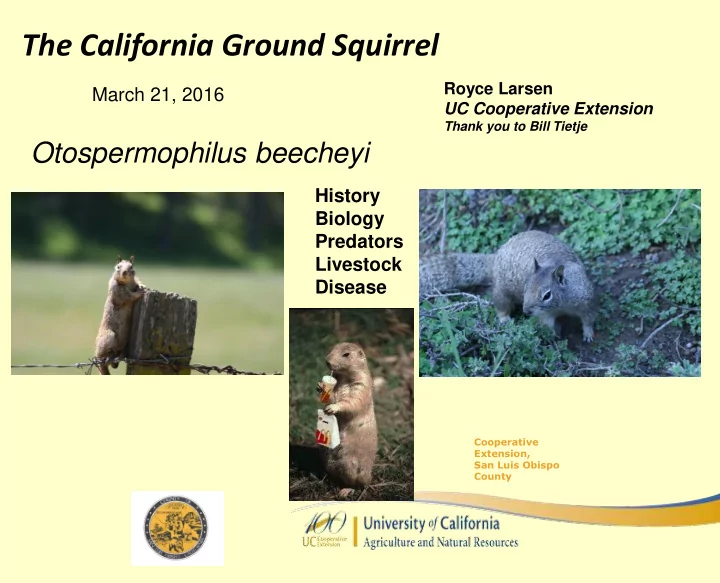
The California Ground Squirrel Royce Larsen March 21, 2016 UC Cooperative Extension Thank you to Bill Tietje Otospermophilus beecheyi History Biology Predators Livestock Disease Cooperative Extension, San Luis Obispo County Brief


slide-1
SLIDE 1

The California Ground Squirrel

Cooperative Extension, San Luis Obispo County

Royce Larsen UC Cooperative Extension

Thank you to Bill Tietje

Otospermophilus beecheyi

History Biology Predators Livestock Disease March 21, 2016
slide-2
SLIDE 2

Brief History

Santa Barbara Mission—1808

First Squirrel Campaign, 1,000’s Killed in 9 days

The Bounty!

(repealed 1877) 1901 statewide interest in control First Vertebrate Pest Conference (Sacramento, 1956) 3 cents/squirrel – lots of Squirrels Claimed

  • County Budgets were Strained
  • Abuses Occurred
  • Control was not very good
slide-3
SLIDE 3

Annual Cycle

Hibernate (Nov-Jan) Active (Feb-Jun)

Estivate (Jun-Aug)

Hibernate Coldest Part of Year

They are not Obligate Hibernators

Sleep During Hottest Period Individual Basis, Environmental and Nutritional Factors

Biology

slide-4
SLIDE 4
  • 1 litter/year
  • 30 day gestation
  • 5-7 (10-11) young nursed underground 6 wks.
  • Males disperse/Clusters of females; Jv/Yrl: 80% of Population
  • Yrl are reproductively mature)
  • Live up to 6 years in wild

Several Openings, ~100 ft of Burrow, 2-4 Feet Deep

Breeding Biology

slide-5
SLIDE 5

Feeding Habits

Variety of Fresh Greens (spring), Seeds, Dried Nuts Well Adapted to Find Sparsely Dispersed Food Build a Cache for Later Use How many squirrels? Stay near their burrows, home range about 150 yards Population Density

slide-6
SLIDE 6

Population Density

30-35/acre

slide-7
SLIDE 7
  • Provides ideal habitat
  • -shelter (predators)
  • -food (acorns)
  • Burrowing dries roots
  • Soil moved to surface

may be contaminated w/oak root fungus

  • Destroys seedlings

Oak Tree & Squirrels

slide-8
SLIDE 8

Predators

  • Squirrel 70% of rattlesnake diet
  • Blood proteins (older have immunity)
  • Hemotoxin (old) /Neurotoxin (young)

Raptor Post Need IPM Program Squirrels will rub/eat rattlesnake skins

LATO

slide-9
SLIDE 9

Cattle & Squirrel

  • A. Forage Competition
  • Reduce gain by 1 lb./day
  • 200 squirrels = one 1,000 lb. Cow
  • B. Most critical time: Late winter

(period of inadequate forage growth for cattle)

  • C. Study: Fehmi, Russo, Bartolome. 2005.

Effects of Livestock on CA Gd Sq. J. Range Ecology & Mgmt.

Conclusion: At moderate grazing intensity and during years of adequate rainfall, can have cattle, squirrels, & predators the squirrels support.

Squirrel populations Increase in Grazed Areas

slide-10
SLIDE 10

Diseases

Bubonic Plague Tularemia Leptosprosis Cryptosporidosis? Should not feed squirrels

slide-11
SLIDE 11

County checks reports

  • f waterborne illness

Several people have described feeling sick after visiting the water park; health officials believe one-celled parasite may be to blame

Nathan Welton and Laurie Phillips The Tribune

Posted on Thu, Sep. 02, 2004

The Tribune San Luis Obispo County sanluisobispo.com

Diseases

?

Cryptosporidium parvum

slide-12
SLIDE 12

Cryptosporidium Occurence in Ground Squirrels

0% 10% 20% 30% 40% 50% 60% 70% Winter Spring Summer Fall

Percent Infected

Adult Juvenile

1) There were differences between age and season 2) There were no differences between male and female

Diseases

slide-13
SLIDE 13

A new Cryptosporidium sp. was isolated through DNA testing. New Cryptosporidium from ground squirrels named C. rubeyi. Is this new species a threat to human health?????

Diseases - Recent Study

slide-14
SLIDE 14

The Bad:

  • Ag pest extraordinaire!
  • Health hazard: Bubonic plague
  • Oak seedling predator

The Good:

  • Keystone Spp.: helps maintain

predator & grassland diversity

Bad Guys!—w/a bit of Good

Challenge: Maintain the functional roles

  • f burrowing mammals in ways compatible

with human activates—IPM Program!

END