degradation at the land-ocean interface George Tanski, Michael - - PowerPoint PPT Presentation

degradation at the land ocean interface
SMART_READER_LITE
LIVE PREVIEW

degradation at the land-ocean interface George Tanski, Michael - - PowerPoint PPT Presentation

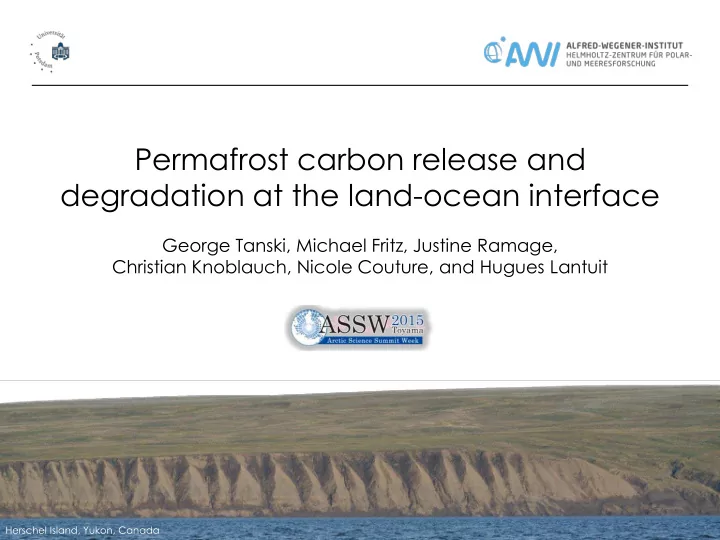
Permafrost carbon release and degradation at the land-ocean interface George Tanski, Michael Fritz, Justine Ramage, Christian Knoblauch, Nicole Couture, and Hugues Lantuit Herschel Island, Yukon, Canada Background of northern landmass of

slide-1
SLIDE 1

Permafrost carbon release and degradation at the land-ocean interface

George Tanski, Michael Fritz, Justine Ramage, Christian Knoblauch, Nicole Couture, and Hugues Lantuit

Herschel Island, Yukon, Canada

slide-2
SLIDE 2

Background

  • f northern landmass
  • f global coasts

km of coastline

Global carbon storage in soils TARNOCAI et al. 2009 (Gt Corg.) George Tanski 1

slide-3
SLIDE 3

Background

  • f the coast are unlithified

Erosion rates up to

Herschel Island, Yukon Coast, Canada George Tanski 2

slide-4
SLIDE 4

Background

Komakuk Beach, Yukon Coast, Canada

  • f the coast are unlithified

Erosion rates up to

George Tanski 3

slide-5
SLIDE 5

Background

Herschel Island, Yukon, Canada Photo: J. WOLTER

  • f the coast are unlithified

Erosion rates up to

George Tanski 4

slide-6
SLIDE 6

Topic I

Dissolved organic carbon (DOC)

OC ≤ 0.45 µm

Particulate organic carbon (POC) Sediments

release...

George Tanski 5

slide-7
SLIDE 7

Unglaciated Glaciated

Beaufort Sea (Arctic Ocean)

Herschel Island Study sites Roland Bay Kay Point

Canada

Topic I: Release of DOC from ground ice

George Tanski 6

slide-8
SLIDE 8

Topic I: Release of DOC from ground ice

Coastal erosion* DOC: ? SOC: 0.04 Gg yr-1 Sediment: 2.66 Gg yr-1 River discharge** DOC: 1.3 Gg yr-1 POC: 2.1 Gg yr-1 Sediment: 127.0 Gg yr-1

George Tanski

* MACDONALD et al. 1998 ** COUTURE 2010

1 Gg = 1012 g = 109 kg = 106 t

7

slide-9
SLIDE 9
  • Ground ice content and types along the Yukon Coastal Plain

Topic I: Release of DOC from ground ice

A) Ice wedges B) Massive ice beds C) Pore/Non-massive intrasedimental ice C: 26% A+B: 11% 37% ground ice

After COUTURE 2010

George Tanski 8

slide-10
SLIDE 10
  • Ground ice content and types along the Yukon Coastal Plain

Topic I: Release of DOC from ground ice

A) B) C) A) Ice wedges B) Massive ice beds C) Pore/Non-massive intrasedimental ice C: 26% A+B: 11% 37% ground ice

After COUTURE 2010

George Tanski 9

slide-11
SLIDE 11
  • Calculation of DOC flux

Topic I: Release of DOC from ground ice

Modified, after COUTURE 2010

DOCflux= n j=1 lj ∗ hj ∗ Rj ∗ DOCstoragej

George Tanski

DOCstorage= n j=1 θj ∗ ρ ∗ DOCconc.j

10

slide-12
SLIDE 12

Topic I: Release of DOC from ground ice

Coastal erosion** DOC: 0.09-3 Gg yr-1 SOC: 0.04 Gg yr-1 Sediment: 2.66 Gg yr-1 River discharge* DOC: 1.3 Gg yr-1 POC: 2.1 Gg yr-1 Sediment: 127.0 Gg yr-1

George Tanski

* MACDONALD et al. 1998 ** COUTURE 2010

1 Gg = 1012 g = 109 kg = 106 t

11

slide-13
SLIDE 13
  • Low dissolved organic carbon fluxes from eroding permafrost coasts
  • Western part and Herschel Island are hotspots
  • Mostly fluxes from ice thrust moraine ridges and lacustrine deposits
  • Mostly as POC  DOC/POC ratio of ~1:1000
  • OC input from the Mackenzie dominates the Beaufort Sea
  • But: High bioavailabilty of DOC assumed
  • Recent studies show high bioavailabilty
  • e.g. VONK et al. 2013  DOC loss > 34.0 ± 0.8% within two weeks
  • e.g. HOOD et al. 2009  45% of DOCterr. bioavailable

Topic I: Conclusion

George Tanski 12

slide-14
SLIDE 14

Topic II

Dissolved organic carbon (DOC)

OC ≤ 0.45 µm

Particulate organic carbon (POC) Sediments

release...

Nutrients (NH4, NO2, NO3)

George Tanski 13

slide-15
SLIDE 15

Unglaciated Glaciated

Beaufort Sea (Arctic Ocean)

Herschel Island Study site

Canada

Slump D

Topic II: Degradation of organic matter

George Tanski 14

slide-16
SLIDE 16

Topic II: Degradation of organic matter

Retrogressive thaw slump: „Slump D“ George Tanski 15

slide-17
SLIDE 17

Evolution of „Slump D“

Topic II: Degradation of organic matter

George Tanski 16

slide-18
SLIDE 18

Vegetation classification of „Slump D“ based on NDVI

Topic II: Degradation of organic matter

George Tanski 17

slide-19
SLIDE 19

30cm depth Surface/10cm depth

DOC

Topic II: Degradation of organic matter

George Tanski 18

slide-20
SLIDE 20

Surface/10cm depth 30cm depth

DON

Topic II: Degradation of organic matter

George Tanski 19

slide-21
SLIDE 21

30cm depth Surface/10cm depth

NH4

Topic II: Degradation of organic matter

George Tanski 20

slide-22
SLIDE 22
  • DOC conc. gradient from permafrost headwall to slump deposits

 Degradation of DOC right after thawing

  • High ammonium conc. directly after thawing

 Indicator for quick depletion of organic material

  • Strong degradtion of organic material at the land-ocean interface

Topic II: Conclusion

George Tanski 21

slide-23
SLIDE 23

What are the degradation mechanisms? What are the degradation patterns of POC? What happens with permafrost carbon after transport into the ocean? What are possible impacts on nearshore marine nearshore ecosystem? How is OC incorporated into local food webs?

Outlook and open questions

George Tanski 22

slide-24
SLIDE 24
  • PYRN celebratesf its 10th anniversary
  • Just released its long-term strategy until 2018
  • Is seeking to increase the network
  • More involvement of east asian partners planned
  • @ICOP 2016 big young researcher workshop planned
  • ICOP 2016 chance to be part of the new Executive Committee
  • You can apply for travel funding!

PYRN

George Tanski 23

slide-25
SLIDE 25
  • Improvement of the network
  • Census preparation in progress
  • Meet us at the poster session!
  • Find us online or on facebook!

PYRN

George Tanski 24

slide-26
SLIDE 26

Herschel Island, Yukon, Canada

Thank you very much for the attention!