
SLIDE 1
Hibernation in arctic mammals. Kelly Drew Brian Barnes Institute of Arctic Biology
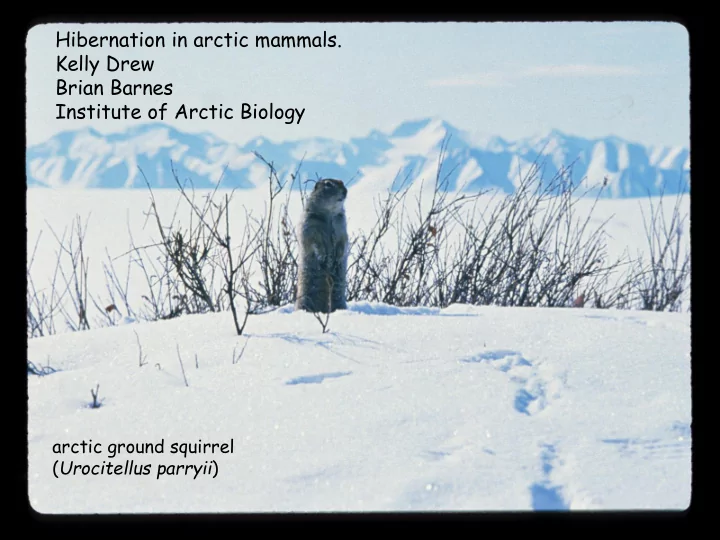
arctic ground squirrel (Urocitellus parryii)
Brian Barnes Institute of Arctic Biology arctic ground squirrel ( - - PowerPoint PPT Presentation
Hibernation in arctic mammals. Kelly Drew Brian Barnes Institute of Arctic Biology arctic ground squirrel ( Urocitellus parryii ) Arctic ground squirrels supercool their body fluids during hibernation. Two year record of core body temperature
Hibernation in arctic mammals. Kelly Drew Brian Barnes Institute of Arctic Biology
arctic ground squirrel (Urocitellus parryii)
8/1/98 12/1/98 4/1/99 8/1/99 12/1/99 4/1/00
5 10 15 20 25 30 35 40 45
(oF)
08/01/98 10/01/98 12/01/98 02/01/99 04/01/99 06/01/99
5 10 15 20 25 30 35 40 45
0.0 0.2 0.4 0.6 0.8 1.0 1.2 1.4 1.6 1.8 2.0 2.2 2.4
5 10 15 20 25 30 35 40
activity
250 500 750 1000
Tb VO2 act
hours BMR
Karpovich S, Toien O, CL Buck and Barnes BM. 2009. Energetics of arousal episodes under arctic conditions in arctic ground squirrels. J Comp Physiol 179 691-700 basal metabolism
metabolic rate
body temperature activity
body temperature (oC)
activity
250 500 750 1000
Tb VO2 act
body temperature metabolic rate activity
BMR
body temperature (oC)
activity
250 500 750 1000
Tb VO2 act
body temperature metabolic rate activity
BMR
Photo by J. Hechtel
5 10 15 20 25 30 35 40 45
black bear arctic ground squirrel
contrast of body temperatures during hibernation in small and large mammals Hibernating black bears are human- sized, do not need to eat, drink, defecate or urinate for 7 months, do not lose muscle or bone mass, and can be wakened at anytime.
Tøien et al. 2011 Science