
SLIDE 1
BRIAN PERRY CIVIL
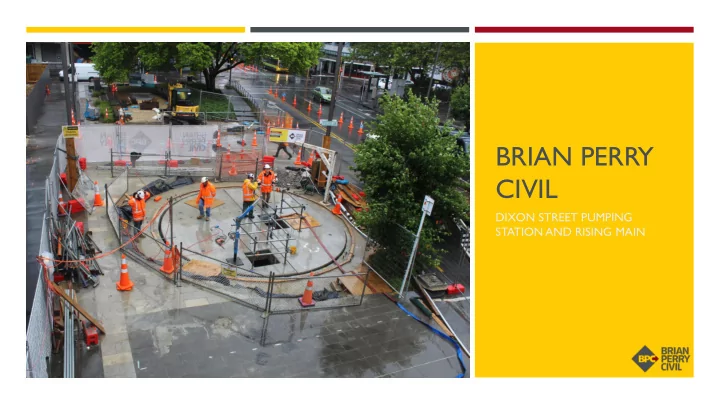
DIXON STREET PUMPING STATION AND RISING MAIN
CIVIL DIXON STREET PUMPING STATION AND RISING MAIN BRIAN PERRY - - PowerPoint PPT Presentation
BRIAN PERRY CIVIL DIXON STREET PUMPING STATION AND RISING MAIN BRIAN PERRY CIVIL Established by Brian Perry in 1954, Brian From its origins in drainage work in the The Company was bought by Fletcher Perry Civil is a contractor with a
DIXON STREET PUMPING STATION AND RISING MAIN
Established by Brian Perry in 1954, Brian Perry Civil is a contractor with a reputation for performance, innovation and quality in high risk civil engineering projects. From its origins in drainage work in the Waikato, the Company progressed to river and marine works, energy pipelines, civil structures and foundation work. Operations expanded geographically around New Zealand and to the South Pacific Islands. The Company was bought by Fletcher Construction in 1986 and is now undertaking civil engineering projects ranging from small drainage jobs to major infrastructure projects.
Brian Perry Civil expanded their
in 1989. This year marks 30 years of
BPC Wellington have carried out a vast portfolio of notable piling and ground improvement projects throughout the Wellington Region.
ORIENTAL BAY ENHANCEMENT WHIROKINO TRESTLE AND MANAWATU RIVER BRIDGE NGAURANGA TO AOTEA QUAY SMART MOTORWAY KUMOTOTO WELLINGTON MAJESTIC CENTRE JOHNSONVILLE TRIANGLE IMPROVEMENTS CENTREPORT MACKAYS TO PEKA PEKA EXPRESSWAY
Construction of a new 6.5m diameter, 7m deep underground pumping station
Mechanical fit-out
175m of new rising main
Located on a contaminated land site in Wellington CBD.
Constructed to accommodate the additional flows of the new developments, alleviating capacity issues in the downstream network.
First PS to be constructed in the CBD in over 40 years.
BPC submitted a proposal based a segmental precast caisson system.
A market review highlighted the lack of a suitable supplier of concrete segments within New Zealand and Australia. We contacted FP McCann in the UK which had a supply of 6.5m diameter segments in stock.
Traditional methods would have involved overdigging the extent of the excavation to provide working room to construct the structure.
The ECI and construction required extensive liaising and collaborative engagement with GHD to finalise and implement the testing and design phases.
To the best of our knowledge this is the first time this technology has been used in New Zealand.
Thus, this system has not been proven in a seismic environment. BPC worked collaboratively with GHD, and our sub consultant Arup, to finalise the design and to ensure that the segmental caisson and the internal walls could be designed to perform effectively in an earthquake. This work included:
Assessing ground conditions
Seismic modelling and;
Defining structural performance requirements
BPC produced a 3D model to visualise the new pump station layout.
By opting to use a segmental caisson:
No requirement for large scale temporary works (shoring).
Absolute minimum footprint of the excavation, thereby reducing the volume of material to be excavated, minimising the volume of contaminated material to be removed.
The minimised footprint allowed us to position a 6.5m diameter structure on the site, without the need to close Feltex Lane.
During the planning stage, it was noted that one of our greatest health and safety risks was going to be safe access, egress and ventilation of the work space.
The nature of a segmental caisson allows all work to be carried out safely from ground level.
The 7.5m deep caisson excavation and external structure was completed without any workers entering the caisson
The RFP included small number of drawings that inferred that the client was open to ‘Another Way’ to construct the project Responses to questions during the RFP re-affirmed the desire to want to do things differently; no unnecessary provision for Risks Extensive and open dialogue during the ‘Preferred T ender’ stage clarified responsibilities and mitigate outstanding risks All parties entered into the project with the knowledge that decisions were being made ‘Best for Project’; scope, role and responsibilities were all understood. Result: The contract was ‘Administrative’ not ‘Adversarial’
Civil Contractors New Zealand Wellington / Wairarapa Branch Project
Year Award 2019 Finalist in the Civil Contractors New Zealand National Awards 2019 Finalist in the Fletcher Building Excellence Awards Outstanding Customer Leading Team 2019 Institute of Public Works Engineering Australasia NZ Engineer Awards Best Public Works Project under $5m 2019