Pri Princ ncipal Fe Fede deral Civil Civil Rig ights L s Laws - - PowerPoint PPT Presentation

pri princ ncipal fe fede deral civil civil rig ights l s
SMART_READER_LITE
LIVE PREVIEW

Pri Princ ncipal Fe Fede deral Civil Civil Rig ights L s Laws - - PowerPoint PPT Presentation

Pri Princ ncipal Fe Fede deral Civil Civil Rig ights L s Laws Title VI of the Civil Rights Act of 1964 Section 504 of the Rehabilitation Act of 1973 Section 109 of the Housing and Community Development Act of 1974 Fair


slide-1
SLIDE 1

NSP1 Implementation Training Slide 1
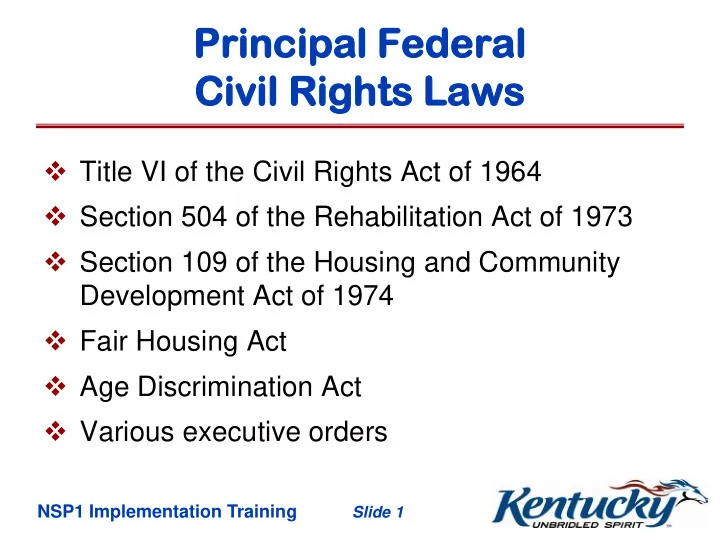
Pri Princ ncipal Fe Fede deral Civil Civil Rig ights L s Laws

 Title VI of the Civil Rights Act of 1964  Section 504 of the Rehabilitation Act of 1973  Section 109 of the Housing and Community Development Act of 1974  Fair Housing Act  Age Discrimination Act  Various executive orders

slide-2
SLIDE 2

NSP1 Implementation Training Slide 2

Fair Housing g and d Civil Righ ghts

 HUD has jurisdiction only on the funds it distributes.  If you have funds from more than one federal source, you must comply with all requirements. If they are contradictory, you must comply with the requirements that are the most restrictive.

slide-3
SLIDE 3

NSP1 Implementation Training Slide 3

Fair Housing g and d Civil Righ ghts

 Does it apply to your organization? Yes!  Any agency, organization, or person receiving any type of Federal financial assistance is considered a recipient.  Includes public and private, for profit and nonprofit organizations, religious and secular

  • rganizations, that receive assistance.
slide-4
SLIDE 4

NSP1 Implementation Training Slide 4

Fa Fair Hous Housing ng & & Equa Equal Opportuni rtunity ty

 Comply with non-discrimination and equal

  • pportunity laws

– Affirmatively further fair housing – Affirmative marketing plan when 5+ assisted units

  • State has sample to follow

 Comply with Section 504 regarding handicapped access  Comply with Section 3 regarding employment and contracting for low income persons

slide-5
SLIDE 5

NSP1 Implementation Training Slide 5

Title VI of the Civil Rights Act of 1964

 Prohibits discrimination based on race, color, and national origin.  Applies to money paid, property transferred,

  • r other federal financial assistance.

 Legal Basis for Limited English Proficiency Obligation/Guidance  Can use KHC letter (see separate Word doc

  • n requirements)
slide-6
SLIDE 6

NSP1 Implementation Training Slide 6

HUD LEP (Li (Limited Engl d English h Profi Proficiency)

 Issued January 2007 --  www.hud.gov/lep  Improve access to limited LEP (persons who cannot communicate in English) who are eligible participants for federally-funded programs.

slide-7
SLIDE 7

NSP1 Implementation Training Slide 7

HUD LEP (Li (Limited Engl d English h Profi Proficiency)

 Extent of your obligations:

– Number or portion of LEP persons eligible or likely to be served – Frequency with which they contact program – Nature/importance of program/documents – Resources available to recipient (and cost)

slide-8
SLIDE 8

NSP1 Implementation Training Slide 8

HUD LEP (Li (Limited Engl d English h Profi Proficiency)

 Develop an LEP plan:

– Identify LEP individuals requiring assistance (and languages) – Identify types of assistance to be provided – Train staff – Notify LEP persons of services available – Monitor/update LEP plan as needs change

slide-9
SLIDE 9

NSP1 Implementation Training Slide 9

LEP: Legal Document

 The English document – legal document  Translated document – information only  Disclaimer --“This document is a translation of a HUD-issued legal document. HUD provides this translation .”

slide-10
SLIDE 10

NSP1 Implementation Training Slide 10

Size of Language Group Recommended Provision of Written Language Assistance  LEP population exceeds 5% or 1,000 or more in the eligible population in the market area

  • r among current beneficiaries

Translated vital documents  More than 5% of the eligible population or beneficiaries and more than 50 in number Translated vital documents

HUD LEP (Limited Engl glish P Proficiency)

slide-11
SLIDE 11

NSP1 Implementation Training Slide 11

Size of Language Group Recommended Provision of Written Language Assistance  More than 5% of the eligible Translated written notice of right population or beneficiaries and to receive free oral 50 or less in number interpretation of documents.  5% or less of the eligible population or beneficiaries and No written translation is less than 1,000 in number required.

HUD LEP (Limited Engl glish P Proficiency)

slide-12
SLIDE 12

NSP1 Implementation Training Slide 12

LEP Vital Documents

 Examples of Vital Documents include: – Applications for admissions; – Leases; – House Rules; – Eviction Notices; – Personal declaration forms; – Continued Occupancy forms; – Fraud Notices

slide-13
SLIDE 13

NSP1 Implementation Training Slide 13

Section 504 of the Rehabilitation Act of 1973

 Prohibits discrimination based on disability in programs

  • r activities that receive federal financial assistance or in

programs conducted by any Executive Agency or the Postal Service.

slide-14
SLIDE 14

NSP1 Implementation Training Slide 14

Who is a Person with a Disability Under Section 504?

 “Individual with a Disability” –a person with a a physical or mental impairment that:  Substantially limits one or more major life activities;  Has a record of such an impairment; or,  Is regarded as having an impairment.

slide-15
SLIDE 15

NSP1 Implementation Training Slide 15

Se Sect ction 5 504

 Programs must be usable by and accessible to persons with disabilities. 24 CFR 8.20.  Reasonable accommodation 24 CFR 8.33

slide-16
SLIDE 16

NSP1 Implementation Training Slide 16

Se Sect ction 5 504

 HUD regulations require that 5 percent of units in multifamily new construction and buildings undergoing substantial rehabilitation have accessible units meeting the requirements of

  • UFAS. 24 CFR §§8.22, 8.23. (an additional 2%

accessible to persons with sensory impairments)

slide-17
SLIDE 17

NSP1 Implementation Training Slide 17

Sec Section 504 504

Housing must also:  Meet the needs of the community  Be provided in most integrated setting possible  Be available in a range of sizes and amenities

slide-18
SLIDE 18

NSP1 Implementation Training Slide 18

Duration of Obligation Under Section 504 and Title VI

 Section 504 and Title VI apply for the duration

  • f the period for which the housing is used for

the purpose for which the funds are given. 24 CFR §8.50, 24 CFR §1.5  Ex: Applies for full length of NSP affordability period –not just for the year that the funds are actually given.

slide-19
SLIDE 19

NSP1 Implementation Training Slide 19

Section 109 of the Housing and Community Development Act of 1974

 Section 109 prohibits discrimination on the basis of race, color, national origin, sex or religion in programs and activities receiving financial assistance through Title I of HUD's Community Development and Block Grant Program.

slide-20
SLIDE 20

NSP1 Implementation Training Slide 20

Section 3

 Purpose: to ensure that economic

  • pportunities resulting from HUD financial

assistance, to the greatest extent feasible, will be directed to low-and very low-income persons, particularly those receiving government assistance for housing. 24 CFR §135.1

slide-21
SLIDE 21

NSP1 Implementation Training Slide 21

Section 3

 Covered Programs – Development – Operations – Modernization – Housing and Community Development – Housing rehabilitation – Housing construction

slide-22
SLIDE 22

NSP1 Implementation Training Slide 22

Section 3

 Section 3 of the Housing and Urban Development Act of 1968 recognizes that the normal expenditure of certain HUD funds typically results in new jobs, contracts, and other economic opportunities  When these opportunities are created, low- and very low-income persons residing in the community in which the funds are spent (regardless of race and gender), and the businesses that substantially employ them, shall receive priority consideration.

slide-23
SLIDE 23

NSP1 Implementation Training Slide 23

Section 3

 Section 3 is one of HUD’s tools for ensuring that the expenditure of federal funds in economically distressed communities has a multiplier effect by targeting local low- and very low-income persons and qualified businesses for jobs, training, and contracting opportunities.

slide-24
SLIDE 24

NSP1 Implementation Training Slide 24

Threshol holds ds

 Housing & Community Development:

– $200k –Recipient/Project – $100k –Contractor/Subcontractor §135.3(a)(3)

 NSP: Combined investment in excess of $200,000 of into projects arising in connection with housing construction, demolition, rehabilitation, or other public construction – regardless of the actual amount that is spent on each individual unit/property.

slide-25
SLIDE 25

NSP1 Implementation Training Slide 25

Recipient Responsibilities

 Notify Section 3 residents of employment and contracting opportunities  Facilitate employment and training of residents  Incorporate Section 3 clause  Inform contractors of requirements  Assist contractors with compliance  Document compliance actions

slide-26
SLIDE 26

NSP1 Implementation Training Slide 26

Numerical Goals

 Employment:

– 30 percent of new hires annually. §135.30(b)

 Contracts:

– 10 percent of the total $ amount of all Section 3 covered contracts for building trades work

and

– 3 percent of the total $ amount of all other Section 3 covered contracts

slide-27
SLIDE 27

NSP1 Implementation Training Slide 27

Reporting & Recordkeeping

 Recipients are required to submit Summary Report, HUD Form 60002, an annual report showing recipient’s Section 3 effectiveness  HUD shall have access to all records, reports and other documents that are maintained to demonstrate compliance with Section 3

slide-28
SLIDE 28

NSP1 Implementation Training Slide 28

Fa Fair Hous Housing ng & & Equa Equal Opportuni rtunity ty ( (conti ntinue ued) d)

 See implementation training Word document for NSP-specific items  Other applicable rules:

– Assist beneficiaries with limited English proficiency – Take action to promote contracting with minority & women owned businesses

 Cannot provide assistance to persons not legally in the U.S.

– Local governments must ask – Nonprofits not required to ask

slide-29
SLIDE 29

NSP1 Implementation Training Slide 29

Fair Housing Act

 Prohibits discrimination because of race, color, religion, sex, disability, familial status, and national origin.  Covers all types of housing intended as a short

  • r long-term residence, including shelters,

transitional housing facilities, nursing homes, and manufactured housing.

slide-30
SLIDE 30

NSP1 Implementation Training Slide 30

Fair Housing Act

 Requires the following in covered multifamily dwellings: – accessible public and common use areas – accessible route into and through unit – doors that are wide enough for wheelchairs – usable kitchens and bathrooms that allow a person using a wheelchair to maneuver – other adaptable features (e.g. environmental controls , grab bars)

slide-31
SLIDE 31

NSP1 Implementation Training Slide 31

Fair Housing Act

 Section 808 (e)(5) “administer the programs and activities relating to housing and urban development in a manner affirmatively to further the policies of this subchapter;”  GOAL –Promote Fair Housing Choice and Equal Opportunity in Housing:

– Build diverse & inclusive communities; – Increase housing opportunities; – Enhance job opportunities; – Enhance education opportunities.

slide-32
SLIDE 32

NSP1 Implementation Training Slide 32

Affirmatively Furthering Fair Housing

 To affirmatively further fair housing, generally:

– Conduct an analysis of impediments to fair housing choice; – Take appropriate actions to overcome impediments; and – Maintain records of the actions taken.

slide-33
SLIDE 33

NSP1 Implementation Training Slide 33

Impediments to Fair Housing Choice

Where do you identify impediments? State plan (KHC and DLG):  http://www.kyhousing.org/uploadedFiles/Resour ces/Analysis.pdf?n=7476  Bowling Green, Covington, some other communities have own analysis of impediments

slide-34
SLIDE 34

NSP1 Implementation Training Slide 34

Impediments to Fair Housing Choice

Examples include:  Exclusionary zoning;  Lack of accessible housing;  Segregated communities;  Racial profiling.

slide-35
SLIDE 35

NSP1 Implementation Training Slide 35

Impediments to Fair Housing Choice

 Lack of services (water, sewage, transportation, etc.)  No fair housing services or testing; and  Policies that impact one segment of residents

slide-36
SLIDE 36

NSP1 Implementation Training Slide 36

Overcom

  • ming I

ng Impedi diment nts

Examples include:  Build affordable housing in non-minority neighborhoods;  Conduct town halls to discuss violent and hate crimes;  Engage the business community and civic groups in discussion of civil rights and fair housing issues;

slide-37
SLIDE 37

NSP1 Implementation Training Slide 37

Overcom

  • ming I

ng Impedi diment nts

 Establish a local fair housing group;  Work to repeal or modify ordinances/policies that impact minorities;  Establish inclusionary zoning.

slide-38
SLIDE 38

NSP1 Implementation Training Slide 38

Maintaining Records

Records to be maintained include:  Racial and ethnic data  Number of affordable housing units built in non- minority neighborhoods; effects  Number of town hall/meetings conducted ; effects  Number of meetings with business and civic

  • rganizations; effects
slide-39
SLIDE 39

NSP1 Implementation Training Slide 39

Maintaining Records

 Name, date, responsibilities, and staffing of the local fair housing group; effects  How many local ordinances/policies were modified or eliminated; effects

slide-40
SLIDE 40

NSP1 Implementation Training Slide 40

Fair Housing Act

 Section 808 (e)(6) “annually report to the Congress, and make available to the public, data on the race, color, religion, sex, national

  • rigin, age, handicap, and family characteristics
  • f persons and households…”
slide-41
SLIDE 41

NSP1 Implementation Training Slide 41

Fair Housing Act

 Section 808 (e)(5) “administer the programs and activities relating to housing and urban development in a manner affirmatively to further the policies of this subchapter to achieve a condition in which individuals of similar income levels in the same housing market area have a like range of housing choices available to them regardless of their race, color, religion, sex, handicap, familial status, or national origin.”

slide-42
SLIDE 42

NSP1 Implementation Training Slide 42

AFHM-Plan

 Affirmative Fair Housing Marketing Plan Forms  HUD Form 935.2A –Multi-family Housing  HUD Form 935.2B –Single Family Housing  HUD Form 935.2C – Condominiums/Cooperatives

slide-43
SLIDE 43

NSP1 Implementation Training Slide 43

Are re the these Fa Fair Hous Housing ng Vi Viol

  • lations?

 A homeowner selling his/her home in a predominantly white neighborhood displays a preference for white buyers.  A landlord charges Hispanic tenants a higher deposit because he/she believes they cause more damage than non-Hispanics.

slide-44
SLIDE 44

NSP1 Implementation Training Slide 44

Are re the these Fa Fair Hous Housing ng Vi Viol

  • lations?

 An African-American family in the market for a new home hires a real estate agent. The agent shows them only homes in predominantly minority neighborhoods, even though there are many other homes in the same price range in other neighborhoods.

slide-45
SLIDE 45

NSP1 Implementation Training Slide 45

Are re the these Fa Fair Hous Housing ng Vi Viol

  • lations?

 An elderly, disabled tenant who is a participant in HUD’s Housing Choice Voucher program (Section 8) lives with her sister, who acts as her

  • caregiver. The housing authority’s rental policy

does not allow family members to be live-in

  • caregivers. The tenant requests an exception as a

reasonable accommodation; the housing authority refuses.

slide-46
SLIDE 46

NSP1 Implementation Training Slide 46

Are re the these Fa Fair Hous Housing ng Vi Viol

  • lations?

 The case was settled by HUD; the housing authority must pay $20,000 to each sister, $20,000 to the law school that brought the complaint on their behalf, and forgive up to $10,000 in disputed past due rent.

slide-47
SLIDE 47

NSP1 Implementation Training Slide 47

Are re the these Fa Fair Hous Housing ng Vi Viol

  • lations?

 A private landlord tells a HUD investigator, “I do not have any blacks on my property and I am aware that we have a biracial president, but no federal law will make me rent to anyone I do not want to.” The landlord had rented a trailer to a white family, then later disconnected water service and forced them to leave because he objected to a family member’s interracial dating.

slide-48
SLIDE 48

NSP1 Implementation Training Slide 48

Are re the these Fa Fair Hous Housing ng Vi Viol

  • lations?

 Stonecleave Village rental property managers received complaints about loud behavior and playing of organized sports in the facility’s common

  • area. The condo board designed a field in the rear
  • f the complex for children to play.
slide-49
SLIDE 49

NSP1 Implementation Training Slide 49

Are re the these Fa Fair Hous Housing ng Vi Viol

  • lations?

Families were then informed that they were being fined $10 per day for two days for children playing in the common area, $10 per day for two days for allegedly causing damage; $25 to reimburse for the damage; and $437.50 for attorney fees. Prior to this, the families had not received any fines or warning, and when an adult resident was having a party on the common grounds, no fine was issued.

slide-50
SLIDE 50

NSP1 Implementation Training Slide 50

Are re the these Fa Fair Hous Housing ng Vi Viol

  • lations?

HUD has charged the property management company and board with discriminating against families with children.

slide-51
SLIDE 51

NSP1 Implementation Training Slide 51

Monit nitor

  • ring

ing

 DLG required to monitor projects to ensure: – Approved activities carried out in a timely manner – Activities conducted in compliance with NSP

  • bjectives & requirements

– On-going affordability requirements met

slide-52
SLIDE 52

NSP1 Implementation Training Slide 52

Monit nitor

  • ring

ing

 Monitoring can be carried out by reviewing reports (desk review) as well as on-site inspections & reviews – Set up, interim & other forms intended to allow for a lot of desk monitoring as projects implemented – Site visits will focus on record keeping, financial management, cross-cutting other Federal regulations

slide-53
SLIDE 53

Acknow

  • wle

ledgment nts

Some of the slides on this website were borrowed from HUD. http://www.hud.gov/webcasts/archives/ARRATraining.pdf Other information was provided by KHC. For more information, please visit

http://www.kyhousing.org/uploadedFiles/Resources/Analysis.pdf?n=7476