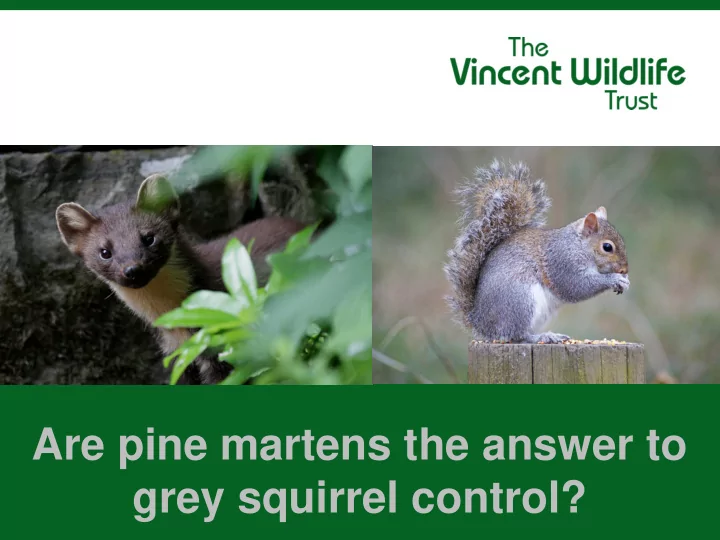
Are pine martens the answer to grey squirrel control? Journalists - - PowerPoint PPT Presentation
Are pine martens the answer to grey squirrel control? Journalists seem to think so.. The Vincent Wildlife Trust Founded in 1975 by Hon. Vincent Weir A charity engaged in mammal research, surveys, monitoring & conservation
Journalists seem to think so…..
The Vincent Wildlife Trust
- Founded in 1975 by Hon. Vincent Weir
- A charity engaged in mammal research,
surveys, monitoring & conservation
- History of national distribution surveys
– otter, water vole, polecat & pine marten
- Current focus on rare bats and the
smaller mustelids- polecat, stoat, weasel and pine marten.
Research Education Conservation
The pine marten
- One of six native British mustelids
- Cat-sized, cream bib, bushy tail,
prominent pale ears
- 3-D habitat specialist
- Typically associated with extensive
woodland & ‘old growth’ features
- Prefer to den above ground (tree
cavities)
- Home range size 1 - 32km2
- Omnivorous & opportunistic diet –
small mammals, fruit, small birds & invertebrates.
The grey squirrel
- Non-native.
- Introduced to Britain & Ireland.
- Threatens survival of native red
squirrels through competition & disease (squirrel pox virus).
- Cost of grey squirrel damage to
commercial forestry in UK = >£10 million per year.
- “One of the world’s most invasive alien
species” (Lowe et al. 2004).
- Natural range of grey squirrel in North
America overlaps with American marten and fisher (natural predators)
- nly in very small area (Sheehy & Lawton,
2014).
Pine martens and squirrels in Ireland
- Grey squirrels introduced to Ireland in
1911.
- Grey squirrels present in 26 of 32
counties (Carey et al. 2007).
- In late 1990s, red & grey squirrel
populations in some northern counties reported as ‘‘unsettled’’ for first time
(O’Teangana et al. 2000).
- Anecdotal reports that grey squirrel
had declined locally since the 1980s, allowing for a resurgence of the red squirrel population.
- This coincided with recovery of the
pine marten.
- Suggestion that the distribution of the
3 species may be linked (Carey et al. 2007).
The majority of respondents (84.7%) wish to see the Pine marten restored in Wales
- Study carried out in 2011-2012 by
Emma Sheehy & Colin Lawton at National University of Ireland.
- Investigated the role of the pine
marten in grey and red squirrel population dynamics.
Pine martens and squirrels in Ireland
Methods: Study area: Laois & Offaly (in the midlands) including a buffer zone, & Wicklow (in east).
- Sightings and hair tube
surveys used to collect distribution data on pine martens & squirrels.
- Squirrels live trapped to
determine abundance and density.
- Squirrel body size,
condition & breeding activity recorded.
Research Education Conservation
Pine martens and squirrels in Ireland
Sheehy & Lawton, 2014
Research Education Conservation
Results:
- Strong negative correlation between detection of grey squirrel
& pine marten. Only 1 site where both species were found.
- Grey squirrel population has crashed in 9,000 km2 of its former
range.
- Red squirrel has recolonised 6,500 km2 of its historic range.
- Red squirrel & pine marten populations overlap extensively but
grey squirrel & pine marten overlap is limited.
- In woodland where pine martens occurred at high density, grey
squirrel density was very low & grey squirrel body mass was low & overall health was poor.
- High density predator population may be influencing foraging
behaviour, body condition, reproductive activity or density in grey squirrel population.
Pine martens and squirrels in Ireland
Sheehy & Lawton, 2014
Research Education Conservation
Grey squirrel & pine marten distribution & densities from sightings between 2010-2012. Sighting locations (left) & 10km radius kernel density (right).
Pine martens and squirrels in Ireland
Sheehy & Lawton, 2014
Pine martens and squirrels in Ireland
Pine marten diet
- Grey squirrel % frequency of
- ccurrence in diet = 15.6%.
Similar to contribution of grey squirrel to American marten & fisher diet in North America.
- Red squirrel % frequency of
- ccurrence in diet = 2.4%.
Consistent with other studies in Ireland & Scotland.
Sheehy et al. 2013
Pine martens and squirrels in Scotland
- Anecdotal evidence that where pine
martens have recovered & expanded their range in parts of Scotland, grey squirrels have declined.
- Research underway by Emma Sheehy &
Xavier Lambin at Aberdeen University to investigate relationship between pine martens, grey & red squirrels in Scotland.
Pine Marten Recovery Project
- Aims to restore viable, self-sustaining
pine marten populations across England and Wales where habitat &
- ther conditions are suitable.
- First translocations taking place now:
20 animals being translocated from Scotland to mid Wales, to reinforce small existing population.
- Feasibility study completed in 2014
- Evaluated proposal against IUCN
guidelines
- Used habitat suitability model to identify
suitable release sites
- Community/stakeholder engagement in
potential release areas
- Identify potential conflicts
- Detailed field surveys & risk assessments
- Disease Risk Analysis completed by
wildlife vet & reviewed by veterinary experts
Feasibility Study
- Habitat suitability model
(MAXENT) identified areas
- f suitable habitat for pine
marten reinforcement (most
suitable areas in green on map).
- Optimal areas will have:
- Minimum habitat area and
connectivity for viable numbers
- f pine marten home ranges.
- Minimum potential conflict
& full support of local communities.
Identifying reinforcement areas
Initial release sites in mid- Wales.
Identifying reinforcement areas
- Gathered baseline data on:
- Prey availability (small
mammal surveys)
- grey squirrel abundance
- bat species
- woodland structure &
composition
- Prepared release sites
- Release pens
- Den boxes
Preparing release sites
- Liaising with landowners/users.
- Meetings with NFU/FUW.
- 3 public community meetings.
- Attendance of local shows (e.g. Welsh
Game Fair).
- Highlighting local history & heritage –
Bele’r coed.
- Public opinion survey showed >90%
respondents supportive of pine marten recovery.
Engaging people
- Surveys at ‘donor sites’ in Scotland.
- Licence granted by Scottish Natural
Heritage to remove pine martens.
- Catching 2-4 adults from each site
(equal ratio of males & female). Full health check & fitted with radio- collars before translocation.
- NRW licences granted to release,
and Home Office licences to catch, process & tag animals
Sourcing animals
Why help pine martens recover?
- Native species - it should be here!
- No evidence of natural recovery in
Wales & England
- Intrinsic value, biodiversity, iconic
woodland species
- Potential for eco-tourism
- Biological control for grey squirrels?
(Interest in ‘ecosystem services’)
- Feasibility study cost £100k
- Reinforcement program total >£1m
Pine Marten Recovery Project
Pine martens and squirrels in Wales
As part of pine marten release, a PhD student is researching direct & indirect influences of pine martens on grey squirrels before, during & after translocation. Research includes:
- Pine marten foraging & the extent of
predation of squirrels
- Squirrel population studies
- Radio-tracking of squirrels to investigate
behavioural change.
- Assessing any reduction in tree damage by
grey squirrels over time.