
SLIDE 1
CO CONNE NNECT CTING ING FAR ARMERS ERS TO TO TEC TECHNO HNOLOGY LOGY IN IN IN INDI DIA
PROJECT GROUP NO: 5 SAUNDARYA KUMARI MISHRA BARBRA WANJIKU SONALI BEDI XIAOFEI YANG TUONG NGUYEN MANH CELINE SNEHA
TEC TECHNO HNOLOGY LOGY IN IN IN INDI DIA PROJECT GROUP NO: 5 - - PowerPoint PPT Presentation
CO CONNE NNECT CTING ING FAR ARMERS ERS TO TO TEC TECHNO HNOLOGY LOGY IN IN IN INDI DIA PROJECT GROUP NO: 5 SAUNDARYA KUMARI MISHRA BARBRA WANJIKU SONALI BEDI XIAOFEI YANG TUONG NGUYEN MANH CELINE SNEHA INT INTRO RODUCTION
PROJECT GROUP NO: 5 SAUNDARYA KUMARI MISHRA BARBRA WANJIKU SONALI BEDI XIAOFEI YANG TUONG NGUYEN MANH CELINE SNEHA
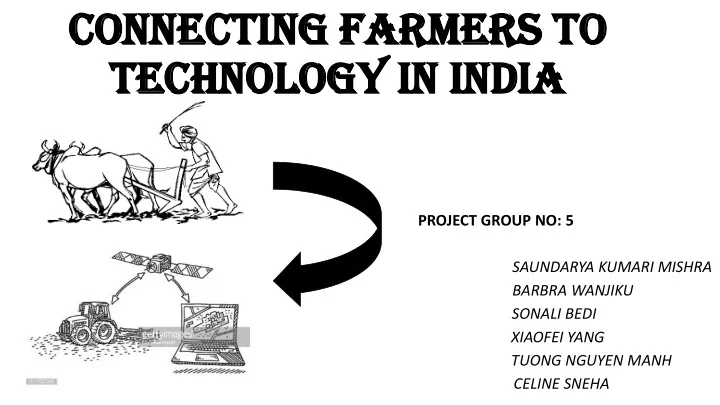
Traditional farming
response of scientific knowledge.
process.
Rogers et al. 1971
Small holdings of farmers
holdings due to breakdown of joint family system encouraging conversion
farmers, which result in un-economic land holdings in general. Illiteracy of farmers
technological developments in the country. Many farmers in rural areas do not have up to date information on how to grow food efficiently and economically.
husbandry like land ploughing unlike other areas where mechanization has resulted low production cost by saving time, energy and cost of repeated ploughing.
Unawareness of farmers
recommended dose fertilizer application, government policies and efficient irrigation application (drip irrigation), weather forecasting.
promoting new policies which can uplift a farmer, the farming community are unaware of them. Hence they fail to obtain the good
highly variable both in time and space including weather events like drought, flood, heat waves, and tropical storms cyclones severely effects the agriculture production.
Communication gap between farmer and scientist
and projects, but these may not succeed because they have not been properly communicated to the farmer.
India, as many countries GM crops are a controversial tecnology. The farming society fails to accept the non-natural production systems having the belief that only naturally produced crops are good.
Cont…
policies ,Communication .
GMO Cotton Cultivation in
gradually increased from 38,038 ha in 2002-03 to 0.56 million ha by 2004- 05 and showed a steep increase to 1.3 million ha. in 2005-06, an increase of 160%.
41% of the cotton area in India came under Bt hybrid umbrella
extent that not only can save water for the crops, but also on the quantity of fertiliser and deployment of labourers. Not to stop there, the yield has been very encouraging.
tuberose flowers in the locality with the support of drip irrigation now. Prior to this, he harvested close to 25 kilograms per hectare, but after the installation of drip irrigation, his yield has gone up to 55 kg per hectare.
https://www.thehindu.com/todays-paper/tp-national/tp- tamilnadu/drip-irrigation-a-success-story/article3660659.ece
TECHNOLOGY