T HE LEGAL ISSUES THAT ACCOMPA- things, all improvements were to be - - PDF document

t
SMART_READER_LITE
LIVE PREVIEW

T HE LEGAL ISSUES THAT ACCOMPA- things, all improvements were to be - - PDF document

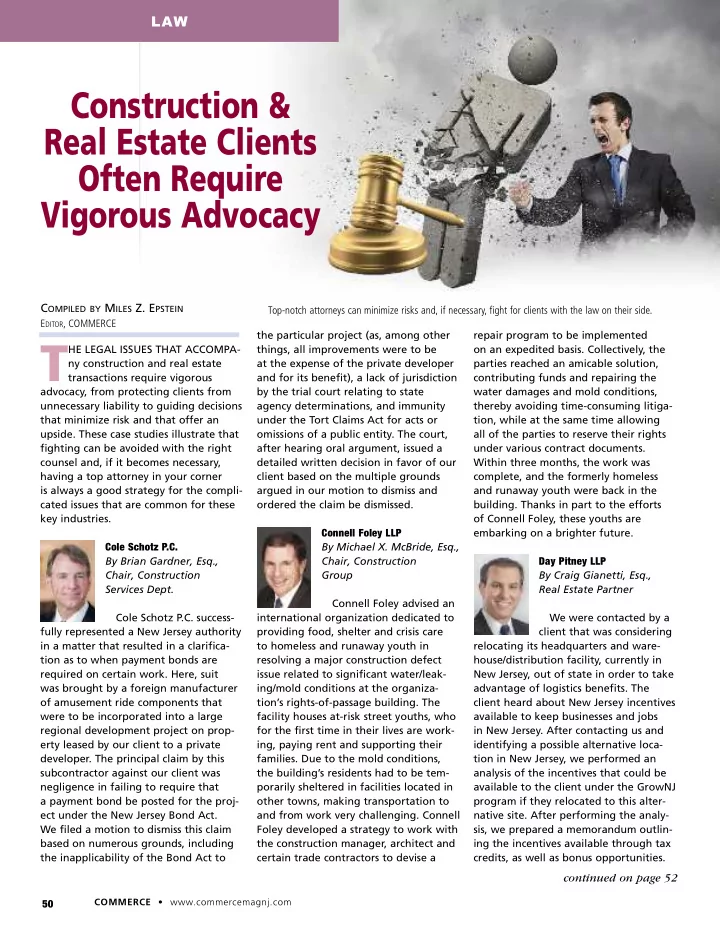
LAW Construction & Real Estate Clients Often Require Vigorous Advocacy C OMPILED BY M ILES Z. E PSTEIN Top-notch attorneys can minimize risks and, if necessary, fight for clients with the law on their side. E DITOR , COMMERCE the


slide-1
SLIDE 1

50

COMMERCE • www.commercemagnj.com

continued on page 52

T

HE LEGAL ISSUES THAT ACCOMPA- ny construction and real estate transactions require vigorous advocacy, from protecting clients from unnecessary liability to guiding decisions that minimize risk and that offer an

  • upside. These case studies illustrate that

fighting can be avoided with the right counsel and, if it becomes necessary, having a top attorney in your corner is always a good strategy for the compli- cated issues that are common for these key industries. Cole Schotz P.C. By Brian Gardner, Esq., Chair, Construction Services Dept. Cole Schotz P.C. success- fully represented a New Jersey authority in a matter that resulted in a clarifica- tion as to when payment bonds are required on certain work. Here, suit was brought by a foreign manufacturer

  • f amusement ride components that

were to be incorporated into a large regional development project on prop- erty leased by our client to a private

  • developer. The principal claim by this

subcontractor against our client was negligence in failing to require that a payment bond be posted for the proj- ect under the New Jersey Bond Act. We filed a motion to dismiss this claim based on numerous grounds, including the inapplicability of the Bond Act to the particular project (as, among other things, all improvements were to be at the expense of the private developer and for its benefit), a lack of jurisdiction by the trial court relating to state agency determinations, and immunity under the Tort Claims Act for acts or

  • missions of a public entity. The court,

after hearing oral argument, issued a detailed written decision in favor of our client based on the multiple grounds argued in our motion to dismiss and

  • rdered the claim be dismissed.

Connell Foley LLP By Michael X. McBride, Esq., Chair, Construction Group Connell Foley advised an international organization dedicated to providing food, shelter and crisis care to homeless and runaway youth in resolving a major construction defect issue related to significant water/leak- ing/mold conditions at the organiza- tion’s rights-of-passage building. The facility houses at-risk street youths, who for the first time in their lives are work- ing, paying rent and supporting their

  • families. Due to the mold conditions,

the building’s residents had to be tem- porarily sheltered in facilities located in

  • ther towns, making transportation to

and from work very challenging. Connell Foley developed a strategy to work with the construction manager, architect and certain trade contractors to devise a repair program to be implemented

  • n an expedited basis. Collectively, the

parties reached an amicable solution, contributing funds and repairing the water damages and mold conditions, thereby avoiding time-consuming litiga- tion, while at the same time allowing all of the parties to reserve their rights under various contract documents. Within three months, the work was complete, and the formerly homeless and runaway youth were back in the

  • building. Thanks in part to the efforts
  • f Connell Foley, these youths are

embarking on a brighter future. Day Pitney LLP By Craig Gianetti, Esq., Real Estate Partner We were contacted by a client that was considering relocating its headquarters and ware- house/distribution facility, currently in New Jersey, out of state in order to take advantage of logistics benefits. The client heard about New Jersey incentives available to keep businesses and jobs in New Jersey. After contacting us and identifying a possible alternative loca- tion in New Jersey, we performed an analysis of the incentives that could be available to the client under the GrowNJ program if they relocated to this alter- native site. After performing the analy- sis, we prepared a memorandum outlin- ing the incentives available through tax credits, as well as bonus opportunities.

COMPILED BY MILES Z. EPSTEIN

EDITOR, COMMERCE Top-notch attorneys can minimize risks and, if necessary, fight for clients with the law on their side.

Construction & Real Estate Clients Often Require Vigorous Advocacy

LAW

slide-2
SLIDE 2

52

COMMERCE • www.commercemagnj.com

LAW

continued from page 50 continued on page 54

After discussing the results of the research with the client, we worked with the client to prepare a GrowNJ application and worked with the NJEDA representatives in processing the

  • application. The client was eventually awarded tax credits to

remain in New Jersey and did not relocate out

  • f state. The client has now moved into the new, larger

location and has added additional jobs to its workforce. Gibbons P.C. By Russell B. Bershad, Esq., Co-Chair, Real Property & Environmental Dept. Your client is a major conglomerate that

  • wns dozens of domestic facilities and leases

hundreds more in the United States and overseas. What do you do when the client announces it plans to divide into three new companies, divide its facilities among them and asks you to spearhead the real estate work involved in trans- ferring the facilities? First step, you put on your management hat, organize a team of lawyers to handle the work, set up a database to assemble and report critical information and enlist the assistance of other lawyers in the firm who are flu- ent in a dozen or so languages needed to review the over- seas leases in-house, while engaging outside lawyers for the balance of the agreements. While many overseas agreements are written in English and the local language, others are not and you need to understand the terms related to transfers and assignments. With lead lawyers negotiating new head- quarters leases and a great team of lawyers, well organized and led, completing the reviews, populating the database, managing outside counsel, and carrying out the transfers, Gibbons got the job done on time and within budget— and the “spin” transaction was successfully completed. Greenbaum, Rowe, Smith & Davis, LLP By Dennis A. Estis, Esq., Chair, Construction Practice Group Our firm represented a northern New Jersey condominium association in a construction defect lawsuit against a developer. Almost all of the unit

  • wners in the building, a newly completed 18 story high-

rise with Hudson River and New York City skyline views, had entered into mortgages that were “taken back” by the devel-

  • per, which had offered the loans as the mortgagee when

the units were purchased. The mortgages were then sold by the developer to a bank at a discount, with the developer’s principal executing estoppel certificates as required by the

  • bank. Developers have historically been reluctant to take

back mortgages and be faced with waiting decades for their money, but this permitted the developer to sell the loans at a discount, and receive the bulk of the payments. The court ruled in favor of our client, the association, on its defective construction claim, and judgment was entered in an amount slightly under $3 million. The developer, however, believing it was judgment-proof as it had discontinued operations and

E

CONOMIC DEVELOPMENT, CONSTRUCTION AND real estate projects are fueled by capital investments from area banks and credit unions, who often use inno- vative strategies to help clients get financing. The following examples show how this process is vital to New Jersey’s citi- zens, businesses, communities, as well as the state’s economy. North Jersey Federal Credit Union By Richard Garcia, Chief Lending Officer Recently, we were able to successfully fund two mortgages and a home equity loan that larger banks wouldn’t have touched. Two of the loans for mortgages were for longtime members, so we were even more delighted to be able to successfully work with

  • them. In both cases, we refinanced mortgages. Both needed

to consolidate some debt. There were some minor credit flags in both cases, but through our due diligence, not enough to make either member a true credit risk. We were successful in making our members happy. We were also able to fund a home equity loan for a city employee. Again, we recognized that larger financial institutions would not have worked with the member to successfully fund the loan. We helped members realize their financial goals. This is what service to our members is all about.

COMPILED BY MILES Z. EPSTEIN EDITOR, COMMERCE

Banks and Credit Unions Fuel Vital Construction & Real Estate Projects

New Jersey’s economic well-being is supported by the capital investments of the state’s banks and credit unions.

BANKING

continued on page 54

slide-3
SLIDE 3

54

COMMERCE • www.commercemagnj.com

LAW BANKING

distributed all of the dividends to stakeholders long before the judgment was rendered, refused to pay. With our strate- gy now refocused on getting our client paid, the bank was then joined in the action. The developer sought to dismiss

  • ur claims against the bank, but the trial court denied that

motion and determined that the association had the legal right to go after the money owed on the mortgages issued by the developer. In turn, the bank applied some pressure

  • f its own, demanding that the principal of the developer,

who had guaranteed the loans when they were sold to the bank, make payment to our client in full. With no realistic course of action left to pursue, the developer paid the judg- ment in full, thereby avoiding being subject to available sanctions by the bank. McCarter & English, LLP By Jeffrey A. Petit, Esq., Practice Leader, Real Estate Group The benefits to locating a solar project on a closed landfill are many and great. The state’s Energy Master Plan specifically encourages the use of closed landfills for energy generation. It is a commercially and envi- ronmentally smart reuse of land that is otherwise unusable. The remote location of landfills avoids issues with neighbors. There is usually nothing to obstruct the sun, and it’s far

continued on page 56 continued from page 52

Regal Bank By Brian McGuinness, Chief Lending Officer, Senior Vice President An established multi- family unit operator recently came to us in a panic. In the 11th hour before his closing, his lender had “re-traded” the loan. This means the lender presented the loan in one way, but when it came time for a commitment, the borrower was suddenly looking at a different set of terms that were unacceptable to him. Regal Bank stepped right in, picked up where the other lender had dropped the ball, and saved the day by delivering on what we promised. This type of success story is a byproduct of Regal Bank’s breadth of knowledge in the North Jersey marketplace. The proactive culture at Regal Bank begins at the highest levels and is woven through the very fabric of the bank. Our board of directors, loan commit- tee and management team are all extremely well-versed in the metrics of multi-family lending. This is a real advantage when a loan requires full board approval and a fast turn-

  • around. Regal Bank is large enough to extend loans up to

$5 million and nimble enough to understand the nuances

  • f each loan. We excel at getting buyers to the closing table
  • n time, and most times ahead of schedule.

continued on page 56 continued from page 52

Equal Housing Lender. Equal Opportunity Lender. Member FDIC

A Bank You Can Believe In

At Regal Bank, we are dedicated to improving the quality of the communities we serve by building valuable customer relationships and delivering personalized fi nancial solutions. Whether you’re taking your business to the next level, planning for another stage in your life or just looking for new ways to invest, you can count on us to do what’s right for you.

Your Lending Team: Sean Howland

Vice President and Loan Offi cer Monte Ehrenkranz Vice President of Business Development Brian McGuinness Senior Vice President and Chief Lending Offi cer

Livingston, Roseland, Florham Park, Millburn & West Orange

570 West Mount Pleasant Avenue | Livingston, NJ

973-577-7160 | regalbanknj.com

slide-4
SLIDE 4

56

COMMERCE • www.commercemagnj.com

LAW BANKING

preferable to clearing woodlands or using otherwise fertile

  • farmland. That’s why our client PSE&G has incorporated such

projects as a major part of its Solar 4 All™ Program. With

  • pportunity, however, come issues: addressing the presence
  • f hazardous materials, avoiding damaging the landfill cap,

ensuring the structure remains effective if the landfill shifts

  • r settles, and sometimes, relocating a gas-collection system.

PSE&G recently consummated a lease of the closed Kinsley landfill in Deptford, with the assistance of our commercial leasing expert Thomas DaCosta Lobo and our environmental expert Keith Lynott. The project, which was named the “Renewable Energy Project of the Year” by the New Jersey Association of Energy Engineers, comprises 36,841 solar pan- els on 35 acres and generates enough electricity to power 2,000 average-sized homes. Norris McLaughlin & Marcus, P.A. By Tim McKeown, Esq., Partner, Real Estate Practice Group I recently reviewed a lease for a tenant con- taining provisions that not only favored the landlord, but exposed the tenant to potentially devastating financial consequences. All too often, small businesses pay little attention to their lease documents or even understand their significance until it’s too late. For example, the lease had

continued on page 58 continued from page 54

Valley National Bank By Russell C. Murawski, First Senior Vice President, Manager, Commercial Real Estate Dept. We recently partnered with state and city organizations to provide funding for a new economic development project that brings a major supermarket to Elizabeth, New Jersey. A shopping center, anchored by the supermarket, will provide area residents with access to a wide range of fresh and affordably priced food. Healthy food choices have not been widely available to the local residents of this area of Elizabeth, which has been characterized as a “food desert.” The City of Elizabeth, the New Jersey Economic Development Authority (NJEDA) and the Elizabeth Economic Development Company are providing significant funding for the project. We were able to work with these organizations to complete the financing needed to allow the project to move forward. Bringing this project to fruition was not easy, but by partnering with the City of Elizabeth, the Elizabeth Economic Development Company, the NJEDA and Jacob Enterprises (the lead developer), Valley was able to do its part in addressing a community need for a full-service supermarket and provide new economic opportunities for area residents. n

continued from page 54

clients work on Wall Street, so the stock market will influence their spending decisions.

LAW

Ferro Labella & Zucker LLC By Rocco J. Labella, Esq., Managing Partner In looking to 2016, opti- mism generated by the strong results experienced in 2015 will likely be tempered by uncertainty relat- ing to the presidential election, rising interest rates, global terrorism concerns and a struggling stock market. The legal industry should enjoy healthy earnings, as many firms have adapted to more efficient staffing models. Harwood Lloyd LLC By David M. Repetto, Esq., Co-Managing Partner In 2016, Harwood Lloyd, as well as other firms, will face the challenge of continuing to pro- vide quality legal representation that meets the needs of clients to control legal costs and expenses. 2016 will provide more opportunities for growth both in existing practice areas, as well as in expanding the scope of legal services that Harwood Lloyd currently provides. Jackson Lewis P.C. By Richard J. Cino, Esq., Office Managing Shareholder (Morristown) As clients face increasing pressure to keep costs down without sacrificing quality, law firms will contin- ue to be expected to adapt and impro- vise in order to add value. Processes will become more digitalized, and we must capitalize on the advantages of legal technology, yet ensure our highly skilled personnel stay relevant. Cognizant

  • f these expectations and possibilities,

Jackson Lewis remains committed to partnering with our clients by listening to their needs.

2016 FORECAST

continued from page 20 continued on page 64

slide-5
SLIDE 5

no requirement that the landlord have

  • insurance. The tenant could face termi-

nation if something happened to the premises and the landlord did not have sufficient funds to make the repairs. The lease also contained a unilateral waiver of subrogation, which exposed the tenant to a damage claim by the landlord’s carrier in the event it paid a claim by the landlord. Also absent was a mutual release of liability which pro- tects the tenant from exposure as a result of a shortfall in insurance cover-

  • age. Also, instead of a mutual indemnifi-

cation provision, the lease contained a unilateral indemnification provision which served to expose the tenant to liability costs arising out of landlord’s

  • negligence. Fortunately, we were able to

employ an exit strategy that got the ten- ant out of the lease and into a new and more reasonable lease, thereby signifi- cantly reducing its financial exposure. NPZ Law Group, P.C. By David H. Nachman, Esq., Managing Attorney Low interest rates contin- ue to drive the growth of the real estate and construction sectors. Our firm continues to assist internation- al businesses with visa and immigration law compliance to relocate their execu- tives and managers in the United States. NPZ Law Group was recently involved in the restructuring of a high-profile Canadian-based real estate and con- struction company. Executives were sought to head up U.S. operations after solidifying business operations through-

  • ut Canada. Transfers of this nature

(L-1) are relatively swift and encounter little resistance from the U.S. Depart- ment of Homeland Security (DHS). However, in this case, the organization was structured (from a tax perspective) to maximize limited liability and this structure was seemingly adverse to the equity ownership interest required for the use of the L-1 visa. Working closely with the Canadian financial partners and U.S. accountants of our clients,

  • ur team of U.S. and Canadian immigra-

tion attorneys convinced the DHS that the organization maintained a “qualify- ing relationship” allowing for the prop- er use of the L-1 intracompany visa

  • classification. Now, the door is open

to allow for the transfer of other orga- nizational employees in the H-1B Professional, the E-1 Treaty Trader/Treaty Investor, and other nonimmigrant visa

  • classifications. n

58

COMMERCE • www.commercemagnj.com

LAW

continued from page 56

LEGISLATIVE UPDATE

A

S THE 217TH NEW JERSEY LEGISLA- ture convenes later this month, legislators will be given a menu

  • f issues and initiatives which will need to

be addressed. Let’s begin with the starters. There is “out-of-network” care which aims to cap rising medical costs by restricting how healthcare providers bill for services not covered by insurance. Then there is the issue of gaming in northern New

  • Jersey. Will there be a ballot question in November

asking voters to approve casinos north of Atlantic City? No one knows for sure. On the environmental front, there is the issue of renewable energy standards. How much should we rely on wind and solar as sources of energy? How expensive will it be? Moving on to the main courses, we have the Trans- portation Trust Fund issue. Do New Jerseyans have an appetite for an increase in the state’s gasoline tax? Or can private employers stomach mandates imposed

  • n them by Trenton lawmakers on the number of sick

days provided to employees? And then—just when you think you have had your fill—there is the state budget. Will there be enough money to pay for all the services New Jerseyans have grown accustomed to? Will there be a phase-out of the death taxes? Will taxes increase for millionaires and corporations? Will there be additional pension and health reforms? Will our hamburger budget be able to handle the demands of legislators with Porterhouse on their minds? Stakeholders want their piece of the pie, but where will the money come from? n Stakeholders want their piece of the pie, but where will the money come from?

BY ANTHONY RUSSO

EVP, GOVERNMENT AFFAIRS & COMMUNICATIONS

“Revenue” Pie is on the Menu, and Everyone Wants a Piece