Sustainable Transportation Equity Project (STEP) Work Group Meeting - - PowerPoint PPT Presentation

sustainable transportation equity project step work group
SMART_READER_LITE
LIVE PREVIEW

Sustainable Transportation Equity Project (STEP) Work Group Meeting - - PowerPoint PPT Presentation

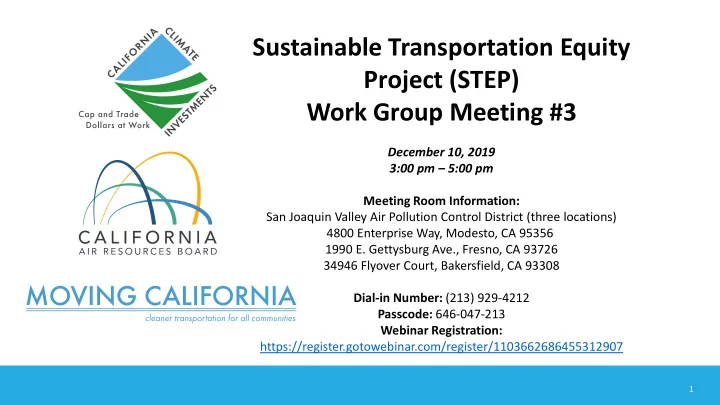
Sustainable Transportation Equity Project (STEP) Work Group Meeting #3 December 10, 2019 3:00 pm 5:00 pm Meeting Room Information: San Joaquin Valley Air Pollution Control District (three locations) 4800 Enterprise Way, Modesto, CA 95356


slide-1
SLIDE 1

1

Sustainable Transportation Equity Project (STEP) Work Group Meeting #3

December 10, 2019 3:00 pm – 5:00 pm Meeting Room Information: San Joaquin Valley Air Pollution Control District (three locations) 4800 Enterprise Way, Modesto, CA 95356 1990 E. Gettysburg Ave., Fresno, CA 93726 34946 Flyover Court, Bakersfield, CA 93308 Dial-in Number: (213) 929-4212 Passcode: 646-047-213 Webinar Registration: https://register.gotowebinar.com/register/1103662686455312907

slide-2
SLIDE 2

What i is STEP?

  • The Sustainable Transportation Equity Project
  • New pilot that is part of the Low Carbon Transportation Program
  • Funded by California Climate Investments
  • Goals of Pilot:

1. Reduce greenhouse gas emissions 2. Increase access to key destinations 3. Address community residents’ transportation needs

2

slide-3
SLIDE 3

How w will S l STEP a acc ccomplis lish i its ts goals ls?

  • By funding two types of grants
  • Planning and Capacity Building Grants
  • $2 million for multiple grants
  • In low-income and disadvantaged communities
  • Implementation Grants
  • $20 million for 1 to 3 grants
  • In disadvantaged communities

3

slide-4
SLIDE 4

Workgroup M Meeting ng S Sche hedule (tentative)

e)

#1 - October

  • Overview
  • Framework
  • Eligible Applicants

& Partnership Structure

  • Grant Area &

Benefits to Priority Populations

  • Technical

Assistance #2 - November

  • Eligible Projects
  • Threshold Requirements
  • Community

Engagement

  • GHG Reductions
  • Data Collection
  • Resource

Contribution

  • Workforce

Development

  • Displacement

Avoidance

  • Climate Adaptation

4

#3 - December

  • Example Grants
  • Application Review and Scoring
  • Technical Assistance
  • Research and Evaluation

#4 - January

  • Wrap-Up
slide-5
SLIDE 5

In the room: Write answers on handout and turn in to us at the end of the meeting On the phone: Write answers on handout and email to step@arb.ca.gov On the webinar: Write answers in the Chat box of GoToWebinar

5

SUR URVEY

slide-6
SLIDE 6

Who i is parti ticipati ting?

  • 1. What is your name?
  • 2. What organization do you represent?
  • 3. What type of organization do you represent?
  • 4. In what county is your community located?

Note: All questions are OPTIONAL.

6

SUR URVEY

slide-7
SLIDE 7

Recap p – Eligi gible P e Proj

  • jec

ects

What We Heard Our Response How many implementation grants will you award? Planning grants? 1 to 3 implementation grants. We estimate about 10 planning grants but it depends on the applications we receive. Is the purchase of vehicles eligible? Yes, if those purchases are tied to the eligible projects and are zero- emission vehicles on the CVRP/HVIP lists.* Are shuttle services eligible? Yes, shuttle services are considered shared mobility. If the project included the procurement of shuttles, the shuttle vehicles would need to be zero-emission. Is funding for staff positions eligible? Yes. What costs are eligible under zero- emission readiness projects? UPDATE: See expanded list of proposed eligible projects here, which includes a list of proposed eligible costs for each project type. This list is still being updated based on public feedback.

7

* Vehicle models that were removed due to CVRP policy changes effective December 3, 2019 are still eligible for STEP.

slide-8
SLIDE 8

8

SUR URVEY

  • 5. What are y

your r suggestions f for r the Prop

  • posed

ed Eligi gible P e Proj

  • jec

ects L List, which i includes es prop

  • posed

ed eligible projects, e eligible costs ts, , and readiness requi uirements?

See expanded list of proposed eligible projects here.

slide-9
SLIDE 9

Recap p – Eligi gible P e Proj

  • jec

ects

9

What We Heard Our Response Are there any requirements for how the different project types are implemented? No, we do not have specific requirements for how different project types are implemented. However, any design and implementation decisions should reflect and help address community-identified transportation needs. Are there specifications regarding the size

  • f an eligible “community”?

No, we do not specify a particular size for a STEP community. Communities must be defined by the Applicant and may vary substantially in size.

slide-10
SLIDE 10

Recap p – Thres eshol

  • ld R

Requirem emen ents

What We Heard Our Response How did you come up with the budget allocations of 5% and 3% for community engagement and outreach? These should be higher. UPDATE: We propose to simplify STEP’s requirements and allow for more flexibility in the budget based on what Applicants need by eliminating most budget allocations in the threshold requirements. The three budget allocations that will remain are: 2% minimum for data tracking and reporting, 50% minimum for transportation strategies, and 40% minimum for resource contribution. Are the percent requirements relative to the total project budget or to the grant budget? The data tracking and reporting and transportation strategies minimums are percentages relative to the total project budget. The resource contribution is a percentage relative to the grant budget. Depending on the MPO, a letter of support from an MPO might be challenging to procure. UPDATE: Instead of requiring a letter of support from an MPO or RTPA, we will require a letter of support from any public agency. The letter will have to show that projects support the strategies identified in the region’s SCS (if applicable) or RTPA. We received additional suggestions for eligible resource contributions. We plan on updating the list of eligible resource contributions, and sharing in a future workgroup meeting.

10

slide-11
SLIDE 11

Plann nning ng Grant

11

Objectives

  • Identify community residents’ transportation needs
  • Prepare for projects that will increase mobility and reduce

greenhouse gas emissions

See expanded list of proposed eligible projects here.

slide-12
SLIDE 12

Plann nning ng Grant – Partnership p Structur ure

12

California Air Resources Board Lead Applicant Co-applicant #3, etc. Co-applicant #2 Co-applicant #1

  • Community-based
  • rganizations
  • Federally-recognized tribes
  • Cities
  • Counties (for

unincorporated areas)

  • Councils of government

and air districts whose jurisdictions do not cross county lines

slide-13
SLIDE 13

Plann nning ng Grant – STEP Community ty

13

  • Project is located in the STEP

Community

  • At least 50% of STEP

Community residents live in disadvantaged or low-income community census tracts

www.arb.ca.gov/cci-communityinvestments

slide-14
SLIDE 14

Example P Plann nning G Grant

14

Lead Applicant: City Co-applicants:

  • Community-based organization
  • Chamber of commerce

Project: Community transportation needs assessment STEP Community description:

  • Neighborhood that is cut off from the rest of the city by a highway
  • Mostly residential, but there are many small businesses on the other side of the

highway, where residents work and shop

  • Large non-English-speaking population
  • One quarter of residents live in a CalEnviroscreen-identified disadvantaged

community

  • All of residents live in an AB 1550-identified low-income community
slide-15
SLIDE 15

Plann nning ng Grant – Fra ramewo work

15

Objectives

  • Defined by STEP
  • 1 – Identify community residents’ transportation needs
  • 2 – Prepare for projects that will increase mobility and reduce greenhouse gas emissions

Vision

  • Defined by Applicant in Vision Statement
  • Must articulate the overall vision for how the grant will meet Objectives

Projects

  • Planning and capacity building projects that the Applicant wants STEP to (at least partially) fund
  • Identified by the Applicant as part of a community engagement process
slide-16
SLIDE 16

Example P Plann nning G Grant

16

Vision:

  • Community-based organization identified the need for more community

engagement in this neighborhood

  • In partnership with the community:
  • Identify community residents’ barriers to transportation, common destinations, and

transportation modes of interest

  • Educate community residents on different clean transportation and mobility options
  • Develop a list of projects that, when implemented, will help residents overcome the physical

(the highway) and other barriers to transportation and increase access to clean transportation and mobility options

slide-17
SLIDE 17

Example P Plann nning G Grant

17

Project: Community transportation needs assessment, including

  • Extensive, multi-lingual community engagement through surveys, existing

community events, and focus groups

  • Outreach and education on clean transportation and mobility options
  • An advisory committee of community residents to prioritize projects

Budget:

Staff time $120,000 Material development $10,000 Events, focus groups, and advisory panel, including compensation for participation $66,000 Data tracking and reporting $4,000 Total $200,000

slide-18
SLIDE 18

Plann nning ng Grant – Threshold R Requi uirements

18

All requirements must be addressed to be eligible for funding consideration.

  • Community Inclusion
  • Data Tracking and Reporting
  • Consistency with Existing

Plans

  • Workforce and Economic

Development

  • Displacement Avoidance
  • Climate Adaptation and

Resiliency

slide-19
SLIDE 19

Example P Plann nning G Grant

19

Community Inclusion:

  • Community-based organization is Lead, supported by Chamber of Commerce
  • Identified strategies for community engagement throughout implementation
  • Prioritized strategies that will facilitate community-decision making
  • Focus on non-English-speaking residents

Data Tracking and Reporting:

  • City is Lead
  • Set aside 2% of budget

Consistency with Existing Plans:

  • Letter of support from the city’s Planning Department describing consistency

with the Climate Action Plan and support for strategies identified in the SCS

slide-20
SLIDE 20

Example P Plann nning G Grant

20

Workforce and Economic Development:

  • Chamber of Commerce is Lead
  • Community engagement will include discussion of how to prioritize reliable and

clean transportation for residents to get to work and other necessary locations

  • Outreach and education will cover how transportation access might impact

employment

Displacement Avoidance:

  • Advisory committee will discuss potential burdens from implementation of

prioritized transportation projects and create recommendations to alleviate these burdens

Climate Adaptation and Resiliency:

  • Community engagement will include discussion of how increased flooding and

hotter days will impact transportation needs and barriers

slide-21
SLIDE 21

21

SUR URVEY

  • 6. What a

are your s r suggestions for r the eligibility and t threshold r requirements f for t r the S STEP Pl Planning a and Capacity ty Building Grant?

slide-22
SLIDE 22

Implem emen entation

  • n Gr

Grant

22

Objectives

  • Reduce greenhouse gas emissions and vehicle miles traveled in

single-occupancy combustion vehicles.

  • Increase mobility and access to key destinations.
  • Address community residents’ transportation needs.

See expanded list of proposed eligible projects here.

slide-23
SLIDE 23

Implem emen entation

  • n Gr

Grant – Partnership S Structur ure

23

California Air Resources Board Lead Applicant Co-applicant #3, etc. Co-applicant #2 Co-applicant #1

  • Community-based
  • rganizations
  • Federally-recognized tribes
  • Cities
  • Counties (for

unincorporated areas)

  • Councils of government

and air districts whose jurisdictions do not cross county lines

slide-24
SLIDE 24

Implem emen entation

  • n Gr

Grant – STEP P Com

  • mmunity

24

  • At least 50% of STEP

Community residents live in disadvantaged community census tracts

  • Majority of projects are located

in the STEP Community

  • All projects address

transportation-related needs of STEP Community residents

https://oehha.ca.gov/calenviroscreen/sb535

slide-25
SLIDE 25

Example e Implem emen entation

  • n Grant

25

Lead Applicant: Community-based organization Co-applicants:

  • County
  • Transit agency
  • Electric bus

manufacturer

  • Private mobility

provider

  • Active transportation

advocacy nonprofit

  • Senior center
  • Council of government
  • California State

University (CSU)

STEP Community description:

  • Unincorporated community, which lacks basic active transportation infrastructure
  • Most community residents commute to work/run errands via few major corridors in their
  • wn combustion vehicles
  • Those who rely on public transit struggle to get to work on time
  • Nearly impossible to connect trips with current transit options
  • Community is close enough to job centers for residents to bike/walk to work
  • Growing population of elderly residents
  • Majority of residents live in disadvantaged community census tracts
slide-26
SLIDE 26

Implem emen entation

  • n Gr

Grant - Fra ramewo work

26

Objectives

  • Defined by STEP
  • 1 - Reduce greenhouse gas emissions and vehicle miles traveled in single-occupancy combustion vehicles.
  • 2 - Increase mobility and access to key destinations.
  • 3 - Address community residents’ transportation needs.

Vision

  • Defined by applicant in Vision statement
  • Must articulate the overall vision for how the grant will meet Objectives

Strategies

  • Categories of projects that the Applicant can pick from
  • Identified by the applicant as part of a community engagement process

Projects

  • Capital, infrastructure, operations, and planning projects that the Applicant wants STEP to (at least

partially) fund

  • Identified by the applicant as part of a community engagement process
slide-27
SLIDE 27

Implem emen entation

  • n Gr

Grant - Strategi egies es*

27

*There may be overlap between Strategies.

Transportation Strategies (2)

  • Active Transportation
  • Fixed-Route Transit
  • Shared Mobility

Innovative Strategies (1)

  • Land Use
  • Pricing
  • Space Conversion

Groundwork Strategies (1)

  • Planning & Engagement
  • Outreach & Education
  • Community Development
slide-28
SLIDE 28

Example e Implem emen entation

  • n Grant

28

Vision:

  • Working with local neighborhood associations and other community groups, the

community-based organization has learned

  • Residents rely heavily on single-occupancy combustion vehicles
  • Projects will:
  • Make public transit and active transportation trips realistic
  • Help make travel cheaper for residents and clean the air residents breathe
  • Focus on expanding accessible clean transportation options in a few key corridors

Strategies

  • 3 Transportation Strategies
  • 1 Innovative Strategy
  • 1 Groundwork Strategy
slide-29
SLIDE 29

Example e Implem emen entation

  • n Grant

29

Strategy Project Need Addressed Fixed-Route Transit (Transportation Strategy #1a) Traffic signal optimization, bus-

  • nly lanes, other infrastructure,

and operations for new bus rapid transit service Buses are late and unreliable, so it is hard for residents to get to work on time, or to link trips when running errands Fixed-Route Transit (Transportation Strategy #1b) Bus-rail integration to align the new bus rapid transit service schedule with that of the light- rail train Most commuters have to wait at least 40 minutes when they’re transferring between the bus and train – many drive instead Fixed-Route Transit (Transportation Strategy #1c) Transit pass program for small business employees and customers Residents who work and shop at the small businesses (or would if they could get to them) typically drive because they have heard how challenging the public transit trips are

slide-30
SLIDE 30

Example e Implem emen entation

  • n Grant

30

Strategy Project Need Addressed Active Transportation (Transportation Strategy #2) Protected bike lanes, accessible sidewalks, and other active transportation infrastructure Wide, fast streets discourage active transportation, but many residents are interested in biking and walking Outreach & Education (Groundwork Strategy #1a) A series of educational community events to teach residents of all ages how to bike safely, engage residents in street design, and engage law enforcement in active transportation Residents have been ticketed for riding their bikes on the sidewalks, but are worried about riding their bikes along wide, fast streets

slide-31
SLIDE 31

Example e Implem emen entation

  • n Grant

31

Strategy Project Need Addressed Shared Mobility (Transportation Strategy #3) Zero-emission shuttle service for the senior center that also connects to BRT stops A rapidly-growing elderly population likes to socialize at the new senior center, but the senior center has no active bus routes and most elderly residents do not drive Outreach & Education (Groundwork Strategy #1b) Senior center ambassador program Volunteer program to help seniors navigate existing and new clean transportation options Pricing (Innovative Strategy #1) Design and implementation of new parking pricing program Traffic getting into the key job centers slows down commutes for public transit users and discourages active transportation use

slide-32
SLIDE 32

Implem emen entation

  • n Gr

Grant – Budg dget Requirem emen ents & E Exa xample Implem emen entation

  • n Gr

Grant

32

Budget:

Transportation strategies $7 million At least 50% of total project budget Innovative strategies $1 million Groundwork strategies $720,000 Workforce and economic development $500,000 Displacement avoidance $500,000 Data tracking and reporting $280,000 At least 2% of total project budget Total STEP funds $10 million Resource contribution $4 million At least 40% of grant budget Total Funds $14 million

slide-33
SLIDE 33

Implem emen entation

  • n Gr

Grant – Threshold R Requi uirements

For Whole Grant

  • Consistency with Existing Plans
  • Resource Contribution
  • Workforce and Economic

Development

  • Displacement Avoidance

33

All requirements must be addressed to be eligible for funding consideration.

Per Project

  • Community Inclusion
  • Community-identified Transportation

Needs

  • Community Engagement
  • Outreach and Education
  • Data Tracking and Reporting
  • Climate Adaptation and Resiliency
  • Longevity and Lessons Learned
slide-34
SLIDE 34

Example e Implem emen entation

  • n Grant

34

Consistency with Existing Plans:

  • Letter of support from the county’s Planning Department describing consistency with

the specific plan for the area and support for strategies identified in the SCS

Resource Contribution:

  • Grant budget is $10 million
  • Resource contribution has to be at minimum $4 million
  • Includes:
  • Staff costs for CSU, transit agency, county, and COG
  • Community engagement participation stipends from COG
  • Active transportation infrastructure
  • Low Carbon Transit Operations Program funds for future Bus-Rapid Transit
  • peration
  • Financial support from senior center to support shuttle service
  • Installation of electric infrastructure for bus and shuttle charging
  • Electricity costs for bus and shuttle operations
  • Half of shuttles from private mobility provider
slide-35
SLIDE 35

Example e Implem emen entation

  • n Grant

35

Workforce and Economic Development:

  • Includes plan to offer training program for operations and maintenance of

electric vehicles through collaboration between Transit Agency and CSU

  • Includes community benefit agreement where active transportation

infrastructure project commits to:

  • Contract with all local, small, and/or diversely-owned businesses
  • Hire residents of the community’s disadvantaged community census tracts for at least half
  • f all hires
  • Funded through STEP
slide-36
SLIDE 36

Example e Implem emen entation

  • n Grant

36

Displacement Avoidance:

  • Describes existing displacement avoidance policies, plans, and programs
  • Identifies three new policies to prevent the displacement of low-income

households

  • Incentives for inclusionary zoning led by County
  • Demonstration of application to a state program to fund the preservation of

affordable housing

  • Culturally appropriate tenant rights education led by the CBO
  • Identifies two new policies to prevent the displacement of local and small

businesses

  • Contracting with local/small/diversely-owned business as part of active

transportation infrastructure project’s community benefit agreement

  • Develop a business continuity program during construction events led by County
  • Funded through STEP
slide-37
SLIDE 37

Example e Implem emen entation

  • n Grant

37

Example for Bus-Rapid Transit Project* Project Lead: Transit Agency Other Relevant Applicants:

  • County
  • Community-based organization
  • CSU
  • Electric bus manufacturer

*Applicant will need to supply this information and information about all other Threshold Requirements for each proposed Project.

slide-38
SLIDE 38

Example e Implem emen entation

  • n Grant

38

Example for Bus-Rapid Transit Project* Community-identified Transportation Needs:

  • CBO efforts and Unmet Transit Needs Assessment identified same need
  • Buses are late and unreliable, so it is hard for residents to get to work on time, or to

trip-chain to run errands

Community Engagement:

  • Transit Agency has plan to work with community-based organization throughout

construction and operation of the service and update service based on residents’ feedback

  • Includes a Community Advisory Panel to provide feedback on all aspects of grant
  • Funded through STEP

Outreach and Education:

  • Transit Agency has plan to work with community-based organization to develop

community-specific marketing materials to advertise new service

  • Funded through STEP
slide-39
SLIDE 39

Example e Implem emen entation

  • n Grant

39

Example for Bus-Rapid Transit Project* Data Tracking and Reporting:

  • Quantified benefits using CARB calculator tool
  • Transit agency will work with CSU (as Data Lead for the Grant) to collect data on

bus-rapid transit project

  • Funded through STEP

Climate Adaptation and Resiliency:

  • STEP community will experience more days with extreme heat
  • BRT project will include shading infrastructure and greenery at bus stops and all

buses will have air conditioning

  • Plan for potential increases in maintenance costs
slide-40
SLIDE 40

Example e Implem emen entation

  • n Grant

40

Example for Bus-Rapid Transit Project* Longevity:

  • STEP funds will pay for 2 years of operation of BRT services
  • Transit agency plans to use Low Carbon Transit Operations Program to fund next

3 years of operation

  • Then continue funding service through other unidentified funding sources
  • If operation of service does not continue, transit agency will use electric buses
  • n other bus routes

Lessons Learned:

  • Transit agency plans to document lessons learned throughout implementation

and share with other agencies in specified forums

  • Transit agency will work with community-based organization to focus lessons

learned on community engagement during implementation

slide-41
SLIDE 41

41

SUR URVEY

  • 7. What a

are your s r suggestions for r the eligibility and t threshold r requirements f for t r the S STEP Implem emen entation

  • n Gr

Grant?

slide-42
SLIDE 42

Applicati tion R Review P Process

42

Applicant submits Application. STEP staff review Applications to ensure they meet Scoring Thresholds. Applications that do not meet Scoring Thresholds will not be scored. Interagency review panel evaluates all Applications that meet Scoring Thresholds using identified Scoring Criteria. Recipients are selected.

slide-43
SLIDE 43

Application n Compo pone nents

2) Applicants and Partnership Structure

  • Partnership Agreement with Lead

Applicant, Co-applicants, and other community stakeholders

  • Application qualifications documentation

and reference letters

3) STEP Community

  • Description and map
  • Includes project locations and priority

population census tracts

4) Threshold Requirements

  • Resource Contribution

documentation/letters of support*

  • Consistency with Existing Plans letters
  • f support
  • Workforce and Economic Development

component

  • Displacement Avoidance component

43

1) Framework

  • Vision Statement, Strategies*, and

Projects

  • Overall budget

*Not required for the Planning Grant

slide-44
SLIDE 44

Applicati tion C Components ts – per proj

  • jec

ect

5) Project Plan

  • Task list with timeline

and roles identified

  • Budget
  • Readiness

documentation/letters

  • f support
  • Benefits to priority

populations narrative

44

6) Threshold Requirements

  • Community Inclusion
  • Community-identified Transportation Needs

narrative*

  • Community Engagement component
  • Outreach and Education narrative/plan, if applicable*
  • Data Tracking and Reporting component
  • Benefits quantification using CARB calculator tool
  • Climate Adaptation and Resiliency narrative/plan, if

applicable

  • Longevity and Lessons Learned narrative/plan, if

applicable*

*Not required for the Planning Grant

slide-45
SLIDE 45

45

SUR URVEY

  • 8. What ap

application c components m s may b be partic ticula larly ch challe llengin ing f for A Applic licants ts t to

  • com
  • mple

lete?

slide-46
SLIDE 46

Applicati tion R Review P Process

46

Applicant submits Application. STEP staff review Applications to ensure they meet Scoring Thresholds. Applications that do not meet Scoring Thresholds will not be scored. Interagency review panel evaluates all Applications that meet Scoring Thresholds using identified Scoring Criteria. Recipients are selected.

slide-47
SLIDE 47

Scor

  • ring T

g Thres eshol

  • lds

1) General Completeness 2) Framework

  • Meets Strategy* and Project

requirements

3) Applicants and Partnership Structure

  • Partnership Agreement
  • Meets Applicant requirements

47

4) STEP Community

  • Map and narrative
  • Meets priority population and

project location requirements

5) Threshold Requirements

  • Requested narratives, plans,

documentation, letters of support, quantification, and budget set- asides

*Not required for the Planning Grant

slide-48
SLIDE 48

Applicati tion R Review P Process

48

Applicant submits Application. STEP staff review Applications to ensure they meet Scoring Thresholds. Applications that do not meet Scoring Thresholds will not be scored. Interagency review panel evaluates all Applications that meet Scoring Thresholds using identified Scoring Criteria. Recipients are selected.

slide-49
SLIDE 49

Prop

  • pos
  • sed

ed S Scoring Criteri ria

49

1) Framework

  • Vision Statement, Strategies*, and

Projects

  • Overall budget

2) Applicants and Partnership Structure

  • Quality of Partnership Agreement with

Lead Applicant, Co-applicants, and other community stakeholders

  • Application qualifications documentation

and letters of support

3) STEP Community

  • Description and map

4) Threshold Requirements

  • Quality of Workforce and Economic

Development component

  • Quality of Displacement Avoidance

component

*Not required for the Planning Grant

slide-50
SLIDE 50

Proposed S Scori ring Criteri ria – per proj

  • jec

ect

5) Project Plan

  • Task list with timeline

and roles identified

  • Budget
  • Readiness

documentation/letters

  • f support
  • Quality of benefits to

priority populations

50

6) Threshold Requirements

  • Community Inclusion
  • Quality of community engagement for Community-

identified Transportation Needs *

  • Quality of Community Engagement component
  • Need for/quality of Outreach and Education

narrative/plan, if applicable*

  • Data Tracking and Reporting component
  • Amount of GHG emission reductions
  • Need for/quality of Climate Adaptation and Resiliency

narrative/plan, if applicable

  • Need for/quality of Longevity and Lessons Learned

narrative/plan, if applicable*

*Not required for the Planning Grant

slide-51
SLIDE 51

Prop

  • pos
  • sed

ed S Scoring Criteri ria (ten entative) e)

51

7) Additional Benefits

  • Connections with other existing efforts, for example:
  • Pro-housing policies
  • SB 2 Planning Grants
  • Vision Zero
  • Safe Routes to School
  • Rural communities
  • Community-based organization or tribe as Lead Applicant
  • Communities with high housing and transportation burdens
  • Other?
slide-52
SLIDE 52

52

SUR URVEY

  • Connections with other existing efforts, for example:
  • Pro-housing policies
  • 9. What a

t additi tional benefi fits ts should we consider scoring?

  • SB 2 Planning Grants
  • Vision Zero
  • Safe Routes to School
  • Rural communities
  • Community-based organization or tribe as Lead Applicant
  • Communities with high housing and transportation burdens
  • Other?
slide-53
SLIDE 53

Applicati tion R Review P Process

53

Applicant submits Application. STEP staff review Applications to ensure they meet Scoring Thresholds. Applications that do not meet Scoring Thresholds will not be scored. Interagency review panel evaluates all Applications that meet Scoring Thresholds using identified Scoring Criteria. Recipients are selected.

slide-54
SLIDE 54

Rec ecip ipient Sele Selectio ion

  • Planning Grant
  • Multiple recipients (anticipate about 10)
  • Implementation Grant
  • 1-3 recipients

54

slide-55
SLIDE 55

Tec echnic ical l Assistanc nce (ten entative) e)

  • Evaluate the readiness of all Applicants and projects interested in receiving

technical assistance and recommend next steps

  • Support application development for all Implementation Grant applicants
  • Includes support for benefits quantification using CARB calculator tools
  • Personalized based on needs of applicant
  • Support all recipients of Implementation Grants
  • Includes support for data tracking and reporting
  • Personalized based on needs of recipient
  • Compile information about relevant upcoming grant opportunities and share with

Planning Grant recipients http://www.sgc.ca.gov/programs/tech/

55

slide-56
SLIDE 56

Research a and E Evaluation

  • Research project with Climate Smart Communities Consortium
  • Develop methodology to evaluate the impact of CARB clean mobility pilot

projects

  • Conduct evaluations on a selection of CARB clean mobility pilot projects
  • Includes baseline evaluation of STEP Communities that receive

Implementation Grants

  • Plan for future post-implementation evaluation as well

56

slide-57
SLIDE 57

Moving CA website Contact STEP staff at:

  • step@arb.ca.gov
  • (916) 440-8284

Subscribe to GovDelivery. Select Clean and Sustainable Mobility Options under the heading Clean Transportation Incentives.

Placeholder

57

Stay Up Updated Join O Our N Next Workg kgroup M p Meeting

January 15, 2019 from 3:00 pm – 5:00 pm

California Air Resources Board Monitoring and Laboratory Division Building (13th and T) 1927 13th St Sacramento, California 95811

Dial-in Number: (415) 655-0060 Participant Passcode: 380-347-944

Webinar Registration: https://attendee.gotowebinar.com/register/754446326350 1938699 SURV RVEY

  • 10. What is your email address?