
SLIDE 1
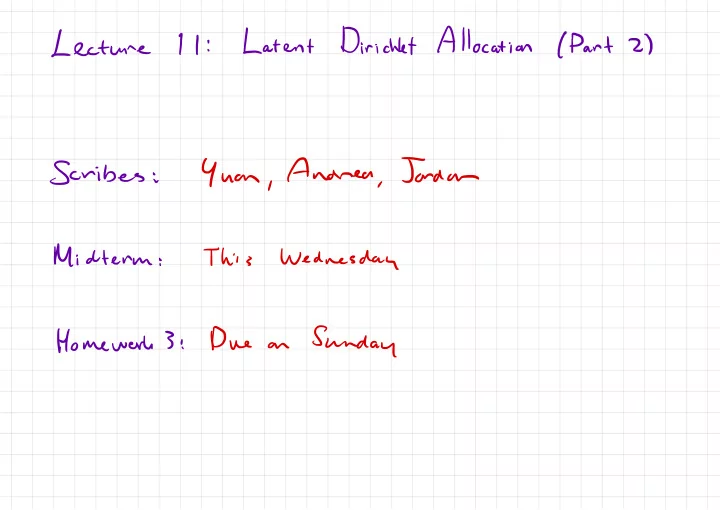
Lecture
11 : LatentDirichet
Allocation ( Part
2) Scribes :Yuan
, Andrea , Jordan Midterm : This Wednesday Homework 3 : Due anSunday
Sunday Homework 3 : an Diniohlet Allocation Model Latent - - PowerPoint PPT Presentation
Dirichet Allocation Latent Lecture ( Part 11 2) : Jordan Yuan Andrea Scribes : , , Midterm This Wednesday : Due Sunday Homework 3 : an Diniohlet Allocation Model Latent Generative : Generative model : Pu Diricwetlw
Lecture
11 : LatentDirichet
Allocation ( Part
2) Scribes :Yuan
, Andrea , Jordan Midterm : This Wednesday Homework 3 : Due anSunday
Algorithm
1 :Collapsed
GibbsSampling
fibbsUpdates
( topic assignments 1 Zdn ~ p ( 7 du 1 y , 7.FT
f. an = 7 \ { 7dn }Implementation
Requirement Need to . compute monginals,7
) =|dOdB
pcyit , p ,O )Conjugate
,wv)
Od~ Diniohktld , , ... ,ak ) Collapsed
Gibbs
Updates
Update far TasteAssignments
yd \ { gaaNdh
whv
= Bv + Nuv e- Sufficient StatisticsNi
""+EBv
. anq
Nail ".in?nII7dn=h)Nhv=na.n,=,aIjYdni=YIIZa'nih
]Nid
")
d 'n' tdh log
Pc 9 Bly ) = aongygaxlgply ,9P) , B Lower bound p PLYIQB ) pczly ,0,B )L( { 0,15 } ,q
)
=Egan
, ,[log.pl#TjB1sloypiy.0.p
) =log
ply ,O,p )[
( 0 ,p,y ) 0,13 = angmaaLIQB
, 10 ) , B qlz ;¢ ) = 91719,01137 ( will do this ) (
MAP ) angqngaxLl{
an
} , g) = argampuxEgan, ,[ by
P]
= angmax # qa ;¢ ) [ log pcyiz ,B ) + leg Palo ) ] t log PIG + leg PIB ) , B Exponential Family , Representation p ( × i y ) = h(x\ exp [ yt tcx )#gaµ,§
)]
Etgn;¢s[ by pc 7101 ) = Elq , , ,q , [ { log Odu . ( { Ittaneh ))) (
MAP ) Lower bound pcy , 7. 9. B )L( { 0,13 } ,q )
=Eqa :p
, t.bg#1sbgply.&m Expectation Step :Ndu= {
Fla,#17an=h
] ) =[
¢ndh ¢ ahh = Ftq , , ,¢ , [ I[7dn=h ) ) = Flpcz , , ,p ,g , [ I[7an=h ) ] Compute expected values LDA
: OtherSampling
Algorithms Sequential
Monte CarloRequirement
: SequenceSingle
document :p
PC 994in , 7 di :n ) Marginal9(
For ,n I Fd , lin Sequential
Marte Carlo ( General Formulation) Assume
: Unnmmalized Densities g. 1 × , ) ... .jfkt
) First step : ImportanceSampling
x. s ~ 9 ( × , ) ws , :-. ycxsilqkil Subsequent steps : Proposefrom
previous samplesat
. , ~ Discrete ( win , ' "int
' '}
x. it . , ~ins
!×"
+ . , )xst~qcxi.ly?I.7x!t:=x!.x.aiiIi
' xt ~ qcxtix , it . , )8+45
' it ) Incremental weiswlvi.
is a.sn#sqcxilxa?I
, ' ft . ,K LDA
: OtherSampling
Algorithms Sequential
Monte CarlopPlYd
.nl?amil3)p(7d,nlbd,i:n-i,7d.l:n:^)
= pcyd , ' in ,7d , '.nl/B)pCyd.l:nu,7d.l:n.i
)9(
For ,n I Fd , linPHI
.nl bdy.to?In...lPCyd.i:n%7ad?iin.i1pcydn:n.,#iInilp1pi7'a,nl7IiYnYyd.iin.i.p ) = pcgda -17in , B) = µMpwI[9nn=D Isaiah ) v LDA
: OtherSampling
Algorithms
Hamiltonian Monte CarloRequires
: Gradientlog
jointTqp
UC 0,13 ) =¢dnEe
Epa iy ,D,p ) [ Ittndneh ) ) Example Question : Suppose you were to run LDAplop
ly ) ? Monte
Carlo :Algorithm
X. =Is ' 'finlpl
HMC( Single
step ) 2!£5
Fi
~Norm
18 , th ):X
' .x.
÷ Is ' e. ← .{
It " £4 Is " u > d LDA
: OtherSampling
Algorithms
Example Question : Suppose you were to run LDAPIQP
ly ) ? Answer ; No . Computing the gradient for each leapfrog step would require a full press