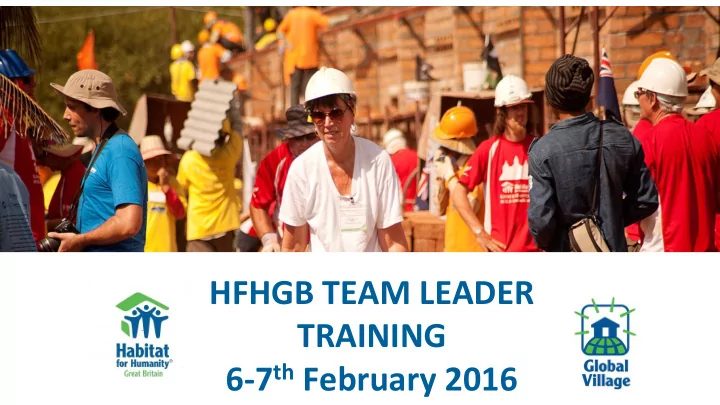
HFHGB TEAM LEADER TRAINING 6-7 th February 2016 Agenda Sunday 7 th - - PowerPoint PPT Presentation
HFHGB TEAM LEADER TRAINING 6-7 th February 2016 Agenda Sunday 7 th February AM Sunday 7 th February PM Saturday 6 th February PM 8.45-9.00 Recap of Day 1 12pm 12.30pm Welcome and 13.00pm 2.30pm Risk Management Introduction 9.00am
Agenda
Saturday 6th February PM 12pm – 12.30pm Welcome and Introduction 12.30 - 1.30pm What is a Global Village Team Leader 1.30pm – 2.00pm Internal HFHGB Processes 2.00pm – 2.15pm BREAK 2.15pm – 3.30pm Preparing to lead a Build 3.30pm – 4.00pm Working with Corporates 4.00-4.30pm Registration 4.30pm – 5.00pm Fundraising
Sunday 7th February AM 8.45-9.00 – Recap of Day 1 9.00am – 9.30am Communicating with your team 9.30am – 10.00am Money Matters 10.00am – 10.30am Working in the host country BREAK 10.30am – 10.45am 10.45am – 11.30am Tricky Situations 11.30am – 12.00pm Personal Health and Safety 12.00pm – 13.00pm LUNCH Sunday 7th February PM 13.00pm – 2.30pm Risk Management 2.30pm – 3.00pm Crisis Management and Insurance 3.00pm – 3.15pm BREAK 3.00pm – 3.15pm Team Dynamics Reflection meetings Addressing Conflict 3.30pm – 4.00 Post-Build Addressing Re-entry Evaluations Cultivating long-term supporters 4.00pm – Wrap up and Questions
Habitat for Humanity Great Britain
Sunday 7th February AM
Power of Home
Home is the cornerstone of hope for those living in poverty. Habitat for Humanity Great Britain helps the poorest and most vulnerable people lift themselves out of poverty by partnering with them to build their homes and communities. With a home comes protection from the elements, from disease and from
- violence. A decent and secure home provides the foundation for health,
education and employment. As a leading international non-governmental organisation focused on shelter, Habitat for Humanity understands the Power of Home.
The cycle of poverty
Poor Housing
Poor Education
Poor Wages
Poor Health
Poor Employment
Poor Community cohesion
Poor
- pportunities
for children Poverty Housing
How are we doing this?
Microfinance
Water, Sanitation and Health (WASH) Safe & Renewable Energy
Disaster Relief
Orphans and Vulnerable Groups (OVG)
Advocacy
Where we Build
HFHGB 2015 Updates
- £1,643,926 generated for restricted international projects
- GV transferred £134,573 to host programmes and sent 142 volunteers
- Nepal earthquake – £350, 000 raised
- Brazil and Bolivia – 1.8 million women helped through advocacy project in Cochabamba
- Ethiopia – 100 families helped through slum upgrade and improved sanitation.
- New CEO – Meryl Davies
Global Village
- To Build
- To invest funds and partner with organizations and families
- To inspire advocates
HFHGB GV Focus Countries
- Brazil
- Poland
- Kyrgyzstan
- India
- Cambodia
- Malawi
- South Africa (not available in
2016)
- Romania
- Zambia
- Thailand
- Ethiopia (limited
availability)
- Nepal (limited availability)
12
GV Team Leaders
Becoming a Team Leader
- GV build as a participant (or equivalent
- verseas volunteering programme)
- Undertake Team Leader Training
- Deputise on a Build
- Get a valid first aid certificate and DBS
check
What makes a good Team Leader? Leader Attributes
Roles and Responsibilities of TL
- Recruit team members
- Be the first point of contact for volunteers pre-trip
- Provide appropriate orientation materials for team members via the sending
coordinator
- To support team members with their fundraising activities
- To facilitate team meetings (where possible) both before and during the build
- To provide expertise and skills needed in times of crisis
Where the Team Leader fits
Team Leader
Global Village Sending Coordinator Global Village Hosting Coordinator Host Community or Local affiliate Neighbours
Supporting you as a TL
- Team Leader Manual
- Policies and Procedures
- Supporting your volunteers
- Insurance Documentation
- Expense Forms
www.habitatforhumanity.org.uk/get-involved/global-volunteering/team-leader-resources
HFHGB Internal Processes
HFHGB GV roles and responsibilities:
- Support TL’s and volunteers
- Setting up the Build
- Pricing and Budgets
- Scheduling
- Host Country Communications
- Support in-country logistics & operations
Setting up a Build
- International Trip Calendar
- Raisers Edge event
- Everyday Hero Campaign
- Budgeting with Host Country
and finalise costs
- MOU for Team Leader
Budgeting and Costs
HFHGB Costs
- Insurance
- Miscellaneous (T-shirts, postage, use of Brand)
- Team Leader Costs (inc. flight and expenses)
- Contingency
In-country Costs
- Meals
- Transport
- Accommodation
Donation to HFH Costs are split between total number of paying participants. TL’s can choose to pay their own costs.
Preparing for a Build
- Messaging your Build
- Team Recruitment
- Register Interest Process on HFHGB website
- Expectations Call/Email
- Open vs Corporate
Messaging your GV Build
Why do we do Global Village?
Team Recruitment Andy Clark
- Register Interest on HFHGB website
- First point of contact with the public
- What information would you give initially?
Exercise: What do you think needs to be in a introductory email?
Utilising your Networks
- Personal Contacts
- Friends and Family
- Professional network
- Previous volunteers
- Case Study: How to engage your employer
Engaging your Employer
- Company supports me annually for 1 week for a trip, I've worked with
MD of 7 years
- Spoke to my MD regarding a competition and sending one member of
staff
- Our owner is very keen on supporting charities and is proud to have me
doing what I do
- I wrote a piece to go into company magazine
- Entrants to write in 300 words why they want to be chosen to go and
what they would get from it
- MD also agreed to have HFH as the charity we sponsor this year in
fundraising etc.
Working with Corporates (Barry and Jan)
- There is no recruitment element
- Registration is for collection of personal information rather
than for payment
- SC will have a point of contact within the corporate
- TL may be introduced to the team at later stage
TOP TIPS FROM PREVIOUS TL’s
Working with Corporates (Barry and Jan)
- Listen – culture and custom of the organisation may be very different from
what you are used to.
- Communicate clearly the expectations of volunteers and the reason they are on
the Build.
- Don’t try to be everybody's friend, be clear about boundaries and your role as
a HFHGB TL.
- Circulate – work with different people at different times. Try not be seen ‘in the
pocket’ of the corporate leadership.
- Be scrupulous with record keeping.
- Make time to check in with the leadership about the progress of the Build.
- Keep an eye out for future potential leaders within the team.
Working with Corporates (Barry and Jan)
Actively endorse the corporates involvement with HFHGB.
- Fulfils CSR in visible and long lasting way.
- Forms bonds between colleagues in different locations and/or levels of t
he company.
- Develops trust, collective responsibility and ‘looking after each other’.
- Provides real opportunities to problem solves in real life situations.
- Takes employees out of their comfort zone.
- Provides staff with cultural exchanges.
Registration
- Vary depending on the type of team
- Registration and payment of Deposit
- Collection of personal information for team roster
Registration Process with HFHGB
- Register Interest and connect with TL
- Input Details
- Pay registration Fee
- Everyday Hero Page
- T-shirt and Insurance
Fundraising
- Fundraising Toolkit
- Developed by HFHGB
- Available on website
- Introduction to fundraising
- Everyday Hero – Fundraising platform
- Team pages linked to each GV Build
- Integration into our system
- Additional functionality, eg team pages and leader boards
- Does not claim Gift Aid
Fundraising and Coaching volunteers
- You are our main resource!
- Large part of fundraising is ‘the story’
- ‘PEOPLE GIVE TO PEOPLE’
- Messaging their Build appropriately
- Developing the volunteer’s story
- Form their Story
- Tell your own story – why do you build?
- Set their Goal
HFHGB TL Training Sunday 7th
- Day 1 Recap
- Who is HFH and what is GV?
- What makes a good TL?
- GV Internal Processes
- Messaging your Build and Recruitment
- Working with Corporates
- Fundraising
- Questions and Comments
- Expectations of the day
Communicating with your Team
Our communication with your volunteers HFHGB is (usually) first point of contact – then we pass them onto you Anything you don’t know, we can help
- Setting up a Facebook Group
- A personalized website?
- Monthly emails?
- Google Hangout?
- What ever you decide – keep us in the loop or CC us into the communications!
Preparing Volunteers
- Habitat’s work
- Introductions
- Fundraising support
- Payment and Cancellation
- Consultations with medical professional
- Booking flights – we will work with you to help determine the best course of action
- Packing list
- HFHGB Policies – Insurance, Gift Giving
- Homepartner story
Managing expectations
What can change
- n a GV Build?
The Global Village Build
- Building structures is not the main thing – building relations, building communities
- Managing expectations of the team in consultation with the Host Coordinator
- Assigning Roles – you will also have your Deputy!
- Money Matters
- Cultural sensitivities
- Tricky Situations
- Team dynamics
- Emergency Management and Insurance
- Risk Assessments
- Health and Safety
- Reflection & Evaluation
Money Matters
- Payment and Cancellation Policy
- Post Build Expenses
- TL expenses
- Contingency Funds
- Handling Team Funds
Payment and Cancellation Policy
- Agree to policy on registration
- All payments due 45 days before departure
- How to pay?
- Matching Gifts
- Excess funds
- Fundraising for airfare
- Cancellation by Participant
- More than 45 days
- Less than 45 days
- Cancellation by HFHGB
Post build-expenses
Team Leader Expenses
- Allowance of up £100
- Visa, Vaccination, Travel
- Team meet-up prior to departure
Team Expenses (Contingency Funds)
- Change in policy – we advise you to take some money with you or we can advance.
- In the event of an emergency
- Team Costs + Medical Costs + Food if not provided
- Keep separate from your expenses
- Make a note of the exchange rate you received when changing your £££.
Retain all receipts!
Name of vendor and contact details What the purchase was for – has to be itemised Date and Signature of vendor Amount (in local currency)
Working in the host country
- Roles and responsibilities of TL and Host Co-ordinator
- Communicating Expectations
- Cultural sensitivities
Roles and Responsibilities of HC and TL
TL
- Health and Safety of the team
- Maintain GB standards
- Support hosting coordinator
Host Co-ordinator
- Work with sending coordinator
- Contextualise the program
- Translation and communicate cultural differences
Cultural Sensitivities
We are building communities – we seek to PARTNER
- The culture game – The cultural iceberg
- Cultural sensitivities
The rule of thumb is always:
- Ask if you don’t know
- Be flexible and ready to apologise if necessary
- Smile and be willing to learn
Preparing your team
- Brief team members on cultural appropriateness for the country they are going to.
- Good topic of discussion in pre trip communications with the team
- Your hosting coordinator will be able to advise you on cultural do’s and don’ts (appropriate dress, behaviour, greetings etc.)
- Different things are valued in different cultures
- Encourage volunteers to do their own research
.
Gift Giving
- HFHI have robust Gift Giving Policy
- Gifts can often be misconstrued
- Could accidentally reduce dignity
- Leave all donations with Host Coordinator
Examples
Tricky Situations
Tricky Situations
Photo Taking
- A photo of the ‘needy’ – or a photo of your equal?
- A photo that promotes dignity
- How would you advise a volunteer that wanted to photograph
someone in-country
- Photo Guidelines
Examples
Tricky Situations
Alcohol Consumption
- Respect community standards
- Represent HFHGB well
- Help team keep perspective
- Establish our expectations and team norms
Examples
Personal Health and Safety
- Pre-trip and Enroute
- During Build
- Post Build
Health Matters Pre-Trip
Advise volunteers to seek the advice of health professional prior to travel
- Vaccinations
- Anti-Malarial Tablets
- Adequate supply of personal medication
(and copy prescription) Full disclosure to TL and HFHGB.
- Could invalidate insurance if not disclosed.
Health En-route and In-Country
En-route:
- DVT/Jet lag
- Travel sickness
In country:
- Water – 4-6 litre of bottled water
- Food – Cook it, peel it or forget it.
- Sanitation – antibacterial hand gels
- Malaria – get the team into a routine, DEET and nets,
- Sun Safety – factor 50, shade and rest.
- Diarrhoea – most common travel related illness
- Dehydration
- Heat Stroke/Exhaustion
Common Ailments
- Diarrhoea – most common
travel related illness
- Usually mild, lasting 3-5 days
- Drink lots of fluids and oral
rehydration
- Seek medical advice if
symptoms persist more than 5 days
- Blood or mucus
- High Fever (+38C)
- Vomiting and unable to keep
down fluids
Common Ailments
- Dehydration
- Hot weather and physical
exertion
- Drinking 5L of water a day
- Carrying a water container
- Ensure a regular supply of clean
drinkable water
- Shade and rest
- Encourage volunteers to monitor
colour of their urine
- Heat Stroke/Exhaustion
- Body become hot and loses salt
and water
- Faintness/dizziness
- Muscle cramps
- Heavy sweating
- Intense thirst
- If untreated can lead to more
serious heat stroke
- Lie down in cool place
- Remove unnecessary clothing
- Cool skin and fan while moist
- Replace fluids
Safety on the Build Site
- Alcohol or smoking not permitted on the build site
- Any volunteer unfit to work because of drink from the can be
refused entry to the site.
- Volunteers must be sensitive in their interaction with locals
and staff
- Volunteers should be not alone with children.
Safety Matters In-Country
- Dress conservatively – no military / camouflage dress
- Don’t wear expensive-looking jewelry
- Conceal valuables (inc phones/tablets)
- Be extra vigilant on the street
- Always min number of 3 people – preferably 4
- Keep copies of key documents
- Passport photos
- If you must use ATM machines - go in a group of 3
Medical Matters Post-Trip
- Finish Anti-Malarial Tablets
- Flu Symptoms?
- Get a check-up
- If any illness is diagnosed on return - encourage volunteers
to inform HFHGB immediately.
First Aid
- Minimum requirement
- Qualified first aider on team
- HFHGB can help you to arrange and pay for a First
Aid Training course
Risk Management
- What's at risk?
- Onsite Safety
- What is a Risk Assessment ?
- Carrying out Risk Assessments
- On site Risk Management
- Offsite Risk Management
- Accommodation
- Travel
- Safety Briefings
- Examples
What’s at risk?
What is at risk when we take a group of volunteers
- n a Habitat for Humanity
Global Village trip? Programme Impact Reputation Safety Health
Risk Management
- Groups of 3 - 4
- 5 minutes to consider risks on a GV Build
- Identify risks and provide feedback
On Site Safety
Team Leader Checklist
- Working at height
- Scaffolding
- Working at depth
- Machinery
- Manual work
- Tools
- Chemicals
- Site tidiness
- PPE
- Alcohol and drugs
You are responsible so remember you have the authority to stop the work until it is safe to continue.
Site Safety
- Encourage all team members to read and adhere to
regulations
- Sign to confirm they have had the H and S briefing
- Find a place on site, if possible, to display large copy
- Use ‘Site Safety Sheets’ in briefing sessions
- Ensure they know who the First Aider is
- Personal Protection Equipment – compulsory / advisory
Risk assessment is:
Severity of Hazard x Likelihood of Occurrence X Effect of Occurrence
Which means:
Slight, Serious or Major Hazard x Low, Medium or High Risk x slight / one(few?), serious / several, major / whole team affected.
What is Risk Assessment?
Carrying Out a Risk Assessment
- Types and the likelihood of incident
- Severity of the hazard and the harm outcome if this incident
- ccurred
- Identify methods to minimize and manage the risk
- Continually reassess the risk and make amendments where
necessary Keep a log of risk management activities
- On site / accommodation
- Risk management subjects discussed with team
- Mitigation strategies implemented
- Return it to HFHGB GV at the end as your evidence
Risk Assessments
Assessment Score Action 27 Refer to HfHGB immediately 6-18 Modify activity if possible. Ensure that methods in place to manage / minimise risk are strictly adhered to <6 Ensure that methods in place to manage / minimise risk are strictly adhered to.
Continually reassess to recalculate scores and therefore ensure risks remain properly understood and managed.
RA Form
The point of the risk assessment form is not to play with words or numbers – changing them if risks change
To anticipate, avoid and manage possible dangers, however slight they seem.
Onsite Risk Management
- Manage the risk and/or manage the team / people
- Take a cautious approach
- Tell the team that an area or activity is hazardous
- If you feel something is unsafe then it probably is
- Have people work in pairs – looking out for each other
- Constantly assess the risks – this should become second nature
whilst on site
On-site Risk Management
At the beginning of the build - each day - each new activity - note the hazards - decide how to minimize the risks:
- Briefings - a simple “Beware….”
- Provide / ensure use of safety equipment for the activity
- Demonstrating proper techniques – lifting / equipment use
- Modify activity if possible
- Ensure that methods in place to manage/minimise risk are strictly adhered
to
Continually reassess – risks will change throughout day/Build
Risk Management off-site
- Travel & accommodation
- Cultural activities
- R&R
- Big picture events in country
- People and the team
Travel
- Transport must have seat
belts – non-negotiable
- Tyres
- No loose tools
- One volunteer per seat
- No rides in back of pickups
- Driver fatigue
- Minimise driving in dark
- Speed and conditions
Accommodation
- Fire exits – team to know - no
- bstructions
- Smoke alarms fitted
- Fire equipment
- Electric sockets
- Power down periods / candles
- Mosquito nets
Safety briefings
- At the beginning and end of the day
- Prevents accidents
- Feedback on what has gone well and highlight
any problems
- Promotes safe building
- Gives the team members a point of reference
Example 1
Example 2
Example 3
Risk Management
Problem Issues Resources available Solutions Actions
Read the scenario - What is the task?
Exercise 1
You are working at a reasonably remote new hilly site east of Galle. The site is 30 minutes away from your hotel in Galle. There is no secure storage at the site for any tools. On Tuesday
- ne of the 2 mini buses has been used to take an injured
volunteer to the local hospital and has not yet returned. The remaining minibus has a mechanical fault and the engine will not start. It is well past the time for leaving the site and it is getting dark. The priest at the local Buddhist temple is offering their minibus to transport volunteers back to the hotel.
Crisis Management and Insurance
- Crisis Management Pack
- Crisis Flow Chart
- ACE Insurance
- Team Member Roster
- Personal data
- Passports
- Emergency contacts
- Medical and dietary information
- Copy of visa (if applicable)
- Accident claim forms
- Emergency Management Flowchart and Plan
- Incident Report Form
- ACE Claim Form
- GV Emergency Contact Sheet
- Insurance Policy Number and Contact Details
- GV Emergency Contact Information sheet
- Hosting country emergency contact numbers
- HFHGB GV 24/7 Emergency contact information
- Embassy contact information
Crisis Management Packet
- We are here 24/7
- Call us with emergencies only – often the Host
is the best person to call as they are on the ground and will be able to advise.
- We can help to contact family member if
necessary
GV Emergency Line
Emergency Management Plan
ACE Insurance
Accidental death and dismemberment Up to $250, 000 Disability Benefit (Permanent total disability) $250,000 Out of country medical expense benefits Maximum for medical expense benefits: Maximum for pre-existing conditions: Maximum for dental treatment (injury only): $250,000 $50,000 $250,000 Home country extension benefit Up to the ‘Out of Country Medical Expenses Maximum Benefit’ Home country medical guarantee benefit Up to $10,000 Emergency medical evacuation benefit 100% of expenses covered Repatriation of remains benefit 100% of expenses covered Family reunion benefit $100 per day, up to 5 days Security expense benefit Up to $100,000 (Aggregate limit: $500,000 per occurrence)
ACE Insurance
24/7 Helpline
- Require a referral to a hospital and doctor
- Are hospitalised
- Need to be evacuated or repatriated
- Need to guarantee payment for medical expenses
- Experience local communication problems in medical emergency
- Safety is threatened by a political or military event
Main Exclusions
- Intentionally self-inflicted injuries.
- Suicide or attempted suicide while sane.
- Pregnancy, childbirth or miscarriage.
- Accidents occurring while a passenger on, operating or learning to operate any aircraft.
- Injuries or sickness suffered:
- Under the influence of drugs (other than prescribed) or alcohol.
- while racing or committing or attempting to commit a felony.
- During recreational travel in or on any off-road motorized vehicle not requiring licensing as a motor vehicle.
At home, Matt volunteers at the local dog kennel. When he builds with Global Village in Malawi, he cant resist buddying up with a dog near the work site. When he’s petting the dog, across the site someone drops a brick and the noise scares the dog. The dog bites Matt. Matt is bleeding profusely. It is very unlikely that the dog has had rabies vaccination.
Emergency Management Scenario 1
- Administer first aid
- Call the host coordinator
- Ask where the best clinic is
- Ask Deputy TL to stay with the team
- Take Matt to local clinic
- Ask Matt is he wants you to call his family
- Pay for medical care (ask for receipt!)
- Call GV Emergency line
- Write notes of incident report, insurance forms
- Update Matt’s family
- Update GV
- Monitor Matt’s health and tell him to seek medical advice in the UK.
- Inform the team to stay away from animals
Scenario
When you go down to breakfast on Friday morning you are surprised to be told that there has been a very serious fire during the night in one of the bedrooms shared by two volunteers. Fortunately the two volunteers managed to escape from their densely smoke filled room but they were very lucky to survive.
Emergency Management Scenario 2
Managing Team Dynamics
- Tuckman’s Model (1965)
- Reflection Meetings
- Addressing Conflict
- Exercise : Role Play Scenarios
Team Dynamics
Forming
- High dependence on leader and there is
little agreement between the team.
Storming
- Decisions don’t come easily within group, and
cliques may form. Compromises may be required to enable progress. Performing is characterised by:
- The team is strategically aware and disagreements are
resolved positively. There is a focus on over-achieving goals. Norming
- Consensus is largely formed and the team may
engage in fun and social activities.
Reflections Meetings
Create meaningful, participatory discussions
This is where you can inspire volunteers and create long term advocates for HFHGB.
- Find a private space
- Maximize participation
- Pick the right time
- First meeting – ‘Share one expectation you have for the trip’ - could be part of pre-trip
communications
- ‘High’s and Lows’ are great icebreaker – but aim higher!
- Adapt it to fit the situation
- ORID Framework
ORID
O – Observe
- What did you see?
- Who did you meet?
- How did people act?
- What about their houses and community?
R- Reflect
- How did you feel in the community?
- What is different /similar to your own family and the
community?
- What did you think about on the work site today?
I – Interpret
- What support does the partner family have?
- Why is their community strong?
- What choices does the partner family have? What is
- ut of their control?
D – Decide
- How have you helped people experiencing poverty?
- Where you live – who has trouble affording housing?
- What could you do in your community?
- What’s your next step? Who will you contact to get
started?
Addressing Conflict
- Role of the TL to mediate, facilitate and create a cohesive team.
- Making the team ware of the ‘Tuckman’s Model’.
- Encourage volunteers to bring issues to TL in the first instance
- Addressing inappropriate behaviour with team members, making
them aware of the negative impact they could be having.
- Different personalities will require different strategies.
- Disciplinary Procedure for Volunteers.
Addressing Conflict
Scenario 1: A team member who has worked in construction for many years commandeers a team meeting to voice his opinions about local building techniques. He insists that the local masons should implement the same building techniques as those in his home country as they would be more efficient. He is concerned that the team will not finish the house if they continue to take the lead from the local masons, rather he has volunteered to take the lead on the building site the following day. Scenario 2: A team member confronts another during a team meeting, accusing her of not working during the days’ Build. She feels the other team member spent more time playing with local children rather than contributing to teams goal of raising the walls. She felt that she has worked hard fundraising in her home –country and that this is being wasted by other team members who are ‘not pulling their weight’.
Post Build
- Addressing Re-entry
- Cultivating Long Term
Supporters
- Evaluations
Addressing re-entry
- Although the team has disbanded, your role as TL is not over!
- Common feelings upon return:
- Isolation and Loneliness
- Rebellion
- Disillusionment
- Guilt
- 4 stage of re-entry
- Fun
- Flight
- Fight
- Fit
Addressing re-entry
- Talking about what team members are feeling is the first step toward
dealing with re-entry.
- A topic for discussion during the later team meetings.
- Ask team members to think about their expectations for returning home
and how they can support each-other.
- Let them know they can call the team leader to talk.
- Re-entry fantasies:
- I will write everyone I meet!
- People are dying to see and hear about my trip
- I will be glad to be home.
- I am going to give away everything I own!
Evaluations
- Online Evaluations through EMEA
- 360 evaluation – from host country, team leader and volunteers
- Team Member Build Evaluation
- Team Leader Build Evaluation
Encourage TLs to set aside time during Build to ensure these are completed.
- HFHGB Build Evaluation
- DTL Evaluation Form
Cultivating long-term supporters
GV not as a one-off. Their role in global housing crisis and how they can help – this could be d iscussed in Reflection meetings. HFHGB can follow up with team members identified by you as potential l eaders. Continue supporting HFHGB
- Challenge Events
- Advocacy
- Fundraise