Characteristics of an E ffective Team Team Simulation What is a - - PDF document

characteristics of an e ffective team
SMART_READER_LITE
LIVE PREVIEW

Characteristics of an E ffective Team Team Simulation What is a - - PDF document

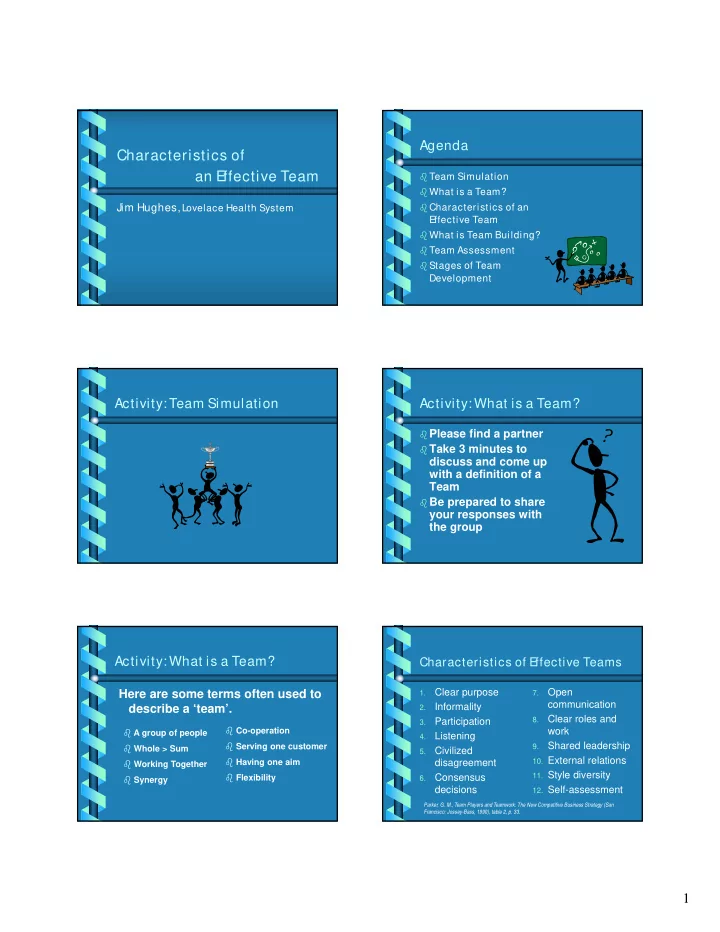
Agenda Characteristics of an E ffective Team Team Simulation What is a Team? Jim Hughes, Lovelace Health System Characteristics of an E ffective Team What is Team Building? Team Assessment Stages of Team Development


slide-1
SLIDE 1

1

Characteristics of an E ffective Team

Jim Hughes, Lovelace Health System

Agenda

 Team Simulation  What is a Team?  Characteristics of an

E ffective Team

 What is Team Building?  Team Assessment  Stages of Team

Development

Activity: Team Simulation Activity: What is a Team?

Please find a partner Take 3 minutes to

discuss and come up with a definition of a Team

Be prepared to share

your responses with the group

Here are some terms often used to describe a ‘team’.

 A group of people  Whole > Sum  Working Together  Synergy  Co-operation  Serving one customer  Having one aim  Flexibility

Activity: What is a Team?

Characteristics of E ffective Teams

1.

Clear purpose

2.

Informality

3.

Participation

4.

Listening

5.

Civilized disagreement

6.

Consensus decisions

7.

Open communication

8.

Clear roles and work

9.

Shared leadership

  • 10. External relations
  • 11. Style diversity
  • 12. Self-assessment

Parker, G. M., Team Players and Teamwork: The New Competitive Business Strategy (San Francisco: Jossey-Bass, 1990), table 2, p. 33.

slide-2
SLIDE 2

2 Clear Purpose

The vision, mission, goal, or task of the team has been defined and is now accepted by everyone. There is a plan in place.

Informality

The climate tends to be informal, comfortable, and

  • relaxed. There are

no obvious tensions or signs

  • f boredom.

Participation

There is much discussion, and everyone is encouraged to

  • participate. E

veryone has a say in how things are done.

Listening

The members use effective listening techniques such as questioning, paraphrasing, and summarizing to get

  • ut ideas.

Civilized disagreement

There is disagreement, but the team is comfortable with this and shows no signs

  • f avoiding, smoothing over, or

suppressing conflict.

Consensus decisions

For important decisions, the goal is substantial - but not necessarily unanimous - agreement through open discussion of everyone’s ideas.

slide-3
SLIDE 3

3 Open communication

Team members feel free to express their feelings on the tasks as well as on the group’s operation. There are few hidden agendas. Communication takes place

  • utside of meetings.

Clear roles and work

There are clear expectations about the roles played by each team member. When action assignments are taken, clear assignments are made, accepted, and carried out. Work is fairly distributed among team members.

Shared leadership

While the team has a formal leader, leadership functions shift from time to time depending on the circumstances, the needs of the group, and the skills of the members. The formal leader models the appropriate behavior and helps establish positive norms.

E xternal relations

The team spends time developing key

  • utside relationships, mobilizing

resources, and building credibility with important players in other parts of the

  • rganization.

Style diversity

The team has a broad spectrum of team- player types including members who emphasize attention to task, goal setting, focus on process, and questions about how the team is functioning.

Self-assessment

Periodically, the team stops to examine how well it is functioning and what may be interfering with its effectiveness.

slide-4
SLIDE 4

4 What is team building?

If a team is a group of people working towards a common goal.

Team Building is the process of enabling that group of people to reach their goal. What is team building? The major tasks involved in team building are:

  • 1. To clarify the team goals
  • 2. To identify those issues which inhibit

the team from reaching their goals

  • 3. To address those issues, remove the

inhibitors and enable the goals to be achieved

Team Assessment

Take a minute and think about the teams you lead or are involved with… Please complete the Team-Assessment

Stages of Team Development

Norming Tuckman’s Stages of development

Stage 1. Forming

When teams first get together, members are generally cautious and uncertain about many things. People explore, dabble, try something. During the forming period everyone tries their best to look ahead and think about all the things that need to be done. Leader must set the focus.

Stage 2. Storming

Inevitably the process begins to heat up under the pressures of work and conflicting perspectives. People jockey for influence. Patient and impatient people clash. Trust is tested, and confusions around goals and roles begin to surface. If there are heavy deadlines, this stage can be quite tense.

slide-5
SLIDE 5

5 Stage 3. Norming

As people get to know each other, they reconcile and agree on things like decision-making processes, resources, timing, quality standards. A "norm" is something everyone

  • understands. Norms are the formal

and informal rules that make up the

  • perating system of productive work.

Stage 4. Performing

The group is starting to utilize its newly found "norms of trust," and can begin focusing on the tasks to be accomplished; there should be enough drive, creativity, and cohesiveness to take on most tasks. The Team is now really a Team.

Stage 5. Adjourning

The final stages of team development; it has been an experience of sharing and growing with each other and now members may separate. For many, the group has been a safety net and truly has become their

  • community. Evaluation is key at this
  • stage. Document and Learn from the

experience.

Review and E valuation

What was your main “take-away”

from today’s workshop?

Take a few minutes to complete the

workshop evaluation

Conclusion

“Team “Teamwork is is the abili the ability to to work toget work together towar toward a a comm common

  • n visio
  • vision. The

. The abili ability to ty to dire direct indi individual acco accomplishments toward rd orga

  • rganizational obj

nizational objectives. I

  • ctives. It is

is the fuel that the fuel that allows allows commo common peo people to to att attain in unco uncommon resu

  • results. “

“ Unknown A

  • wn Author
  • r

Thank You!

Jim Hughes Director of Organizational Development Lovelace Health System