Tapering The periodogram works well with data containing only - - PowerPoint PPT Presentation

tapering the periodogram works well with data containing
SMART_READER_LITE
LIVE PREVIEW

Tapering The periodogram works well with data containing only - - PowerPoint PPT Presentation

Tapering The periodogram works well with data containing only Fourier frequencies: w = rnorm(128, sd = 0.01); x5 = cos(2*pi*(5/128)*(1:128)) + w; x6 = cos(2*pi*(6/128)*(1:128)) + w; par(mfcol = c(3, 1), mar = c(2, 2, 1, 1)); spectrum(x5,


slide-1
SLIDE 1

Tapering

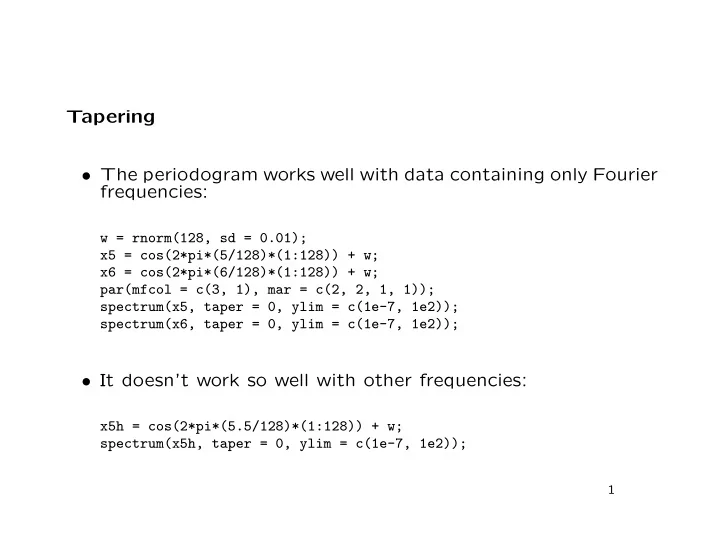
  • The periodogram works well with data containing only Fourier

frequencies:

w = rnorm(128, sd = 0.01); x5 = cos(2*pi*(5/128)*(1:128)) + w; x6 = cos(2*pi*(6/128)*(1:128)) + w; par(mfcol = c(3, 1), mar = c(2, 2, 1, 1)); spectrum(x5, taper = 0, ylim = c(1e-7, 1e2)); spectrum(x6, taper = 0, ylim = c(1e-7, 1e2));

  • It doesn’t work so well with other frequencies:

x5h = cos(2*pi*(5.5/128)*(1:128)) + w; spectrum(x5h, taper = 0, ylim = c(1e-7, 1e2));

1

slide-2
SLIDE 2
  • One solution is to taper the data:

spectrum(x5h, taper = 0.5, ylim = c(1e-7, 1e2))

  • This works by multiplying the data by a data window:

par(mfcol = c(3, 1), mar = c(2, 2, 1, 1)); plot(tapr(rep(1, 128), 0.25)); plot(x5h); plot(tapr(x5h, 0.25));

  • The data window modifies a fraction of the data at each end
  • f the series, to make the data more nearly continuous when

it is wrapped.

2

slide-3
SLIDE 3
  • Tapering makes the main peak wider, but much reduces side

lobes.

  • To see the side lobes, make the periodogram graphs on a

finer grid of frequencies: par(mfcol = c(2, 1), mar = c(2, 2, 1, 1)); spectrum(x5h, taper = 0.0, ylim = c(1e-7, 1e2), pad = 896) spectrum(x5h, taper = 0.5, ylim = c(1e-7, 1e2), pad = 896)

  • The default in R’s spectrum (or spec.pgram, which does the

work) is to taper 10% at each end of the data.

3