Successful Engagement of M inorities in Research: A Building Trust - - PowerPoint PPT Presentation

successful engagement of m inorities in research a
SMART_READER_LITE
LIVE PREVIEW

Successful Engagement of M inorities in Research: A Building Trust - - PowerPoint PPT Presentation

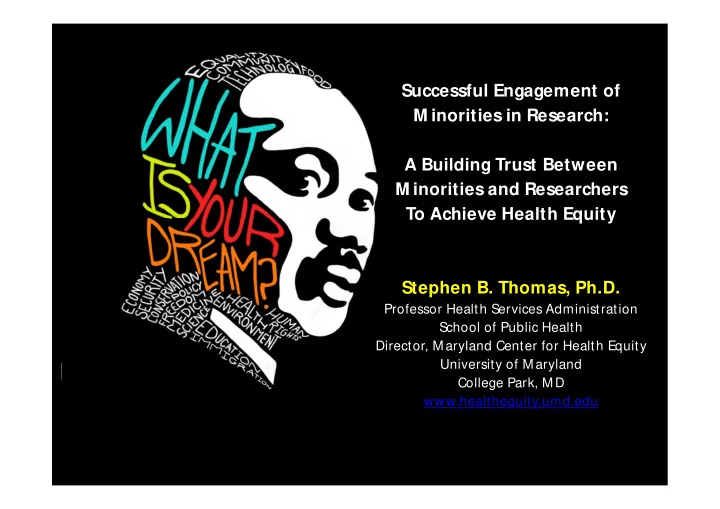
Successful Engagement of M inorities in Research: A Building Trust Between M inorities and Researchers To Achieve Health Equity Stephen B. Thomas, Ph.D. Professor Health Services Administration School of Public Health Director, M aryland


slide-1
SLIDE 1

Successful Engagement of M inorities in Research: A Building Trust Between M inorities and Researchers To Achieve Health Equity Stephen B. Thomas, Ph.D.

Professor Health Services Administration School of Public Health Director, M aryland Center for Health Equity University of M aryland College Park, M D www.healthequity.umd.edu

slide-2
SLIDE 2

National Institute of M inority Health and Health Disparities and Office of the Director, National Institutes of Health American Reinvestment and Recovery Act RC2M D004766; Principal Investigators: Sandra Quinn & Stephen Thomas

SCHOOL OF PUBLIC HEALTH

§

CENTER FOR HEALTH EQUITY

Architects of Community Engaged Research

  • Drs. Mary A. Garza, Craig S. Fryer, Stephen B. Thomas, Sandra C. Quinn and James Butler, III
slide-3
SLIDE 3
slide-4
SLIDE 4

http:/ / www.buildingtrustumd.org

slide-5
SLIDE 5
slide-6
SLIDE 6

National Institute of M inority Health and Health Disparities and Office of the Director, National Institutes of Health American Reinvestment and Recovery Act RC2M D004766; Principal Investigators: Sandra Quinn & Stephen Thomas

SCHOOL OF PUBLIC HEALTH

§

CENTER FOR HEALTH EQUITY

THE OPPORTUNITY

Photo Credit: Sandra Quinn

slide-7
SLIDE 7

National Institute of M inority Health and Health Disparities and Office of the Director, National Institutes of Health American Reinvestment and Recovery Act RC2M D004766; Principal Investigators: Sandra Quinn & Stephen Thomas

SCHOOL OF PUBLIC HEALTH

§

CENTER FOR HEALTH EQUITY

AFFORDABLE CARE ACT of 2010

slide-8
SLIDE 8

M aryland Health Improvement & Disparities Reduction Act of 2012

Signed into Law by Governor M artin O’M alley on April 10, 2012.

slide-9
SLIDE 9

National Institute of M inority Health and Health Disparities and Office of the Director, National Institutes of Health American Reinvestment and Recovery Act RC2M D004766; Principal Investigators: Sandra Quinn & Stephen Thomas

SCHOOL OF PUBLIC HEALTH

§

CENTER FOR HEALTH EQUITY

THE CHALLENGE

Photo Credit: Sandra Quinn

slide-10
SLIDE 10

National Institute of M inority Health and Health Disparities and Office of the Director, National Institutes of Health American Reinvestment and Recovery Act RC2M D004766; Principal Investigators: Sandra Quinn & Stephen Thomas

SCHOOL OF PUBLIC HEALTH

§

CENTER FOR HEALTH EQUITY

The Social Context of Health Disparities

The ultimate aim is to uncover social, cultural and environmental factors beyond the biomedical model and address a broad range of issues. This approach includes, but not limited to, breaking the cycle of poverty, increasing access to quality health care, eliminating environmental hazards in homes and neighborhoods, and the implementation of effective prevention programs tailored to specific community needs.

slide-11
SLIDE 11

National Institute of M inority Health and Health Disparities and Office of the Director, National Institutes of Health American Reinvestment and Recovery Act RC2M D004766; Principal Investigators: Sandra Quinn & Stephen Thomas

SCHOOL OF PUBLIC HEALTH

§

CENTER FOR HEALTH EQUITY

Because of historic inequalities and racism in the health care system, many African Americans may delay seeking health care. Beliefs about health and illness also influence community response to health communication messages designed to promote health and prevent disease.

The Burdens of Race and History

slide-12
SLIDE 12

National Institute on M inority Health and Health Disparities and Office of the Director, National Institutes of Health American Reinvestment and Recovery Act RC2M D004766; Principal Investigators: Sandra Quinn & Stephen Thomas

SCHOOL OF PUBLIC HEALTH

§ MARYLAND CENTER FOR HEALTH EQUITY

History M atters

slide-13
SLIDE 13

National Institute on M inority Health and Health Disparities and Office of the Director, National Institutes of Health American Reinvestment and Recovery Act RC2M D004766; Principal Investigators: Sandra Quinn & Stephen Thomas

SCHOOL OF PUBLIC HEALTH

§ MARYLAND CENTER FOR HEALTH EQUITY

slide-14
SLIDE 14

National Institute on M inority Health and Health Disparities and Office of the Director, National Institutes of Health American Reinvestment and Recovery Act RC2M D004766; Principal Investigators: Sandra Quinn & Stephen Thomas

SCHOOL OF PUBLIC HEALTH

§ MARYLAND CENTER FOR HEALTH EQUITY

U.S. Public Health Service Syphilis Study done at Tuskegee (1932-1972)

A doctor draws blood from one

  • f the Tuskegee test subjects

The Tuskegee S yphilis Study, described as arguably the most infamous biomedical research study in U.S. History

slide-15
SLIDE 15

Cultural Memory

slide-16
SLIDE 16

National Institute on M inority Health and Health Disparities and Office of the Director, National Institutes of Health American Reinvestment and Recovery Act RC2M D004766; Principal Investigators: Sandra Quinn & Stephen Thomas

SCHOOL OF PUBLIC HEALTH

§ MARYLAND CENTER FOR HEALTH EQUITY

Health Disparities and Health Equity

According to Healthy People 2020

  • A health disparity is “ …

a particular type of health difference that is closely linked with social, economic, and/or environmental disadvantage.”

  • In contrast, health equity is “ …

the attainment of the highest level of health for all people.”

slide-17
SLIDE 17

National Institute on M inority Health and Health Disparities and Office of the Director, National Institutes of Health American Reinvestment and Recovery Act RC2M D004766; Principal Investigators: Sandra Quinn & Stephen Thomas

SCHOOL OF PUBLIC HEALTH

§ MARYLAND CENTER FOR HEALTH EQUITY

AIDSCases Among Adults and Adolescents by Race/ Ethnicity

Last Modified: April 28, 2011 Content Source:Divisions of HIV/AIDS Prevention National Center for HIV/AIDS, Viral Hepatitis, STD, and TB Prevention

slide-18
SLIDE 18

National Institute on M inority Health and Health Disparities and Office of the Director, National Institutes of Health American Reinvestment and Recovery Act RC2M D004766; Principal Investigators: Sandra Quinn & Stephen Thomas

SCHOOL OF PUBLIC HEALTH

§ MARYLAND CENTER FOR HEALTH EQUITY

Disparities in Breast Cancer Incidence & M ortality

Female Breast Cancer Incidence Rates by Race Incidence Rates by Race

and Ethnicity, U.S., 1999–2007

Female Breast Cancer Mortality by Race and Ethnicity in US, 1999-2007

Death Rates by Race and Ethnicity, U.S., 1999–2007 Source: Centers for Disease Control and Prevention

slide-19
SLIDE 19

National Institute on M inority Health and Health Disparities and Office of the Director, National Institutes of Health American Reinvestment and Recovery Act RC2M D004766; Principal Investigators: Sandra Quinn & Stephen Thomas

SCHOOL OF PUBLIC HEALTH

§ MARYLAND CENTER FOR HEALTH EQUITY

If You are Black: Breast Cancer First Diagnosis at Stage 3 or 4

“ Black women often arrive at the hospital with cancers so advanced, they rival the late-stage disease that doctors see among women in developing nations… 20% of African-American women with breast cancer did not learn of their disease until it had advanced to

Stage 3 or 4. By comparison, only 11 percent of white

women learn at late stages” (NYT 12-20-13).

slide-20
SLIDE 20

National Institute on M inority Health and Health Disparities and Office of the Director, National Institutes of Health American Reinvestment and Recovery Act RC2M D004766; Principal Investigators: Sandra Quinn & Stephen Thomas

SCHOOL OF PUBLIC HEALTH

§ MARYLAND CENTER FOR HEALTH EQUITY

Tackling a Racial Gap in Breast Cancer Survival

New York Times 12-20-13

slide-21
SLIDE 21

National Institute on M inority Health and Health Disparities and Office of the Director, National Institutes of Health American Reinvestment and Recovery Act RC2M D004766; Principal Investigators: Sandra Quinn & Stephen Thomas

SCHOOL OF PUBLIC HEALTH

§ MARYLAND CENTER FOR HEALTH EQUITY

THE FRAMEWORK

Photo Credit: Sandra Quinn

slide-22
SLIDE 22

National Institute on M inority Health and Health Disparities and Office of the Director, National Institutes of Health American Reinvestment and Recovery Act RC2M D004766; Principal Investigators: Sandra Quinn & Stephen Thomas

SCHOOL OF PUBLIC HEALTH

§ MARYLAND CENTER FOR HEALTH EQUITY

Thomas, S. B., S. C. Quinn, et al. (2011). "Toward a Fourth Generation of Disparities Research to Achieve Health Equity." Annual Review of Public Health 32(1): 399-416.

slide-23
SLIDE 23

National Institute on M inority Health and Health Disparities and Office of the Director, National Institutes of Health American Reinvestment and Recovery Act RC2M D004766; Principal Investigators: Sandra Quinn & Stephen Thomas

SCHOOL OF PUBLIC HEALTH

§ MARYLAND CENTER FOR HEALTH EQUITY

slide-24
SLIDE 24

National Institute on M inority Health and Health Disparities and Office of the Director, National Institutes of Health American Reinvestment and Recovery Act RC2M D004766; Principal Investigators: Sandra Quinn & Stephen Thomas

SCHOOL OF PUBLIC HEALTH

§ MARYLAND CENTER FOR HEALTH EQUITY

Thomas, S. B., S. C. Quinn, Butler, J., Fryer, C..S., Garza, M .A. (2011). "Toward a Fourth Generation of Disparities Research to Achieve Health Equity." Annual Review of Public Health 32(1): 399-416

The Health Equity Action Research Trajectory: A Platform for 4th Generation Disparities Research

slide-25
SLIDE 25

National Institute of M inority Health and Health Disparities and Office of the Director, National Institutes of Health American Reinvestment and Recovery Act RC2M D004766; Principal Investigators: Sandra Quinn & Stephen Thomas

SCHOOL OF PUBLIC HEALTH

§

CENTER FOR HEALTH EQUITY

INNOVATIVE METHODS

Photo Credit: Sandra Quinn

slide-26
SLIDE 26

National Institute of M inority Health and Health Disparities and Office of the Director, National Institutes of Health American Reinvestment and Recovery Act RC2M D004766; Principal Investigators: Sandra Quinn & Stephen Thomas

SCHOOL OF PUBLIC HEALTH

§

CENTER FOR HEALTH EQUITY

Common Community Engagement Strategies

  • 1. Hire people from the target population
  • 2. Include minority investigators and staff on

the research team

  • 3. Develop a community advisory board
  • 4. Sustain community partnerships once

research and funding have ended

Harris et al., 2001; Horowitz et al., 2009

slide-27
SLIDE 27

2001 FEDERAL DHHS TAKE A LOVED ONE TO THE DOCTOR DAY 4th GENERATION APPROACH: TAKE A HEALTH PROFESSIONAL TO THE PEOPLE

slide-28
SLIDE 28

THE HEALTHY BLACK FAMILY PROJECT (2004-2012) A Community-Based Demonstration Project Designed for Health Promotion and Disease Prevention

NIH-NIM HD PG60M D000207

slide-29
SLIDE 29

HEAL THY BLACK FAM IL Y PROGRAM ACTIVITIES Physical Activity Nutrition Education & Guidance Stress M anagement Smoking Cessation Family Health History Self-M anagement of Chronic Disease Referral to M edical Home

Ford, A., Reddick, K., Browne, M., Robins, A., THOMAS, S. & Quinn S. (2009). Beyond the cathedral: Building trust to engage the African American community in health promotion & disease prevention. Health Promotion Practice, 10, 485-489.

slide-30
SLIDE 30

Health Advocates In-Research and Research (H.A.I.R.) Network of Black Barbershops & Beauty Salons

slide-31
SLIDE 31
slide-32
SLIDE 32

Linnan, L., THOMAS, S., D’Angelo, H., & Ferguson, Y. (2012). African American barbershops and beauty salons: An innovative approach to reducing health disparities through community building and health education In M. Minkler (Ed.), (3rd Edition). New Brunswick, NJ: Rutgers University Press.

slide-33
SLIDE 33
slide-34
SLIDE 34

National Institute on M inority Health and Health Disparities and Office of the Director, National Institutes of Health American Reinvestment and Recovery Act RC2M D004766; Principal Investigators: Sandra Quinn & Stephen Thomas

SCHOOL OF PUBLIC HEALTH

§ MARYLAND CENTER FOR HEALTH EQUITY

DANGER AND OPPORTUNITY

Photo Credit: Sandra Quinn

slide-35
SLIDE 35

National Institute of M inority Health and Health Disparities and Office of the Director, National Institutes of Health American Reinvestment and Recovery Act RC2M D004766; Principal Investigators: Sandra Quinn & Stephen Thomas

SCHOOL OF PUBLIC HEALTH

§

CENTER FOR HEALTH EQUITY

The danger is to assume that:

1.

racism is not relevant in the scientific pursuit of solutions for the elimination of health disparities;

2.

that some populations will always suffer premature illness and death by virtue of their culture bound

lifestyle choices; and thus,

3.

that the elimination of disparities is impossible and health equity unachievable in a free market society.

Thomas, S. B., S. C. Quinn, Butler, J., Fryer, C..S., Garza, M .A. (2011). "Toward a Fourth Generation of Disparities Research to Achieve Health Equity." Annual Review of Public Health 32(1): 399-416

slide-36
SLIDE 36

National Institute of M inority Health and Health Disparities and Office of the Director, National Institutes of Health American Reinvestment and Recovery Act RC2M D004766; Principal Investigators: Sandra Quinn & Stephen Thomas

SCHOOL OF PUBLIC HEALTH

§

CENTER FOR HEALTH EQUITY

The opportunity is to recognize health disparities as an issue of justice because specific groups were subjected to systematic racial discrimination and denied the basic benefits of society, a violation of the social contract.

Boucher, David and Paul Kelly, eds. 1994.The Social Contract from Hobbes to Rawls, New Y

  • rk: Routledge
slide-37
SLIDE 37
slide-38
SLIDE 38