Status of strip scintillator ECAL and HCAL Tohru Takeshita - - PowerPoint PPT Presentation

status of strip scintillator ecal and hcal
SMART_READER_LITE
LIVE PREVIEW

Status of strip scintillator ECAL and HCAL Tohru Takeshita - - PowerPoint PPT Presentation

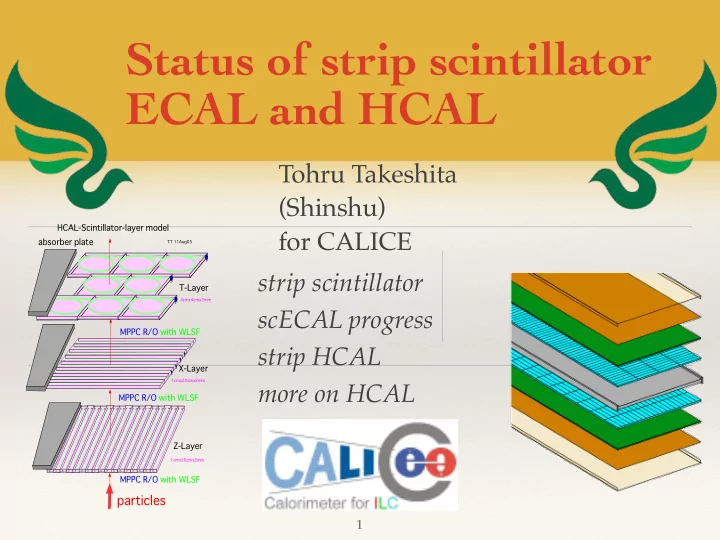
Status of strip scintillator ECAL and HCAL Tohru Takeshita (Shinshu) HCAL-Scintillator-layer model for CALICE absorber plate TT 11Aug05 strip scintillator T-Layer 4cmx4cmx2mm scECAL progress MPPC R/O with WLSF strip HCAL


slide-1
SLIDE 1

Status of strip scintillator ECAL and HCAL

Tohru Takeshita (Shinshu) for CALICE strip scintillator scECAL progress strip HCAL more on HCAL

HCAL-Scintillator-layer model

TT 11Aug05

particles

T-Layer X-Layer Z-Layer

4cmx4cmx2mm 1cmx20cmx2mm 1cmx20cmx2mm

MPPC R/O with WLSF MPPC R/O with WLSF MPPC R/O with WLSF absorber plate

1

slide-2
SLIDE 2

PFA requirements

❖ Jet Energy resolution ~ 3% ❖ fine segmentation in 3D (longitudinal and lateral) ❖ for both ECAL (5mm) and HAL(3cm) : current opt. ❖ strip scintillator technology can achieve high

granularity

❖ with perpendicular setup for both ECAL and HCAL ❖ moreover it is able reduce the number of R/O channels

~1/10

❖ HCAL strip would be 1cm width which is compatible

(S)DHCAL

❖ with analog read out capability ~AHCAL

T.Takeshita LCWS15@Whistler

Track/ECAL/HCAL

2

slide-3
SLIDE 3

る。また、シンチレーターは切り出してきたシンチレーター材のロットによっ て個体差があることが知られており、このばらつきの大きさについては調査が 必要である。

MPPCからの距離 #p.e. MPV

[mm] 5 10 15 20 25 30 35 40 45 5 10 15 20 25 30 35 40 45 50

2mm thick baseline and bottom

Baseline design Simple bottom 図 基準設計と下面読み出し 厚さ

MPPCからの距離 #p.e. MPV

図 くさび形のシンチレーター 厚さ 厚さ のシンチレーター 厚さが になると、発光量と反射回数の増減によって光電子数は厚さ のときの約 割になると予想される 式 。さらに、開口部分の寄与を考え る。開口部分とは、 を設置する面の反射材がない部分である。 T.Takeshita LCWS15@Whistler

strip for scECAL

❖ 5mmx45mm strips direct MPPC readout ❖ attached at the end side or bottom ❖ enough light yield ❖ good uniformity except near sensor ❖ scintillation light transmission simulation

MPPC

Scintillator strip

PCB

end side R/O bottom R/O distance from a MPPC light yield Ieki

Simulation result

Tsuzuki 2mm thick

3

slide-4
SLIDE 4

T.Takeshita LCWS15@Whistler

strip for HCAL

18cm2 1cm wide 3mm thick good uniformity with camac ADC βrays 18cm2 Itoh

❖ 18cm long strip with WLSF read out ❖ perpendicular set up ❖ combination with tiles will remove ghost ❖ photon yield ~30p.e. ❖ 18 cm long strip with ❖ WLSF read out ❖ good uniformity ❖ by beta rays at lab. ❖ 1600 pix MPPC 25um

MIP 1p.e. 2p.e.

4

slide-5
SLIDE 5

T.Takeshita LCWS15@Whistler

strip HCAL

❖ fine segmented HCAL looks better for

tracking in hadron interaction

❖ scintillator HCAL is better for EM shower

measurement

❖ we do “cherry picking” calice AHCAL 25GeV π- calice SDHCAL 50GeV π- calice DCAL 16GeV π-

1x1cm2 3x3cm2

5

slide-6
SLIDE 6

T.Takeshita LCWS15@Whistler

photo sensor for scCAL

❖ ECAL need very large dynamic range for number of photons ❖ MPPC has limited number of pixels which has saturation

phenomena with rapid recovery

1700 MIP energy / sc-strip (5x45mm2) dE /strip (GeV)

number of pixels in a MPPC should be 10k, when 7p.e./MIP

ECMS=500GeV

6

slide-7
SLIDE 7

T.Takeshita LCWS15@Whistler

10k pixel MPPC

10um ❖ 10um pitch MPPC in

1mmx1mm

❖ =10k pixel MPPC ❖ response with scintillator is

measured

❖ reached ~ 10000 p.e. ❖ signal is significantly smaller ❖ need careful signal amp/ADC ❖ current SPIROC2 facing

difficulty

pixel size is small, small C

7

slide-8
SLIDE 8

T.Takeshita LCWS15@Whistler

strip problem

❖ ghost ❖ strip calorimeters suffer from ghost

problem for both ECAL and HCAL

❖ ghosts appear when multi-particle

passing near by

❖ ghost can be avoided by

introducing tile layers

❖ size of the tile depends on the

strip width

g h

  • s

t

γ γ

8

slide-9
SLIDE 9

T.Takeshita LCWS15@Whistler

scintillator problems in HCAL

MC with Birks law 5GeV π longitudinal layer # black: total green : proton red : electrons blue : pi+- cyan : heavy ion

❖ neutron rich events ❖ can be removed by time and isolation

cuts

❖ low energy / slow protons which deposit

huge energy in a strip/tile

❖ significant contribution to fluctuation ❖ must be removed, however this makes ❖ total energy smaller ❖ under study

9

slide-10
SLIDE 10

T.Takeshita LCWS15@Whistler

strip scECAL status

❖ integrated layers are being tested ❖ with scintillator strips and the read out

electronics

❖ with 10k pixel MPPC of 1x1mm2

scintillator layer read out layer read out layer

2x18x18cm2 18x18cm2 144 strips 2x144ch

10

slide-11
SLIDE 11

T.Takeshita LCWS15@Whistler

strip scECAL test at CERN

Tungsten stack

11

❖ together with AHCAL in absorbers ❖ 2014 at PS T20 with steel and 2015

at SPS H2/6 with tungsten

❖ 3 ECAL layers & 12 AHCAL layers

slide-12
SLIDE 12

T.Takeshita LCWS15@Whistler

strip scECAL unit : EBU

Transverse EBU Longitudinal EBU Transverse EBU already tested HBUs EBUs

strip strip strip

10k pix

Bottom readout end readout end readout

10k pix 1600 pix

Tungsten stacks

12

slide-13
SLIDE 13

T.Takeshita LCWS15@Whistler

scECAL layers

❖ online hit maps at CERN/SPS ❖ for muon calibration ❖ layer-1 is a bit noisy due to low

thresholds

❖ further analysis is on going

a good muon event 144strips/layer

13

slide-14
SLIDE 14

T.Takeshita LCWS15@Whistler

strip scECAL performance

muon 50GeV

❖ hit information from ❖ second and third

scECAL layers are combined

❖ to have matching hits ❖ problematic strips

degrade hit map

❖ importance of tuning ❖ before the experiments

14

slide-15
SLIDE 15

T.Takeshita LCWS15@Whistler

strip HCAL prototype

18cm 18cm 18cm 1cm 16channels

❖ four layers have be constructed ❖ stuck together at the beam ❖ read out by EASIROC module ❖ contains SPIROC, however,

independent from others

15

slide-16
SLIDE 16

T.Takeshita LCWS15@Whistler

strip HCAL read out

❖ EASIROC NIM module ❖ ASIC:easiroc by OMEGA

❖ external trigger mode ❖ bias voltage with DC/DC ❖ external ADC ❖ temperature monitor ❖ Ethernet I/O ❖ DAQ & parameter setting

32ch. 64ch.

Variable Low Gain PA (4 bits)

Hold Read

Low Gain Multiplexed Output Ch31_trig Channel 0

Common to the 32 channels

Channel 31

Variable High Gain PA (4 bits)

+

V_th

Latch RS

Channel0_trigger

Discri

OR32

Slow Shaper

25 - 175 ns

LG Slow Shaper

Variable Shaping Time (3 bits) 15 ns

Read

Trigger Multiplexed Output

Low Gain PreAmp.

HG Slow Shaper Variable Shaping Time (3 bits)

0.1pF - 1.5pF 1.5pF

10-bit DAC

RS or Discri 0.1pF - 1.5pF 15pF High Gain PreAmp.

Hold Read

High Gain Multiplexed Output

+

Slow Shaper

25 - 175 ns 3pF

in_calib

Bipolar Fast Shaper

8-bit DAC 0-4.5V IN Ch0

ON c15p 3pF Ctest Figure 4 – One channel description

図 の回路図の概略 。 に配置する必要があった。特に、高電圧のかかる の信号線は密集しがちであ るが、十分な間隔 程度 で配置しなければならないため、慎重な設計が必要 であった。 また、ファイバートラッカー用に特化するのではなく、 を用いての測定に 広く対応できることも念頭において作成したため、汎用性の高いモジュールとなっ た。 の測定で必要な機能はほぼ全て内蔵されており、持ち運びも容易である。 モジュールの作成はジー・エヌ・ディー社に依頼し、設計にも協力して頂いた。以 下の図 、図 に完成したモジュールの概観を示す。

内蔵バイアス電源(0~90V) MPPC64ch 温度計 Ethernet by SiTCP (FPGA編集) EASIROC x2 ADC FPGA LVDS 出力 計装用ADC ASIC保護回路

年 月 日火曜日

図 の内部基板。

16
slide-17
SLIDE 17

T.Takeshita LCWS15@Whistler

strip HCAL prototype

❖ uniformity by muons ❖ positions were determined by the

next layer

❖ will be calibrated with photon-yield

mip by muons pedestal ADC dist. photo-sensor photo-sensor dead channel both layers are required to be single hits distance from MPPC (mm) <non uniformity> ~13%

17

slide-18
SLIDE 18

T.Takeshita LCWS15@Whistler

HCAL improvement

❖ active fine granular absorber for

PFA

❖ by Cherenkov detection ❖ with very thin photo-sensor ~

MPPC

❖ heavy and transparent absorber ❖ currently testing the lead-glass ❖ X0~1.7cm, t ~ 5.5 g/cm3 ❖ refractive index n=1.8

18

slide-19
SLIDE 19

T.Takeshita LCWS15@Whistler

HCAL improvement

❖ active fine granular absorber for

PFA

❖ by Cherenkov detection ❖ with very thin photo-sensor ~

MPPC

❖ heavy and transparent absorber ❖ currently testing the lead-glass ❖ X0~1.7cm, t ~ 5.5 g/cm3 ❖ refractive index n=1.8

heavy absorber transparent PPD 3cmx3c

3cm 4cm

18

slide-20
SLIDE 20

T.Takeshita LCWS15@Whistler

Cherenkov light detection

absorbed

❖ extremely small number of photons

than scintillation ~(1-1/n2)/ λ2

❖ higher refraction index n is desired ❖ UV light detection is a key ❖ will be absorbed in lead glass ❖ photo-sensor must be glued with ❖ high n > 1.41, otherwise totally

reflected

19

slide-21
SLIDE 21

T.Takeshita LCWS15@Whistler

muon Cherenkov

3cmx3cmx4cm MPPC

  • 3x3mm2

μ

❖ at H6 CERN Beam ❖ LG : DF6 3x3x4cm3 ❖ a MPPC (100um pitch) 3x3 mm2 detects ❖ ~15 p.e./4cmLG ❖ with glue

ADC LG 4cm

20

slide-22
SLIDE 22

T.Takeshita LCWS15@Whistler

muon Cherenkov

3cmx3cmx4cm MPPC

  • 3x3mm2

μ

❖ at H6 CERN Beam ❖ LG : DF6 3x3x4cm3 ❖ a MPPC (100um pitch) 3x3 mm2 detects ❖ ~15 p.e./4cmLG ❖ with glue

ADC LG 4cm gauss 4-32p.e. gauss 8-22p.e.

20

slide-23
SLIDE 23

T.Takeshita LCWS15@Whistler

summary and outlook

❖ scintillator strip calorimeters ❖ scECAL is close to module 0 for ILC ❖ strip HCAL can be achieved with less R/O

ch

❖ further possibility with active absorber ❖ PFA modification to fit strip technology ❖ take into account information from

absorber

21

slide-24
SLIDE 24

T.Takeshita LCWS15@Whistler

Hadron energy resolution

calice-AHCAL calice-DHCAL calice-SDHCAL

❖ energy resolutions ❖ AHCAL is better than S/DHCAL

20% 10% 50GeV 50GeV 50GeV

22