
SLIDE 1
1
A Brief History of Astronomical A Brief History of Astronomical Imaging Systems Imaging Systems Oldest Oldest “ “Imaging Imaging” ” Instruments Instruments
- circa 1000 CE – 1600 CE
- Used to measure angles and positions
- Included No Optics
– Astrolabe – Octant, Sextant – Tycho Brahe’s Mural Quadrant (1576)
- Star Catalog accurate to 1' (1 arcminute = 1/60° ≈ limit of
resolution of unaided human eye)
– Astronomical Observatories were built by church as part of European Cathedrals
- (possible subject for course term paper)
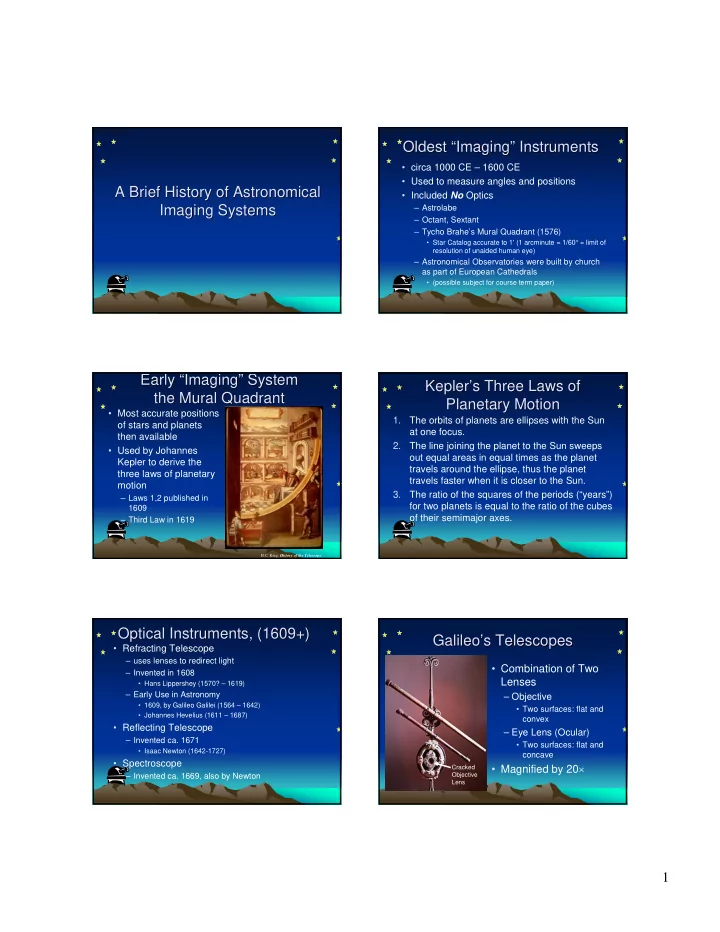
Early Early “ “Imaging Imaging” ” System System the Mural Quadrant the Mural Quadrant
- Most accurate positions
- f stars and planets
then available
- Used by Johannes
Kepler to derive the three laws of planetary motion
– Laws 1,2 published in 1609 – Third Law in 1619
H.C. King, History of the Telescope
Kepler Kepler’ ’s s Three Laws of Three Laws of Planetary Motion Planetary Motion
1. The orbits of planets are ellipses with the Sun at one focus. 2. The line joining the planet to the Sun sweeps
- ut equal areas in equal times as the planet
travels around the ellipse, thus the planet travels faster when it is closer to the Sun. 3. The ratio of the squares of the periods (“years”) for two planets is equal to the ratio of the cubes
- f their semimajor axes.
Optical Instruments, (1609+) Optical Instruments, (1609+)
- Refracting Telescope
– uses lenses to redirect light – Invented in 1608
- Hans Lippershey (1570? – 1619)
– Early Use in Astronomy
- 1609, by Galileo Galilei (1564 – 1642)
- Johannes Hevelius (1611 – 1687)
- Reflecting Telescope
– Invented ca. 1671
- Isaac Newton (1642-1727)
- Spectroscope
– Invented ca. 1669, also by Newton
Galileo Galileo’ ’s Telescopes s Telescopes
- Combination of Two
Lenses
– Objective
- Two surfaces: flat and
convex
– Eye Lens (Ocular)
- Two surfaces: flat and
concave
- Magnified by 20×
Cracked Objective Lens