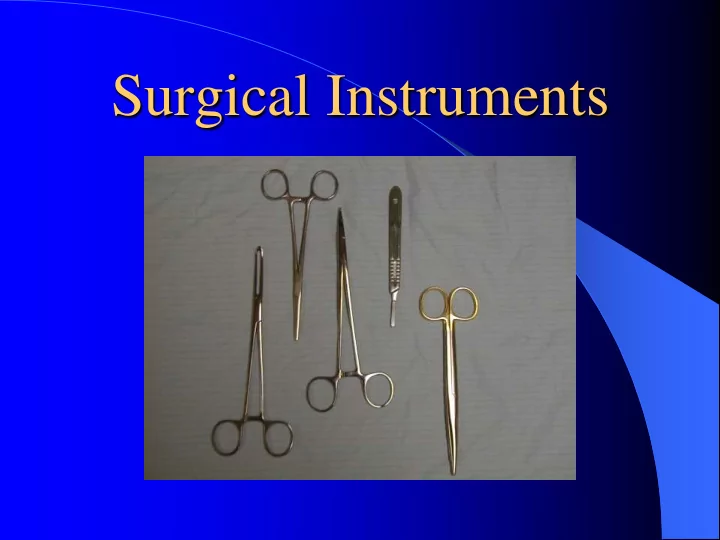
SLIDE 1
Surgical Instruments
SLIDE 2 Instruments
Instruments are classified by their function
– Cutting & Dissecting – Grasping & Holding – Clamping & Occluding – Exposing & Retracting – Suturing & Stapling – Viewing – Suctioning
SLIDE 3 Instruments
– Dilating & Probing – Measuring – Microinstruments – Powered instruments
SLIDE 4
Cutting & Dissecting
SLIDE 5 Cutting & Dissecting
Cutting instruments have sharp edges.
They are used to dissect, incise, separate, or excise tissue.
Most instrument sets will include #3
and #7 knife handles & suture, curved mayo, metz and tenotomy scissors.
SLIDE 6 Knife Handles
Come in various
widths & lengths
Blades are attached
by slipping the slit in the blade into the groove on the handle
#7 #4 #3
SLIDE 7 Knife Blades
Blades with
numeric prefix of “1” (e.g., 10, 11, 12, 15) fit #3 or #7 handles
Blades with the
numeric prefix “2” (e.g., 20, 21, 22, 23, 24) fit #4 handles
SLIDE 8 Knife Blades
#10 are used for
large skin incisions
#15 are used for
short shallow incisions
#11 are used for
initial skin puncture
incisions
#10 #15 #11
SLIDE 9 Other Knife handles
Long handles are
used inside deep incisions (e.g., open abdominal cases)
Beaver knifes are
used for small delicate cases
SLIDE 10
SLIDE 11
SLIDE 12 Scissors
Blades of scissors may
be straight, angled, or curved
Tips may be pointed
be long or short
Should be used only
for their intended purpose
SLIDE 13
Straight Mayo (Suture) Scissors
SLIDE 14
Bandage/Dressing Scissors
SLIDE 15
Tissue/Dissecting Scissors
SLIDE 16
Curved Mayo Scissors
SLIDE 17
Metzenbaum Scissors
SLIDE 18
Tenotomy scissors
SLIDE 19
Iris Scissors
SLIDE 20
Other cutting Instruments
SLIDE 21
Ronguer
SLIDE 22
Osteotome
SLIDE 23
Curette
SLIDE 24
Freer Elevator
SLIDE 25
Rasp
SLIDE 26
Grasping & Holding
SLIDE 27
Grasping & Holding
These instruments are used to
grasp tissue and hold it in place without injuring surrounding tissues
Forceps can be ringed or the
thumbed variety
SLIDE 28
Grasping & Holding
Most instrument sets will include
kocher, allis, babcock, adson, tissue, debakey forceps, sponge sticks & towel clips.
SLIDE 29
Forceps
SLIDE 30
Kocher
SLIDE 31
Allis
SLIDE 32
Babcock
SLIDE 33
Sponge Stick
SLIDE 34
Towel Clip
SLIDE 35
Adsons
SLIDE 36
Tissue
SLIDE 37
Ferris Smith
SLIDE 38
DeBakey
SLIDE 39
Russians
SLIDE 40
Clamping & Occluding
SLIDE 41
Clamping & Occluding
These instruments are used to
apply pressure
Some clamps are designed to crush
the structure when applied
Others are noncrushing and are
used to occlude or secure tissue
SLIDE 42
Clamping & Occluding
Most instrument sets will include
mosquito, crile, kelly, tonsil, peon, and right angle clamps.
SLIDE 43
Anatomy of a Clamp
SLIDE 44
Mosquito
SLIDE 45
Crile
SLIDE 46
SLIDE 47
Kelly
SLIDE 48
SLIDE 49
Tonsil
SLIDE 50
SLIDE 51
Peon
SLIDE 52 mosquito crile kelly tonsil peon
SLIDE 53
Right Angle
SLIDE 54
Non-crushing Clamps
SLIDE 55
Bowel Clamp
SLIDE 56
Vascular Clamp
SLIDE 57
Bulldogs
SLIDE 58
Exposing and Retracting
SLIDE 59
Exposing and Retracting
Used to pull Soft tissue and muscle
aside to expose surgical site
2 types:
–Hand held –Self retaining
SLIDE 60
Exposing and Retracting
Most instrument sets will include
small hand held , army-navy, malleable, weitlaner, and richardson retractors.
SLIDE 61
Hand Held Retractors
SLIDE 62
Skin Hooks
SLIDE 63
Senn
SLIDE 64
Cushing Vein Retractor
SLIDE 65
Volkman
SLIDE 66
Army-Navy
SLIDE 67
Malleable (Ribbon)
SLIDE 68
Richardson
SLIDE 69
Kelly
SLIDE 70
Harrington
SLIDE 71
Deaver
SLIDE 72
Self Retaining Retractors
SLIDE 73
Weitlaner
SLIDE 74
Cerebellar
SLIDE 75
Gelpi
SLIDE 76
Balfour
SLIDE 77
Bookwalter
SLIDE 78
Suturing and Stapling
SLIDE 79
Suturing and Stapling
Needle holder sizes vary according
to type of needle used
Most instrument sets will have
webster, crilewood, and mayo hegar type needle holders.
SLIDE 80
Suturing and Stapling
Clip appliers place individual
staples, available in reusable and disposable
Disposable staplers
SLIDE 81
Needle Holders
SLIDE 82
Webster
SLIDE 83
Crilewood
SLIDE 84
Mayo Hegar
SLIDE 85
Castroviejo
SLIDE 86
Skin Stapler
SLIDE 87
Weck Hemoclip Applier
SLIDE 88
Ligaclip Applier
SLIDE 90
Viewing
SLIDE 91
Viewing
Surgeons can examine body
cavities, hallow organs, or structures with viewing instruments
Procedures may be performed
through them
SLIDE 92
Nasal Speculum
SLIDE 93
Vaginal Speculums
SLIDE 94
Rectal Speculums
SLIDE 95
Rigid Endoscope
SLIDE 96
Laparoscopic Trocars
SLIDE 97
Laparoscopic Instruments
SLIDE 98
Thorascopic Trocars
SLIDE 99
Arthroscopy Cannulas
SLIDE 100
Cystoscopy Sheath
SLIDE 101
Camera & Light Cord
SLIDE 102
Flexible Bronchoscope
SLIDE 103
Flexible Ureteroscope
SLIDE 104
Proctoscope
SLIDE 105
Suctions
SLIDE 106
Yankauer
SLIDE 107
Frazier
SLIDE 108
Poole
SLIDE 109
Probes & Dilators
SLIDE 110
Uterine Dilators
SLIDE 111
Uterine Sound
SLIDE 112
Urethral Sounds
SLIDE 113
Lacrimal Duct Probe
SLIDE 114
Vascular Tunnelers
SLIDE 115
Measuring
SLIDE 116
Rulers
SLIDE 117
Depth Gauge
SLIDE 118
Total Hip Trials
SLIDE 119
Microinstruments
SLIDE 120
Castroviejo Needle Holder
SLIDE 121
Micro Scissors
SLIDE 122
Bishop Harman Forceps
SLIDE 123
Powered Instruments
SLIDE 124
Powered Instruments
3Types
–Battery powered –Air powered –Electric powered
SLIDE 125
Stryker System 5
SLIDE 126
Midas Rex
SLIDE 127
TPS System
SLIDE 128 Arthroscopic Shaver
SLIDE 129
Minor Set
SLIDE 130
Major Set/Lower Tray
SLIDE 131
Major Set/Upper Tray
SLIDE 132
Major Retractor Set
SLIDE 133
Care & Handling of Instruments
SLIDE 134 Handling instruments
Instruments are placed firmly into the
surgeon’s palm in such a manner that it is ready of immediate use.
Ringed instruments are handed with the box
locks closed.
Curved instruments are passed with the
curve in the direction of intended use.
SLIDE 135
SLIDE 136
SLIDE 137
SLIDE 138 To facilitate suturing the needle is
secured about 1/8 inch down from the tip of the needle holder and about a third of the distance from the eye or swaged end
SLIDE 139 Care of Instruments
During the procedure,
used instruments should wiped with a damp sponge or placed in a basin of sterile distilled water.
SLIDE 140 Care of Instruments
Do not saline on
instruments.
Do not allow blood to
dry on instruments.
Saline & blood can
damage instrument surfaces causing corrosion and pitting.
SLIDE 141 Care of Instruments
Flush suction tips with
sterile distilled water periodically to keep lumens patent.
Flush all lumened
instruments thoroughly at the end
blood from drying inside lumens.
SLIDE 142 Care of Instruments
Powered hand
pieces and batteries should not be immersed in liquid as this could damage internal mechanisms.