Functional Abdominal Pain: Implementing Nonpharmacologic Therapies - - PDF document

functional abdominal pain implementing nonpharmacologic
SMART_READER_LITE
LIVE PREVIEW

Functional Abdominal Pain: Implementing Nonpharmacologic Therapies - - PDF document

Functional Abdominal Pain: Implementing Nonpharmacologic Therapies into Your Practice NASPGHAN 2015 Miranda van Tilburg and Bruno P. Chumpitazi Case Presentation Objective 1: Review the efficacy of psychosocial therapies in children with


slide-1
SLIDE 1

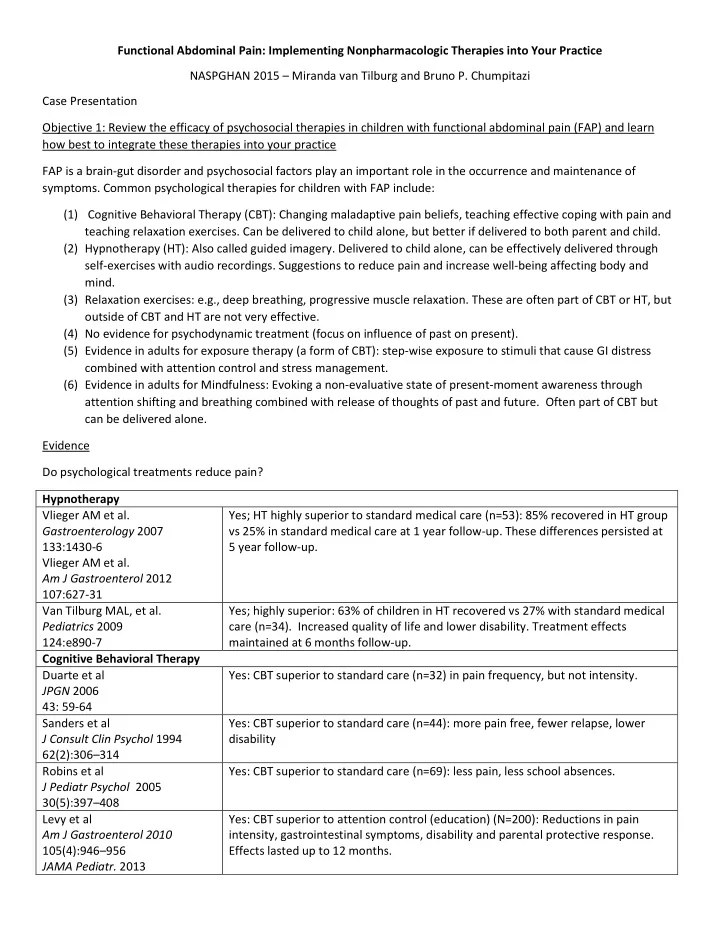
Functional Abdominal Pain: Implementing Nonpharmacologic Therapies into Your Practice NASPGHAN 2015 – Miranda van Tilburg and Bruno P. Chumpitazi Case Presentation Objective 1: Review the efficacy of psychosocial therapies in children with functional abdominal pain (FAP) and learn how best to integrate these therapies into your practice FAP is a brain-gut disorder and psychosocial factors play an important role in the occurrence and maintenance of

  • symptoms. Common psychological therapies for children with FAP include:

(1) Cognitive Behavioral Therapy (CBT): Changing maladaptive pain beliefs, teaching effective coping with pain and teaching relaxation exercises. Can be delivered to child alone, but better if delivered to both parent and child. (2) Hypnotherapy (HT): Also called guided imagery. Delivered to child alone, can be effectively delivered through self-exercises with audio recordings. Suggestions to reduce pain and increase well-being affecting body and mind. (3) Relaxation exercises: e.g., deep breathing, progressive muscle relaxation. These are often part of CBT or HT, but

  • utside of CBT and HT are not very effective.

(4) No evidence for psychodynamic treatment (focus on influence of past on present). (5) Evidence in adults for exposure therapy (a form of CBT): step-wise exposure to stimuli that cause GI distress combined with attention control and stress management. (6) Evidence in adults for Mindfulness: Evoking a non-evaluative state of present-moment awareness through attention shifting and breathing combined with release of thoughts of past and future. Often part of CBT but can be delivered alone. Evidence Do psychological treatments reduce pain? Hypnotherapy Vlieger AM et al. Gastroenterology 2007 133:1430-6 Vlieger AM et al. Am J Gastroenterol 2012 107:627-31 Yes; HT highly superior to standard medical care (n=53): 85% recovered in HT group vs 25% in standard medical care at 1 year follow-up. These differences persisted at 5 year follow-up. Van Tilburg MAL, et al. Pediatrics 2009 124:e890-7 Yes; highly superior: 63% of children in HT recovered vs 27% with standard medical care (n=34). Increased quality of life and lower disability. Treatment effects maintained at 6 months follow-up. Cognitive Behavioral Therapy Duarte et al JPGN 2006 43: 59-64 Yes: CBT superior to standard care (n=32) in pain frequency, but not intensity. Sanders et al J Consult Clin Psychol 1994 62(2):306–314 Yes: CBT superior to standard care (n=44): more pain free, fewer relapse, lower disability Robins et al J Pediatr Psychol 2005 30(5):397–408 Yes: CBT superior to standard care (n=69): less pain, less school absences. Levy et al Am J Gastroenterol 2010 105(4):946–956 JAMA Pediatr. 2013 Yes: CBT superior to attention control (education) (N=200): Reductions in pain intensity, gastrointestinal symptoms, disability and parental protective response. Effects lasted up to 12 months.

slide-2
SLIDE 2

Thomas CM, Versalovic J. Gut Microbes 2010; 1:1-16.

167(2):178–184 Alfven and Lindstrom Acta Paediatr 2007 96(1):76–81 Yes: CBT plus physiotherapy vs physiotherapy(n=48): No significant differences at 1 year follow up. Groβ and Warschburger Int J Behav Med 2000 20(3):434–443 Yes: CBT superior to waitlist (n=29): reductions in pain intensity and duration. No differences at 3 months follow-up. Levy et al NASPGHAN 2015 Yes: Parent-only CBT vs education reduces child gastrointestinal symptoms and disability up to 6 months after treatment How to integrate 1) Psychologist, or master level therapist with appropriate training (e.g., LCSW)

  • a. Within your practice
  • b. Local to you: NASPGHAN referral list (NASPGHAN.org →professional education→ motility resources)

American Society of Clinical Hypnosis (http://www.asch.net/Public/MemberReferralSearch.aspx American Psychology Association http://locator.apa.org/index.cfm?event=search.text Society of Pediatric Psychology Division 54 Pediatric Gastroenterology Interest Group (http://www.apadivisions.org/division-54/sigs/gastroenterology/index.aspx) 2) E-therapy

  • a. Many therapists use skype (laws vary per state)
  • b. Internet delivered CBT tested but not available outside research
  • c. Audio-recorded hypnotherapy tested but not available yet. Scripts available for free to trained therapists

contact: tilburg@med.unc.edu

  • d. Audio-recorded guide imagery and relaxation exercises for chronic pain: www.painretreat.net

Objective 2: Review the efficacy of probiotics in children with FAP and how to use them Probiotic: “Live” microorganisms which when administered in adequate amounts confer a health benefit on the host. (Guidelines for the evaluation of probiotics in food. Rome/Geneva: FAO/WHO; 2002) Proposed mechanisms by which probiotics work

slide-3
SLIDE 3

Evidence Does the gut microbiota composition differ between children with IBS and healthy controls? Rigsbee, L et al. Am J Gastroenterol 2012 107:1740-51. Yes; Differences in the abundances of several bacterial genera revealed in children (pre and adolescent) with IBS-D (n=22). Several “relationships” identified via networking analysis. Saulnier, DM et al. Gastroenterology 2011 41:1782-1791 Yes; Several differences in the abundances at the class and genus levels in children with IBS (n=22). There were also differences in composition to distinguish IBS subtypes and pain severity groupings. Several adult studies have demonstrated differences between those with IBS and healthy controls though the results have not been consistent (Rajilic-Stojanovic M, et al. Am J Gastroenterol 2015; 110:278-87.) Have probiotics demonstrated benefit in childhood FAP/IBS? Bausserman M, et al. J Pediatr 2005 147:197-201 Somewhat, Lactobacillus GG (1010 CFU bid x 6 weeks) did not decrease pain vs. placebo, but did decrease abdominal distention (N=50 IBS) Gawronska A, et al. APT 2007 25:177-184 Yes, Lactobacillus GG (3x10⁹ CFU bid x 4 weeks) increased the likelihood of having no pain at completion vs. placebo (25% vs. 9.6%), and decreased overall frequency of

  • pain. More robust findings were found in those with IBS. (N=104 FAP)

Francavilla R, et al. Pediatrics 2010 126:e1445-52 Yes, Lactobacillus GG (3x10⁹ CFU bid x 8 weeks) decreased pain during and over the course of a follow-up period vs. placebo in children with IBS N=141 (83 IBS, 58 FAP) Guandalini S, et al. JPGN 2010 51:24-30 Yes, VSL#3 (one or two sachets daily x 6 weeks) decreased global score, pain, abdominal bloating in a cross-over trial vs. placebo (N=59 IBS) Romano C et al. J Paediatr Child Health 2014; 50:E68-71. Somewhat, Lactobacillus reuteri DSM 17938 (2x10⁸ CFU bid x 4 weeks) decreased pain intensity but not frequency. (N=60 FAP) Objective 3: Review the efficacy of the low FODMAP diet in children with FAP and how to integrate it into your practice What is the low FODMAP diet? FODMAP stands for fermentable oligosaccharides disaccharides monosaccharides and polyols. This diet which restricts carbohydrates that may be difficult to absorb including fructose (fruit juices), lactose (dairy), fructans (wheat/onions), galactans (beans), and polyols (artificial sweeteners). Emerging evidence in children Chumpitazi B, et al. Gut Microbes 2014 5:165-75. Yes, low FODMAP open label pilot trial x 1 week with overall decrease in pain

  • frequency. 50% had marked decrease in abdominal pain frequency (N=8 IBS)

Chumpitazi B, et al. APT 2015 42: 418-27. Yes, low FODMAP vs. typical American diet x 48 hrs randomized, double-blind, cross-

  • ver study with overall group having decreased abdominal pain frequency on low

FODMAP diet. Responders (n=8) identified with 50% or more decrease in abdominal pain frequency had a different gut microbiome composition prior to the start of the diet than those who did not respond. (N=33 IBS) Several adult IBS studies have demonstrated low FODMAP diet efficacy (Halmos E, et al. Gastroenterology 2014; 146:67- 75.) How to integrate 1) Handouts 2) Registered dietitian

  • a. Within your practice
  • b. Local to you: http://www.eatright.org/find-an-expert

3) Mobile apps: http://www.med.monash.edu.au/cecs/gastro/fodmap/iphone-app.html 4) Social media: @MonashFODMAP (twitter)