Silicon refractive index The dispersion producing the best fit to - - PowerPoint PPT Presentation

silicon refractive index
SMART_READER_LITE
LIVE PREVIEW

Silicon refractive index The dispersion producing the best fit to - - PowerPoint PPT Presentation

Silicon refractive index The dispersion producing the best fit to measurements at ambient room temperature (293 K) [D.F. Edwards, Silicon (Si). In: E.D. Palik, Editor, Handbook of Optical Constants of Solids, Academic Press Inc. (1985) pp.


slide-1
SLIDE 1

Silicon refractive index

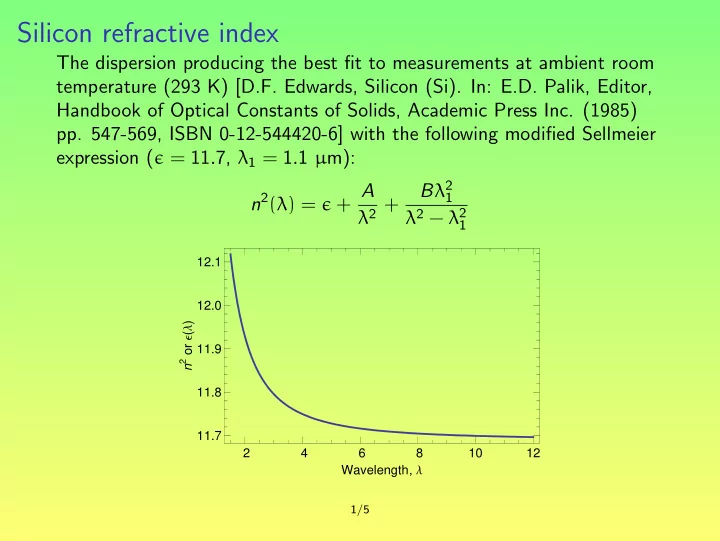
The dispersion producing the best fit to measurements at ambient room temperature (293 K) [D.F. Edwards, Silicon (Si). In: E.D. Palik, Editor, Handbook of Optical Constants of Solids, Academic Press Inc. (1985)

  • pp. 547-569, ISBN 0-12-544420-6] with the following modified Sellmeier

expression (ǫ = 11.7, λ1 = 1.1 µm): n2(λ) = ǫ + A λ2 + Bλ2

1

λ2 − λ2

1

2 4 6 8 10 12 11.7 11.8 11.9 12.0 12.1 Wavelength, Λ n2 or Ε(Λ) 1/5

slide-2
SLIDE 2

Approximations

Large value of ǫ ≈ 12 makes reasonably good a model of perfectly conducting metal. We assume a metal bar of radius a and length l located at a distance d from the beam orbit. If the bunch length σz ≫ d, then the field on the bar is a slow function of time, and one can use electrostatic approximation to solve the fields.

2/5

slide-3
SLIDE 3

Calculations

ζ is coordinate measured along the bar. The potential generated at point ζ of the bar at time t is φB(t, ζ) = 2λB(t) ln

  • d2 + ζ2

where λB is the charge per unit length of the bunch λB(t) = Q √ 2πσz e−t2c2/2σ2

z

This potential should be compensated by the image charge on the bar. Λ(t, ζ) is the charge per unit length of the bar. In the limit a ≪ l, d, the potential generated by the image charge on the surface of the bar is φim(t, ζ) ≈ 2Λ(ζ) ln 2l a − ∞ dζ(Λ′(ζ + ξ) − Λ′(ζ − ξ)) ln(ξ/l) The sum of two potentials does not depend on ζ φim(t, ζ) + φB(t, ζ) = φ0(t)

3/5

slide-4
SLIDE 4

Solution

To solve the equation, neglect the integral. This introduces a relative error of order of 1/ ln(2l/a). Λ(ζ) = φ0 − 2λB(t) ln √ d2 + ζ2 2 ln(2d/a) The constant φ0 is found from the condition that the total charge on the bar is zero:

  • Λ(ζ)dζ = 0.

The electric field of the bar kicks the beam. Further calculations will be numerical and require more specificity. I need better knowledge about d, a, l.

4/5

slide-5
SLIDE 5

Geometry of the experiment

5/5