ESS 439 lab 2 Isotropic materials, Anisotropic minerals Isotropic - - PowerPoint PPT Presentation

ess 439 lab 2
SMART_READER_LITE
LIVE PREVIEW

ESS 439 lab 2 Isotropic materials, Anisotropic minerals Isotropic - - PowerPoint PPT Presentation

ESS 439 lab 2 Isotropic materials, Anisotropic minerals Isotropic medium: velocity of light is same in all directions (wave normal = ray direction), e.g., glass and isometric crystals. Isotropic substances have a single refractive index.


slide-1
SLIDE 1

ESS 439 lab 2

Isotropic materials, Anisotropic minerals

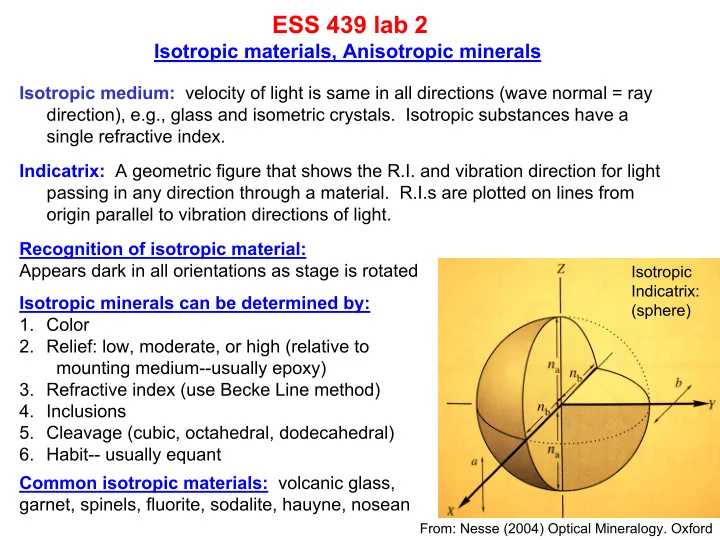
Isotropic medium: velocity of light is same in all directions (wave normal = ray direction), e.g., glass and isometric crystals. Isotropic substances have a single refractive index. Indicatrix: A geometric figure that shows the R.I. and vibration direction for light passing in any direction through a material. R.I.s are plotted on lines from

  • rigin parallel to vibration directions of light.

Isotropic Indicatrix: (sphere)

Recognition of isotropic material: Appears dark in all orientations as stage is rotated Isotropic minerals can be determined by:

  • 1. Color
  • 2. Relief: low, moderate, or high (relative to

mounting medium--usually epoxy)

  • 3. Refractive index (use Becke Line method)
  • 4. Inclusions
  • 5. Cleavage (cubic, octahedral, dodecahedral)
  • 6. Habit-- usually equant

Common isotropic materials: volcanic glass, garnet, spinels, fluorite, sodalite, hauyne, nosean

From: Nesse (2004) Optical Mineralogy. Oxford

slide-2
SLIDE 2

Lab 2 (cont.) Refractometry

Refractive Index is measured in a grain mount by immersing grains of minerals (or glass) in an

  • il of known refractive and observing the

movement of the Becke line. Use plane polarized light, medium or high power

  • bjective and partially closed iris diaphragm

If nmineral ≠ noil, a thin line of white light at the grain boundary (Becke line) will move into the grain as the objective is raised above focus if ngrain < noil or will move into the oil if noil < ngrain If the n’s are the same the grain will be invisible. Actually, two colored lines (red) and blue) should appear because n is a function of λ (dispersion). These lines will move in opposite directions as the

  • bjective is raised or lowered from the focus
  • position. This may be difficult to see.

For precise work, use a Na lamp (λ = 539 nm). n

  • f the oil is then measured in a Abbe refractometer

From: Nesse (2004) Optical Mineralogy. Oxford

slide-3
SLIDE 3

Lab 2 (cont.) Exercises

  • 1. If we have time, we will prepare grain mounts and demonstrate the technique
  • 2. Locate the following thin sections (multiples of each) and answer the questions

Hansen Lake: Locate the isotropic mineral. Determine its relief relative to the

  • ther constituents in this slide. This section also contains isotropic volcanic glass.

KH-1 and/or BSQ 35: Locate the isotropic mineral, determine its relief and color

  • 3. Mauna Loa (basalt): Sections should be 30 microns thick. Phenocrysts are olivine.

Using plane polarized light (analyzer out) (i) Does olivine show any color, cleavage or crystal faces? Using crossed polars (analyzer in) (ii) What colors do you see? Are these colors the same for all olivines? (iii) Describe what happens as the stage is rotated through 360° (iv) Select an olivine, rotate stage until “extinct”, rotate 45°cw , insert gypsum plate and describe what you see. Repeat rotating 45°ccw 4 Adamello (granodiorite, Italy): Locate a biotite crystal showing good cleavage (i) Using ppl, determine color of biotite when cleavage is E-W and N-S. (ii) Locate biotite showing no cleavage, and describe color changes (if any) (iii) Using xpl, describe what happens as the stage is rotated

slide-4
SLIDE 4

Lab 2b Anisotropic minerals: General discussion

Anisotropic mins: Vlight depends on orientation of ray path and they exhibit double refraction (light splits into 2 rays vibrating at right angles and each ray has different V) Two groups: (1) Uniaxial minerals (tetragonal, hexagonal systems) have one direction (c axis—called the optic axis) along which mineral behaves isotropically. (2) Biaxial minerals (orthorhombic, monoclinic, triclinic systems) have two directions (2 optic axes) along which mineral behaves isotropically. Calcite double refraction experiment (calcite is trigonal and uniaxial). The two rays are referred to as the ordinary ray (ω) and the extraordinary ray (ε). The ε ray vibrates in a plane containing the c-axis and the ray path and ω vibrates at right angles to c-axis and ray path. The R.I. of ω ray is nω and R.I. of the ε ray is nε.

Select a clear calcite rhomb and place the rhomb above a small dot on a sheet of paper in orientation

  • shown. You will see two dots produced by

refraction of the ε and ω rays. One dot (produced by the ω ray) will appear shallower that the other and will describe a circle around the other dot (produced by the ε ray) as the rhomb is rotated. Place a piece of polaroid film on the rhomb with its privileged direction oriented N-S. One dot will

  • disappear. Which one? Rotate the film 90º and
  • repeat. The other dot disappears. Why?

Explain your observations with diagrams.

From: Nesse (2004) Optical Mineralogy. Oxford

slide-5
SLIDE 5

Retardation and interference colors

Ray of polarized light passing into mineral slice of thickness d is resolved into two orthogonal rays with different velocities and wavelengths

From: Nesse (2004) Optical Mineralogy. Oxford

Slow ray “lags” behind fast ray by distance ∆ (retardation) ∆ = d(ns – nf). ns-nf is called the birefringence (δ) and it is a function of the orientation of the mineral relative to the light path. Paths along an optic axis will have zero δ while paths ┴ optic axis will have maximum δ. Other paths will have intermediate δ. With white light, δ will result in a distinctive interference color after passing through analyzer. ∆=dδ With white light, all λ’s are present and each λ is split into a fast and a slow ray. At any give d, ∆ is pretty much constant for each λ. In this case, some λ’s reach the analyzer in-phase and are cancelled while others are out-

  • f-phase and are transmitted. The combination of different

λ’s that pass through the analyzer produce the interference

  • color. In summary, the interference color observed

depends on the thickness of the mineral slice, its crystallographic orientation and its birefringence

slide-6
SLIDE 6

Retardation and interference (cont.) (a) Monochromatic light. The slow ray lags behind the fast ray; in this example by exactly

  • ne wavelength (∆=1λ). When the ray enters

the analyzer it is resolved into a vibration direction 90º to the privileged direction of the analyzer and is therefore cut out.

From: Nesse (2004) Optical Mineralogy. Oxford

(b) Monochromatic light. The slow ray lags behind the fast ray; in this example by exactly

  • ne-half wavelength (∆=½λ). When the ray

enters the analyzer it is resolved into a vibration direction parallel to the privileged direction of the analyzer and is transmitted. ∆=1λ ∆=½λ

slide-7
SLIDE 7

Retardation, interference and colors (cont.) Interference colors result when polychromatic light (white light) is used. Nesse (eqn 5.5) shows that: T = 100*(sin2(180º(∆/λ))) where T = % transmission when the mineral is rotated to the 45º position (a) ∆ = 250 nm All λ’s are out-of-phase so all λ’s are transmitted to produce a white interference color (first order white). Example: quartz. (b) ∆ = 500 nm Primarily red and violet transmitted to give first order red, e.g., orthopyroxene (c) ∆ = 2500 nm Mineral with very high birefringence, e.g., calcite, produces white interference color of a high order. Interference colors are shown on the color chart with change from red to blue occurring at ~550, 1100, 1650 nm producing “orders” of colors.

From: Nesse (2004) Optical Mineralogy. Oxford

slide-8
SLIDE 8

Other optical phenomena in anisotropic minerals

Pleochroism: Viewed in plane polarized light (ppl) Mineral color produced by differential absorption of different λ’s Observed as a color change as the stage is rotated as the different vibration directions are aligned parallel to the E-W polarizer Colors are listed accordingly, e.g., for tourmaline ε = pale green ω = dark green Extinction: Viewed under crossed polars (xpl) Mineral will go “extinct” (appear dark) four times during a 360° stage rotation as vibration directions coincide with the orientation of the polarizer and analyzer Extinction angle is measured relative to a known crystallographic direction Types of extinction: Parallel: mineral goes extinct when a prominent crystallographic direction or cleavage is parallel to the cross hairs, e.g., in hexagonal and tetragonal minerals one vibration direction is always parallel to the c-axis. Inclined: mineral goes extinct when a prominent crystallographic direction or cleavage s at an angle (the extinction angle) to the cross hairs (common in monoclinic and triclinic minerals) Symmetrical: when the extinction position bisects the angle between two prominent crystallographic directions, e.g., pyroxenes and amphiboles No extinction angle: some minerals do not show prominent faces or cleavages

slide-9
SLIDE 9

Determination of fast and slow rays using accessory plate Other optical phenomena in anisotropic minerals (cont.)

Gypsum plate ∆=530 nm Mica plate ∆=147 nm slow empty

a b In this example, we would like to know which is the slow ray and which is the fast ray. First, rotate mineral to its extinction position. a b Rotate 45º and observe interference color a b Insert gypsum plate and observe the interference colors. Using the color chart determine if the interference color increases or decreases. Slow on slow will increase the

  • int. color and slow on fast will decrease the int. color. If

the a vibration direction is slow relative to b, int. color will decrease and vice versa. s f