SSUSH18 The student will describe Franklin Roosevelts New Deal as a - - PowerPoint PPT Presentation
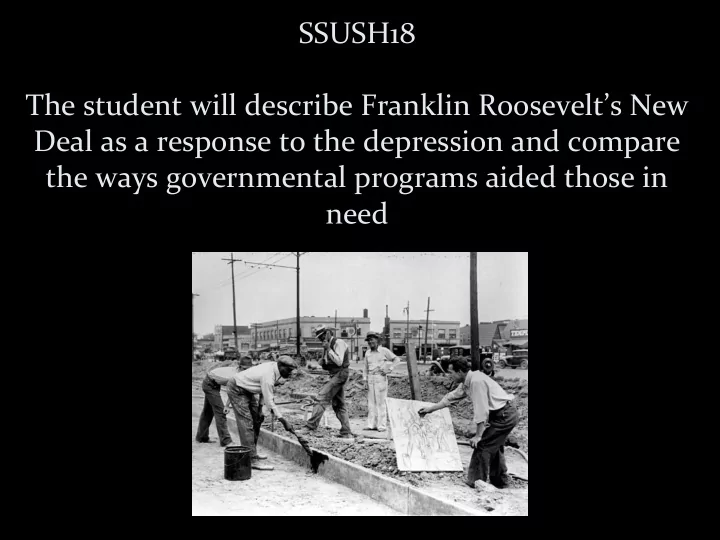
SSUSH18 The student will describe Franklin Roosevelts New Deal as a response to the depression and compare the ways governmental programs aided those in need What was the New Deal? A comprehensive series of social & economic
What was the New Deal?
- A comprehensive
series of social & economic programs enacted during the Great Depression by the FDR Administration that have become part
- f our everyday lives
today.
- a. Describe the creation of the Tennessee
Valley Authority as a works program and as an effort to control the environment
- In 1933 the Tennessee Valley Authority (TVA) was created as
part of Roosevelt’s New Deal to control floods and bring electricity to rural America
- The TVA generated over 40,000 jobs building dams, power
plants, roads and miles of wiring
What do workers do with the money they earn? How could the TVA help the economy?
Federal Deposit Insurance Corporation (FDIC)
is a United States government corporation providing deposit insurance to depositors in US banks. The FDIC was created by the 1933 Banking Act after the Great Depression to restore trust in the American banking system; more than one-third of banks failed in the years before the FDIC's creation, and bank runs were common. The insurance limit was initially US $2,500 per ownership category. Now, the FDIC insures deposits in member banks up to US $250,000 per ownership category.
Securities and Exchange Commission (SEC)
- Created in 1934 as a part of the Securities
Exchange Act of 1934, the SEC is an agency of the United States federal government that has primary responsibility for enforcing the federal securities laws, proposing securities rules, and regulating the securities industry, the nation's stock and options exchanges, and other activities and organizations, including the electronic securities markets in the United States.
Civilian Conservation Corps (CCC)
Formed in March 1933, the Civilian Conservation Corps (CCC) was one of the first New Deal
- programs. It was a public works project intended to
promote environmental conservation and to build good citizens through vigorous, disciplined outdoor
- labor. According to FDR, the goal of the CCC was
relieve the rural unemployed and keep youth “off the city street corners.”
Works Progress Administration (WPA)
Established by FDR in 1935 through Executive Order 7034, the Work Projects Administration (WPA) was the largest American New Deal agency, employing millions of unemployed people (mostly unskilled men) to carry out public works projects, including the construction of public buildings and roads. The WPA provided jobs and income to the unemployed during the Great Depression in the United States.
- b. Explain the Wagner Act and the rise
- f industrial unionism
- The Wagner Act gave workers more power
through the right to form unions
- Formed in 1935 the Wagner Act:
– guaranteed workers the right to unionize – allowed for collective bargaining – allowed for binding arbitration – formed the National Labor Relations Board to monitor labor issues
- c. Explain the passage of the Social Security
Act as a part of the second New Deal
- After two years of New
Deal programs, the American economy showed little sign of recovery
- To try and speed up
the recovery process, Roosevelt launched his second New Deal
Social Security Act
- Passed in 1935 the Social Security Act
provided :
– retirement benefits – unemployment insurance – welfare payments to the needy
Fair Labor Standards Act
- Created in 1938
- Established:
– A National Minimum Wage – A Forty Hour Work Week – Guaranteed Time & A Half for Overtime in certain jobs – A Prohibition on Child Labor
- d. Identify Eleanor Roosevelt as a symbol of
social progress and women’s activism
- Eleanor Roosevelt spoke to many women and
minority groups and relayed their plight to the President
- Though little progress in race relations was
made, Eleanor helped promote minority and women’s rights
- Accolades
– Helped create the Universal Declaration of Human Rights – Served on the Presidential Commission on the status of Women – Served as a U.S. delegate to the United Nations – Served as Chair of the Commission on Human Rights
- e. Identify the political challenges to Roosevelt’s
domestic and international leadership; include the role of Huey Long, the “court packing bill,” and the Neutrality Act
- Roosevelt’s New Deal Programs had
- pponents including Huey Long, a
Senator from Louisiana
- Started “Share the Wealth” clubs
believing that the government should take money from the rich and give it to the poor
- Wanted to run for President
- Was assassinated 1935
Court Packing
- The Supreme Court had struck down several of
Roosevelt’s programs declaring them unconstitutional
- In an attempt to control the Supreme Court,
Roosevelt sent Congress a bill which would allow him to increase the number of justices on the court
- This would allow Roosevelt to appoint justices
who were “friendly” towards his New Deal policies
Court Packing
- After much protest by
Congress and many Americans, the bill was killed in the Senate
- Roosevelt over
estimated his power
Neutrality Act
- As not only the U.S., but the world struggled to emerge from
the economic depression, military dictators in several countries began to gain power (Germany, Italy, Japan, Russia).
- Worried that the U.S. would be drawn into another European
war, Congress passed the Neutrality Act which made it illegal for Americans to sell weapons to any country at war and that goods purchased from the U.S. had to be paid in cash and transported on non U.S. ships
Why would Congress insist
- n goods being transported
- n non U.S. ships?