FREIGHT MOBILITY PLAN UPDATE FATF: Discussion of Freight Project - - PowerPoint PPT Presentation

freight mobility
SMART_READER_LITE
LIVE PREVIEW

FREIGHT MOBILITY PLAN UPDATE FATF: Discussion of Freight Project - - PowerPoint PPT Presentation

ATLANTAREGIONAL FREIGHT MOBILITY PLAN UPDATE FATF: Discussion of Freight Project Priorities, Strategies and Initiatives December 03, 2015 Agenda Introductions Update on Freight Activity Clusters & Rail Needs Freight Project

slide-1
SLIDE 1

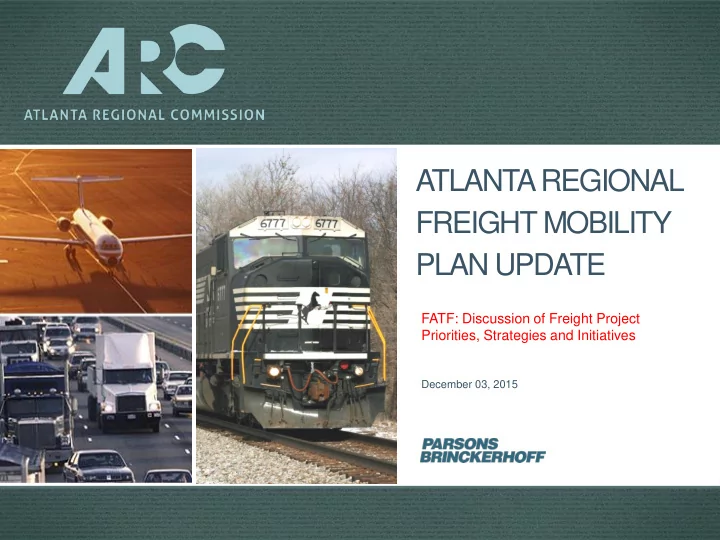
ATLANTAREGIONAL FREIGHT MOBILITY PLAN UPDATE

FATF: Discussion of Freight Project Priorities, Strategies and Initiatives

December 03, 2015

slide-2
SLIDE 2

Agenda

  • Introductions
  • Update on Freight

Activity Clusters & Rail Needs

  • Freight Project

Priorities

  • Strategies & Initiatives
  • Next Steps
slide-3
SLIDE 3

Atlanta’s Primary Freight Clusters

  • 11 Freight

intensive clusters identified using freight facility and regional center data

slide-4
SLIDE 4

Cluster Coverage of Manufacturing Facilities

Source: GA Power Cluster Leased Area (Sq. ft.) Percent of Total Leased Area

  • No. of Firms

Average Facility Size I-20 East 8,866,434 12% 50 177,329 Fulton Industrial Blvd. 5,727,596 8% 70 81,823 I-85/PIB/Jimmy Carter Blvd. 3,736,728 5% 60 62,279 Gwinnett/Satellite Blvd./SR 316 3,276,135 4% 38 86,214 Fairburn/Camp Creek 2,130,230 3% 13 163,864 McDonough 1,776,677 2% 14 126,906 Airport/Clayton 1,209,191 2% 18 67,177 Subtotal 26,722,991 36% 263 109,370 Remainder of Region 47,938,838 64% 710 64,898 Total 74,661,829 100% 973 76,734

slide-5
SLIDE 5

Cluster Coverage of Warehouse and Distribution Center Facilities

Source: GA Power Cluster Leased Area (Sq. ft.) Percent of Total Leased Area

  • No. of Firms

Average Facility Size Fulton Industrial Blvd. 21,860,200 17% 83 263,376 McDonough 17,364,802 13% 32 542,650 I-85/PIB/Jimmy Carter Blvd. 7,699,134 6% 38 202,609 Airport/Clayton 6,607,929 5% 22 300,360 Fairburn/Camp Creek 6,136,180 5% 14 438,299 Gwinnett/Satellite Blvd./SR 316 3,895,954 3% 15 259,730 I-20 East 2,893,500 2% 11 263,045 Subtotal 66,457,699 51% 215 324,296 Remainder of Region 63,419,366 49% 206 231,052 Total 129,877,065 100% 421 308,497

slide-6
SLIDE 6

Cluster Coverage of Commercial Activity

Cluster Total Employment Percent of Total Region Core 272,614 9% Alpharetta 143,811 5% Gwinnett/Satellite Blvd./SR 316 114,772 4% Buckhead 96,727 3% I-85/PIB/Jimmy Carter Blvd. 93,798 3% Kennesaw/Barrett Pkwy. 57,434 2% Fulton Industrial Blvd. 49,592 2% I-20 East 40,315 1% Airport/Clayton 38,985 1% Fairburn/Camp Creek 14,403 <1% McDonough 10,895 <1% Subtotal 933,346 32% Remainder of Region 1,990,594 68% Total 2,923,940 100%

slide-7
SLIDE 7

Freight Rail Needs

  • Its result will be more

frequent and longer trains

  • Delays at existing rail

bottlenecks - notably the Howell Junction crossing of NS and CSX main lines - will be exacerbated if they are not addressed

  • Growth at the Port of Savannah will continue to fuel freight traffic growth

in the Atlanta region, particularly for freight rail

Source: Google Earth

slide-8
SLIDE 8

Freight Project Prioritization

slide-9
SLIDE 9

Universe of Freight Projects: 930

Sources:

  • ARC Regional

Transportation Plan (RTP)

  • 2008 ARC Freight Mobility

Plan

  • ASTRoMaP
  • Cargo Atlanta Study
  • County Comprehensive

Transportation Plans

  • SR 6 Corridor Study
  • GDOT Statewide Freight

and Logistics Plan

  • Fulton Industrial Boulevard

Master Plan

  • Stakeholder Input

9% 47% 1% 19% 18% 6% Bridge Capacity Enhancement New Interchange / Connection Operations & Safety Intersection / Interchange Improvement Other

slide-10
SLIDE 10

Major Programmed Freight Related Projects 2016-2021

Legend

Programmed Freight Projects Regional Truck Routes Expressways Counties

  • 16 freight-related

projects in ARC’s Transportation Improvement Plan (TIP)

  • Construction

programmed to begin in 5 year TIP horizon 2016 -2021

slide-11
SLIDE 11

Major Freight Related Projects in 2016-2021 TIP

Road Location Description I-285 At SR 400 I-285 Interchange Reconstruction And Collector/Distributor I-285 East At I-20 East I-285 East Interchange Improvements I-285 West At I-20 West I-285 West Interchange Reconstruction I-85 South At SR 74 (Senoia Road) I-85 South Interchange Improvements I-285 South At Bouldercrest Road I-285 South Interchange Improvements I-285 West At SR 280 (South Cobb Drive) I-285 West Interchange Improvements I-285 West At SR 6 (Camp Creek Parkway) I-285 West - Diverging Diamond Interchange I-75 From SR 331 (Forest Parkway) to I-285 I-75 Northbound Collector/Distributor Lanes

slide-12
SLIDE 12

Major Freight Related Projects in 2016-2021 TIP (cont’d)

Road Location Description I-75 North At Windy Hill Road I-75 North - Diverging Diamond Interchange I-85 North At SR 324 (Gravel Springs Road) I-85 North - New Interchange I-85 North From Hamilton Mill Road in Gwinnett County to SR 211 in Barrow County I-85 North Widening I-85 South At Poplar Road I-85 South - New Interchange Lithonia Industrial Boulevard Extension From Hillandale Drive to Woodrow Road Lithonia Industrial Boulevard Extension: Phase III - New Alignment Sigman Road From East of Lester Road to Irwin Bridge Road Sigman Road Widening SR 92 (Hiram Douglasville Highway) From between Brown and Malone Streets in Douglas County (Terminus of DO-282C) to Nebo Road In Paulding County SR 92 (Hiram Douglasville Highway) Widening US 23 From SR 138 (North Henry Boulevard / Stockbridge Road) to I-675 In Clayton County US 23 Widening

slide-13
SLIDE 13

Screening Projects for Prioritization

1% 31% 3% 11% 53% Bridge Capacity Enhancement New Interchange / Connection Operations & Safety Intersection / Interchange Improvement

Screening from 930 to 87:

  • Identified as freight-

related

  • Located on the Atlanta

Strategic Truck Route Master Plan (ASTRoMaP)

  • Excluding projects

already programmed, plus

  • thers completed,

duplicated, etc.

  • Including projects

identified as Long-Range in the RTP, as well as from other sources

slide-14
SLIDE 14

Legend

Identified Freight Projects

  • n ASTRoMaP Network

Low Travel Time Reliability (Buffer time index > 0.6) Regional Truck Routes Expressways Counties

87 Projects for Prioritization

  • Location of 87

freight projects undergoing prioritization

slide-15
SLIDE 15

Prioritization Process Recap: 1st Stage - Feasibility

  • Each project scored as a “yes/no”

– Any “No” – eliminates project – All “Yes” – advances project to 2nd Stage DIMENSION CRITERION

Relevance Identified as freight project, or located on ASTRoMaP (~ Critical Urban Freight Corridors) Community Support No major community opposition known, or has strong community support Financial No major funding obstacle known (e.g. does not

  • verwhelm budget)

Benefit Cost Ratio If known: benefits exceed (or expected to exceed) costs

slide-16
SLIDE 16

2nd Stage – Goal Advancement

GOAL WEIGHT PERFORMANCE MEASURE CORRELATION

Global Hub 30% Projects improving ASTRoMaP speed (Mobility) or Accessibility Measure buffering score at least 3; doing both scores 9 Skilled Workforce 15% Projects generating logistics-related jobs score at least 3, and 9 if a large number (e.g.> 100) Advanced Network 30% Projects improving speed, buffering, or crashes on ASTRoMaP, or improving Accessibility Measure buffering score at least 3; doing any two scores 9 Vibrant Centers 15% Freight projects in LCIs score at least 3; those part of an LCI comprehensive freight program score 9 Health & Culture 10% Projects reducing NOx, PM2.5, and/or GHG score at least 3; large reductions (TBD) score 9

slide-17
SLIDE 17

3rd Stage – Project Portfolio

DIMENSION PURPOSE

Balance across goals Help assure all goals adequately addressed Balance across region Help assure broader needs are met throughout region Packaging: synergy Recognize that some combinations of projects are mutually supportive

slide-18
SLIDE 18

Prioritized Projects - Preliminary Top Tier

  • 18 Projects

emerging in a preliminary top tier

– from Stage 2 screening

Freight Related Projects Low Travel Time Reliability (Buffer Time Index > 0.6) Regional Truck Routes Expressways Counties

slide-19
SLIDE 19

Major Projects in Preliminary Top Tier

  • AR-959: I-75 North / I-285

Interchange Improvements

– Flyover Ramp from I-75 Northbound To I-285 Westbound

  • AR-955: I-75 South - New

Interchange At Bethlehem Rd

Freight Related Projects Low Travel Time Reliability (Buffer Time Index > 0.6) Regional Truck Routes Expressways Counties

slide-20
SLIDE 20

Freight Projects – Preliminary Top Tier*

Road Location Description I-285 / I-85 North At I-285 Eastbound To I-85 Northbound Direction (In Vicinity Of Pleasantdale Road Exit) Revive 285 - I-285 / I-85 North Interchange Improvements SR 70 (Fulton Industrial Boulevard) From SR 6 (Camp Creek Parkway) To James Aldredge Boulevard SR 70 (Fulton Industrial Boulevard) Widening I-75 South At Bethlehem Road I-75 South - New Interchange I-285 South At Washington Road I-285 South Interchange Improvements I-75 North / I-285 At I-75 Southbound To I-285 Westbound Flyover Ramp Revive 285 - I-75 North / I-285 Interchange Improvements I-75 North / I-285 At I-75 Northbound To I-285 Westbound Flyover Ramp Revive 285 - I-75 North / I-285 Interchange Improvements SR 140 (Jimmy Carter Boulevard) From SR 13 (Buford Highway) To SR 141 (Peachtree Industrial Boulevard) SR 140 (Jimmy Carter Boulevard) Widening Marietta Rd Inman and Tilford Yard Replace bridge due to weight restrictions

*List is not organized by rank

slide-21
SLIDE 21

Freight Projects – Preliminary Top Tier* (cont’d)

Road Location Description I-285 Interchange I-285 at Bolton Road Provide a new connection to I-285 just south of the Chattahoochee River crossing at Bolton Road. Redesign the I-285 as a full interchange. SR 6 (Camp Creek Parkway) Widening From I-285 West To I-85 South SR 6 (Camp Creek Parkway) Widening I-85 South At Gullatt Road I-85 South - New Interchange SR 138 (Stockbridge Highway) From East Fairview Road To Ebenezer Road / Stanton Road SR 138 (Stockbridge Highway) SR 6 SR 61 to I-85; ITS truck sensors at 5 locations Widen outside lane in both Directions to 13 feet, with Truck ITS application Jimmy Carter Blvd Jimmy Carter Blvd at Buford Hwy The Continuous Flow Intersection (CFI) is an innovative and cost effective solution to improving the LOS and delays at this intersection. The project will pull

  • ut left turns in advance of the intersection, allowing

left turns and through movements to happen simultaneously.

*List is not organized by rank

slide-22
SLIDE 22

Freight Projects – Preliminary Top Tier* (cont’d)

Road Location Description I-20 West Bound Ramp Fulton Industrial Blvd I-20 West Bound Ramp Intersection Improvements turn radii modifications and median repairs to accommodate larger freight vehicles I-20 Eastbound Ramps Fulton Industrial Blvd I-20 East Bound Ramp Intersection Improvements turn radii modifications and median repairs to accommodate larger freight vehicles US 78 Northside to I-285 Add center dual left turn lane - 5.5 miles. Donald Lee Hollowell From Hamilton Holmes west to I- 285, approx. 1.25 miles Widen DL Hollowell from two lanes to five lanes to accommodate transit from Hamilton Holmes to I-285, approximately 1.25 miles

*List is not organized by rank

slide-23
SLIDE 23

Preliminary Top Tier Projects and Travel Time Reliability

Freight Related Projects Travel Time Reliability Less than 0.3 0.3 to 0.6 0.6 to 1 1 to 2 More than 2 Regional Truck Routes Expressways Counties

slide-24
SLIDE 24

Preliminary Top Tier Projects and Crash Density

Freight Related Projects Crash Density (Per Mile) Less than 1 1 to 5 5 to 10 10 to 20 More than 20 Regional Truck Routes Expressways Counties

slide-25
SLIDE 25

CIDs and LCI Areas – Preliminary Top Tier Projects

Freight Related Projects CID LCIs Regional Truck Routes Expressways Counties

slide-26
SLIDE 26

Recommended Freight Strategies & Initiatives

slide-27
SLIDE 27

Strategies & Initiatives: Subareas/Corridors, Parking

  • Freight Subarea/Corridor Plans

– Fulton Industrial Blvd Corridor Study

  • Assess long-term capacity needs

– County Subarea or Cluster Area Freight Plans

  • Options – Douglas, Gwinnett, Henry, Others
  • Land use needs for freight and residential growth

– South Fulton CID Masterplan

  • Maximize economic development opportunity

– GDOT Downtown Corridor Operations Study – Tara Boulevard Corridor Study

  • Truck Parking Study

– Long-haul truck parking needs – Emerging mixed-use population centers

  • Downtown, Midtown, Buckhead
slide-28
SLIDE 28

Strategies & Initiatives: Truck Friendly Lanes

  • Explore truck friendly lanes on ASTRoMaP

system

– Purpose: advance, potentially expand operational upgrade recommendation from GDOT SR 6 Access Management study – Objective: improve freight safety, reliability, and facility access – SR 6 components:

  • Shoulders widened to create 13’ truck lane
  • ITS enhancements enabling green signal manipulation for

better truck progress

  • Associated signage and intersection improvements
  • Implies active management of freight performance

– Lower tech variation on CAV Pilot

slide-29
SLIDE 29

Strategies & Initiatives: Cultivation of 21st Century Technology

  • Initiatives intertwine over time  groundwork for

evolving “internet of things”

Freight CAV Pilot:

  • Purpose: develop initial application of connected/automated

vehicle technology for freight delivery

  • Objective: clarify benefits and test introduction of incipient

technology for safety, reliability, economic development, resilience – and ultimately capacity advantage

  • Pilot Design (example): partnership with

carrier/s to provide signal priority for safety-enhanced trucks delivering urgent air cargo to specified clusters, utilizing real-time traffic feeds to activate under gridlock conditions

slide-30
SLIDE 30

Strategies & Initiatives: Cultivation of 21st Century Technology (cont’d)

Industrial Property Redevelopment:

  • Purpose: support introduction of factory/warehouse

automation and convergence of functions to invigorate and densify close-in industrial clusters

– Technologies include robotics, optics, remote sensing, material handling, 3D printing, etc.

  • Objectives:

– Improve economic competitiveness and effective capacity of land – Reduce logistics costs and freight travel (delivery and empty) distances – Create potential platform for cooperative logistics and lateral economies of scale

  • Initiative Design (example): encourage industries and developers

introducing automated, dense footprint facilities in close-in industrial clusters (e.g. FIB, PIB) through:

– Assistance in parcel assembly – Development incentives and pre-approvals – Transportation capacity improvements and operational upgrades (e.g. CAV)

slide-31
SLIDE 31

Strategies & Initiatives: Home Delivery Study

  • Purpose: track and assess profound and costly shift in retail with

large effect on freight patterns

– Storefront vs. on-line strategies being invented

  • Objective: ensure transportation planning keeps pace with change

Factors:

  • Battle for convenience

– Store or collection point pickup vs. delivery to consumer door – Same day and 1 hour delivery require local staging facilities

  • Battle to capture and grow limited route density

– “Prime”-style free delivery encourages household bulks (e.g. paper products, pet food)  means more and larger delivery trucks – Emerging afternoon delivery pattern

  • Developing demography: e.g. on-line millennials; aging, less-mobile

baby boomers

slide-32
SLIDE 32

Strategies & Initiatives: Home Delivery (cont’d)

  • Challenge and opportunity for community

integration of freight

– Neighborhood conflicts and security concerns – Consumer benefits of freight become visible – Venue for cleaner, safer trucks e.g. via alternative fuels, CAV technology

  • Convenience becomes performance factor for

consumer-driven freight

slide-33
SLIDE 33

Strategies & Initiatives: Off-Hours Delivery Pilot

  • Purpose: explore methods to increase freight deliveries during night

and other off-peak periods

  • Objectives: improve capacity utilization, productivity, reliability, air

emissions

  • Considerations:

– Industry operates off-peak now, when it can – Chief obstacle: business practices and costs for receivers of freight  the shippers’ customers – Challenges include transitional loss of route efficiency (density) – Approaches include start-up incentives, unassisted access, focus on geographic pockets (e.g. CIDs) and half-closed/closed system fleets – Precedents available to draw from

  • Option to leverage FHWA matching grant program
slide-34
SLIDE 34

Strategies & Initiatives: Resiliency

  • Resiliency Planning Assessment

– Purpose: understand crucial vulnerabilities to supply chain disruption and plan response – Objective: mitigate effects of disruption (severe weather, security events, etc.) on industry, populace, economy – Focus on critical supply chains: e.g. energy, food, health care

  • Supply & consumption points, routes & alternates
  • Response strategies, partners and roles
slide-35
SLIDE 35

Strategies & Initiatives: Alternative Fuels

  • Support Expansion of Natural Gas Fueling

– Purpose: enable adoption of practical, cleaner freight fuel – Objective: reduce air emissions and long term freight costs; aid integration of freight in communities – Factors:

  • Lower CAP emissions (= healthier), mixed GHG

emissions

  • Abundant resource, was/should be lower cost
  • Adoption slowed but continuing
  • Fueling stations prerequisite: CNG (regional freight),

LNG (long haul and through freight)

  • Component of low cost logistics environment
slide-36
SLIDE 36

Natural Gas Fueling Stations

  • Number of alternate fuel

stations in Georgia = 52

  • Number of alternate fuel

stations in Metro Atlanta = 28

Source: US DOE

slide-37
SLIDE 37

Strategies & Initiatives: Improvement Studies

  • Evaluate, conduct studies proposed from TIP

solicitation and stakeholder outreach

– Huff Rd Widening and Complete Street Scoping Study – Marietta Rd Freight Improvement Scoping Study – Commerce Drive/Fulton Industrial Circle Realignment Feasibility Study – Moreland Avenue (SR 42) from Cedar Grove Rd (SR 54 Conn) to Bailey Street – South Fulton Multi-Modal Study – Solomon Street at Searcy Avenue/Spalding Street/High Falls Road – Hapeville Silent Railroad Crossings – Holly Springs Industrial Drive Extension-New Alignment – Holcomb Bridge Road Railroad Crossing Study

slide-38
SLIDE 38

Strategies & Initiatives: Financing Sources

  • FAST Act ($300 billion federal Reauthorization Conference Bill):

– $10.8 billion nationally for freight over 5 years – 58% new highway formula program (= average $25 million per year per state) – 42% new large project ($100 ml.+) competitive grant program, about half multimodal

  • TFA 2015 (GA Transportation Funding Act):

– Adds $.8-1.0 billion per year for all transportation – Allows county and municipalities to establish gas taxes and special purpose local option sales taxes

  • Community Improvement District (CID) real estate assessments

– Potential dovetail with TFA 2015 local levies

  • Public-Private Partnership (P3) opportunities

– Requires revenue stream in some form – Prospects better with faster permitting

slide-39
SLIDE 39

Next Steps

  • Complete Project Prioritization
  • Option: Low Cost Projects Program
  • Final Report
  • Adoption in February 2016 as part of the

Atlanta’s Region Plan

slide-40
SLIDE 40

Thank you!

Daniel Studdard, AICP, ARC Senior Planner dstuddard@atlantaregional.com 404-463-3306 http://www.atlantaregional.com/freight Joe Bryan BryanJG@pbworld.com Claudia M. Bilotto, AICP, bilottocm@pbworld.com