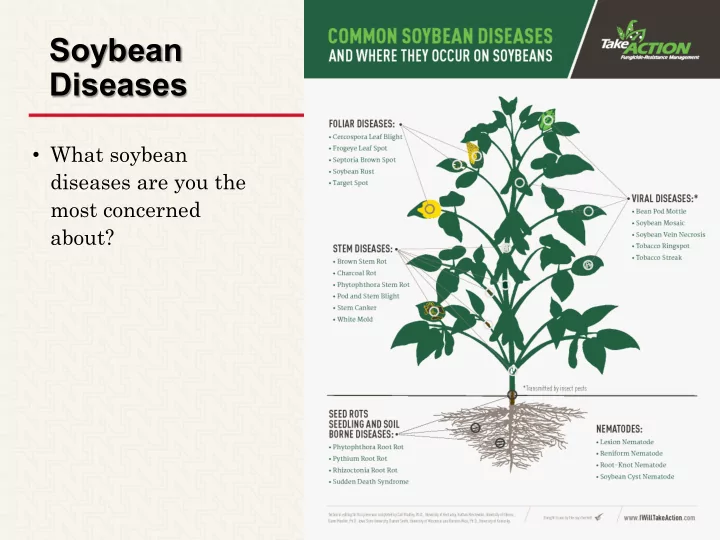
SLIDE 1 Soybean Diseases
diseases are you the most concerned about?
SLIDE 2
Frogeye Leaf Spot Management in a New Decade
Nebraska Extension: Nathan Mueller, Megan Taylor, Tamra Jackson- Ziems, and Loren Giesler
SLIDE 3
Goals for Us
Increase my knowledge of frogeye leaf spot
Pathogen, disease cycle, and disease triangle Identification Fungicide resistance
Increase my knowledge of best management practices
Variety selection, crop rotation/residue, fungicide selection and resistance management Resources to utilize Developing your 2020 farm plan
SLIDE 4 Pathogen and Disease Cycle
- Caused by the fungal pathogen
Cercospora sojina
- Disease survives in residue and in
infected seed
- Wind and rain spread inoculum (fungal
spores) to soybean plants where infection occur
- Disease cycle repeats, and spores
spread to new leaves, plants, and fields
- Infection at any stage, but usually after
flowering, upper canopy on new leaves
- Stems and pods can be infected later in
the season
Source: Soybean Disease Management CPN-1017 Frogeye Leaf Spot
SLIDE 5 Pathogen and Disease Cycle
Susceptible Variety Moderately Resistant Variety Environmental Conditions (70-80-85°F & 90% relative humidity, frequent rainfall events, 48 to 72 hours of leaf wetness) Environmental Conditions Pathogen: (Cercospora sojina) High Risk: Continuous soybean plus no-till Pathogen
(Cercospora sojina)
Yield loss of 0-35%
Yield loss of 0-5%
SLIDE 6
Frogeye Leaf Spot Identification
SLIDE 7 Frogeye Leaf Spot Identification
- 1. Infection at any stage, but usually
after flowering, upper canopy on new leaves
- 2. First appears on upper leaf surfaces
as small, dark, water-soaked spots
- 3. Small dark spots enlarge to 1/4 inch,
centers change from gray to brown to light tan and surrounded by a narrow reddish purple margin
- 4. Lesions may coalesce, irregular
areas
- 5. Stems and pods can be infected
later in the season
SLIDE 8
Progression of Frogeye Leaf Spot
SLIDE 9
Frogeye Look-alikes
Phyllosticta Target Spot Alternaria Bottom Line: Lab testing is key to proper identification
SLIDE 10
Fungicide Resistance – Weed Guide page 255
frogeye leaf spot
SLIDE 11 U.S. Counties and Year QoI (Group 11 or Strobilurin) Fungicide Resistance confirmed in Cercospora sojina causing Frogeye Leaf Spot
Widespread Occurrence of Quinone Outside Inhibitor Fungicide- Resistant Isolates of Cercospora sojina, Causal Agent
- f Frogeye Leaf Spot of Soybean, in the United States. G. Zhang, et
- al. 2018. Plant Health Progress 19:295-302.
https://doi.org/10.1094/PHP-04-18-0016-RS
WATCH OUT! Resistance may already be here!
Late 2018 SDSU conf. 4 counties in SD
#IRPests
SLIDE 12
- Soybean varieties vary in their susceptibility and
resistant varieties are available. Check with your seed company rep
- Crop rotation and residue management
- Scout for disease, especially following warm, moist
conditions at or after flowering
- Fungicides can increase yields if applied at growth
stage R3- R5. Products containing a QoI (strobilurin) fungicide usually provide better control of this disease.
- Resistance to QoI fungicides becoming more common
and close to Nebraska
- Consider a product with 2 or more modes of action
- ***NOTE – If you see reduced effects of fungicides –
please contact us or collect/send samples for advanced testing
Frogeye Leaf Spot Management
SLIDE 13 2019 - QoI Fungicide Resistance Confirmed in Cercospora sojina causing Frogeye Leaf Spot in 10 Nebraska Counties
Neves, D., Jackson-Ziems, T., and Bradley, C. 2019.
#IRPests FUNGICIDE RESISTANCE IS HERE!
Resistance confirmed in 111
sojina isolates (98%)
SLIDE 14
- Never use fungicides with
active ingredients from single mode of action
strategies for most effective management
- Frogeye resistant soybean
varieties
- Longer crop rotations
- Use of foliar fungicides with
active ingredients from 2-3 modes of action (3+7+11)
Frogeye Leaf Spot Management – what to do when you have QoI fungicide resistance
SLIDE 15 Fungicide Efficacy for Management of Frogeye Leaf Spot
From the Disease Management Section of the 2020 Guide for Weed, Disease, and Insect Management and the North Central Regional Committee on Soybean Diseases NCERA-137
Rating
VG F G-VG G-VG F VG
Rating
P
P
P P P NL G-VG F-G F
SLIDE 16 Rating
G-VG VG VG F F-G G-VG G-VG
Rating
P-F G-VG G
Fungicide Efficacy for Management of Frogeye Leaf Spot
From the Disease Management Section of the 2020 Guide for Weed, Disease, and Insect Management and the North Central Regional Committee on Soybean Diseases NCERA-137
SLIDE 17 Resources to Utilize
- 1. Soybean Disease Management
Publication CPN-1017
- 2. UNL Weed Guide – Turn to page
272-273
Adviser/Extension Educator
- 4. Websites
- 1. cropwatch.unl.edu
- 2. iwilltakeaction.com (examples)
- 3. cropprotectionnetwork.org
SLIDE 18
United Soybean Board (Checkoff) iwilltakeaction.com
SLIDE 19 Developing a 2020 Farm Plan
- Know who or where to get more information (use resources mentioned… print,
bookmark, etc.)
- Get frogeye leaf spot resistance ratings for varieties
- Work with seed dealers
- Rank susceptibility of the varieties you are considering or already ordered
- Rank fields for frogeye leaf spot risk (crop rotation, past pressure, past fungicide
efficacy)
- Scout for disease, especially following warm, moist conditions at or after
flowering
- Use of foliar fungicides with active ingredients from 2-3 modes of action if
spraying is warranted
- Use Guide For Weed, Disease, and Insect Management in Nebraska Fungicide
Efficacy Table to help – page 272-273