Rheumatological Rheumatological Diseases Diseases Rheumatological - - PDF document

rheumatological rheumatological diseases diseases
SMART_READER_LITE
LIVE PREVIEW

Rheumatological Rheumatological Diseases Diseases Rheumatological - - PDF document

Rheumatologic Diseases Rheumatologic Diseases 6/23/2011 6/23/2011 Rheumatological Rheumatological Diseases Diseases Rheumatological Rheumatological Diseases Diseases Disease Disease Autoantibody Autoantibody Systemic Lupus


slide-1
SLIDE 1

Rheumatologic Diseases Rheumatologic Diseases 6/23/2011 6/23/2011 Fernando Vega, M.D. Fernando Vega, M.D. 1

Rheumatological Rheumatological Diseases Diseases

Fernando Vega, MD Fernando Vega, MD HIHIM 409 HIHIM 409 July 2, 2009 July 2, 2009

Rheumatological Rheumatological Diseases Diseases

Disease Disease Autoantibody Autoantibody

Systemic Lupus Erythematosus Anti Systemic Lupus Erythematosus Anti-

  • dsDNA, Anti

dsDNA, Anti-

  • SM

SM Rheumatoid Arthritis Rheumatoid Arthritis RF, Anti RF, Anti-

  • RA33

RA33 , Sjogrens Syndrome Sjogrens Syndrome Anti Anti-

  • Ro(SS

Ro(SS-

  • A),Anti

A),Anti-

  • La(SS

La(SS-

  • B)

B) Systemic Sclerosis Systemic Sclerosis Anti Anti-

  • Scl

Scl-

  • 70, Anti

70, Anti-

  • centromere

centromere Polymyositis/Dermatomyositis Polymyositis/Dermatomyositis Anti Anti-

  • Jo

Jo-

  • 1

1 Mixed Connective Tissue Disease Anti Mixed Connective Tissue Disease Anti-

  • U1

U1-

  • RNP

RNP Wegener’s Granulomatosus Wegener’s Granulomatosus c c-

  • ANCA

ANCA

Systemic Lupus Erythematosus Systemic Lupus Erythematosus

General

General

autoimmune multisystem disease

autoimmune multisystem disease

prevalence 1 in 2,000

prevalence 1 in 2,000

prevalence 1 in 2,000

prevalence 1 in 2,000

9 to 1; female to male (1 in 700)

9 to 1; female to male (1 in 700)

peak age 15

peak age 15-

  • 25

25

immune complex

immune complex deposition deposition

Systemic Lupus Erythematosus Systemic Lupus Erythematosus

  • Common complaints and presentations

Common complaints and presentations

Fever

Fever

Malaise

Malaise

Malaise

Malaise

Joint pains

Joint pains

Myalgias

Myalgias

Fatigue

Fatigue

Loss of cognitive abilities

Loss of cognitive abilities

Systemic Lupus Erythematosus Systemic Lupus Erythematosus

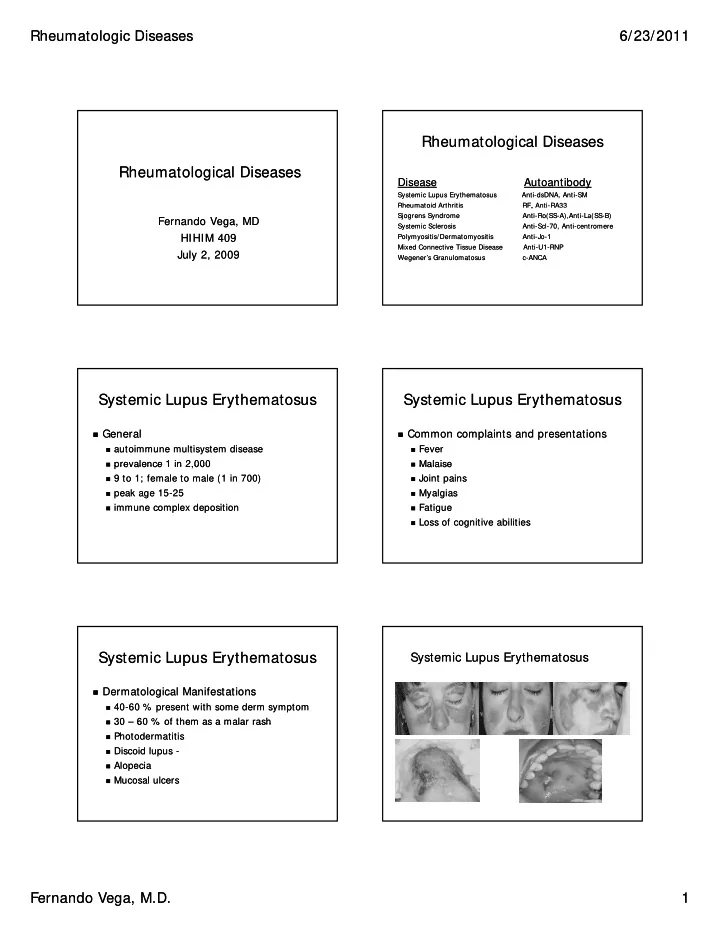
Dermatological Manifestations

Dermatological Manifestations

40

40-

  • 60 % present with some

60 % present with some derm derm symptom symptom

30

30 – 60 % of them as a 60 % of them as a malar malar rash rash

30

30 60 % of them as a 60 % of them as a malar malar rash rash

Photodermatitis

Photodermatitis

Discoid lupus

Discoid lupus -

  • Alopecia

Alopecia

Mucosal ulcers

Mucosal ulcers

Systemic Lupus Erythematosus Systemic Lupus Erythematosus

slide-2
SLIDE 2

Rheumatologic Diseases Rheumatologic Diseases 6/23/2011 6/23/2011 Fernando Vega, M.D. Fernando Vega, M.D. 2

Systemic Lupus Erythematosus Systemic Lupus Erythematosus

Discoid Lupus: Cutaneous manifestations

Discoid Lupus: Cutaneous manifestations

Scar upon healing

Scar upon healing

Systemic Lupus Erythematosus Systemic Lupus Erythematosus

Systemic Lupus Erythematosus Systemic Lupus Erythematosus

Musculoskeletal Manifestations

Musculoskeletal Manifestations

Joint pains

Joint pains

Often small joints

Often small joints – wrist and fingers wrist and fingers j g

Not as disabling as RA of hand and wrist

Not as disabling as RA of hand and wrist

Doesn’t cause severe destruction of joints

Doesn’t cause severe destruction of joints

Systemic Lupus Systemic Lupus Erythematosus Erythematosus Systemic Lupus Erythematosus Systemic Lupus Erythematosus

Most common cause of death is end organ

Most common cause of death is end organ damage damage

80% of end organ damage is caused by

80% of end organ damage is caused by

80% of end organ damage is caused by

80% of end organ damage is caused by Prednisone Prednisone

Systemic Lupus Systemic Lupus Erythematosus Erythematosus

Musculoskeletal 25.2%

Musculoskeletal 25.2%

Neuropsychiatric 15%

Neuropsychiatric 15%

Ocular 12 6%

Ocular 12 6%

End Organ Damage End Organ Damage

Ocular 12.6%

Ocular 12.6%

Renal 11.7%

Renal 11.7%

Pulmonary 10.4%

Pulmonary 10.4%

Cardiovascular 10.1%

Cardiovascular 10.1%

Gastrointestinal 7.3%

Gastrointestinal 7.3%

Skin 7.4%

Skin 7.4%

Peripheral

Peripheral Vascular 5.5% Vascular 5.5%

Diabetes Mellitus

Diabetes Mellitus

slide-3
SLIDE 3

Rheumatologic Diseases Rheumatologic Diseases 6/23/2011 6/23/2011 Fernando Vega, M.D. Fernando Vega, M.D. 3

Systemic Lupus Erythematosus Systemic Lupus Erythematosus

Estrogen increases autoantibody production

Estrogen increases autoantibody production 2 l h 2 l h 16 l h h d l ti 16 l h h d l ti

Exogenous Exogenous Estorogens Estorogens

2 alpha

2 alpha vs vs 16 alpha hydroxylation 16 alpha hydroxylation

Reversing hydroxylation pathway

Reversing hydroxylation pathway

Broccoli helps reverse hydroxylation (clinically

Broccoli helps reverse hydroxylation (clinically relevant?) relevant?)

Systemic Lupus Erythematosus Systemic Lupus Erythematosus

Hormone Replacement Therapy

Hormone Replacement Therapy

Exogenous Estrogens Exogenous Estrogens SELENA Study SELENA Study

Hormone Replacement Therapy

Hormone Replacement Therapy

No increase in severe flares

No increase in severe flares

20%increse in overall flares (

20% increse in overall flares (Lahita Lahita 1981) 1981) Oral Contraceptive Therapy

Oral Contraceptive Therapy

No increase in flares

No increase in flares

But 50% of women have But 50% of women have aPL aPL

Systemic Lupus Erythematosus Systemic Lupus Erythematosus

UVA and UVB

UVA and UVB

Drugs:

Drugs: Bactrim Bactrim and and Neupogen Neupogen

Environmental Triggers Environmental Triggers

g p g p g

Smoking

Smoking

Infections

Infections

  • Pets Dogs

Pets Dogs

  • Lab workers

Lab workers

Silica

Silica

Mercury

Mercury

Systemic Lupus Erythematosus Systemic Lupus Erythematosus

Prognosis and Survival Prognosis and Survival

1953 1953-

  • 1978

1978

100% 100%

1978 1978

90% 90% 50% 50% 1 1 2 2 3 3 4 4

1953 1953

80% 80% 60% 60% 70% 70% 5

1960 1960

Anti Anti-

  • Phospholipid

Phospholipid Syndrome Syndrome

APS occurs either as a primary condition or as a

APS occurs either as a primary condition or as a secondary condition in the setting of an underlying secondary condition in the setting of an underlying disease particularly disorders in the spectrum of disease particularly disorders in the spectrum of disease, particularly disorders in the spectrum of disease, particularly disorders in the spectrum of systemic lupus systemic lupus erythematosus erythematosus (SLE). (SLE).

Anti Anti-

  • Phospholipid

Phospholipid Syndrome Syndrome

Presence in the serum of at least one type of

Presence in the serum of at least one type of autoantibody known as an autoantibody known as an antiphospholipid antiphospholipid antibody antibody (aPL aPL)

Definition: Definition:

(aPL aPL)

The occurrence of at least one clinical feature from a

The occurrence of at least one clinical feature from a diverse list of potential disease manifestations, the most diverse list of potential disease manifestations, the most common: common:

venous or arterial thromboses

venous or arterial thromboses

  • recurrent fetal loss

recurrent fetal loss

  • thrombocytopenia

thrombocytopenia

slide-4
SLIDE 4

Rheumatologic Diseases Rheumatologic Diseases 6/23/2011 6/23/2011 Fernando Vega, M.D. Fernando Vega, M.D. 4

Anti Anti-

  • Phospholipid

Phospholipid Syndrome Syndrome

Although the clinical manifestations of APS occur in other disease Although the clinical manifestations of APS occur in other disease populations, in the APS they occur by definition in the context of populations, in the APS they occur by definition in the context of aPL aPL. . APL may be detected by: APL may be detected by: .APL may be detected by: .APL may be detected by:

  • Lupus anticoagulant tests

Lupus anticoagulant tests

  • Anticardiolipin

Anticardiolipin antibody ELISA antibody ELISA

  • Anti

Anti-

  • ß2 glycoprotein

ß2 glycoprotein-

  • I ELISA

I ELISA

Anti Anti-

  • Phospholipid

Phospholipid Syndrome Syndrome

  • Occurrence of one or more otherwise unexplained thrombotic or

Occurrence of one or more otherwise unexplained thrombotic or thromboembolic thromboembolic events. events.

  • One or more specific adverse outcomes related to pregnancy, as

One or more specific adverse outcomes related to pregnancy, as Clinical suspicion for APS should be raised in the Clinical suspicion for APS should be raised in the following scenarios: following scenarios: p p g y, p p g y, defined in the preceding section defined in the preceding section

  • Otherwise unexplained thrombocytopenia or prolongation of a test

Otherwise unexplained thrombocytopenia or prolongation of a test

  • f blood coagulation (
  • f blood coagulation (eg

eg, PT or , PT or aPTT aPTT). ).

Clinical Manifestations of the Clinical Manifestations of the Antiphospholipid Antiphospholipid Syndrome Syndrome

Levine J et al. N Levine J et al. N Engl Engl J Med 2002;346:752 J Med 2002;346:752-

  • 763

763

Anti Anti-

  • Phospholipid

Phospholipid Syndrome Syndrome

  • Transient

Transient aCL aCL have been reported in up to 10 percent of healthy have been reported in up to 10 percent of healthy blood donors on initial testing, but persist on repeat testing in only blood donors on initial testing, but persist on repeat testing in only about 1.5 percent of individuals about 1.5 percent of individuals

False positive tests False positive tests — —

  • Transiently increased

Transiently increased aCL aCL may occur in the setting of viral or other may occur in the setting of viral or other infections. infections.

  • Before making the diagnosis of APS

Before making the diagnosis of APS aCL aCL, anti , anti-

  • ß2

ß2-

  • GP

GP-

  • I, or LA should

I, or LA should be repeated in 12 weeks be repeated in 12 weeks

Anti Anti-

  • Phospholipid

Phospholipid Syndrome Syndrome

  • Inherited and acquired coagulation and anticoagulation factor

Inherited and acquired coagulation and anticoagulation factor disorders ( disorders (eg eg, protein C and protein S deficiency, factor V Leiden , protein C and protein S deficiency, factor V Leiden deficiency) deficiency)

Differential Diagnosis of Differential Diagnosis of Venous Thrombosis Venous Thrombosis

  • Defective clot

Defective clot lysis lysis

  • Cancer and

Cancer and myeloproliferative myeloproliferative disorders disorders

  • Nephrotic

Nephrotic syndrome syndrome

Anti Anti-

  • Phospholipid

Phospholipid Syndrome Syndrome

  • Atherosclerosis

Atherosclerosis

  • Embolic disease

Embolic disease

  • Atrial

Atrial fibrillation or much less common fibrillation or much less common atrial atrial myxoma myxoma

Differential diagnosis of Differential diagnosis of Arterial Thrombosis Arterial Thrombosis

  • Atrial

Atrial fibrillation or, much less common, fibrillation or, much less common, atrial atrial myxoma myxoma – Marked left ventricular dysfunction Marked left ventricular dysfunction

  • Endocarditis

Endocarditis

  • Cholesterol emboli

Cholesterol emboli

  • Paradoxical embolism

Paradoxical embolism

  • Decompression sickness (Caisson's disease)

Decompression sickness (Caisson's disease)

  • Thrombotic thrombocytopenic

Thrombotic thrombocytopenic purpura purpura/hemolytic /hemolytic-

  • uremic syndrome

uremic syndrome

  • Polyarteritis

Polyarteritis nodosa nodosa and other forms of systemic and other forms of systemic vasculitis vasculitis

slide-5
SLIDE 5

Rheumatologic Diseases Rheumatologic Diseases 6/23/2011 6/23/2011 Fernando Vega, M.D. Fernando Vega, M.D. 5

Rheumatoid Arthritis Rheumatoid Arthritis

1% of the population

1% of the population

Women affected 2

Women affected 2-

  • 3 X more than men

3 X more than men

Age of onset is 40

Age of onset is 40-

  • 50

50

Juvenile form

Juvenile form

Rheumatoid Arthritis Rheumatoid Arthritis

  • Clinical features

Clinical features

Immunological

Immunological

Lymphadenopathy

Lymphadenopathy y p p y y p p y

Amyloidosis

Amyloidosis

Haematological

Haematological

Anaemia

Anaemia

Skin

Skin

Rheumatoid nodules

Rheumatoid nodules

Vasculitis

Vasculitis

Rheumatoid Arthritis Rheumatoid Arthritis

Clinical features

Clinical features

– Bones and muscles

Bones and muscles

  • Muscle weakness

Muscle weakness

  • Osteoporosis

Osteoporosis

– Eyes

Eyes

  • Sjogren’s

Sjogren’s syndrome syndrome

  • Scleritis

Scleritis

– Nervous system

Nervous system

  • Peripheral nerve and cord compression

Peripheral nerve and cord compression

Rheumatoid Arthritis Rheumatoid Arthritis Rheumatoid Arthritis Rheumatoid Arthritis

Rheumatoid Arthritis Rheumatoid Arthritis

Clinical features

Clinical features

– Heart

Heart

Acute

Acute pericarditis pericarditis

Endocarditis

Endocarditis

Myocarditis

Myocarditis

Myocardial infarction

Myocardial infarction

– Lungs

Lungs

Pleuritis

Pleuritis

Obliterative

Obliterative bronchiolitis bronchiolitis

Pulmonary nodules

Pulmonary nodules

Interstitial fibrosis

Interstitial fibrosis

slide-6
SLIDE 6

Rheumatologic Diseases Rheumatologic Diseases 6/23/2011 6/23/2011 Fernando Vega, M.D. Fernando Vega, M.D. 6

Rheumatoid Arthritis: Diagnostic Criteria Rheumatoid Arthritis: Diagnostic Criteria

  • 1. Morning stiffness (> 1h)
  • 1. Morning stiffness (> 1h)
  • 2. Swelling of three or more joints
  • 2. Swelling of three or more joints
  • 3. Swelling of hand joints (prox interphalangeal,
  • 3. Swelling of hand joints (prox interphalangeal,

metacarpophalyngeal, or wrist) metacarpophalyngeal, or wrist)

  • 4. Symmetric joint swelling
  • 4. Symmetric joint swelling
  • 5. Subcutaneous nodules
  • 5. Subcutaneous nodules
  • 6. Serum Rheumatoid Factor
  • 6. Serum Rheumatoid Factor
  • 7. Radiographic evidence of erosions or periarticular
  • 7. Radiographic evidence of erosions or periarticular
  • steopenia in hand or wrists
  • steopenia in hand or wrists

Criteria 1 Criteria 1-

  • 4 must have been present continuously for 6 weeks or longer and

4 must have been present continuously for 6 weeks or longer and must be observed by a physician. A diagnosis of rheumatoid arthritis must be observed by a physician. A diagnosis of rheumatoid arthritis requires that 4 of the 7 criteria are fulfilled. requires that 4 of the 7 criteria are fulfilled.

Rheumatoid Arthritis: Diagnostic Criteria Rheumatoid Arthritis: Diagnostic Criteria Diagnostic Criteria may be less clinically Diagnostic Criteria may be less clinically useful in the face of newer treatment useful in the face of newer treatment strategies strategies Short Delay of Therapy Affected Short Delay of Therapy Affected Radiographic Outcome Radiographic Outcome

10 10 12 12 14 14 Delayed Treatment = median 123 days Delayed Treatment = median 123 days

Sharp Score Sharp Score

Lard LR, et al. Lard LR, et al. Am J Med. Am J Med. 2001;111:446 2001;111:446-

  • 451.

451.

Time (months) Time (months) 2 4 6 8 6 6 12 12 18 18 24 24

Early Treatment = median 15 days Early Treatment = median 15 days

Consequences of RA Consequences of RA

Premature mortality

Premature mortality

Increased morbidity

Increased morbidity

Significant impact on quality of life

Significant impact on quality of life

Pain with associated functional disability

Pain with associated functional disability Fatig e 81% of patients 41% ith se e e Fatig e 81% of patients 41% ith se e e

Fatigue, 81% of patients; 41% with severe

Fatigue, 81% of patients; 41% with severe fatigue fatigue

Depression

Depression

Work disability

Work disability

25% within 7 years of onset, 50% within 21 years

25% within 7 years of onset, 50% within 21 years

33% reduction in income vs non work

33% reduction in income vs non work-

  • disabled

disabled

Wolfe F, Hawley D J, Wolfe F, Hawley D J, J Rheum J Rheum. 1998;25:2108 . 1998;25:2108-

  • 2117.

2117. Wolfe F et al. Wolfe F et al. Arthritis Rheum Arthritis Rheum. 1994;37:481 . 1994;37:481-

  • 494.

494.

Rheumatoid Arthritis Rheumatoid Arthritis

Cytokine Cytokine Signaling Signaling Pathways Involved in Pathways Involved in Inflammatory Arthritis Inflammatory Arthritis

Choy E and Choy E and Panayi Panayi G. N

  • G. N Engl

Engl J Med 2001;344:907 J Med 2001;344:907-

  • 916

916

slide-7
SLIDE 7

Rheumatologic Diseases Rheumatologic Diseases 6/23/2011 6/23/2011 Fernando Vega, M.D. Fernando Vega, M.D. 7

Rheumatoid Arthritis Rheumatoid Arthritis

Methods of Blocking the Activity of an Inflammatory Methods of Blocking the Activity of an Inflammatory Cytokine Cytokine

Cytokine Cytokine-

  • Receptor Interaction

Receptor Interaction

Choy E and Choy E and Panayi Panayi G. N

  • G. N Engl

Engl J Med 2001;344:907 J Med 2001;344:907-

  • 916

916

Methods of Blocking the Activity of an Inflammatory Methods of Blocking the Activity of an Inflammatory Cytokine Cytokine

Cytokine Cytokine-

  • Receptor Interaction

Receptor Interaction

Choy E and Choy E and Panayi Panayi G. N

  • G. N Engl

Engl J Med 2001;344:907 J Med 2001;344:907-

  • 916

916

Methods of Blocking the Activity of an Inflammatory Methods of Blocking the Activity of an Inflammatory Cytokine Cytokine

Cytokine Cytokine-

  • Receptor Interaction

Receptor Interaction

Choy E and Choy E and Panayi Panayi G. N

  • G. N Engl

Engl J Med 2001;344:907 J Med 2001;344:907-

  • 916

916

Methods of Blocking the Activity of an Inflammatory Methods of Blocking the Activity of an Inflammatory Cytokine Cytokine

Cytokine Cytokine-

  • Receptor Interaction

Receptor Interaction

Choy E and Choy E and Panayi Panayi G. N

  • G. N Engl

Engl J Med 2001;344:907 J Med 2001;344:907-

  • 916

916

Chimeric Chimeric A2 (cA2) Monoclonal A2 (cA2) Monoclonal Antibody Antibody

Mouse Mouse (binding site for TNF (binding site for TNF-

  • α

α) )

Human (IgG1) Human (IgG1)

  • Chimeric

Chimeric (mouse/human) IgG1 (mouse/human) IgG1 monoclonal antibody monoclonal antibody

  • Binds to TNF

Binds to TNF-

  • α

α with high with high affinity and specificity affinity and specificity

Knight, et al. Knight, et al. Mol Mol Immunol Immunol. . 1993. 1993.

slide-8
SLIDE 8

Rheumatologic Diseases Rheumatologic Diseases 6/23/2011 6/23/2011 Fernando Vega, M.D. Fernando Vega, M.D. 8

Rheumatoid Arthritis Rheumatoid Arthritis Rheumatoid Arthritis Rheumatoid Arthritis Rheumatoid Arthritis Rheumatoid Arthritis

Sjogren Syndrome Sjogren Syndrome

Chronic disorder characterized by immune

Chronic disorder characterized by immune-

  • mediated destruction of exocrine glands

mediated destruction of exocrine glands

Primary vs Secondary:

Primary vs Secondary: P i i di i f l i P i i di i f l i

Primary is diagnosis of exclusion

Primary is diagnosis of exclusion

Secondary refers to the sicca complex

Secondary refers to the sicca complex accompanying any of the connective tissue accompanying any of the connective tissue diseases (xerophthalmia, keratoconjuntivitis, diseases (xerophthalmia, keratoconjuntivitis, xerostomia with/without salivary gland xerostomia with/without salivary gland enlargement) enlargement)

Sjogren Syndrome Sjogren Syndrome

1% of the population and in 10

1% of the population and in 10-

  • 15% of

15% of RA patients RA patients

9:1

9:1 female:male female:male preponderance preponderance

9:1

9:1 female:male female:male preponderance preponderance

Age of onset 40

Age of onset 40-

  • 60 years

60 years

Associated with a

Associated with a 33 33-

  • 44

44 times increased times increased risk of lymphoma. risk of lymphoma.

Sjogren Syndrome Sjogren Syndrome

  • May affect the skin, external genitalia, GI

May affect the skin, external genitalia, GI tract, kidneys, and lungs tract, kidneys, and lungs

  • Minor salivary gland biopsy demonstrates

Minor salivary gland biopsy demonstrates y g p y y g p y lymphocytic infiltration. lymphocytic infiltration.

  • Parotid biopsy more sensitive and specific

Parotid biopsy more sensitive and specific

  • Associated with Sjogren Syndrome A (RO

Associated with Sjogren Syndrome A (RO-

  • SS

SS-

  • A) in 60% and Sjogren Syndrome B

A) in 60% and Sjogren Syndrome B (LA (LA-

  • SS

SS-

  • B) in 30%

B) in 30%

slide-9
SLIDE 9

Rheumatologic Diseases Rheumatologic Diseases 6/23/2011 6/23/2011 Fernando Vega, M.D. Fernando Vega, M.D. 9

Sjogren Syndrome Diagnostic Criteria Sjogren Syndrome Diagnostic Criteria

1.

  • 1. Dry eyes

Dry eyes (> 3mos), sensation of sand or gravel in eyes, (> 3mos), sensation of sand or gravel in eyes,

  • r use of tear substitutes> 3x per day
  • r use of tear substitutes> 3x per day

2.

  • 2. Dry mouth

Dry mouth (> 3mos), recurrent or persistent swollen (> 3mos), recurrent or persistent swollen salivary glands, or frequent drinking of liquids to aid in salivary glands, or frequent drinking of liquids to aid in swallowing dry foods. swallowing dry foods. 3.

  • 3. Schirmer

Schirmer-

  • I test

I test (< 5mm in 5 min) or Rose Bengal score (< 5mm in 5 min) or Rose Bengal score ( ) g ( ) g > 4. > 4. 4.

  • 4. > 50 mononuclear cells/4mm

> 50 mononuclear cells/4mm2 glandular tissue glandular tissue 5.

  • 5. Abnormal salivary

Abnormal salivary scintigraphy scintigraphy or parotid

  • r parotid sialography

sialography or

  • r

unstimulated unstimulated salivary flow < 1.5ml in 15 min salivary flow < 1.5ml in 15 min 6.

  • 6. Presence of anti

Presence of anti-

  • Ro/SS

Ro/SS-

  • A

A, anti , anti-

  • La/SS

La/SS-

  • b, antinuclear

b, antinuclear antibodies, or rheumatoid factor. antibodies, or rheumatoid factor.

Sjogren Syndrome Sjogren Syndrome

  • 80% experience xerostomia

80% experience xerostomia

  • Difficulty chewing, dysphagia, taste

Difficulty chewing, dysphagia, taste changes fissures of tongue and lips changes fissures of tongue and lips changes, fissures of tongue and lips, changes, fissures of tongue and lips, increased dental caries and oral increased dental caries and oral candidiasis candidiasis

  • Salivary gland enlargement

Salivary gland enlargement

  • Sicca syndrome

Sicca syndrome

Sjogren Syndrome Sjogren Syndrome Sjogren Syndrome: Treatment Sjogren Syndrome: Treatment

  • Symptomatic: saliva substitutes, artificial

Symptomatic: saliva substitutes, artificial tears, increased oral fluid intake tears, increased oral fluid intake

  • Avoid decongestants antihistamines

Avoid decongestants antihistamines

  • Avoid decongestants, antihistamines,

Avoid decongestants, antihistamines, anticholinergics, diuretics anticholinergics, diuretics

  • Pilocarpine, antifungals, close dental

Pilocarpine, antifungals, close dental follow follow-

  • up, surveillance for malignancy

up, surveillance for malignancy

Scleroderma Scleroderma

Also known as systemic sclerosis

Also known as systemic sclerosis

Sclerotic skin changes often accompanied by

Sclerotic skin changes often accompanied by multisystem disease. multisystem disease.

Progressive fibrosis from increased collagen

Progressive fibrosis from increased collagen deposition in deposition in intersitium intersitium and and intima intima of small

  • f small

arteries and connective tissues arteries and connective tissues

May be benign

May be benign cutaneous cutaneous involvement or involvement or aggressive systemic disease. aggressive systemic disease.

Scleroderma Scleroderma

  • 4-
  • 12 new cases per million per year

12 new cases per million per year

  • 3-
  • 4:1 female preponderance

4:1 female preponderance Average age of onset between 3 Average age of onset between 3rd

rd and 5

and 5th

th

  • Average age of onset between 3

Average age of onset between 3rd

rd and 5

and 5th

th

decade decade

slide-10
SLIDE 10

Rheumatologic Diseases Rheumatologic Diseases 6/23/2011 6/23/2011 Fernando Vega, M.D. Fernando Vega, M.D. 10 10

Scleroderma Diagnostic Criteria Scleroderma Diagnostic Criteria

One major criterion: scleromatous skin

One major criterion: scleromatous skin changes proximal to the metacarpal changes proximal to the metacarpal-

  • phalangeal joints

phalangeal joints

Two of three minor criteria: sclerodactyly,

Two of three minor criteria: sclerodactyly, digital pitting scars, bi digital pitting scars, bi-

  • basilar pulmonary

basilar pulmonary fibrosis on CXR fibrosis on CXR

Scleroderma Scleroderma

presentation presentation

Raynaud’s phenomenon

Raynaud’s phenomenon

edema fingers and hands

edema fingers and hands

skin thickening

skin thickening

visceral manifestations visceral manifestations

GI tract, lung, heart, kidneys, thyroid

GI tract, lung, heart, kidneys, thyroid

arthralgias and muscle weakness often arthralgias and muscle weakness often

Scleroderma Scleroderma Scleroderma Scleroderma Polymyositis and Dermatomyositis Polymyositis and Dermatomyositis

Proximal muscle weakness and

Proximal muscle weakness and nonsuppurative inflammation of skeletal nonsuppurative inflammation of skeletal muscle muscle

5 cases per million per year

5 cases per million per year

5 cases per million per year

5 cases per million per year

2:1 female:male

2:1 female:male

Age 40

Age 40-

  • 60, but a pediatric variant of 5

60, but a pediatric variant of 5-

  • 15

15 year old year old

Polymyositis/Dermatomyositis Polymyositis/Dermatomyositis Diagnosis Diagnosis

  • Proximal muscle weakness

Proximal muscle weakness

  • Elevated serum

Elevated serum creatinine creatinine kinase kinase

  • Myopathic

Myopathic changes on electromyography changes on electromyography

  • Myopathic

Myopathic changes on electromyography changes on electromyography

  • Muscle biopsy with evidence of

Muscle biopsy with evidence of lymphocytic inflammation lymphocytic inflammation Dx Dx is definitive with all four, probable with is definitive with all four, probable with three, and possible with two. three, and possible with two. Rash accompanies these in Rash accompanies these in dermatomyositis dermatomyositis

slide-11
SLIDE 11

Rheumatologic Diseases Rheumatologic Diseases 6/23/2011 6/23/2011 Fernando Vega, M.D. Fernando Vega, M.D. 11 11

Dermatomyositis Dermatomyositis Polymyositis: Head and Neck Polymyositis: Head and Neck Manifestations Manifestations

  • Difficulty phonating and deglutition 2

Difficulty phonating and deglutition 2nd

nd to

to affected tongue musculature affected tongue musculature

  • Nasal

Nasal regurg regurg 2 2nd

nd to affected pharyngeal

to affected pharyngeal g g g g p y g p y g and palatal musculature and palatal musculature

  • 30% with

30% with dysphagia dysphagia 2 2nd

nd to involvement of

to involvement of upper esophagus, upper esophagus, cricopharyngeus cricopharyngeus, , pharynx, and superior constrictors pharynx, and superior constrictors

  • Aspiration pneumonia

Aspiration pneumonia

Polymyositis and Polymyositis and Dermatomyositis:Treatment Dermatomyositis:Treatment

Steroids for symptomatic patients

Steroids for symptomatic patients

Methotrexate

Methotrexate and and immunosuppressants immunosuppressants for non for non-responders responders for non for non responders responders

Mixed Connective Tissue Disease Mixed Connective Tissue Disease

  • Coexisting features of SLE, scleroderma,

Coexisting features of SLE, scleroderma, and polymyositis and polymyositis

  • High titers of Anti

High titers of Anti-U1RNP U1RNP

  • High titers of Anti

High titers of Anti U1RNP U1RNP

  • 80% female, 30

80% female, 30-

  • 60 years

60 years

  • Head and neck: combination of

Head and neck: combination of manifestations of the above. manifestations of the above.

  • Treat with steroids

Treat with steroids

Vasculitides Vasculitides

The The vasculitides vasculitides are a group of diseases are a group of diseases characterized by non infectious necrotizing characterized by non infectious necrotizing vasculitis vasculitis and resultant ischemia and resultant ischemia. . The associated phrase is “palpable The associated phrase is “palpable purpura purpura” ”

Henoch Henoch-

  • Schoenlein

Schoenlein Purpura Purpura

The most common dermatological dilemma

The most common dermatological dilemma presented to me presented to me

Hypersensitivity

Hypersensitivity vasculitis vasculitis was a common was a common synonym synonym

slide-12
SLIDE 12

Rheumatologic Diseases Rheumatologic Diseases 6/23/2011 6/23/2011 Fernando Vega, M.D. Fernando Vega, M.D. 12 12

Henoch Henoch-

  • Schoenlein

Schoenlein Purpura Purpura

Most common presentation: purple splotches on

Most common presentation: purple splotches on legs legs

90% of cases are kids under 10 years old

90% of cases are kids under 10 years old Usually follows and upper respiratory infection Usually follows and upper respiratory infection

Usually follows and upper respiratory infection

Usually follows and upper respiratory infection

Can follow infections with strep,

Can follow infections with strep, hepB hepB, HSV, , HSV, parvovirusB parvovirusB-

  • 19, MMR,

19, MMR, mycoplasma mycoplasma and more and more

Can be idiosyncratic to

Can be idiosyncratic to AtBx AtBx, ACE’s, , ACE’s,

Only 35% of cases can be traced to an etiology

Only 35% of cases can be traced to an etiology

The most common

The most common vasculitis vasculitis in childhood 20 per in childhood 20 per 100,000 children per year 100,000 children per year

Henoch Henoch-

  • Schoenlein

Schoenlein Purpura Purpura

Most common presentation: purple splotches on

Most common presentation: purple splotches on legs legs

Triad of

Triad of purpura purpura, arthritis and abdominal pain , arthritis and abdominal pain

40% have findings on UA

40% have findings on UA

Can include gastrointestinal

Can include gastrointestinal hemmorhage hemmorhage

Can include

Can include intussusception intussusception

Most of the time just purple splotches

Most of the time just purple splotches

Henoch Henoch-

  • Schoenlein

Schoenlein Purpura Purpura

Needs observation, not treatment unless

Needs observation, not treatment unless secondary findings are present secondary findings are present

NSAIDS make joint pain better but GI symptoms

NSAIDS make joint pain better but GI symptoms worse worse

Steroids are avoided

Steroids are avoided

Very high recovery rate

Very high recovery rate – – 90% 90%

Other Rx:

Other Rx: Dapsone Dapsone, I , I

slide-13
SLIDE 13

Rheumatologic Diseases Rheumatologic Diseases 6/23/2011 6/23/2011 Fernando Vega, M.D. Fernando Vega, M.D. 13 13

September, 2008 September, 2008 September, 2008 September, 2008

Hypersensitivity Vasculitis Hypersensitivity Vasculitis

General

General

collective term group of diseases

collective term group of diseases

inflammation of small vessels

inflammation of small vessels

inflammation of small vessels

inflammation of small vessels

arterioles, capillaries, venules

arterioles, capillaries, venules

circulating and deposited immune complexes

circulating and deposited immune complexes

skin always involved

skin always involved

hemorrhage or classic purpura

hemorrhage or classic purpura

major organ system involvement less common

major organ system involvement less common

Polyarteritis Nodosa Polyarteritis Nodosa

Prototype of vasculitis

Prototype of vasculitis

Less than 1/100000 per year

Less than 1/100000 per year

Males = Females

Males = Females

50

50-

  • 60 years of age

60 years of age

Involves small and medium arteries

Involves small and medium arteries

May result from Hep B infection (30%)

May result from Hep B infection (30%)

GI, hepatobiliary, renal, pancreas and skeletal

GI, hepatobiliary, renal, pancreas and skeletal muscles muscles

slide-14
SLIDE 14

Rheumatologic Diseases Rheumatologic Diseases 6/23/2011 6/23/2011 Fernando Vega, M.D. Fernando Vega, M.D. 14 14

Polyarteritis Nodosa Polyarteritis Nodosa

Head and neck symptoms primarily involve Head and neck symptoms primarily involve the ear and include SNHL and vestibular the ear and include SNHL and vestibular disturbance. disturbance. Proposed mechanism is thromboembolic Proposed mechanism is thromboembolic

  • cclusion of inner ear arteries
  • cclusion of inner ear arteries

May also see CN palsies May also see CN palsies

Wegener’s Granulomatosis Wegener’s Granulomatosis

  • General

General

necrotizing granulomas of upper airway, lower

necrotizing granulomas of upper airway, lower airway, kidney airway, kidney y, y y, y

bilateral pneumonitis 95%

bilateral pneumonitis 95%

chronic sinusitis 90%

chronic sinusitis 90%

mucosal ulceration of nasopharynx 75%

mucosal ulceration of nasopharynx 75%

renal disease 80%

renal disease 80%

hallmark pathologic lesion

hallmark pathologic lesion

necrotizing granulomatous vasculitis

necrotizing granulomatous vasculitis

Wegener’s Granulomatosis Wegener’s Granulomatosis

antineutrophil cytoplasmic antibody (c

antineutrophil cytoplasmic antibody (c-

  • ANCA)

ANCA)

sensitivity 65

sensitivity 65-

  • 90%

90%

high specificity

high specificity

need to confirm diagnosis

need to confirm diagnosis

  • ften 3
  • ften 3-
  • 4 biopsies necessary

4 biopsies necessary

nasopharynx commonly involved good site

nasopharynx commonly involved good site

  • pen pulmonary biopsy occasionally needed
  • pen pulmonary biopsy occasionally needed

untreated mortality of 90% at two years

untreated mortality of 90% at two years

Wegener’s Granulomatosis Wegener’s Granulomatosis

antineutrophil cytoplasmic antibody (c

antineutrophil cytoplasmic antibody (c-

  • ANCA)

ANCA)

sensitivity 65

sensitivity 65-

  • 90%

90%

high specificity

high specificity

need to confirm diagnosis

need to confirm diagnosis

  • ften 3
  • ften 3-
  • 4 biopsies necessary

4 biopsies necessary

nasopharynx commonly involved good site

nasopharynx commonly involved good site

  • pen pulmonary biopsy occasionally needed
  • pen pulmonary biopsy occasionally needed

untreated mortality of 90% at two years

untreated mortality of 90% at two years

Wegener’s Granulomatosis Wegener’s Granulomatosis

Head and Neck Manifestations

Head and Neck Manifestations

nasal symptoms

nasal symptoms

crusting, epistaxis, rhinnorrhea, erosion of septal

crusting, epistaxis, rhinnorrhea, erosion of septal g, p , , p g, p , , p cartilage, saddle deformity, recurrent sinusitis cartilage, saddle deformity, recurrent sinusitis

  • ral cavity
  • ral cavity

hyperplasia of gingiva, gingivitis

hyperplasia of gingiva, gingivitis

Wegerner’s Granulomatosis Wegerner’s Granulomatosis

  • Treatment

Treatment

meticulous dental and nasal care

meticulous dental and nasal care

middle ear drainage

middle ear drainage g

cyclophosphamide 2 mg/kg plus

cyclophosphamide 2 mg/kg plus prednisone 1 mg/kg prednisone 1 mg/kg

remission 93%

remission 93%

azathioprine or methotrexate alternative to

azathioprine or methotrexate alternative to cyclophosphamide cyclophosphamide

slide-15
SLIDE 15

Rheumatologic Diseases Rheumatologic Diseases 6/23/2011 6/23/2011 Fernando Vega, M.D. Fernando Vega, M.D. 15 15

Wegener’s Granulomatosis Wegener’s Granulomatosis

Treatment

Treatment

isolated sinonasal disease

isolated sinonasal disease

low dose steroids, saline irrigation, antibiotics as

low dose steroids, saline irrigation, antibiotics as , g , , g , needed needed

subglottic stenosis

subglottic stenosis

may warrant tracheotomy

may warrant tracheotomy

Wegener’s Granulomatosis Wegener’s Granulomatosis Giant Cell Arteritis (Temporal Arteritis) Giant Cell Arteritis (Temporal Arteritis)

Only extracranial vessels involved

Only extracranial vessels involved

Focal granulomatous inflammation of

Focal granulomatous inflammation of medium and small arteries medium and small arteries medium and small arteries medium and small arteries

Most common vasculitis

Most common vasculitis

Prevalence:850/100000

Prevalence:850/100000

Age 80+

Age 80+

Giant Cell Arteritis Giant Cell Arteritis

Most common initial complaint: Headache

Most common initial complaint: Headache-

  • boring and

boring and constant (47%), up to 90% will develop headache constant (47%), up to 90% will develop headache

ESR > 50mm/hr

ESR > 50mm/hr

Confirmed by temporal artery biopsy of affected side: 5

Confirmed by temporal artery biopsy of affected side: 5-

  • 7cm in length. If negative, biopsy contra lateral side.

7cm in length. If negative, biopsy contra lateral side. F l ti t f 5 F l ti t f 5 40% 40% False negative rate of 5 False negative rate of 5-

  • 40%

40%

Tender and erythematous temporal artery 50%

Tender and erythematous temporal artery 50%

Tender scalp

Tender scalp

Jaw ischemia 50%

Jaw ischemia 50%

Lingual ischemia 25%

Lingual ischemia 25%

Giant Cell Arteritis Giant Cell Arteritis

Otologic: vertigo and hearing loss

Otologic: vertigo and hearing loss

Dysphagia: ascending pharyngeal

Dysphagia: ascending pharyngeal involvement involvement

CN deficits vertebrobasilar insufficiency

CN deficits vertebrobasilar insufficiency

CN deficits, vertebrobasilar insufficiency,

CN deficits, vertebrobasilar insufficiency, psychosis= intracranial disease psychosis= intracranial disease

Blindness: 1/3 untreated patients

Blindness: 1/3 untreated patients

Treatment with prednisone and

Treatment with prednisone and normalizaton of ESR normalizaton of ESR

Giant Cell Giant Cell Arteritis Arteritis (Temporal (Temporal Arteritis Arteritis) )

slide-16
SLIDE 16

Rheumatologic Diseases Rheumatologic Diseases 6/23/2011 6/23/2011 Fernando Vega, M.D. Fernando Vega, M.D. 16 16

Polymyalgia Rheumatica Polymyalgia Rheumatica

Seen in 50% of patients with giant cell

Seen in 50% of patients with giant cell arteritis arteritis

Muscular pain, morning stiffness of

Muscular pain, morning stiffness of proximal muscles elevated ESR without proximal muscles elevated ESR without proximal muscles, elevated ESR without proximal muscles, elevated ESR without inflammatory joint or muscle disease inflammatory joint or muscle disease

Low grade fever, wt loss, malaise

Low grade fever, wt loss, malaise

Low dose prednisone

Low dose prednisone

Behcet’s Disease Behcet’s Disease

  • Vasculitis with triad of oral and genital

Vasculitis with triad of oral and genital ulcers and uveitis or iritis ulcers and uveitis or iritis

  • Aphthous like ulcers, covered in pale

Aphthous like ulcers, covered in pale pseudomembrane pseudomembrane pseudomembrane pseudomembrane

  • Painful, on lips, gingiva, buccal mucosa,

Painful, on lips, gingiva, buccal mucosa, tongue, palate and oropharynx tongue, palate and oropharynx

  • Genital ulcers similar in appearance

Genital ulcers similar in appearance

  • Heal in days to weeks with scarring

Heal in days to weeks with scarring

Behcet’s Disease Behcet’s Disease Kawasaki Disease Kawasaki Disease

Mucocutaneous

Mucocutaneous lymph node syndrome lymph node syndrome

Disease of children

Disease of children

Fever,

Fever, conjuctivitis conjuctivitis, red dry lips, , red dry lips, erythema erythema of

  • f
  • ral mucosa, polymorphous
  • ral mucosa, polymorphous truncal

truncal rash, rash, d ti f th fi d t i l d ti f th fi d t i l desquamation of the fingers and toes, cervical desquamation of the fingers and toes, cervical lymphadenopathy lymphadenopathy

Oral cavity

Oral cavity erythema erythema and cervical and cervical adenopathy adenopathy are presenting symptoms are presenting symptoms

Cardiac abnormalities cause 1

Cardiac abnormalities cause 1-

  • 2% mortality rate

2% mortality rate

Kawasaki Disease Kawasaki Disease

Kawasaki Disease Kawasaki Disease

Lab Features Lab Features

  • ↑ WBC

WBC

  • ↑ ESR, positive CRP

ESR, positive CRP

  • Anemia

Anemia

  • Anemia

Anemia

  • Mild

Mild ↑ transaminases transaminases

  • ↓ albumin

albumin

  • Sterile pyuria, aseptic meningitis

Sterile pyuria, aseptic meningitis

  • ↑ platelets by day 10

platelets by day 10-

  • 14

14

slide-17
SLIDE 17

Rheumatologic Diseases Rheumatologic Diseases 6/23/2011 6/23/2011 Fernando Vega, M.D. Fernando Vega, M.D. 17 17

Kawasaki Disease Kawasaki Disease

Differential Diagnosis Differential Diagnosis

Measles

Measles

Scarlet fever

Scarlet fever

Drug reactions

Drug reactions

Stevens

Stevens-

  • Johnson

Johnson Syndrome Syndrome

Systemic Onset

Systemic Onset g

Viral exanthems

Viral exanthems

Toxic Shock

Toxic Shock Syndrome Syndrome Juvenile Rheumatoid Juvenile Rheumatoid Arthritis Arthritis

Staph scalded skin

Staph scalded skin syndrome syndrome

Kawasaki Disease Kawasaki Disease

Difficulties with Diagnosis Difficulties with Diagnosis

  • Clinical diagnosis

Clinical diagnosis

  • No single test

No single test

  • Diagnosis of exclusion

Diagnosis of exclusion

  • Diagnosis of exclusion

Diagnosis of exclusion

  • Atypical KD

Atypical KD

Do not fulfill all criteria

Do not fulfill all criteria

More common in < 1 year and > 8 years

More common in < 1 year and > 8 years

Kawasaki Disease Kawasaki Disease

Treatment Treatment

Admit to monitor cardiac function

Admit to monitor cardiac function

Complete cardiac evaluation

Complete cardiac evaluation

Complete cardiac evaluation

Complete cardiac evaluation

CXR, EKG, echo

CXR, EKG, echo

IV Ig

IV Ig

ASA

ASA

Kawasaki Disease Kawasaki Disease

Treatment Treatment

IV Ig 2 g/kg as single dose

IV Ig 2 g/kg as single dose

Expect rapid resolution of fever

Expect rapid resolution of fever

Decrease coronary artery aneurysms from 20% to <

Decrease coronary artery aneurysms from 20% to < 5% 5% 5% 5%

ASA

ASA -

  • low dose vs high dose

low dose vs high dose

80

80-

  • 100 mg/kg/day until day 14

100 mg/kg/day until day 14

3-

  • 5 mg/kg/day for 6 weeks

5 mg/kg/day for 6 weeks

Repeat echocardiogram at 6 weeks

Repeat echocardiogram at 6 weeks

slide-18
SLIDE 18

Rheumatologic Diseases Rheumatologic Diseases 6/23/2011 6/23/2011 Fernando Vega, M.D. Fernando Vega, M.D. 18 18

Spondyloarthtitis Spondyloarthtitis (Ankylosing Ankylosing Spondylitis Spondylitis) )

Characteristics

Characteristics

Axial skeletal involvement

Axial skeletal involvement

Axial skeletal involvement

Axial skeletal involvement

Absence of serum rheumatoid

Absence of serum rheumatoid factors factors

Psoriatic Arthritis Psoriatic Arthritis

  • Epidemiology

Epidemiology

Prevalence: affects approximately

Prevalence: affects approximately 10% of patients with psoriasis 10% of patients with psoriasis 10% of patients with psoriasis 10% of patients with psoriasis

0.1

0.1-

  • 0.2% of the population

0.2% of the population

Age: Usually 30

Age: Usually 30-

  • 40 years old

40 years old

Affects women and

Affects women and men equally men equally

Genetics

Genetics: :

50% with psoriatic

50% with psoriatic spondylitis spondylitis HLA HLA B27 gene positive B27 gene positive

Psoriatic Arthritis Psoriatic Arthritis

Clinical features

Clinical features

Mild and intermittent

Mild and intermittent h d h h d h

15% arthritis precedes rash

15% arthritis precedes rash

No correlation

No correlation

Skin involvement and severity of arthritis

Skin involvement and severity of arthritis

Eye conjunctivitis,

Eye conjunctivitis, iridocyclitis iridocyclitis, , episcleritis episcleritis

Psoriatic Arthritis Psoriatic Arthritis

  • Clinical features

Clinical features

Arthritis

Arthritis

Mono/Oligo:70%

Mono/Oligo:70% A i l 25% A i l 25%

Axial:25%

Axial:25%

poly:10%

poly:10%

DIP joint:10%

DIP joint:10%

Arthritis mutilans:5%

Arthritis mutilans:5%

slide-19
SLIDE 19

Rheumatologic Diseases Rheumatologic Diseases 6/23/2011 6/23/2011 Fernando Vega, M.D. Fernando Vega, M.D. 19 19

Psoriatic Arthritis Psoriatic Arthritis

Prognosis

Prognosis

5% develop severe disabling and

5% develop severe disabling and p g p g deforming arthritis deforming arthritis

Sexually Acquired Reactive Sexually Acquired Reactive Arthritis (SARA) Arthritis (SARA)

  • Characteristics

Characteristics

Oligoarticular

Oligoarticular asymmetrical asymmetrical g y arthritis arthritis

Urethritis

Urethritis/ /cervicitis cervicitis

Conjunctivitis

Conjunctivitis

Eponym

Eponym

Reiter’s syndrome

Reiter’s syndrome

Sexually Acquired Reactive Sexually Acquired Reactive Arthritis (SARA) Arthritis (SARA)

Epidemiology

Epidemiology

Incidence: Uncommon. About

Incidence: Uncommon. About 1% of people with 1% of people with urethritis urethritis 1% of people with 1% of people with urethritis urethritis develop SARA develop SARA

Age: Usually 16

Age: Usually 16-

  • 35 years of age

35 years of age

Sex: About 95% of patients are

Sex: About 95% of patients are male male

Race: No association

Race: No association

Sexually Acquired Reactive Sexually Acquired Reactive Arthritis (SARA) Arthritis (SARA)

  • Epidemiology

Epidemiology

Genetics: HLA

Genetics: HLA-

  • B27 gene present

B27 gene present 60 60-90% of patients 90% of patients 60 60 90% of patients 90% of patients

Geography: worldwide

Geography: worldwide

Sexually Acquired Reactive Sexually Acquired Reactive Arthritis (SARA) Arthritis (SARA)

Aetiology and Pathogenesis

Aetiology and Pathogenesis

Triggered by infectious agent

Triggered by infectious agent gg y g gg y g

Chlamydia

Chlamydia trachomatis trachomatis

Ureaplasma

Ureaplasma urealyticum urealyticum

Arthritis is reactive

Arthritis is reactive

Not caused by direct infection of

Not caused by direct infection of the joint the joint

Sexually Acquired Reactive Sexually Acquired Reactive Arthritis (SARA) Arthritis (SARA)

  • Clinical features

Clinical features

Early

Early

Mild systemic

Mild systemic y

Intermittent

Intermittent mucopurulent mucopurulent penile discharge penile discharge

Dysuria

Dysuria

Eye

Eye

Conjunctivitis,

Conjunctivitis, uveitis uveitis, , keratitis keratitis, optic neuritis , optic neuritis

slide-20
SLIDE 20

Rheumatologic Diseases Rheumatologic Diseases 6/23/2011 6/23/2011 Fernando Vega, M.D. Fernando Vega, M.D. 20 20

Sexually Acquired Reactive Sexually Acquired Reactive Arthritis (SARA) Arthritis (SARA)

Clinical features

Clinical features

Musculoskeletal

Musculoskeletal

Arthritis

Arthritis

sausage shaped digits

sausage shaped digits -

  • dactylitis

dactylitis

acute asymmetrical

acute asymmetrical oligoarticular

  • ligoarticular

knees, ankles, MTPJs, IPJs

knees, ankles, MTPJs, IPJs

Sacroiliitis

Sacroiliitis

Achilles

Achilles tenosynovitis tenosynovitis

Enthesitis

Enthesitis

Plantar fasciitis

Plantar fasciitis

Sexually Acquired Reactive Sexually Acquired Reactive Arthritis (SARA) Arthritis (SARA)

  • Clinical features

Clinical features

Skin

Skin

Skin

Skin

Keratoderma

Keratoderma blenorrhagica blenorrhagica

Circinate

Circinate balanitis balanitis

Papules: palms, soles and

Papules: palms, soles and glans glans penis penis

Sexually Acquired Reactive Sexually Acquired Reactive Arthritis (SARA) Arthritis (SARA)

Prognosis

Prognosis

Recovery from initial symptoms

Recovery from initial symptoms

Recovery from initial symptoms

Recovery from initial symptoms -

  • several months

several months

33% chronic disease

33% chronic disease

15

15-

  • 25% permanent disability

25% permanent disability

Sexually Acquired Reactive Sexually Acquired Reactive Arthritis (SARA) Arthritis (SARA) Sexually Acquired Reactive Sexually Acquired Reactive Arthritis (SARA) Arthritis (SARA)

Preceding infection

Preceding infection — — Two types of Two types of bacteria can cause reactive arthritis: bacteria can cause reactive arthritis: those causing enteric infections and those causing enteric infections and those causing those causing urethritis

  • urethritis. The enteric

. The enteric bacteria associated with reactive arthritis bacteria associated with reactive arthritis include: include:

Reactive Arthritis Reactive Arthritis

Two types of bacteria can cause reactive

Two types of bacteria can cause reactive arthritis: those causing enteric infections arthritis: those causing enteric infections and those causing and those causing urethritis urethritis. .

CLINICAL FEATURES CLINICAL FEATURES

g

slide-21
SLIDE 21

Rheumatologic Diseases Rheumatologic Diseases 6/23/2011 6/23/2011 Fernando Vega, M.D. Fernando Vega, M.D. 21 21

Reactive Arthritis Reactive Arthritis

Salmonella of various

Salmonella of various serovars serovars

Shigella

Shigella especially especially Shigella Shigella flexneri flexneri but but

CLINICAL FEATURES CLINICAL FEATURES

g p y p y g also also Shigella Shigella dysenteriae dysenteriae and and sonnei sonnei

Yersinia

Yersinia including including Yersinia Yersinia enterocolitica enterocolitica 0:3 and 0:9 and 0:3 and 0:9 and Yersinia Yersinia pseudotuberculosis pseudotuberculosis

Campylobacter especially Campylobacter

Campylobacter especially Campylobacter jejuni jejuni

Clostridium

Clostridium difficile difficile

Arthritis Associated with Arthritis Associated with Gastrointestinal Disease Gastrointestinal Disease

  • Diseases include:

Diseases include:

Post

Post-

  • dysenteric reactive arthritis

dysenteric reactive arthritis

Inflammatory bowel disease

Inflammatory bowel disease

Crohn’s

Crohn’s disease disease

Ulcerative colitis

Ulcerative colitis

Arthritis Associated with Arthritis Associated with Gastrointestinal Disease Gastrointestinal Disease

Epidemiology

Epidemiology

Prevalence (post

Prevalence (post dysenteric) dysenteric)

Prevalence (post

Prevalence (post-dysenteric) dysenteric) 27/100,000 27/100,000

IBD

IBD-

  • associated arthritis:

associated arthritis:

Peripheral arthritis 12% UC

Peripheral arthritis 12% UC

20% of CD

20% of CD

Axial arthritis 6% UC and CD

Axial arthritis 6% UC and CD

Arthritis Associated with Arthritis Associated with Gastrointestinal Disease Gastrointestinal Disease

  • Epidemiology

Epidemiology

Age: IBD

Age: IBD-

  • associated peripheral

associated peripheral arthritis 25 arthritis 25-

  • 45 years

45 years

Sex/Race: No association

Sex/Race: No association

Genetics: 50% IBD

Genetics: 50% IBD-

  • associated

associated axial arthritis and HLA axial arthritis and HLA-

  • B27 50%

B27 50%

Geography: Post

Geography: Post-

  • dysenteric

dysenteric reactive arthritis more common reactive arthritis more common mainland Europe mainland Europe

Arthritis Associated with Arthritis Associated with Gastrointestinal Disease Gastrointestinal Disease

Etiology

Etiology and pathogenesis and pathogenesis

P t P t d t i ti th iti d t i ti th iti

Post

Post-dysenteric reactive arthritis dysenteric reactive arthritis

Shigella

Shigella dysenteria dysenteria

Shigella

Shigella flexneri flexneri

Salmonella

Salmonella typhimurium typhimurium

Yersinia

Yersinia enterocolitica enterocolitica

Campylobacter

Campylobacter jejuni jejuni

Arthritis Associated with Arthritis Associated with Gastrointestinal Disease Gastrointestinal Disease

  • Clinical features

Clinical features

Arthritis usually follows IBD by 6

Arthritis usually follows IBD by 6 months to several years months to several years

Exacerbations related to severity

Exacerbations related to severity

  • f arthritis
  • f arthritis

Clinical features of post

Clinical features of post-

  • dysenteric reactive arthritis

dysenteric reactive arthritis similar to SARA similar to SARA

slide-22
SLIDE 22

Rheumatologic Diseases Rheumatologic Diseases 6/23/2011 6/23/2011 Fernando Vega, M.D. Fernando Vega, M.D. 22 22

Arthritis Associated with Arthritis Associated with Gastrointestinal Disease Gastrointestinal Disease

Prognosis

Prognosis

IBD

IBD-

  • associated arthritis

associated arthritis

Peripheral arthritis mild

Peripheral arthritis mild

Axial arthritis usually progressive

Axial arthritis usually progressive

Sarcoidosis Sarcoidosis

  • Characteristics

Characteristics

Multi

Multi-

  • system

system granulomatous granulomatous di di disease disease

Systemic

Systemic

Skin

Skin

Eyes

Eyes

Lungs

Lungs

Joints

Joints

Sarcoidosis Sarcoidosis

Epidemiology

Epidemiology

Prevalence: 5/100,000 population

Prevalence: 5/100,000 population k l d l l f k l d l l f

Age: Peak early adult life

Age: Peak early adult life

Sex: More common in women

Sex: More common in women

Race: Severe 16 x Afro

Race: Severe 16 x Afro-

  • Caribbeans
  • Caribbeans. Least common Asian

. Least common Asian and Chinese and Chinese

Geography: Most common large

Geography: Most common large black populations black populations

Sarcoidosis Sarcoidosis

  • Clinical features

Clinical features

Acute illness

Acute illness

Pyrexia, malaise,

Pyrexia, malaise,

Pyrexia, malaise,

Pyrexia, malaise, lymphadenopathy lymphadenopathy

Erythema

Erythema nodosum nodosum, skin , skin sarcoid sarcoid

Polyarthralgia

Polyarthralgia

Uveitis

Uveitis and and keratoconjunctivitis keratoconjunctivitis

Shortness of breath

Shortness of breath

Sarcoidosis Sarcoidosis

Additional investigations

Additional investigations

Serum

Serum angiotensin angiotensin converting converting enzyme enzyme enzyme enzyme

Raised calcium

Raised calcium

Chest radiography

Chest radiography

Bilateral

Bilateral hilar hilar lymphadenopathy lymphadenopathy

Parenchymal

Parenchymal infiltration infiltration

Sarcoidosis Sarcoidosis

slide-23
SLIDE 23

Rheumatologic Diseases Rheumatologic Diseases 6/23/2011 6/23/2011 Fernando Vega, M.D. Fernando Vega, M.D. 23 23

Sarcoidosis Sarcoidosis Sarcoidosis Sarcoidosis