
SLIDE 1
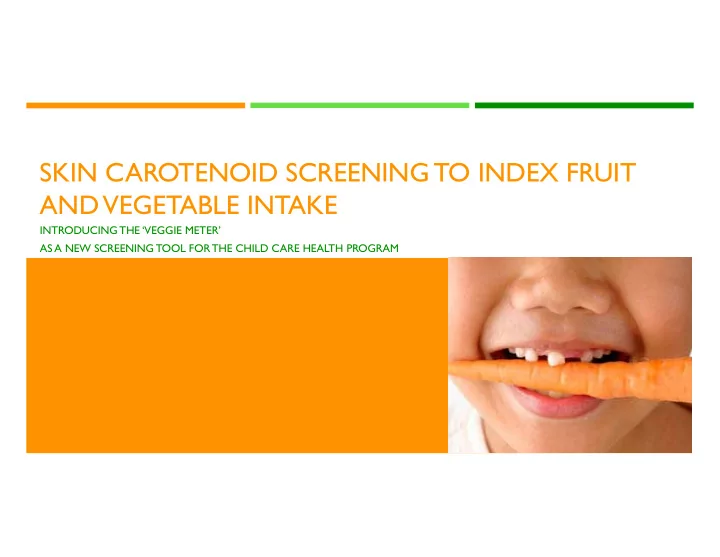
SKIN CAROTENOID SCREENING TO INDEX FRUIT AND VEGETABLE INTAKE
INTRODUCING THE ‘VEGGIE METER’ AS A NEW SCREENING TOOL FOR THE CHILD CARE HEALTH PROGRAM
SKIN CAROTENOID SCREENING TO INDEX FRUIT AND VEGETABLE INTAKE - - PowerPoint PPT Presentation
SKIN CAROTENOID SCREENING TO INDEX FRUIT AND VEGETABLE INTAKE INTRODUCING THE VEGGIE METER AS A NEW SCREENING TOOL FOR THE CHILD CARE HEALTH PROGRAM AGENDA Context for skin carotenoid screening Demonstration of the Veggie Meter
INTRODUCING THE ‘VEGGIE METER’ AS A NEW SCREENING TOOL FOR THE CHILD CARE HEALTH PROGRAM
1952 1925 1253 1773 500 1000 1500 2000 2500 2011-2012 2012-2013 2013-2014 2014-2015 2015-2016 Hearing Vision BMI Dental File review
Number of Children Screened 156 glasses 685 referrals 88 referrals 375 referrals CCHP uses the data to link children to health care resources
To improve nutrition status, the best practice is to link child care centers to resources that improve the child’s daily nutrition and physical activity environment
1 2 Mean change in BMI percentile 2011-2012 2012-2013 2013-2014 2014-2015 Invited to try the HAP in 2012-2013 Invited to try the HAP in 2014-2015 Annual mean change in BMI percentile from Fall to Spring screenings for children ages 2-5y in child care centers that participated in the San Francisco Child Care Health Program and were randomly selected to pilot the Health Apple Program
42% 22% 62% 8% 82% 29% 75% 39% 92% 31% 89% 50% 92% 30% 68% 29% 95% 68%
0% 25% 50% 75% 100%
Visible & self-serve drinking water Using PA curriculum Staff do not only supervise play Physical activity poster is visible No visible TV screen Children are active 90+ min/d
2012-2013 2013-2014 2014-2015
% of Children
National Prevention Strategy (2011) – USDHHS
Let’s Move! Child Care Campaign (2012)
California Wellness Plan (2014) – CDPH CA Preschool SHINE Program (2013)
San Francisco Community Health Improvement Plan (2012) SNAP-Ed funded Nutrition Education and Obesity Prevention Branch
HP2020 targets Energy balance AND Diet quality
16 25 14 15 11 25 50 75 100 All White Asian Latino Black/African American % of Students Percentage of SFUSD high school students who ate 5-plus servings of fruit and/or vegetables daily, 2009-2013
Data source: CHIS
Many parents still struggle to get to school on-time. During that scramble to come to school, they often do not give their children enough time to eat breakfast. They kids sometimes come hungry and they get out of sorts in the classroom. We serve snack at 11am and that may not be soon enough for some of our hungrier children.
We encounter challenges when parents make special meal accommodation requests that are also nutritionally equivalent to what the CACFP requires us to provide children with each meal, most of the times we are able to accommodate but there are times that we have to discuss with families other ways to support them.
The challenges that I have are some children just won’t eat the different vegetable no matter what. I do continue to present the different vegetables and fruits although some children don’t want to try it. The children get a half cup of 100% juice along with a half cup of water mixed each day. One cup of milk per day and 8 ounces of water once a day. This is not a problem for the children they adapt to this well. I think that with me eating the same thing that they eat helps them to want to.
Nearby Spaces are unsafe, limited resources and parents fundraise to bring in Yoga instructors, Zumba instructors, Charity and The Yum Band, Yukelenny and Tree Frog Treks so the programs are spread over many resources which are limited.
Highest Training Needs Identified
T
Regularly using curriculum (N&PA)
Infant physical activity ideas
Screen time
Policy development and Parent Ed. (N&PA)
Expanding menu cycle
Family style meals, authoritative feeding, positive feeding practices
Source: Jahns et al, 2014
Menu based on ChooseMyPlate.gov:
V/F daily = 3.0–4.5-cup equivalents Vegetables
V/F were served cooked, raw, and as 100% juice
Population Location Method Reference Pre-term infants (n = 16 foreskin study) (n = 40 feeding study) Salt Lake City, Utah Resonance Raman spectroscopy correlated with harvested foreskin tissue and serum carotenoids (HPLC). Found that human milk-fed infants had higher carotenoid status than formula-fed infants.
Chan GM, Chan MM, Gellermann W, Ermakov I, Ermakova M, Bhosale P , Bernstein P , Rau C. Resonance Raman spectroscopy and the preterm infant carotenoid status. J Ped Gastroent Nutr 2013;56:556-9.
Economically disadvantaged preschool children (n = 381) Urban Centers in Connecticut Resonance Raman spectroscopy correlated with modified Block Kids Questionnaire and Preschool-Adapted Liking Survey filled
Scarmo S, Henebery K, Peracchio H, Cartmel B, Lin H, Ermakov IV, Gellermann W, Bernstein PS, Duffy VB, Mayne ST. Skin carotenoid status measured by resonance Raman spectroscopy as a biomarker of fruit and vegetable intake in preschool children. Eur J Clin Nutr 2012;66:555-60.
Children ages 5-17 (n = 45) Cache County, Utah Validated resonance Raman spectroscopy against serum carotenoid measurements (HPLC)
Aguilar SS, Wengreen HJ, Lefevre M, Madden GJ, Gast J. Skin carotenoids: a biomarker of fruit and vegetable intake in children. J Acad Nutr Diet 2014;114:1174-80.
Children ages 5-17 (n = 58) Cache County, Utah Gave children juice high or low in carotenoids, or placebo juice. Found that consumption of carotenoid-rich juice increased skin carotenoid status.
Aguilar SS, Wengreen HJ, Dew J. Skin carotenoid response to a high-carotenoid juice in children: A randomized clinical trial. J Acad Nutr Diet 2015;115:1771-8.
5 10 15 Percent 10 20 30 40 50 60 70 80 Skin Carotene in (RRS Intensity)
Range: 16-76
33 vs. 39
likely to have a value below 30 than children at Centers 2 or 3 (OR=2.2, 95%CI: 1.0-4.7, p=0.04)
Please let us know if you would like to join an Advisory Board for CCHP Veggie Meter screening