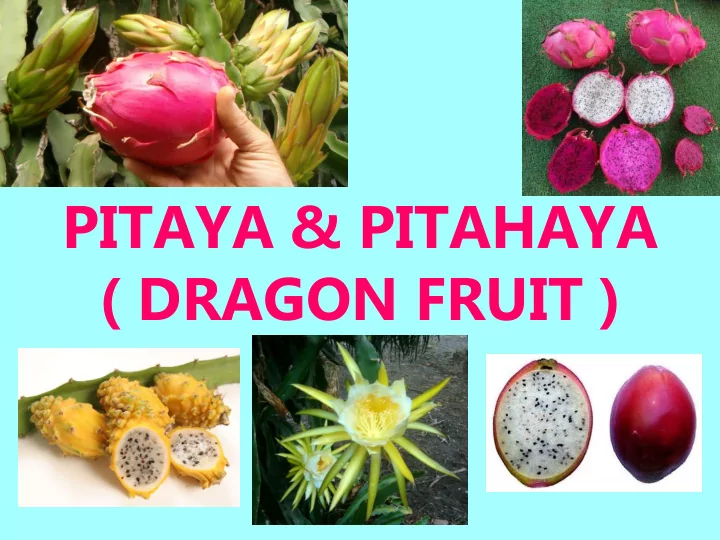
PITAYA & PITAHAYA ( DRAGON FRUIT ) THE LEGEND OF THE DRAGON - - PowerPoint PPT Presentation

pitaya amp pitahaya dragon fruit
SMART_READER_LITE
LIVE PREVIEW

PITAYA & PITAHAYA ( DRAGON FRUIT ) THE LEGEND OF THE DRAGON - - PowerPoint PPT Presentation

PITAYA & PITAHAYA ( DRAGON FRUIT ) THE LEGEND OF THE DRAGON FRUIT (The sensation surrounding this fabulous fruit can be attributed to a legend created by ingenious Asian marketers.) According to the legend The fruit was created thousands


slide-1
SLIDE 1

PITAYA & PITAHAYA ( DRAGON FRUIT )

slide-2
SLIDE 2

THE LEGEND OF THE DRAGON FRUIT

(The sensation surrounding this fabulous fruit can be attributed to a

legend created by ingenious Asian marketers.)

According to the legend The fruit was created thousands of years ago by fire breathing dragons. During a battle when the dragon would breathe fire the last thing to come out would be the fruit. After the dragon is slain the fruit is collected and presented to the Emperor as a coveted treasure and indication of victory. The soldiers would then butcher the dragon and eat the

  • flesh. It was believed that those who feasted on the

flesh would be endowed with the strength and ferocity of the dragon and that they too would be coveted by the Emperor.

slide-3
SLIDE 3

It is written that the dragon’s flame originates deep within its body near the base of its

  • tail. The meat from this part of the dragon

was the most desirable and most sought after portion. Only the officers of each division would be privy to this cut of meat. The ancient Chinese called this cut the “jaina,” which translates literally to “the sweetest and best tasting.”

slide-4
SLIDE 4

The jaina was treasured by all who were privileged enough to taste it, and it is believed that man’s thirst for the jaina is what led to the destruction and eventual extinction of all of the dragons.

slide-5
SLIDE 5

Pitaya, Pitahaya, Dragon Fruit

Vining epiphytic cactus from subtropical and tropical regions of Central Mexico south through Central America and into South America as far south as Peru and as far east as Guyana. It is found on nearly every island in the Caribbean and is cultivated throughout the tropics.

slide-6
SLIDE 6

Hylocereus and Selenicereus

24 to 26 species of Hylocereus with many cultivars and hybrids. More than 100 varieties in California alone, with much confusion on identification. The major species of Hylocereus which are grown commercially are

  • H. polyrhizus, H. undatus

and hybrids of these and

  • ther Hylocereus species

One species of Selenicereus, S. megalanthus, is grown comercially for it’s fruit.

slide-7
SLIDE 7

Vines

Stems may grow more than 20

  • feet. Three ribs

normally occur but four ribs per stem are common in some

  • species. Stems

may be straight

  • r undulating and

may have spines arising from the areoles or be nearly spineless.

slide-8
SLIDE 8

Flowers

  • Flowering occurs in

waves during warm

  • months. As many as

4-8 flowering cycles may occur in tropical areas, however in California's cooler climate it is more normal for an average of 2-3 cycles to occur.

  • Flowering and fruit

set is dependant on temperature and photoperiod.

slide-9
SLIDE 9
  • Flower buds may be from 9” – 12” long in Hylocereus

and up to 14” long in Selenicereus.

  • Unopened flower buds are sometimes cooked and eaten

as vegetables.

  • It takes an average of 30 – 45 days from bud initiation

until the flowers open.

slide-10
SLIDE 10
  • In Southern California, the flowers open at

night for only one night. In the tropics, they are said to flower for two nights with

  • ne species opening and closing for three

days.

  • Flowers are white in color, fragrant

and up to 12” in diameter

slide-11
SLIDE 11
  • Flowers are perfect.

Some species, varieties, and cultivars

  • f Hylocereus are self-

fruitful whereas many

  • thers require cross-

pollination from another species, variety or cultivar.

  • Pollen may be stored

in the refrigerator for up to two weeks and can be kept in the freezer for up to 30 days.

slide-12
SLIDE 12

Fruit Development

  • It takes an average of 45 days for fruit to develop

after pollination occurs in Hylocereus species and up to 150 days for Selenicereus. Fruit ripening may be prolonged if the weather is cool.

slide-13
SLIDE 13

Cultural Requirements

  • Well drained soil,

high in organic matter.

  • Plants are cold hardy

to an average of 28

  • degrees. Some

species, varieties and cultivars may be more or less cold tolerant.

  • Full sun well

increase flower and fruit production but 5% - 30% shade may be required to prevent sunburn in hotter areas.

slide-14
SLIDE 14
  • Trellising is required to support plants.
slide-15
SLIDE 15
  • Trellis is generally 5 - 8 feet

high.

  • Spacing of plants is an

average of 8 feet apart.

  • Heavy pruning about 1

month before flowering (May) has been found to stimulate heavier flowering and fruit production.

  • Arial roots will not attach to

metal, or chemically treated (pressure treated) wood. Burlap is sometimes wrapped around posts to facilitate attachment of arial roots.

slide-16
SLIDE 16

FRUIT

  • Two or three crops fruit of Hylocereus fruit will be produced

in summer and into fall. Selenecereus will produce fruit in late summer or fall.

  • Hylocereus species normally have a hot pink or reddish
  • uter “shell” and flesh which is white, pink or red.
  • Fruit shell may have prominent scales.
slide-17
SLIDE 17
  • Fruit size of Hylocereus species will range

½ pond each to over 3 pounds each.

  • The brix sugar content of fruit will average

from 12% to 21% sugar.

slide-18
SLIDE 18

Fruit may sell for as much as $12 - $25 each.

slide-19
SLIDE 19
  • Red fleshed and pink fleshed fruit contain

relatively high levels of antioxidants.

slide-20
SLIDE 20

Israel has developed one cultivar of Hylocereus which has a yellow skin.

slide-21
SLIDE 21

YELLOW DRAGON FRUIT

(Selenecereus megalanthus)

  • Fruit is smaller but sweeter than other

Pitaya.

slide-22
SLIDE 22
  • Plants of Selenicereus are more cold sensative,

more sun tolerant and are sweeter than most Hylocereus species.

  • Plants are self-fruitful.
  • Fruit have spines which fall off when the fruit is

ripe.

slide-23
SLIDE 23

Hybrid of Hylocereus and Epiphyllum

slide-24
SLIDE 24

Nutritional Values

100 grams of edible part contains:

  • 85.4 gr. Water
  • 0.4 gr. Protein
  • 0.1 gr. Fat
  • 13.2 gr. Carbohydrates
  • 0.5 gr. Fiber
  • 16 mg. Phosphorous
  • 0.3 mg Iron
  • 0.04 mg. Riboflavin
  • 0.2 mg. Niacin
  • 4 mg. Ascorbic Acid
  • 50 Calories
slide-25
SLIDE 25

Hylocereus X Stendatus Connie Mayer

  • A new species cross by German hybridizer, Eckhard Meier. It is

the only red-purple species that is nocturnal. The parent plants are H.stenopterus and H. undatus. (Plants are available from Gray Davis Epiphyllums)

slide-26
SLIDE 26

The Men who were the Pioneers

Grateful appreciation and recognition must be given to the men who pioneered the growing of Pitaya in California: THANK YOU!

Left to Right: Edgar Valdivia Paul Thomson Leo Manual

slide-27
SLIDE 27

DRAGON EGG (PITAYA)

Cereus peruvianus

  • A branching, columnar cactus

with moderate growth rate. Height to 15 or more feet.

  • The variety

‘monsterosus’ is smaller, bluish in color with ribs irregularly broken up into knobs and crests.

slide-28
SLIDE 28

DRAGON EGG (PITAYA)

Cereus peruvianus

  • Spectacular

5”- 6” white flowers

  • pen at

night in late spring or summer.

  • Fruit is sweet, pleasant and mild in flavor but somewhat

grainy in texture.

slide-29
SLIDE 29

PITAYA & PITAHAYA ( DRAGON FRUIT )