SIO15-SS1 2020: Topic 4 Plate Tectonics SIO15-SS1 2020: Topic 4 Plate Tectonics
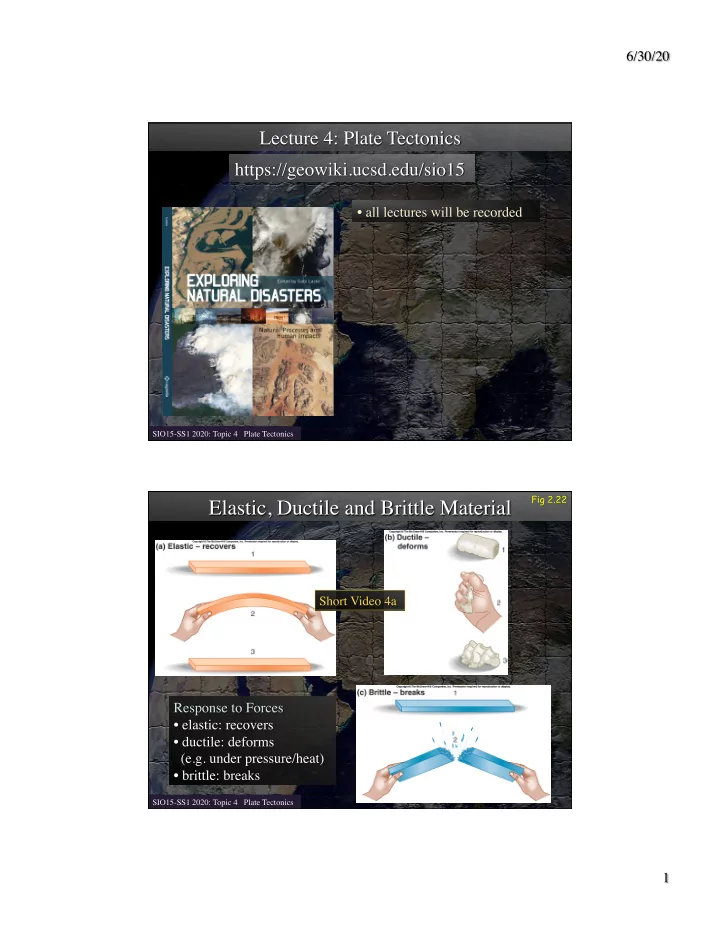
SIO15-SS1 2020: Topic 4 Plate Tectonics SIO15-SS1 2020: Topic 4 - - PDF document
SIO15-SS1 2020: Topic 4 Plate Tectonics SIO15-SS1 2020: Topic 4 Plate Tectonics SIO15-SS1 2020: Topic 4 Plate Tectonics Lithosphere cool and strong but brittle zone of Eqs/volcanoes Asthenosphere warm, soft, ductile Image: S.
SIO15-SS1 2020: Topic 4 Plate Tectonics SIO15-SS1 2020: Topic 4 Plate Tectonics
Lithosphere
- cool and strong but brittle
- zone of Eqs/volcanoes
Asthenosphere
- warm, soft, ductile
Image: S. Marshak “Earth, Portrait of a Planet”
SIO15-SS1 2020: Topic 4 Plate Tectonics
Why do continents have roots? What keeps the lithosphere afloat?
SIO15-SS1 2020: Topic 4 Plate Tectonics
2 counteracting forces
- gravity
- buoyancy
isostatic equilibrium
- forces are balanced
- body floats
Image: S. Marshak “Earth, Portrait of a Planet”
rigid lithosphere floats on soft asthenosphere asthenosphere reacts to imbalance (flows)
SIO15-SS1 2020: Topic 4 Plate Tectonics
- lithosphere is broken up
into 12 major plates
- move about (a few cm per year)
- driven by mantle convection
- divergent
- convergent
- transform
Image: P. Abbott “Natural Disasters”
Mendocino Triple Junction
SIO15-SS1 2020: Topic 4 Plate Tectonics SIO15-SS1 2020: Topic 4 Plate Tectonics
a little bit like this
Image: S. Marshak “Earth, Portrait of a Planet”
- ductile mantle (video 4a)
- viscosity: resistance to flow
(Lecture 2 notes)
SIO15-SS1 2020: Topic 4 Plate Tectonics SIO15-SS1 2020: Topic 4 Plate Tectonics
slab pull
ridge push
slab pull more dominant
slab pull
SIO15-SS1 2020: Topic 4 Plate Tectonics
- lith. formed at MORs
- lith. consumed in subduction zones
- same rate
- plates move a few cm/yr
- earthquakes
- volcanism
- mountain building and other features on Earth’s surface
SIO15-SS1 2020: Topic 4 Plate Tectonics
How do we know that plates move sideways?
- Alfred Wegener, 1915
- continents like jigsaw puzzle
- fossil records match across oceans
- geologic units match across oceans
- apparent polar wander curves
don’t match
SIO15-SS1 2020: Topic 4 Plate Tectonics
continental drift (Alfred Wegener 1915) sea floor observations (Harry Hess 1950s)
What Makes Continents Drift?
- sea floor deepens away from mid-ocean ridges (MORs)
- sediments thicken away from MORs
- heat flow is greater at MORs than elsewhere
- dredging (ocean rock different from continental rocks)
- earthquakes along MORs -> seafloor cracking
map by Heezen and Tharp
SIO15-SS1 2020: Topic 4 Plate Tectonics
- magnetic anomalies
- ocean deep drilling
Dietmar Mueller, SIO
no oceanic lith. older than 200 Mio yrs
- > subduction zones
- Fig. 4.14
SIO15-SS1 2020: Topic 4 Plate Tectonics SIO15-SS1 2020: Topic 4 Plate Tectonics
Shape: like that of bar magnet (dipole)
- magnetic north 2000 at:
81.5ºN, 111.4ºW Origin: currents in metallic liquid outer core
- > magnetic dynamo
Time Evolution: changing field; reversals Observables: strength, declination, inclination
SIO15-SS1 2020: Topic 4 Plate Tectonics
- rock freezing from magma record current field
- Earth’s field/rock position change over time
(record of magn. field)
Image: S. Marshak “Earth, Portrait of a Planet”
Curie Temperature (~ 500ºC)
above: domains align with mag. field below: domains frozen
Source: Wikipedia SIO15-SS1 2020: Topic 4 Plate Tectonics
- mapping of magnetic anomalies (1960s)
- ship tows magnetometer
- records magnetic anomalies
(Earth field+magnetized rock)
- new lava cools below Curie T
- current magnetic N frozen
into rock
- rock moves away from ridge
- symmetric patterns
- Fig. 4.13
SIO15-SS1 2020: Topic 4 Plate Tectonics
- New lithosphere at MOR pushes plates apart
- thickens, cools, gets dense
- loses buoyancy
- more likely to subduct
- sinking slabs pull rest of lithosphere behind it