Review of Plate Earths Topography Tectonics Isostasy Plate - - PDF document

review of plate
SMART_READER_LITE
LIVE PREVIEW

Review of Plate Earths Topography Tectonics Isostasy Plate - - PDF document

Outline Structure of the Earth Lithosphere vs. Asthenosphere Review of Plate Earths Topography Tectonics Isostasy Plate Tectonics Plates on a Map- Quakes & Volcanoes Oceanic Plates Continental


slide-1
SLIDE 1

1

Review of Plate Tectonics

Outline

  • Structure of the Earth
  • Lithosphere vs. Asthenosphere
  • Earth’s Topography
  • Isostasy
  • Plate Tectonics
  • Plates on a Map- Quakes & Volcanoes

– Oceanic Plates – Continental Plates

  • Plate Boundaries
Perspective from Space

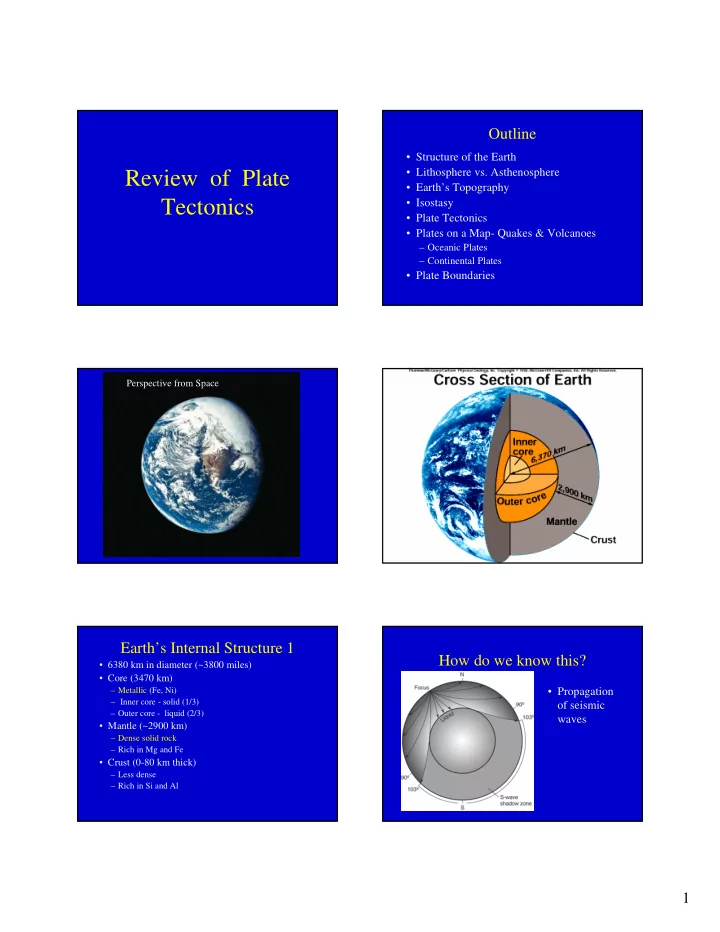
Earth’s Internal Structure 1

  • 6380 km in diameter (~3800 miles)
  • Core (3470 km)
– Metallic (Fe, Ni) – Inner core - solid (1/3) – Outer core - liquid (2/3)
  • Mantle (~2900 km)
– Dense solid rock – Rich in Mg and Fe
  • Crust (0-80 km thick)
– Less dense – Rich in Si and Al

How do we know this?

  • Propagation
  • f seismic

waves

slide-2
SLIDE 2

2

Seismic Velocity Profile of Earth

Velocity (km/sec)

What are the Plates?

  • Lithosphere

– Crust + Uppermost Mantle – Rigid (tectonic plates)

  • Asthenosphere

– Weak part of the upper Mantle

Asthenosphere

  • Mechanical boundary layer
  • Zone of weakness
  • Seismic low-velocity zone
  • Zone of partial melting (2-4% melt)
  • Its depth is controlled by Temperature

(1300 deg C)

  • Allows the plates to slide over it

Lithosphere/Asthenosphere Ocean Basins vs. Continents

slide-3
SLIDE 3

3

Continental vs. Oceanic crust

  • Light (2650 kg/m3)
  • Granite
  • High elevation
  • Not so strong
  • Can be very old
  • Lasts for ever
  • Complex
  • Moves passively
  • Dense (2850 kg/ m3)
  • Basalt
  • Low elevation
  • Strong
  • Young
  • Gets recycled
  • Simple
  • Drives plate motions

Percent area at each elevation, or higher Isostasy

  • The crust “floats” in the mantle
  • Like blocks of wood of different density in

a bathtub

Isostasy

  • Each column of rock will have the same

mass down to the depth of compensation

  • High topography is compensated by thick

crust beneath

Two columns of equal total mass

2700 * 30km 9km * 2850 6km * 1000 85km * 3300 3300 * 70km ρ h ρ h 3.12 x10⁸ kg/m2 3.12 x10⁸ kg/m2 + + ρ =density= kg/m3

Is the mantle really weak?

  • Continent under the load of a glacier
slide-4
SLIDE 4

4

The plates: Distribution of Earthquakes

Seafloor Spreading 1

  • Mantle convects at 1 cm/yr
  • Rising convection at mid-ocean ridges

– Mantle material comes to the surface at ridges

  • Sinking at the trenches
  • The whole ocean is swept clean every 250

to 300 million years

  • Continents can rift apart to produce new

mid-ocean ridges

Seafloor Spreading

  • Continents are carried passively
  • Their leading edges are strongly deformed
  • Oceanic sediments and seamounts get

plastered against the continents

  • Oceanic basins are impermanent, continents

are permanent

  • The earth is a dynamic body, its surface

always changing.

The ocean floor is a tape recorder Magnetic Polarity Reversals

slide-5
SLIDE 5

5

The other side of the story: Subduction

  • The Earth is not expanding
  • Old ocean crust sinks into the mantle at

the trenches

  • Earthquakes show us where the slabs

are

  • Volcanoes form at subduction zones

Subduction Zone What causes the Plates to move?

slide-6
SLIDE 6

6

What causes the Plates to move? Plate Motions All Plate Motions are Rotations

Motion with respect to what? v= ri sin Θ

Plate Boundaries

  • Divergent (plates move apart)
  • Convergent (plates move together)
  • Transform (plates move past each other)

Plate Tectonics and Structural Environments

  • Plate Boundaries

– Divergent – Convergent – Transform

  • Structural Environments

– Extensional – Compressional – Strike-slip – Passive

Divergent Boundaries

slide-7
SLIDE 7

7

Mid Ocean Ridges Divergent Boundaries= Extensional Structural Environment

  • State of Stress- extensional
  • Processes- Thinning and stretching of the crust
  • Types of Structures- rifts, normal faults
  • Examples- mid-ocean rifts, Basin and Range,

East Africa Rift

Normal Faults

Normal Faults

slide-8
SLIDE 8

8

Basin and Range Province Basin and Range Faulting

Active mountain. front, Basin and Range Province, Nevada

Convergent Boundary

Convergent Boundaries= Compressional Structural Environment

  • State of Stress- compression
  • Processes- Thickening and shortening of the crust
  • Types of Structures- Fold and thrust belts, big

mountains

  • Examples- Andes, Himalayas, parts of the Rocky

Mts.

slide-9
SLIDE 9

9

The Appalachians

The Appalachians

Canadian Rockies

Continental Collision

slide-10
SLIDE 10

10

Collisional Boundary The Himalayas Mount Everest Transform Boundaries= Strike-slip Structural Environment

  • State of Stress- horizontal shear
  • Processes- shearing
  • Types of Structures- transform faults, major

strike-slip faults, (also normal and thrust)

  • Examples- San Andreas fault, Alpine fault

(NZ), Anatolian fault (Turkey)

  • Transform

Boundary

  • The most famous

fault

slide-11
SLIDE 11

11

San Francisco Bay San Andreas Fault OceanicTransform Fault

  • Transform Animation
slide-12
SLIDE 12

12

Transforms Link other types
  • f plate boundaries.
They may grow, shrink or be stable.

What type of plate boundary is there along the US East coast? Passive Margin Continental Growth

  • Material plastered onto the continents at

convergent boundaries

  • Example:

– Everything west of Nevada has been added to North America in last 700 Ma

Continental Growth

slide-13
SLIDE 13

13

End

Continental Collision