School Swimming and Water Safety Sue Barlow Programme Manager - - PowerPoint PPT Presentation

school swimming and water safety
SMART_READER_LITE
LIVE PREVIEW

School Swimming and Water Safety Sue Barlow Programme Manager - - PowerPoint PPT Presentation

School Swimming and Water Safety Sue Barlow Programme Manager School Swimming School Swimming and Water Safety Aims of session: 1. National Curriculum requirements for swimming and water safety. 2. PE and School Sport Premium. 3. Tracey


slide-1
SLIDE 1

School Swimming and Water Safety

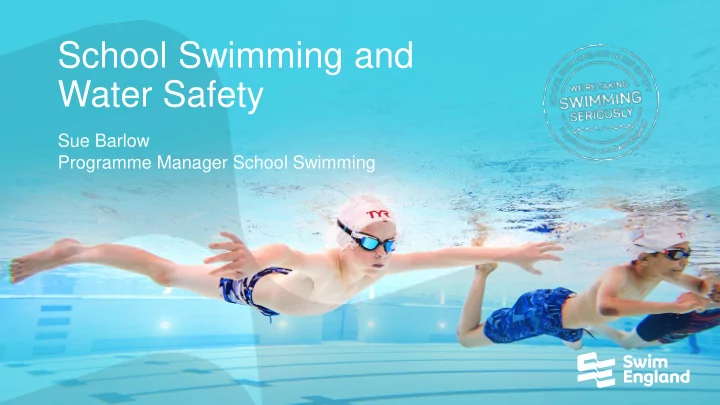
Sue Barlow Programme Manager School Swimming
slide-2
SLIDE 2

School Swimming and Water Safety

Aims of session:

  • 1. National Curriculum requirements for swimming and water safety.
  • 2. PE and School Sport Premium.
  • 3. Tracey Jackson Lincs Inspire LTD
  • 4. Introduce the Swim England School Swimming and Water Safety Charter.
slide-3
SLIDE 3

Why are school swimming lessons important?

  • School swimming is often the one and only
  • pportunity for all children to learn to swim

and know how to be safe in and around water.

  • It’s likely that children who don’t learn to

swim during school lessons, will never learn this lifesaving skill.

  • While 77% of all children can swim the

minimum 25 metres unaided by the time they leave primary school, that figure drops to 42% for children from the least affluent families and is at 86% for the most affluent*.

*Findings from Sport England Active Lives survey December 2018.

slide-4
SLIDE 4

The national curriculum for physical education (PE)

The national curriculum for PE aims to ensure that all pupils:

  • Develop competence to excel in a

broad range of physical activities.

  • Are physically active for sustained

periods of time.

  • Engage in competitive sports and

activities.

  • Lead healthy, active lives.
slide-5
SLIDE 5

National Curriculum requirements for Swimming and Water Safety.

slide-6
SLIDE 6

Swimming and water safety: what does the curriculum say?

All schools must provide swimming instruction either in Key Stage 1 or 2. In particular, pupils should be taught to:

  • 1. Perform safe self-rescue in different

water-based situations.

  • 2. Use a range of strokes effectively.
  • 3. Swim competently, confidently and

proficiently over a distance of at least 25 metres.

slide-7
SLIDE 7

What does this mean?

Perform safe self-rescue in different water-based situations.

  • Knowledge and understanding of water

safety key messages.

  • Know how and when to use appropriate

survival and self-rescue skills.

  • Knowledge and understanding of local

and national water hazards.

  • Knowing what to do if others get into

trouble.

slide-8
SLIDE 8

Water safety and safe self-rescue key messages

  • Always swim in safe place.
  • Always swim with an adult.
  • If you fall in, float, breathe, relax.
  • If someone else is in trouble call

999/112.

8

slide-9
SLIDE 9

What does this mean?

Use a range of strokes effectively.

  • Pupils make choices about the

strokes they use to achieve different

  • utcomes.
  • Experience both alternating and

simultaneous strokes.

  • Adapt the strokes for a range of

purposes and intended outcomes.

  • Strokes do not have to be perfect,

they have to be effective for the intended outcome.

slide-10
SLIDE 10

What does this mean?

Swim competently, confidently and proficiently over a distance of at least 25 metres.

  • Continuous swim for 25 metres or more.
  • Strokes are as strong at the end of the

swim as at the start.

  • Part of the swim should be completed in

deep water.

  • Strokes recognisable to an informed
  • nlooker.
slide-11
SLIDE 11

PE and School Sport Premium

slide-12
SLIDE 12

Refreshed guidance includes

  • Change in reporting date
  • Clarification on role of the Primary PE and Sport Premium to support

school swimming

  • Importance of ensuring the funding is utilised in a sustainable manner

www.gov.uk/guidance/pe-and-sport-premium-for-primary-schools

slide-13
SLIDE 13

Using the PE and School Sports Premium

Schools must use the funding to make additional and sustainable improvements to the quality of PE and sport that is offered by:

  • Developing or adding to the PE and sport activities already offered by

the school. The use of the PE and sport premium for swimming and water safety must be in addition to or beyond regular national curriculum swimming and water safety lessons

  • Building capacity and capability within the school to make sure that

improvements made now will benefit pupils joining the school in future years

slide-14
SLIDE 14

Possible use of funding

  • Provide additional swimming provision.
  • Top-up swimming lessons in Year 6.
  • Hiring qualified swimming teachers
  • Provide existing staff with professional development
  • Enter or run more challenges, for example, Swim Safe session
  • Supporting and involving the least active children by running or

extending school swimming clubs,

  • Swim England School Swimming and Water Safety Charter
slide-15
SLIDE 15

What to report

  • You are also required to publish the percentage of pupils within your

year 6 cohort in the 2018 to 2019 academic year who met the national curriculum requirement to:

  • swim competently, confidently and proficiently over a distance of at least 25

metres

  • use a range of strokes effectively
  • perform safe self-rescue in different water-based situations
  • Attainment data for year 6 pupils should be provided from their most

recent swimming lessons. This may be data from years 3, 4, 5 or 6, depending on the swimming programme at your school.

slide-16
SLIDE 16

Curriculum Swimming and Water Safety Resource Packs

  • Curriculum Swimming and Water Safety Resource Packs
  • The guides give practical advice for how to plan, deliver and report on

curriculum swimming and water safety.

  • Primary schools
  • Primary School Support Materials
  • Lesson providers
  • Swimming teachers
  • Parents and carers

Find these and more on our website at: swimming.org/schools/resource-pack

slide-17
SLIDE 17

Tracey Jackson Swim School Manager and Swim England Tutor

slide-18
SLIDE 18

What’s Available

  • Lincs Inspire sites
  • 3 pools
  • Pools
  • Teaching pool
  • 25 metre 8 lane
  • Bay layout pool
  • Teachers
  • 80 qualified level 2 Teachers
  • 20 Assistant level 1 Teachers
slide-19
SLIDE 19

Support

  • Offer in school support
  • Water safety
  • Advice
  • Talks and presentations to parents and carers
  • Regular contact
slide-20
SLIDE 20

In school support

  • Water Safety
  • School assemblies and workshops
  • Practical sessions during the drowning prevention week
  • Teacher support
  • Advice
  • Water safety code
  • Assemblies for parents going on holiday
  • Regular contact
  • Liaise with local schools to offer available places on swim school
  • Liaise with local schools to offer pool space for school swimming
slide-21
SLIDE 21

Current Offering

  • Schools
  • Private school usage- hire the pool, source their own teachers, deliver NC.

Prices vary

  • Public sector schools – hire the pool , source their own teachers or

provided, prices vary

  • Swim England standards
  • Low numbers
  • Assessments
slide-22
SLIDE 22

The Process

  • Initial contact
  • Booking process
  • Availability
  • Pool depths and allocation of classes
  • Pool programming
slide-23
SLIDE 23

Teachers Training

In house:

  • Monthly
  • Standards
  • Stages
  • Teacher assessments

External :

  • CPD’s
  • Volunteering
  • Online
  • Level 1 and level 2 courses
  • Pre-school qualification
slide-24
SLIDE 24

School Swimming and Water Safety

Supporting resources

slide-25
SLIDE 25

School Swimming and Water Safety Charter

  • A partnership between primary schools,

lesson providers and Swim England, recognising schools for taking swimming and water safety seriously.

  • Designed to support school swimming by

developing and improving teaching and assessments.

  • Recommended for any school

delivering curriculum swimming and water safety lessons.

slide-26
SLIDE 26

School Swimming and Water Safety Charter

  • A structured teaching programme that

meets government criteria for swimming and water safety.

  • A pathway of progressive Awards

for pupils to follow and mark their achievements.

  • Resources for teachers and lesson

providers on how to deliver inclusive, fun and effective school swimming lessons.

slide-27
SLIDE 27

School Swimming and Water Safety with Swim England

  • For Key Stage 1 and Key Stage 2

children aged 5 -11 years.

  • Six core Awards aligned to the Learn

to Swim Framework.

  • Pupils are taught safe self-rescue,

effective stroke technique and swimming competence to 25 metres and beyond.

  • Additional Awards help pupils exceed

national curriculum standards.

slide-28
SLIDE 28

School Swimming and Water Safety Charter Pack

For schools who sign up to the School Swimming and Water Safety Charter. Includes a range of print and digital resources:

  • Award certificates, pin badges,

encouragement stickers and progress cards (passports) for learners.

  • Syllabus guidance cards, lesson plan

tips and templates for teachers.

  • Access to an online portal where

resources can be stored, downloaded and updated.

  • Email updates from Swim England each

term.

  • £30 + VAT
slide-29
SLIDE 29

Further Information

For more information regarding school swimming Email Schoolswimming@swimming.org School Swimming web site www.swimming.org/schools/

slide-30
SLIDE 30

Questions

slide-31
SLIDE 31