
SLIDE 1
Moving Britain Ahead
Stakeholder Reference Group, 15 March 2016 1
Road Investment Strategy M25 South West Quadrant Strategic Study Stakeholder Reference Group
March 16
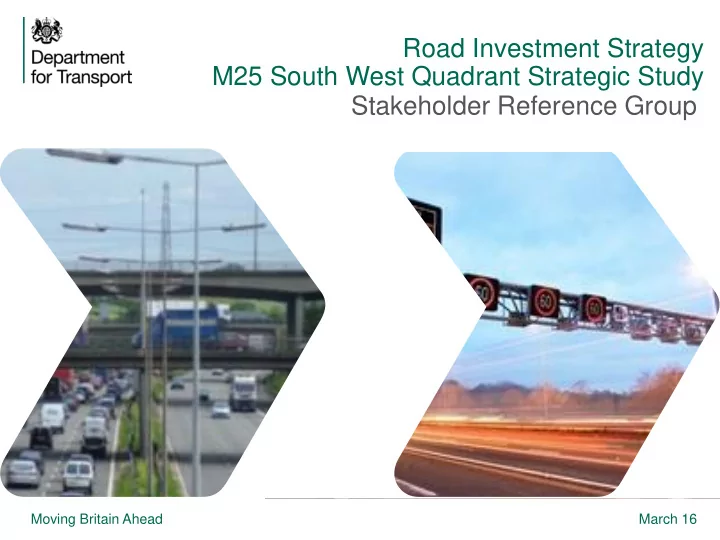
Road Investment Strategy M25 South West Quadrant Strategic Study - - PowerPoint PPT Presentation
Road Investment Strategy M25 South West Quadrant Strategic Study Stakeholder Reference Group Moving Britain Ahead March 16 Stakeholder Reference Group, 15 March 2016 1 Welcome 2 Stakeholder Reference Group, 15 March 2016 Moving Britain
Moving Britain Ahead
Stakeholder Reference Group, 15 March 2016 1
March 16
Moving Britain Ahead
2
March 16
Stakeholder Reference Group, 15 March 2016
Moving Britain Ahead
3
March 16
Stakeholder Reference Group, 15 March 2016
Time
10:00 – 10:30
Challenges 10:30 – 11:30 Break 11:30 – 11:45
Addressing challenges 11:45 – 12:45
12:45 – 13:00 End 13:00
Moving Britain Ahead
4
March 16
Stakeholder Reference Group, 15 March 2016
how it will influence the next Road Investment Strategy
by the M25 SWQ and how these could be addressed
pursuing to meet these challenges
Moving Britain Ahead
5
March 16
Stakeholder Reference Group, 15 March 2016
Roads Futures
Programme Lead
Moving Britain Ahead
6
March 16
Stakeholder Reference Group, 15 March 2016
Moving Britain Ahead
7
March 16
Stakeholder Reference Group, 15 March 2016
Government published the Road Investment Strategy, which outlined how £15.2 billion in capital spend will be invested on the strategic road network between 2015 and 2020.
were announced, bringing the total being taken forward as part of the Road Investment Strategy to 127.
Moving Britain Ahead
8
Six Studies were announced in the first Road Investment Strategy to address issues too large or too complex to resolve in a single 5 year planning period and make fundamental choices about the future of transport in congested parts of the country.
March 16
Stakeholder Reference Group, 15 March 2016
Trans-Pennine Tunnel A1 East of England Oxford to Cambridge Expressway London Orbital (M25) South-West Quadrant Manchester Orbital North-West Quadrant Northern Trans-Pennine
Moving Britain Ahead
9
March 16
Stakeholder Reference Group, 15 March 2016
Moving Britain Ahead
10
March 16
Stakeholder Reference Group, 15 March 2016
The south-west quadrant of the M25 is the busiest road in Britain; it is essential to local people and long distance traffic Pressure is also increasing fast: the busiest parts now carry over 220,000 vehicles per day and severe congestion is a regular occurrence A strategic study has been commissioned to consider this issue and identify a lasting solution that can keep people moving for a generation to come
Moving Britain Ahead
11
March 16
Stakeholder Reference Group, 15 March 2016
The study will have to assess whether it is desirable and possible to enhance the M25; widening the road would be a considerable feat of engineering. The study will also need to consider how to make best use
transport and the local road network play their part. The study needs to consider Government decisions taken on the location of airport expansion in the South East.
Moving Britain Ahead
12
March 16
Stakeholder Reference Group, 15 March 2016
The first Road Investment Strategy made a number of commitments to begin enhancing the M25, through a mixture of schemes to improve sections, junctions and connections. Within the study area, these commitments include introducing hard shoulder running between junctions 15 and 16 and four-lane through-junction running between junctions 10 and 12. Plans for these improvements will be developed throughout 2016, 2017 and 2018, to enable works to start in 2019/20, and the schemes to open in 2022/23.
Moving Britain Ahead
13
Ensure that stakeholder views are understood and properly considered during the study process. It will provide a forum for dialogue between the study sponsors and project managers and the principal stakeholders with interests in the project.
March 16
Stakeholder Reference Group, 15 March 2016
Moving Britain Ahead
14
March 16
WSP|PB appointed to undertake study Define the transport
Review evidence base Identify long list of
Publish initial report Sifting of long listed
Identification of
forward Evaluate short listed
Publish final report before year end
Stakeholder Reference Group, 15 March 2016
Stakeholder Engagement
15
Making the case for change Agreeing a sifting tool & starting the long list Sifting the long list Detailing the short list
January 2016 February 2016 March 2016 April 2016
May 2016 June 2016 July 2016 August 2016 September 2016 October 2016 November 2016 December 2016
16
Assembling evidence of “now”
Confirming constraints
Understanding the evidence for the “future”
January 2016 February 2016 March 2016
April 2016 May 2016
June 2016 July 2016 August 2016 September 2016 October 2016 November 2016 December 2016
17
Statutory requirements
Government and local objectives
Delivery requirements
Public acceptance
January 2016 February 2016 March 2016 April 2016 May 2016
June 2016 July 2016 August 2016
September 2016 October 2016 November 2016 December 2016
18
Creating the long list of interventions
Packaging interventions Testing and scoring with the sifting tool Confirming a shortlist of “most likely to succeed” interventions
January 2016 February 2016 March 2016 April 2016 May 2016 June 2016 July 2016 August 2016
September 2016 October 2016 November 2016 December 2016
19
Design Environmental impacts Costs Travel impacts Wider economic impacts Delivery timeframe Delivery process
20
Community
deprivation Economy
average
Transport
boardings
motorway
21
M25 J11-J12 anticlockwise Morning peak hour Origins include
Destinations include
Source: TrafficMaster
8 table facilitators
Role
22
Tom Metcalfe
Fintan Geraghty
Louise Mantrunola
Nigel Wilkinson
Oliver Stanyon
Graham James
James Purkiss
Fraser Reid
The challenges.
23
1. What do you believe are the causes of the congestion on the M25 between Junctions 10 and 16 and what evidence is there to support these claims? 2. What challenges (existing and future) does the congestion on the M25 between Junctions 10 and 16 present to you in terms
environment, your communities and those you represent and speak on behalf of?
How to address the challenges
24
1. What should be done (considering all transport modes, government objectives and local objectives)? 2. What should not be done? 3. What does success look like?
Moving Britain Ahead
25
March 16
Stakeholder Reference Group, 15 March 2016
Moving Britain Ahead
26
Comments from today will be used to inform the initial report. Please send us any additional comments, questions, data, reports
We will circulate a minute of this meeting alongside the slides presented today Next stakeholder reference group will be in spring /early summer
March 16
Stakeholder Reference Group, 15 March 2016