The Construction Supplier Conference Time Subject Speaker 08:45 - - PowerPoint PPT Presentation

the construction supplier conference
SMART_READER_LITE
LIVE PREVIEW

The Construction Supplier Conference Time Subject Speaker 08:45 - - PowerPoint PPT Presentation

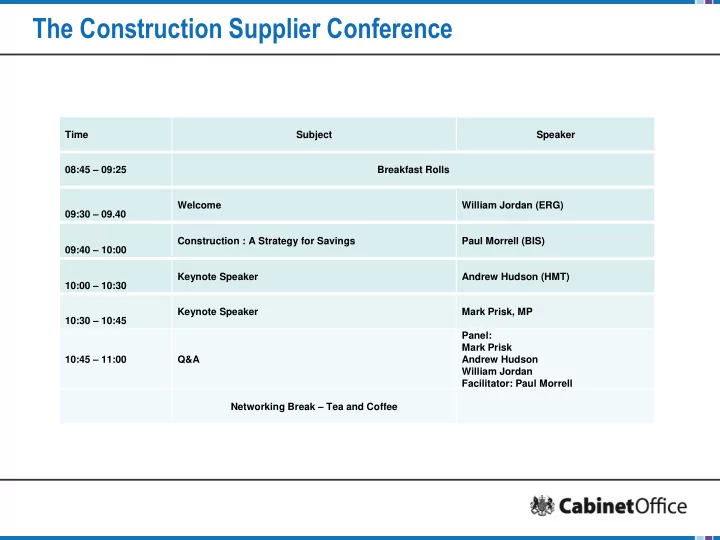
The Construction Supplier Conference Time Subject Speaker 08:45 09:25 Breakfast Rolls Welcome William Jordan (ERG) 09:30 09.40 Construction : A Strategy for Savings Paul Morrell (BIS) 09:40 10:00 Keynote Speaker Andrew Hudson


slide-1
SLIDE 1

The Construction Supplier Conference

Time Subject Speaker 08:45 – 09:25 Breakfast Rolls 09:30 – 09.40 Welcome William Jordan (ERG) 09:40 – 10:00 Construction : A Strategy for Savings Paul Morrell (BIS) 10:00 – 10:30 Keynote Speaker Andrew Hudson (HMT) 10:30 – 10:45 Keynote Speaker Mark Prisk, MP 10:45 – 11:00 Q&A Panel: Mark Prisk Andrew Hudson William Jordan Facilitator: Paul Morrell Networking Break – Tea and Coffee

slide-2
SLIDE 2

The Construction Supplier Conference (Cont)

Time Subject Speaker 11:30– 11:40 Introduction to second session Paul Morrell 11:40– 12:10 BIM John Tocci (Tocci Building Companies) 12:10– 12:30 Procurement Models Ian Tyler (Balfour Beatty) Martin Davis (Specialist Engineering Alliance) 12:30– 13:10 Q&A Discussion Panel: Paul Morrell John Tocci Ian Tyler Martin Davis 13:10– 13:15 Closing Remarks Paul Morrell

slide-3
SLIDE 3

Welcome

William Jordan Chief Sustainability Officer Efficiency and Reform Group, Cabinet Office

slide-4
SLIDE 4

Construction: A strategy for Savings

Paul Morrell Government Chief Construction Adviser Department of Business Innovation and Skills

slide-5
SLIDE 5

Key Suppliers Conference 3

Paul Morrell, Government Chief Construction Adviser

Raising the bar

UNCLASSIFIED

slide-6
SLIDE 6

UNCLASSIFIED

slide-7
SLIDE 7

UNCLASSIFIED

Budget 2011

BIS/HM Treasury Plan for Growth

IUK Implementation Plan IUK Cost of Delivery Study, December 2010 Public Sector General Construction Strategy, due May 2011 IGT Low Carbon Construction Report, November 2010 McNulty Review Final Report, due April 2011

slide-8
SLIDE 8

UNCLASSIFIED

slide-9
SLIDE 9

UNCLASSIFIED

slide-10
SLIDE 10

Great Kanto Highway, Japan

UNCLASSIFIED

slide-11
SLIDE 11

Great Kanto Highway, Japan

UNCLASSIFIED

slide-12
SLIDE 12

Great Kanto Highway, Japan

17 March 2011 23 March 2011

UNCLASSIFIED

slide-13
SLIDE 13

UNCLASSIFIED

slide-14
SLIDE 14

UNCLASSIFIED

slide-15
SLIDE 15

Bump, bump, bump on the back of his head. Winnie thought there must be a better way of coming downstairs …… if only he could stop bumping for a moment and think about it.

UNCLASSIFIED

slide-16
SLIDE 16

Pipeline

UNCLASSIFIED

slide-17
SLIDE 17

2 Years

UNCLASSIFIED

slide-18
SLIDE 18

UNCLASSIFIED

slide-19
SLIDE 19

UNCLASSIFIED

Value in service delivery

slide-20
SLIDE 20

UNCLASSIFIED

slide-21
SLIDE 21

UNCLASSIFIED

slide-22
SLIDE 22

UNCLASSIFIED

slide-23
SLIDE 23

UNCLASSIFIED

slide-24
SLIDE 24

UNCLASSIFIED

slide-25
SLIDE 25

Good .. and good enough

Good .. and good enough Not good enough Over-designed

UNCLASSIFIED

slide-26
SLIDE 26

TOTAL INVESTMENT IN OFFICE BUILDING DISCOUNTED TO PV

5 / %

1 2

5 / %

1 2

7 / %

1 2

3 / %

1 2

6% 7% 24% 41%

NOTE: EXCLUDES OCCUPANTS’ STAFF COSTS

1. Building - construction cost 41% 2. M&E services - running & maintenance 24% 3. Furnishings & furniture

  • capital cost

7½% 4. Land 7% 5. Building - maintenance 6% 6. Cleaning 5½% 7. M&E services - depreciation 5½% 8. Furnishings & furniture - maintenance & depreciation 3½%

UNCLASSIFIED

slide-27
SLIDE 27

TOTAL INVESTMENT IN OFFICE BUILDING DISCOUNTED TO PV

1% 1%

3/ % 4 3/ % 4 1/ % 2

5 / %

1 2

86 / %

1 2

3% 1%

NOTE: INCLUDES OCCUPANTS’ STAFF COSTS

1. Salaries of occupants 86½% 2. Building - construction cost 5½% 3. M&E services - running & maintenance 3% 4. Furnishings & furniture - capital cost 1% 5. Land 1% 6. Building - maintenance 1% 7. Cleaning ¾% 8. M&E services - depreciation ¾% 9. Furnishings & furniture - maintenance & depreciation ½%

UNCLASSIFIED

slide-28
SLIDE 28

Benchmarking

UNCLASSIFIED

slide-29
SLIDE 29

Governance

UNCLASSIFIED

slide-30
SLIDE 30

Challenge

UNCLASSIFIED

slide-31
SLIDE 31

Elimination of waste

UNCLASSIFIED

slide-32
SLIDE 32

Prequalification

UNCLASSIFIED

slide-33
SLIDE 33

UNCLASSIFIED

slide-34
SLIDE 34

Fair payment

UNCLASSIFIED

slide-35
SLIDE 35

Principles of fair payment

  • Deliberate late payment or unjustifiable withholding is not

acceptable

  • If clients are not applying retentions, they should not be

applied along the supply chain

  • Payment periods not to exceed 30 days
  • Payments will be made by electronic BACS transfer
  • Past payment performance will be a key prequalifying

criterion in the selection of lead contractors

  • Clients may wish to pay subcontractors directly
  • Subcontractors involved at the design stage should be paid

for their time on a fee basis

  • Valuation processes should be replaced by milestone

payments and payment schedules

UNCLASSIFIED

slide-36
SLIDE 36

UNCLASSIFIED

slide-37
SLIDE 37

New procurement models

UNCLASSIFIED

slide-38
SLIDE 38

UNCLASSIFIED

slide-39
SLIDE 39

UNCLASSIFIED

slide-40
SLIDE 40

UNCLASSIFIED

slide-41
SLIDE 41

Integration

UNCLASSIFIED

slide-42
SLIDE 42

UNCLASSIFIED

slide-43
SLIDE 43
slide-44
SLIDE 44

Integrated Supply Chains

  • Shared goals & objectives
  • Play to strengths
  • Early involvement
  • Cross company understanding
  • Committing necessary resources
  • Maximise potential of IT
  • Good communication
  • TRUST
  • Value driven procurement
  • Shortening cradle to grave process
  • Embrace continuous improvement

UNCLASSIFIED

slide-45
SLIDE 45

Integrated Supply Chains

  • Shared goals & objectives
  • Play to strengths
  • Early involvement
  • Cross company understanding
  • Committing necessary resources
  • Maximise potential of IT
  • Good communication
  • TRUST
  • Value driven procurement
  • Shortening cradle to grave process
  • Embrace continuous improvement

UNCLASSIFIED

slide-46
SLIDE 46

UNCLASSIFIED

slide-47
SLIDE 47
slide-48
SLIDE 48

Incentivisation

UNCLASSIFIED

slide-49
SLIDE 49

UNCLASSIFIED

Frameworks

slide-50
SLIDE 50

UNCLASSIFIED

slide-51
SLIDE 51

Protecting smaller players

UNCLASSIFIED

slide-52
SLIDE 52

UNCLASSIFIED

slide-53
SLIDE 53

UNCLASSIFIED

slide-54
SLIDE 54

UNCLASSIFIED

slide-55
SLIDE 55

UNCLASSIFIED

slide-56
SLIDE 56

Soft landings

slide-57
SLIDE 57

UNCLASSIFIED

slide-58
SLIDE 58

Building Information Modelling (and Management)

UNCLASSIFIED

slide-59
SLIDE 59

UNCLASSIFIED

slide-60
SLIDE 60

A shared platform

UNCLASSIFIED

slide-61
SLIDE 61

UNCLASSIFIED

Virtual construction

slide-62
SLIDE 62

UNCLASSIFIED

slide-63
SLIDE 63

Loading data

UNCLASSIFIED

slide-64
SLIDE 64
slide-65
SLIDE 65

UNCLASSIFIED

slide-66
SLIDE 66

Obama endorses BIM In his State of the Union Address last week, President Barack Obama … made reference to the power of BIM. During his discussion of innovation and the digital age, Obama recognized the role BIM can play in emergency management, “It’s about connecting every part of America to the digital age…It’s about a firefighter who can download the design of a burning building onto a handheld device.”

UNCLASSIFIED

slide-67
SLIDE 67

Obama endorses BIM In his State of the Union Address last week, President Barack Obama … made reference to the power of BIM. During his discussion of innovation and the digital age, Obama recognized the role BIM can play in emergency management, “It’s about connecting every part of America to the digital age…It’s about a firefighter who can download the design of a burning building onto a handheld device.”

UNCLASSIFIED

slide-68
SLIDE 68

Trial projects

UNCLASSIFIED

slide-69
SLIDE 69

A charter ?

UNCLASSIFIED

slide-70
SLIDE 70

Government plans for construction sector efficiency and growth

Andrew Hudson Director General, Public Services & Growth HM Treasury

4th April 2011

slide-71
SLIDE 71

Contents

  • The overall context
  • The Spending Review
  • The Budget
  • Opportunities and challenges for the construction industry

UNCLASSIFIED

slide-72
SLIDE 72

The fiscal challenge

33 34 35 36 37 38 39 40 41 42 43 44 45 46 47 48 49 1997-98 1999-00 2001-02 2003-04 2005-06 2007-08 2009-10 2011-12 2013-14 2015-16 Per c ent of GDP

Public Sector Current Receipts (Budget) Total Managed Expenditure (Budget)

Forecasts

UNCLASSIFIED

slide-73
SLIDE 73

UNCLASSIFIED

slide-74
SLIDE 74

The consolidation

33 34 35 36 37 38 39 40 41 42 43 44 45 46 47 48 49 1997-98 1999-00 2001-02 2003-04 2005-06 2007-08 2009-10 2011-12 2013-14 2015-16 Per c ent of GDP

Public Sector Current Receipts (Budget) Total Managed Expenditure (Budget)

Forecasts

UNCLASSIFIED

slide-75
SLIDE 75

Prioritising growth enhancing investment

  • Spending Review increased the capital envelope by £2.3bn a year by 2014-15 to

protect high-value investment

  • Prioritised investment to underpin the transition to a high-tech, low-carbon

economy :

– Transport capital investment - which will be higher in 2014-15 than in 2005-06 – Carbon Capture and Storage – Green Investment Bank – UK Centre for Medical Research and Innovation – Diamond 3 Synchrotron

UNCLASSIFIED

slide-76
SLIDE 76

Investing in infrastructure for growth

  • National Infrastructure Plan

identified some £200 billion of infrastructure investment by public and private sectors between 2010 and 2015

  • Private sector share of is expected

to increase from under 60% to some 70%

0% 10% 20% 30% 40% 50% 60% 70% 80% 90% 100%

2005/06 to 2009/10 20010/11 to 2014/15

Private Public

UNCLASSIFIED

slide-77
SLIDE 77

Budget 2010

UNCLASSIFIED

slide-78
SLIDE 78

Plan for Growth - Ambitions

  • To create the most competitive tax system in the G20
  • To make the UK one of the best places in Europe to start, finance and Grow a

business

  • To encourage investment and exports as a route to a more balanced economy
  • To create a more educated workforce that is the most flexible in Europe

UNCLASSIFIED

slide-79
SLIDE 79

The most competitive tax system in the G20

  • Reduced the rate of corporation tax for smaller companies to 20% from 2011
  • Reducing the main rate of corporation tax
  • Emphasis on improved competitiveness, stability and investment.
  • Particular support to Mid-Caps and SMEs

UNCLASSIFIED

slide-80
SLIDE 80

Best place to start, finance and grow a business

Actions to minimise the regulatory burdens:

  • Implement proposals from the Lord Young review of H&S
  • Pushing EU to bear down on overall impact of legislation

Planning Reform:

  • Presumption in favour of development
  • National Planning Policy Frameworks reinforced
  • Extended permitted development rights
  • Planning applications and appeals processed in 12 months.

Regulatory Competition:

  • Binding set of principles of economic regulation to provide greater certainty for long term

investors

UNCLASSIFIED

slide-81
SLIDE 81

Investment and exports as a route to a more balanced economy

  • Regional Growth Fund and priority investment in infrastructure already

announced

  • 21 New Enterprise Zones
  • Reform of UKTI to encourage investment in economically significant projects
  • Publish forward programme of infrastructure projects
  • Reform public sector construction and infrastructure procurement
  • £3 billion capital to the Green Investment Bank

UNCLASSIFIED

slide-82
SLIDE 82

Educated workforce that is the most flexible in Europe

  • Up to 50,000 additional apprenticeship places over the next four years
  • 100,000 work experience placements

UNCLASSIFIED

slide-83
SLIDE 83

Plan for growth construction actions

  • Publish the UK‟s long term forward view of projects
  • Publish a rolling two year forward programme of funded projects
  • Reform public sector construction procurement
  • „FirstBuy‟ programme assisting over 10,000 first time buyers
  • Accelerate the release of public sector land
  • Reform the stamp duty land tax rules applied to bulk purchases
  • Range of measures to remove barriers to entry for new REITs
  • Review construction standards and codes to take out redundancy and duplication
  • New regulatory requirements for zero carbon homes, to apply from 2016

UNCLASSIFIED

slide-84
SLIDE 84

UNCLASSIFIED

Over-prescriptive standards?

slide-85
SLIDE 85

Opportunities for construction

Other sectors / sub-sectors

2 4 6 8 10 12 14

Roads Ports Airports Transport

  • Wales

Flood and coastal Waste

£ billion 2005/06 to 2009/10 20010/11 to 2014/15

Largest five investment areas (over 80% of total)

10 20 30 40 50 60 70 80

Energy Communications Rail Transport - LondonWater

£ billion 2005/06 to 2009/10 20010/11 to 2014/15

UNCLASSIFIED

slide-86
SLIDE 86

Strategic roads

  • Over £10 billion allocated at the Spending Review
  • Highways Agency re-planning investment following Spending Review

allocation, including:

  • Programme includes hard shoulder running projects (e.g. M1, M65, M5/M6),

capacity enhancements (e.g. A11) and key junction improvement works (e.g. A13/A130).

Local authority major projects

  • £1.5 billion announced in Spending Review for new and committed local

schemes

  • Confirmation of first round of projects that are being supported following the

Spending Review announced February 2011

UK transport investment

slide-87
SLIDE 87

Rail

  • £14 billion funding to Network Rail. Current 5 year Control Period (CP4) runs to

2014.

  • Projects include:
  • Improvements to Birmingham New Street and Leeds Stations
  • Capacity and line speed enhancements across the network
  • Thameslink Programme confirmed with a new 2018 completion date to reduce

project risks

  • Significant programme of rolling stock investment

London including Crossrail

  • £6 billion capital programme confirmed in Spending Review
  • Continued investment in modernising the Underground network
  • Crossrail also confirmed with a re-profiled timetable

UK transport investment (cont)

slide-88
SLIDE 88

Water and Flood & Coastal Erosion Risk Management

Water regulated investment programme

  • Price Review 2009 runs to 2015. Combined £21 billion of investment

planned for the period.

  • Balance to be struck between increased competition and investor

confidence/interest to ensure delivery of investment programme post 2015.

Flood & Coastal Erosion Risk Management investment programme

  • Funding allocated to continued investment at spending review
  • Alternative funding model being considered to increase

available funding and local choice.

slide-89
SLIDE 89

Digital communications

Mobile communications

  • Liberalisation of 2G spectrum will enable investment to improve coverage and

speed of mobile data services

  • Auction of valuable 800MHz and 2.6GHz, planned for Q1 2012, will enable

deployment of 4G services. £280 million Government funding to “clear” spectrum for sale

  • Government committed to releasing 500MHz of public sector spectrum by 2020

Government investment in broadband

  • Initial pilot projects announced for North Yorkshire, Cumbria, Herefordshire and

the Highlands and Islands

  • Pilots into procurement in Q1 and Q2 2011 with connections starting in Q1 and

Q2 2012

  • Further round planned for April and then continuous bid process for further
  • projects. £530 million over the SR period
slide-90
SLIDE 90

Energy networks

Offshore transmission

  • £15-20 billion of investment over 10 years
  • Ofgem first two tender rounds launched
  • Round 1 total value £1.1 billion - bids received and appointed
  • Round 2 (£1 billion) process for offshore generation

Price control reviews

  • Next price reviews for transmission and gas distribution due to be implemented

from April 2013

  • Next price review for electricity distribution to be implemented from April 2015
  • Longer, 8 year settlement periods

Roll-out of smart meters

  • Estimated cost to energy suppliers of £1.6 billion to 2020
slide-91
SLIDE 91

Energy generation

New nuclear

  • 8 sites identified for new Nuclear build. Estimate over £47 billion of

projects starting by 2015

  • Dependent on NPS/EMR decisions. First site Hinkley Point seeking

licenses, works could start 2011/12

  • Other sites including Sizewell, Oldbury and Sellafield expected from

2014/15

Offshore wind

  • Projects valued at £7bn expected to start over the next two years
  • Several projects expected to reach close in next 12 months including

Teeside and Humber Gateway

slide-92
SLIDE 92

Construction

Sector Public Private Total Commercial and social £20 billion £29 billion £49 billion Residential £14 billion £28 billion £42 billion Infrastructure £ 7 billion £11 billion £18 billion Refurbishing and improving the existing built stock accounts for about half

  • f this total.

At least 7% of GDP circa £110 billion per annum

slide-93
SLIDE 93

Challenges for construction

  • Mixed evidence on comparative performance
  • Productivity growth better than US, France and Germany

... but Less than half capital intensity of those countries ...and 4th highest costs in EU

  • House building at lowest peacetime levels since 1924
  • Perceived industry fragmentation and lack of supply chain integration – low levels
  • f innovation and skills
  • Lack of forward view of workflow and poor procurement practices a barrier to

growth

slide-94
SLIDE 94

Potential for efficiency

  • National benchmarks and industry indices constantly place UK in upper quartile of

peer group comparables on construction costs

  • Infrastructure Cost Review benchmarking:

– HS Rail costs at least 23% higher in UK – Major stations as much as 50% more expensive – Roads 10% higher but potential for greater efficiencies

  • Savings of about15%, or £10bn, possible over the next five years
  • Plan for Growth target to reduce costs by up to 20% for wider public sector

construction

slide-95
SLIDE 95

Infrastructure Cost Review

slide-96
SLIDE 96

Summary

slide-97
SLIDE 97

Keynote Address Mark Prisk Minister of State for Business and Enterprise

slide-98
SLIDE 98

Panel Session

Mark Prisk Andrew Hudson William Jordan Facilitator: Paul Morrell

slide-99
SLIDE 99

Networking Break

slide-100
SLIDE 100

Second Session

Paul Morrell Government Chief Construction Adviser Department of Business Innovation and Skills

slide-101
SLIDE 101

Building Information Modelling

John Tocci Chief Enabling Officer Tocci Building Companies

slide-102
SLIDE 102

UNCLASSIFIED

Procurement Models – Cost Led Integrated Procurement

Ian Tyler Chief Executive Officer Balfour Beatty Plc

slide-103
SLIDE 103

Procurement Models – Cost Led Integrated Procurement

Ian Tyler Chief Executive Officer Balfour Beatty Plc

slide-104
SLIDE 104

Procurement Models – Cost Led Integrated Procurement

Martin Davis Specialist Engineering Alliance

slide-105
SLIDE 105

Low Carbon Construction IGT Final Report – the challenge

“In the Emerging Findings, one of the propositions was that a number

  • f integrated teams might develop a delivery proposal to show how

an alternative procurement framework might enable the team to

  • drive down costs and
  • deliver a “close to zero carbon” building for the same price as one

built only to current Building Regulations”

slide-106
SLIDE 106

Our Proposition:

how an integrated industry will deliver “more for less” with “integrated project insurance”

CAPEX targets Cut out waste and improve efficiency with smarter integrated procurement and insurance (15% - 20%) Invest - with BIM - in innovative design, cost- effective low carbon solutions and sustainability* 5% - 10%

  • Target net saving (before OPEX savings) (10%)
  • *“Sustainable Buildings need integrated teams”

www.secgroup.org.uk see “activities” NB: In accordance with principles backed by NAO, Strategic Forum, PSCCF and House of Commons Business & Enterprise Committee in “Construction Matters”

slide-107
SLIDE 107

Our Industry Proposition

By:

  • the Specialist Engineering Alliance: CIBSE, BEAMA, ACE, BSRIA, SEC Group and

FETA

  • 30+ design/cost consultants, contractors, specialist contractors and

suppliers/manufacturers

  • insurance brokers and 5+ leading underwriters

Proposition is for GENUINE integration and collaboration, with:

  • independent facilitation,
  • independent risk assurance – technical and financial
  • insurance of the cost plan with “integrated project insurance”

Corollary: Government can itself save significant supervisory costs

slide-108
SLIDE 108

An “alliance” between the client, the industry and its insurers

  • a partnership in risk management

Integrated Project Team (“IPT”)

Lead Contractor Consultants, Specialists and Suppliers FM under a “no blame/no claim” Alliance

Financial alignment to Client’s success criteria (Target cost + gain/pain-share)

Client Insurance Panel

Lead Underwriter + supporting insurers

A new “partnership” Independent Facilitation and Risk Assurance (Technical + Financial)

slide-109
SLIDE 109

An “alliance” between the client, the industry and its insurers

  • a partnership in risk management

Integrated Project Team (“IPT”)

Lead Contractor Consultants, Specialists and Suppliers FM under a “no blame/no claim” Alliance

Financial alignment to Client’s success criteria (Target cost + gain/pain-share)

Client Insurance Panel

Lead Underwriter + supporting insurers

A new “partnership” Independent Facilitation and Risk Assurance (Technical + Financial)

slide-110
SLIDE 110

The manifold traditional individual Risk Insurances are subsumed into one “Integrated Project Insurance” (“IPI”)

Contractor’s All Risks Professional Indemnity Latent Defects Third Party

Covers all members of the Integrated Project Team including the Client on a “first party” basis; also covers 3rd party actions No blame: demonstrate loss, not culprit - legal costs saved. Rights of subrogation waived. Covers “cost overrun” over the agreed cost plan; and it’s a new form of security for the funders Cost - including facilitation, risk assurance and latent defects cover

  • will be 2½%; IPI replaces all

existing policies totalling about the same down the supply chains Integrated Project Insurance

slide-111
SLIDE 111

Criteria for the award of a public contract

The Public Contracts Regulations 2006 N0 5

(based on Directive 2004/18/EC of the European Parliament and Council Article 53)

Either most economically advantageous tender from the point of view of the contracting authority – criteria such as: – quality, – price, – technical merit, – aesthetic and functional characteristics, – environmental characteristics, – running costs, – cost-effectiveness, – after-sales service and technical assistance, – delivery date and delivery period or period for completion,

  • r

– the lowest price.

slide-112
SLIDE 112

Business need and selecting the team

  • Client/Advisory Team decides Functional Brief including

investment benchmarks

  • Selection “most economically advantageous” – competitive

but NOT “lowest price”

  • Independent technical and financial risk assurance checks

before appointment

  • Core integrated team, including project/construction

manager, specialist contractors (with their access to supply chains), cost adviser and facilities manager are appointed

  • Complies with Achieving Excellence in Construction,

Common Minimum Standards, and the Construction Commitments

Cost saving

  • Traditional enquiry, estimating and tendering processes are

avoided

  • Can select groups of practices/companies
  • Can select for series of projects (framework)
  • SME teams will often be highly appropriate

Complements Strategic Forum’s “Integration Toolkit”

www.strategicforum.org.uk

slide-113
SLIDE 113

Development of design solution and target cost plan

  • risk assurance and benchmarking

“Best practice” benchmark – based on recent comparable projects 15% process cost saving 20% process cost saving Adequacy independently assured (technically and financially) Design solution and cost plan developed, with facilitation, by the integrated team on an “open book” basis – and progressively reviewed by the independent technical and financial assurors (including for innovation and sustainability)

£

Basic cost

  • f integrated team

and its supply chains Risk allowances

SEA challenge –

process cost savings

“Competitive tension”

Target cost

slide-114
SLIDE 114

Risk-sharing and “integrated project insurance”

for Gateway 3 approval

£

Basic cost

  • f integrated team

and its supply chains Risk allowances

SEA challenge –

process cost savings

“Competitive tension”

£

Basic cost if with

  • verspends

Gain-share, geared to success criteria

Pain-share = excess Insured cost overrun GMP equivalent Insurers’ cap (pilot projects)

Target cost

£

Basic cost if with further savings

slide-115
SLIDE 115

Implementation

  • Integrated Team excels at meeting the brief by

collaboration and innovation

  • With facilitation, every needless process is

challenged

  • BIM and “BuildOffSite” can develop their full

potential

  • Gain-share/pain-share up to completion are

settled, and any insured losses are finally paid

  • Risk assurance is active through to

completion, so as to give “clean bill of health” for latent defects cover Cost savings:

  • Only changes in the brief (or client

interference) have to be tracked – until incorporated in target cost plan

  • Interim and final account (“price”) issues are

avoided

Proving and Operation

  • Facility is operated/ maintained by

integrated team for pre-agreed period

  • Gain-shares earned for performance “in

use” are paid, say annually

  • Latent defects cover takes over, and pays
  • n a “no fault” basis for 12 years
  • Performance shortfalls (e.g. low carbon)

may be covered under IPI

Cost savings:

  • Inefficient operation and poor

maintenance: minimized

  • Failure to identify culprit for latent defects/

under-performance (designer/ specialist contractor/ supplier) and recover: avoided
slide-116
SLIDE 116

Discussion Session

John Tocci Ian Tyler Martin Davis

slide-117
SLIDE 117

Closing

Paul Morrell Government Chief Construction Adviser