1 Elevator Control Quadrant Elevator Control Quadrant Processes - - PowerPoint PPT Presentation

1
SMART_READER_LITE
LIVE PREVIEW

1 Elevator Control Quadrant Elevator Control Quadrant Processes - - PowerPoint PPT Presentation

Process Selection Case Studies Elevator Control Quadrant Elevator control quadrant: The quadrant is part of the control system for the Aerospace part - Elevator control quadrant wing-elevator of a commercial aircraft. It is to be made of


slide-1
SLIDE 1

1

ME 499-699 Fall 2006 Slides 8 -1

Process Selection Case Studies

Aerospace part - Elevator control quadrant Casing for an electric plug Ceramic valve Plastic bottle

ME 499-699 Fall 2006 Slides 8 -2

Elevator Control Quadrant

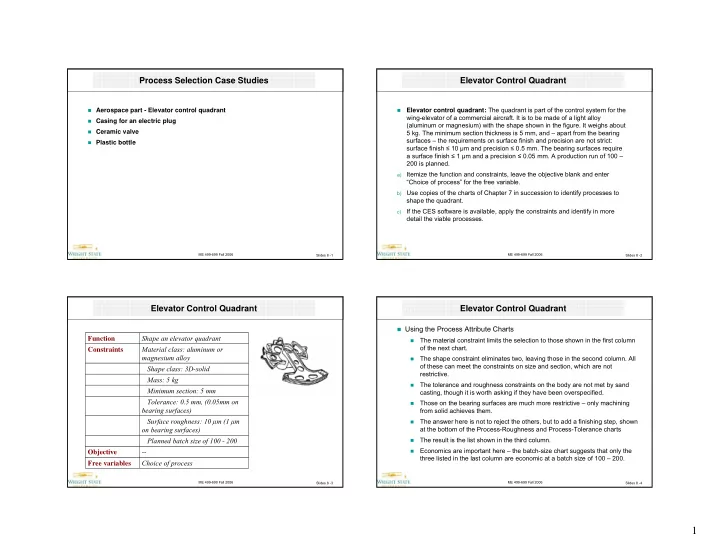
  • Elevator control quadrant: The quadrant is part of the control system for the

wing-elevator of a commercial aircraft. It is to be made of a light alloy (aluminum or magnesium) with the shape shown in the figure. It weighs about 5 kg. The minimum section thickness is 5 mm, and – apart from the bearing surfaces – the requirements on surface finish and precision are not strict: surface finish ≤ 10 μm and precision ≤ 0.5 mm. The bearing surfaces require a surface finish ≤ 1 μm and a precision ≤ 0.05 mm. A production run of 100 – 200 is planned.

a)

Itemize the function and constraints, leave the objective blank and enter “Choice of process” for the free variable.

b)

Use copies of the charts of Chapter 7 in succession to identify processes to shape the quadrant.

c)

If the CES software is available, apply the constraints and identify in more detail the viable processes.

ME 499-699 Fall 2006 Slides 8 -3

Elevator Control Quadrant

Choice of process Free variables

  • Objective

Planned batch size of 100 - 200 Surface roughness: 10 μm (1 μm

  • n bearing surfaces)

Tolerance: 0.5 mm, (0.05mm on bearing surfaces) Minimum section: 5 mm Mass: 5 kg Shape class: 3D-solid Material class: aluminum or magnesium alloy Constraints Shape an elevator quadrant Function

ME 499-699 Fall 2006 Slides 8 -4

Elevator Control Quadrant

Using the Process Attribute Charts

  • The material constraint limits the selection to those shown in the first column
  • f the next chart.
  • The shape constraint eliminates two, leaving those in the second column. All
  • f these can meet the constraints on size and section, which are not

restrictive.

  • The tolerance and roughness constraints on the body are not met by sand

casting, though it is worth asking if they have been overspecified.

  • Those on the bearing surfaces are much more restrictive – only machining

from solid achieves them.

  • The answer here is not to reject the others, but to add a finishing step, shown

at the bottom of the Process-Roughness and Process-Tolerance charts

  • The result is the list shown in the third column.
  • Economics are important here – the batch-size chart suggests that only the

three listed in the last column are economic at a batch size of 100 – 200.

slide-2
SLIDE 2

2

ME 499-699 Fall 2006 Slides 8 -5

Elevator Control Quadrant

Machine from solid Machine from solid Machine from solid Machine from solid FAILS Powder methods Powder methods Powder methods FAILS Sheet forming FAILS Extrusion Forging plus machining Forging plus machining Forging Forging FAILS Low pressure casting plus machining Low pressure casting Low pressure casting Investment casting plus machining Investment casting plus machining Investment casting Investment casting FAILS Die casting plus machining Die casting Die casting FAILS Sand casting Sand casting Processes that are economic at a batch of 100 - 200 Processes meeting the tolerance constraint Processes that survive the shape constraint Processes passing the material constraint

ME 499-699 Fall 2006 Slides 8 -6

Elevator Control Quadrant

Repeat with CES software – Level 2

  • Are the choices different?
ME 499-699 Fall 2006 Slides 8 -7

Casing for an electric plug

  • The electric plug is perhaps the commonest of electrical products. It has a

number of components, each performing one or more functions. The most

  • bvious are the casing and the pins, though there are many more

(connectors, a cable clamp, fasteners, and, in some plugs, a fuse). The task is to investigate processes for shaping the two-part insulating casing, the thinnest part of which is 2 mm thick. Each part weighs about 30 grams and is to be made in a single step from a thermoplastic or thermosetting polymer with a planned batch size of 5 x 10⁴ – 2 x 10⁶. The required tolerance of 0.3 mm and surface roughness of 1 μm must be achieved without using secondary operations.

(a) Itemize the function and constraints, leave the objective blank and enter

“Choice of process” for the free variable.

(b) Use the charts of Chapter 7 successively to identify possible processes to

make the casing

(c) Use the CES software to select materials for the casing.

ME 499-699 Fall 2006 Slides 8 -8

Casing for an electric plug

Choice of process Free variables

  • Objective

Planned batch size of 5 x10⁴ – 2 x10⁶ Surface roughness: 1μm Tolerance: 0.3 mm Minimum section: 2 mm Mass: 0.03 kg Shape class: 3D-solid Material class: Material class: thermoplastic or thermosetting Constraints Shape an electric plug casing Function

slide-3
SLIDE 3

3

ME 499-699 Fall 2006 Slides 8 -9

Casing for an electric plug

Here we seek a net-shape process – the casing must be shaped in one

  • peration without the need for any further finishing.

Applying the constraints as shown in the Process Attribute Charts and

eliminating processes that fail a constraint leaves two candidates:

  • Injection molding and compression molding

CES-EduPack results in the same choices

ME 499-699 Fall 2006 Slides 8 -10

Ceramic valves for faucets

Many household faucets now have ceramic valves replacing faucets in which

rubber washers tended to wear or brass surfaces tended to corrode

Ceramics wear well, and they have excellent corrosion resistance in both pure

and salt water.

A ceramic valve consists of two disks mounted one above the other, spring-

loaded so that their faces are in contact. Each disk has a diameter of 20 mm, a thickness of 3 mm and weighs about 10 grams. In order to seal well, the mating surfaces of the two disks must be flat and smooth, requiring high levels

  • f precision and surface finish; typically tolerance < 0.02 mm and surface

roughness < 0.1 μm. The outer face of each has a slot that registers it, and allows the upper disc to be rotated through 90o (1/4 turn). In the “off” position the holes in the upper disc are blanked off by the solid part of the lower one; in the “on” position the holes are aligned. A production run of 105 –106 is envisaged.

List the function and constraints, leave the objective blank and enter “Choice

  • f process” for the free variable.

Use the charts of Chapter 7 to identify possible processes to make the valve. Use the CES software to select materials for the valve.

ME 499-699 Fall 2006 Slides 8 -11

Ceramic valves for faucets

Choice of process Free variables

  • Objective
  • Planned batch size of 105 –106
  • Surface roughness: 0.1μm
  • Tolerance: 0.02 mm
  • Minimum section: 3 mm
  • Mass: 0.01 kg
  • Shape class: prismatic

Material class: technical ceramic

Constraints Shape an electric plug casing Function

ME 499-699 Fall 2006 Slides 8 -12

Ceramic valves for faucets

Applying the constraints using the Process Attribute Charts, and

eliminating processes that fail a constraint leaves only one candidate: powder methods.

The CES selection distinguishes several powder processes. The two

meet all the requirements except those on precision and tolerance are

Pressing and sintering Powder injection molding A separate grinding and polishing operation must be added to

meet the precision and tolerance requirements

slide-4
SLIDE 4

4

ME 499-699 Fall 2006 Slides 8 -13

Shaping plastic bottles

Plastic bottles are used to contain fluids as various as milk and engine

  • il. A typical polyethylene bottle weighs about 30 grams and has a

wall thickness of about 0.8 mm. The shape is 3-D hollow. The batch size is large (1,000,000 bottles). What process could be used to make them?

List the function and constraints, leave the objective blank and

enter “Choice of process” for the free variable.

Use the Process Attribute charts to identify possible processes to

make the casing.

Use the CES software to select materials for the casing.

ME 499-699 Fall 2006 Slides 8 -14

Shaping plastic bottles

Applying the constraints as shown

  • n the Charts eliminating processes

that fail a constraint in the manner of the table shown previously leaves only two candidates: blow molding and injection molding.

At Level 1 and 2 the CES selection is

the same as that derived from the charts.

At Level 3 CES distinguishes two

variants of blow molding, identifying injection blow molding, as the best choice because it can provide the desired change of section. Commercially, plastic bottles are made using injection blow molding.

Choice of process Free variables

  • Objective
  • Planned batch size >106
  • Surface roughness: 10 μm
  • Tolerance: 1 mm
  • Minimum section: 0.7 - 1 mm
  • Mass: 0.02 – 0.04 kg
  • Shape class: 3-D hollow

Material class: Polyethylene (or thermoplastic)

Constraints

Shape a polyethylene bottle

Function