
1
ME 474-674 Winter 2008 Slides 8 -1More Process Selection Case Studies
Aerospace part - Elevator control quadrant Casing for an electric plug Ceramic valve Plastic bottle
ME 474-674 Winter 2008 Slides 8 -2Elevator Control Quadrant
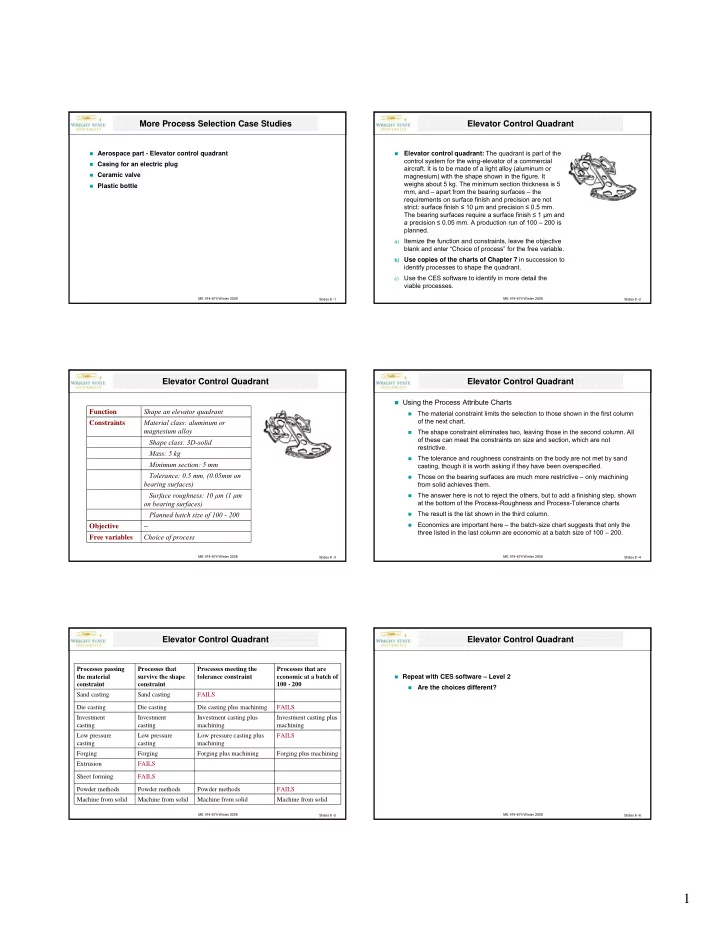
- Elevator control quadrant: The quadrant is part of the
control system for the wing-elevator of a commercial
- aircraft. It is to be made of a light alloy (aluminum or
magnesium) with the shape shown in the figure. It weighs about 5 kg. The minimum section thickness is 5 mm, and – apart from the bearing surfaces – the requirements on surface finish and precision are not strict: surface finish ≤ 10 μm and precision ≤ 0.5 mm. The bearing surfaces require a surface finish ≤ 1 μm and a precision ≤ 0.05 mm. A production run of 100 – 200 is planned.
a)
Itemize the function and constraints, leave the objective blank and enter “Choice of process” for the free variable.
b) Use copies of the charts of Chapter 7 in succession to
identify processes to shape the quadrant.
c)
Use the CES software to identify in more detail the viable processes.
ME 474-674 Winter 2008 Slides 8 -3Elevator Control Quadrant
Choice of process Free variables
- Objective
Planned batch size of 100 - 200 Surface roughness: 10 μm (1 μm
- n bearing surfaces)
Tolerance: 0.5 mm, (0.05mm on bearing surfaces) Minimum section: 5 mm Mass: 5 kg Shape class: 3D-solid Material class: aluminum or magnesium alloy Constraints Shape an elevator quadrant Function
ME 474-674 Winter 2008 Slides 8 -4Elevator Control Quadrant
Using the Process Attribute Charts
- The material constraint limits the selection to those shown in the first column
- f the next chart.
- The shape constraint eliminates two, leaving those in the second column. All
- f these can meet the constraints on size and section, which are not
restrictive.
- The tolerance and roughness constraints on the body are not met by sand
casting, though it is worth asking if they have been overspecified.
- Those on the bearing surfaces are much more restrictive – only machining
from solid achieves them.
- The answer here is not to reject the others, but to add a finishing step, shown
at the bottom of the Process-Roughness and Process-Tolerance charts
- The result is the list shown in the third column.
- Economics are important here – the batch-size chart suggests that only the
three listed in the last column are economic at a batch size of 100 – 200.
ME 474-674 Winter 2008 Slides 8 -5Elevator Control Quadrant
Machine from solid Machine from solid Machine from solid Machine from solid FAILS Powder methods Powder methods Powder methods FAILS Sheet forming FAILS Extrusion Forging plus machining Forging plus machining Forging Forging FAILS Low pressure casting plus machining Low pressure casting Low pressure casting Investment casting plus machining Investment casting plus machining Investment casting Investment casting FAILS Die casting plus machining Die casting Die casting FAILS Sand casting Sand casting Processes that are economic at a batch of 100 - 200 Processes meeting the tolerance constraint Processes that survive the shape constraint Processes passing the material constraint
ME 474-674 Winter 2008 Slides 8 -6Elevator Control Quadrant
Repeat with CES software – Level 2
- Are the choices different?