Nuclear Power and the Spent Fuel Problem 1. The US has the largest - - PowerPoint PPT Presentation

nuclear power and the spent fuel problem
SMART_READER_LITE
LIVE PREVIEW

Nuclear Power and the Spent Fuel Problem 1. The US has the largest - - PowerPoint PPT Presentation

Nuclear Power and the Spent Fuel Problem 1. The US has the largest number of reactors in the world ( 104 ). 2. The spent fuel is bad for you. For a typical, 10-year-old, spent-fuel rod the radiation dose at one meter is 20,000 rem/hr. Five


slide-1
SLIDE 1

Nuclear Power and the Spent Fuel Problem

  • 1. The US has the largest number of reactors in the world (≈ 104).
  • 2. The spent fuel is bad for you.

For a typical, 10-year-old, spent-fuel rod the radiation dose at one meter is 20,000 rem/hr. Five thousand rem is fatal in about a week; typical annual dose in the US is about 1/3 rem.

  • 3. The US now has about 45,000 tons of

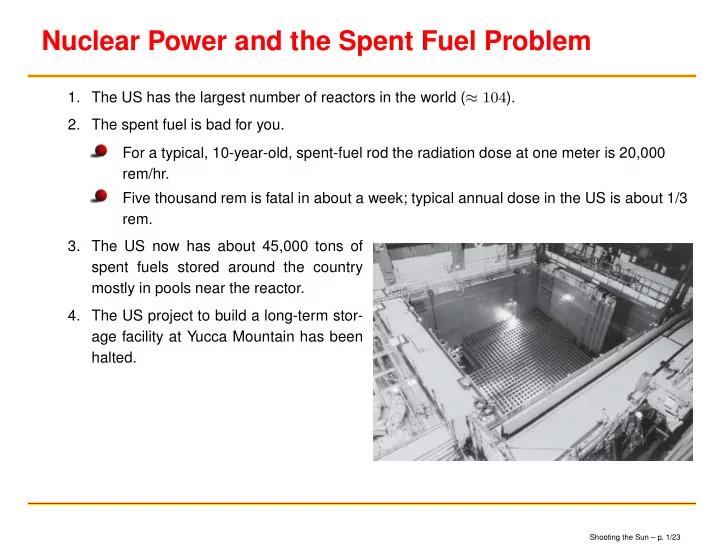
spent fuels stored around the country mostly in pools near the reactor.

  • 4. The US project to build a long-term stor-

age facility at Yucca Mountain has been halted.

Shooting the Sun – p. 1/23

slide-2
SLIDE 2

Shoot it into the Sun!

Shooting the Sun – p. 2/23

slide-3
SLIDE 3

Railguns!

A railgun is an electrically-powered artillery gun that accelerates a conductive projectile along magnetic metal rails. Does not require propellant. Can reach high launch speeds. The US Navy launched a 7-lb projectile at 5,400 mph in the late 2000’s (see it here). Could be used as a low-cost launch system Launch to Space With an Electromagnetic Railgun, Ian

  • R. McNab, IEEE Transactions on Magnetics, 39, no. 1 (2003).

Shooting the Sun – p. 3/23

slide-4
SLIDE 4

Shoot the Sun!

What is the trajectory of a projectile launched from the Earth’s surface at a speed v0 and direction φ as shown in the figure below? Get your answer in terms of v0, φ, the angular velocity ω, the masses, the distances LE and LS, and any other constants. Assume the projectile is launched from a point on the surface and radially outward at the angle φ as shown below. Consider only the gravitational forces from the Sun and the Earth. Assume the Earth and the Sun follow circular orbits around the center of mass of the Earth-Sun system. The Earth-Sun distance is RE = LS + LE.

d d m

C S

center of mass φ dE MS L S L E ME v

p

MS = 1.99 × 1030 kg ME = 5.97 × 1024 kg RE = 1.5 × 10¹¹ m rE = 6.37 × 10⁶ m rS = 6.96 × 10⁸ m

Shooting the Sun – p. 4/23

slide-5
SLIDE 5

Newton’s Law of Gravitation

  • F12 = Gm1m2

r2 ˆ r12

Shooting the Sun – p. 5/23

slide-6
SLIDE 6

Newton’s Law of Gravitation

rSp rS rp m p MS ME rE

Shooting the Sun – p. 6/23

slide-7
SLIDE 7

Launching the Projectile

L E v φ CM v

Shooting the Sun – p. 7/23

slide-8
SLIDE 8

Launching the Projectile

L E v

E

v φ CM

Shooting the Sun – p. 8/23

slide-9
SLIDE 9

Initial Velocity

r

E

Shooting the Sun – p. 9/23

slide-10
SLIDE 10

Testing the Trajectory

6 1011 4 1011 2 1011 2 1011 4 1011 6 1011 2 1011 4 1011 6 1011 8 1011 1 1012 x m y m

Shooting the Sun – p. 10/23

slide-11
SLIDE 11

Phase-Space Plot

50 100 150 200 250 300 350 0.7 0.8 0.9 1.0 1.1 1.2 1.3 phi deg v0vescape

Shooting the Sun – p. 11/23

slide-12
SLIDE 12

Richmond Computational Physics - The Cluster

Research quality cluster exclusively for student use. Head node is a 64-bit machine with eight cores, 3.5 TByte of space and 12 GByte of memory. There are seven remote nodes each with eight cores. Running Red Hat Enterprise linux. You are here.

node01−07 Richmond

VPN Head Node switch

ipmi switch

10 Gb ethernet 1 Gb ethernet 100 Mb ethernet

gluon.richmond.edu

Shooting the Sun – p. 12/23

slide-13
SLIDE 13

Why High-Performance Computing?

The growth in computing power per dollar has spawned a revolution in computational science. The obvious ones: nuclear and particle physics, SETI, biological imaging, Amazon, Google, movies. Less obvious: pharmaceutical design, protein folding, financial forecasting, auto industry. Surprises: Home Depot, Walmart, Speedo, Oil companies, making concrete. Big Surprises: art,a history, welding, small business.

aIn 2008 the National Endowment for the Humanities collaborated with the U.S. De-

partment of Energy to offer one million CPU hours on supercomputers by researchers in the humanities.

Shooting the Sun – p. 13/23

slide-14
SLIDE 14

Accessing gluon from your machine

Windows-based machines installation of WinSCP .

  • 1. Go to download page on http://winscp.net/eng/index.php.
  • 2. Click on the sponsored installation package entitled winscp436setup-sponsored.exe

and save it to the desktop.

  • 3. Double-click it and choose all the defaults.

Windows-based machines installation of PuTTY.

  • 1. Go to http://www.chiark.greenend.org.uk/~sgtatham/putty/and

download putty-0.62-installer.exe to the Desktop.

  • 2. Double-click the installer and choose the defaults EXCEPT for "Create a desktop icon

for PuTTY for all users". Mac-based machines already have have a terminal app for connecting to a remote machine - ssh <netID>@gluon.richmond.edu. Mac-based file-transfer GUIs:

  • 1. Cyberduck: http://cyberduck.ch/
  • 2. RBrowser: http://www.rbrowser.com/
  • 3. Fugu: http://rsug.itd.umich.edu/software/fugu/.

Shooting the Sun – p. 14/23

slide-15
SLIDE 15

Project Introduction

  • 1. What physics problem are you solving?
  • 2. Why is it interesting? Why should I care?
  • 3. Is it doable?
  • 4. Must make use of Monte Carlo methods and the

Richmond Computing Cluster.

  • 5. The projects listed in the syllabus are suggestions only.

Don’t just copy one.

Shooting the Sun – p. 15/23

slide-16
SLIDE 16

Uncertainty in Monte Carlo Calculations

10 100 1000 104 105 0.10 0.50 0.20 0.30 0.15 Nthrows Pmeas Effect of Increasing Nthrows

Pexp

Shooting the Sun – p. 16/23

slide-17
SLIDE 17

Richmond Computational Physics - The Cluster Development Model

Do code development, testing, and debugging on the Physics lab ma- chines. Prepare Mathematica notebooks for batch running on Physics lab ma- chines. Upload Mathematica package files (“*.m”) to the cluster. Test run in batch on the head node for a small number of events. Test run in batch on the cluster for a small number of events. Full-up run on the cluster. Download results to Physics lab machines for final analysis.

node01−07

Head Node D208 Windows machine Linux head node gluon.richmond.edu Remote cluster nodes (56 cores) WinSCP submit.pl <netID>

Shooting the Sun – p. 17/23

slide-18
SLIDE 18

Rules for readable computer code.

No ‘hardwired’ numbers! Give every quantity a name that will remind you

  • f its meaning. Hardwired numbers will cost you dearly.

Use abundant comments. Roughly one-third of the lines should be

  • comments. Describe what you are doing and how. Add comments at the

ends of multi-line loops and functions to identify the end. Use whitespace. Put blank lines between major segments of the code,

e.g. the start of a loop.

Use indentation. Arguments to loops, functions etc. and the following lines should be indented to help identify the range of these structures. For long, repetitive calculations use functions. An example is here along with a previous example of defining a function.

Shooting the Sun – p. 18/23

slide-19
SLIDE 19

Monitor the Cluster - http://gluon.richmond.edu/ganglia

Shooting the Sun – p. 19/23

slide-20
SLIDE 20

Phase-Space Portrait - 1

v /ve (deg) φ

Shooting the Sun – p. 20/23

slide-21
SLIDE 21

Phase-Space Portrait - 2

v /ve (deg) φ

Shooting the Sun – p. 21/23

slide-22
SLIDE 22

Phase-Space Portrait - 3

v /ve (deg) φ

Shooting the Sun – p. 22/23

slide-23
SLIDE 23

Phase-Space Portrait - 4

v /ve (deg) φ

Shooting the Sun – p. 23/23