River Ecosystem in Bangladesh Bangladesh is a great delta formed by - - PDF document

river ecosystem in bangladesh
SMART_READER_LITE
LIVE PREVIEW

River Ecosystem in Bangladesh Bangladesh is a great delta formed by - - PDF document

Gorai River and its Environmental Flow : Problems, opportunities and threats Engr (Ms) Reba Paul E Executive Secretary, Bangladesh Water Partnership ti S t B l d h W t P t hi I nternational Symposium on Harmonising Environmental


slide-1
SLIDE 1

1

Engr (Ms) Reba Paul

E ti S t B l d h W t P t hi

Gorai River and its Environmental Flow : Problems, opportunities and threats

Executive Secretary, Bangladesh Water Partnership

I nternational Symposium on Harmonising Environmental Considerations with Sustainable Development Potential of River Basins Organised by I nstitute for Environment and Development (LESTARI ) Universiti Kebangsaan Malaysia

1

Kebangsaan Malaysia Supported By UNESCO Prince Hotel, Kuala Lumpur, 24-26 March, 2010

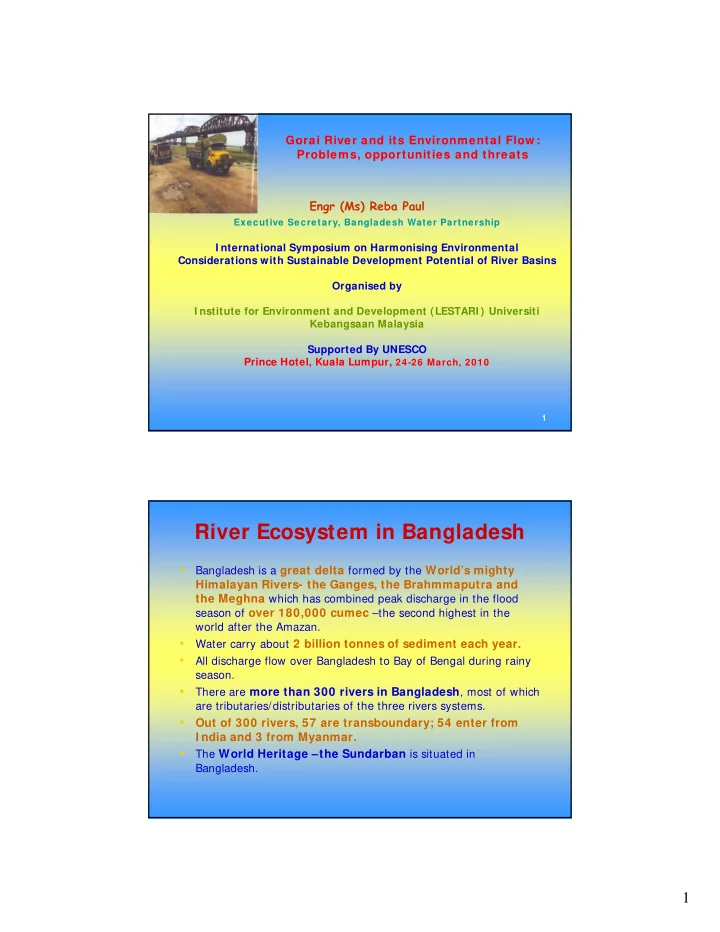
River Ecosystem in Bangladesh

  • Bangladesh is a great delta formed by the World’s mighty

Himalayan Rivers- the Ganges, the Brahmmaputra and the Meghna which has combined peak discharge in the flood

season of over 180,000 cumec –the second highest in the world after the Amazan.

  • Water carry about 2 billion tonnes of sediment each year.
  • All discharge flow over Bangladesh to Bay of Bengal during rainy

season.

  • There are more than 300 rivers in Bangladesh, most of which

are tributaries/distributaries of the three rivers systems.

  • Out of 300 rivers, 57 are transboundary; 54 enter from

I ndia and 3 from Myanmar.

  • The World Heritage –the Sundarban is situated in

Bangladesh.

slide-2
SLIDE 2

2

The Ganges, the Brahmmaputra and the Meghna river Basins

  • All flow over Bangladesh
  • 97 % of total basin

(1600 sq km) area lie

  • utside Bangladesh

and only 7% lies within Bangladesh. Ganges Basin Brahmaputra Basin Meghna Basin

  • Abundant water

during flood season (July-Oct).

  • Scarcity of water

during dry season (December -May)

Flood is a common phenomenon in Bangladesh Flood is a common phenomenon in Bangladesh

River Pollution

slide-3
SLIDE 3

3

Bangladesh faced serious drought in 1979, 1981, 1982, 1989 in recent years From Nov. 1998 to April 1999 practically no rain for 150 days at a stretch.

Drought Problem in Bangladesh

During 1950-1979 drought affected 20% of the country During 1994- 95 drought adversely affected STW’S, LLP’S and traditional irrigation systems. Out of 1200000 irrigation tubewells, 400000 every year go under suction limit in March-April (dry period) and p ( y p ) become out of order. Present food demand is 2 crore 70 lac tons and the future demand of food is 4 crore 15 lac tons by 2015. Irrigation demand will increase by many folds.

Gorai Gorai River River

West Bengal, India West Bengal, India

slide-4
SLIDE 4

4

FARAKKA BARRAGE

Regulated flow in the Ganges by India at Farakka Barrage has initiated desertification in north, south and central parts of Bangladesh.

Low Low fow fow in in Gorai Gorai river and its consequences river and its consequences

  • Both wet and dry season flow in

Both wet and dry season flow in Gorai Gorai river has been decreased river has been decreased significantly after construction of significantly after construction of Farakka Farakka barrage by India. barrage by India.

  • The decrease in flow of

The decrease in flow of Gorai Gorai river has affected agriculture, river has affected agriculture, forestry, fisheries, livestock and caused salinity intrusion in both forestry, fisheries, livestock and caused salinity intrusion in both surface and ground water and water pollution surface and ground water and water pollution surface and ground water and water pollution. surface and ground water and water pollution.

  • Such low flow in

Such low flow in Gorai Gorai has increased siltation at has increased siltation at Gorai Gorai mouth and mouth and Mongla Mongla port ( an economic zone) and intensified flood and cyclones. port ( an economic zone) and intensified flood and cyclones.

  • It has affected the

It has affected the Sundarban Sundarban mangrove forest mangrove forest – –the World Heritage the World Heritage site. site.

  • The present flow in

The present flow in Gorai Gorai is about 5000 m3/s peak. Any further is about 5000 m3/s peak. Any further decrease may cut off decrease may cut off Gorai Gorai river from the Ganges. river from the Ganges. Th t l d fl t ff l t l i 1992 d b Th t l d fl t ff l t l i 1992 d b

  • The natural dry season flow was cut off completely in 1992 and by

The natural dry season flow was cut off completely in 1992 and by dredging the flow was restored in 1998. But it dried up again when dredging the flow was restored in 1998. But it dried up again when dredging was discontinued. dredging was discontinued.

  • Due to low flow in

Due to low flow in Gorai Gorai many development projects like many development projects like Sundarban Sundarban Biodiversity project are being hampered. Biodiversity project are being hampered.

slide-5
SLIDE 5

5

River Siltation

er

R iv e r S ilt a t io n in S

  • u

t h w e s t R e g io n

r a d a b a l a K r e v i R i t n a y a J a h d n a h S r u p r i z U a t l a h S r e v i R a i d n a k h s i B e t u
  • R
l e e B r u p i r a d a M r e v i R i k n a b
  • r
a h t A R a g n a g a b a N R r e v i R R E V I R A N H G E M S k p u r a w S r e v i R a r t i h C r e v i R a h d l i a S r e v i R i t a m u h d a M r e v i R r a g a h G a g n a g i l a K r i a h B r e v i R a s p u R b i z a K i R l i a r g n e h S h s k a t
  • p
a K r e v i R a h s i l I n a h K l a i r A i d a N i l a t m A r e v i R i n a g n a h B a y a N r e v i R i k r a T l a h K r e t a r a s a B R g n a l P l a h K a i r a N R c n a l a P r e v i R n a h K l a i r A r e v i R a i s a r a B r e v i R i t a m u h d a M r e v i R a g n a g a b a N r e v i R r a m u K r e v i R a h k a l a t i S r e v i R r a m u K r e v i R r a m u K r e v i R a n d n a h C i d a N a g n a G i l a K r e v i R a n t e B r e v i R k a d a b
  • K
r e v i R b a r i a h B r e v i R a r t i h C r e v i R r a m u K r e v i R a g n a g a b a N r e v i R i a r a G R E V I R A N H G E M R E P P U R E V I R A M D A P

P a d m a R i v e r Pad ma River Jamuna Rive Gorai River K u m a r R i v e r N a b a g a n g a R Chandna River Upper Meghna River

H e a v y H e a v yS ilta tio n S ilta tio n S lo w S lo wS lita tio n S lita tio n M

  • d

e ra te M

  • d

e ra teS ilta tio n S ilta tio n

g

r a d a b a l a K r e v i R i t n a y a J a h d n a h S r u p r i z U a t l a h S r e v i R a i d n a k h s i B e t u
  • R
l e e B r u p i r a d a M r e v i R i k n a b
  • r
a h t A R a g n a g a b a N R E V I R A N H G E M w S r e v i R a r t i h C r e v i R a h d l i a S r e v i R i t a m u h d a M r e v i R r a g a h G e v i R a s p u R a r g n e h S
  • p
a K r e v i R a h s i l l a i r A i d a N i l a t m A r e v i R i n a g n a h B a y a N r e v i R i k r a T l a h K r e t a r a s a B R g n a l P l a h K a i r a N R c n a l a P r e v i R n a h K l a i r A r e v i R a i s a r a B r e v i R i t a m u h d a M r e v i R a g n a g a b a N r e v i R r a m u K r e v i R a h k a l a t i S r e v i R r a m u K r e v i R r a m u K r e v i R a n d n a h C i d a N a g n a G i l a K r e v i R a n t e B r e v i R k a d a b
  • K
r e v i R b a r i a h B r e v i R a r t i h C r e v i R r a m u K r e v i R a g n a g a b a N r e v i R i a r a G R E V I R A N H G E M R E P P U R E V I R A M D A P

P a d m a R i v e r Pad ma River Jamuna River G

  • rai River

K u m a r R i v e r N a b a g a n g a R Chandna River Upper Meghna River

a r i a P d a b a r i a h K R a i t a m a g n a R R a i l u h D R a l
  • h
k n
  • t
r i K R E V I R R U P Z A B H A H S ' r e v i R i t a k r e v i R r e v i R r a w s e l a B r e v i R a h c a K r e v i R i h h c u g n a F i d a N a l g n u M r e v i R b a r R i l a h k d u a D r e v i R a h c n a b r e v r e v i R i r e v i R p a h c i r
  • M
r e v i R a u t e p l
  • h
K g n a G a l e S r a m t e B a r
  • h
C l a h K i t a p u S r e v i R r a w s e l a B r e v i R i l a h k a u t a P r e v i R a p i h c a l a G r e v i R a i l u t e T r e v i R i l a h k h s i B r e v i R a i l u t e T R r e v i R r a w s i r u B r e v i R i l a h k h s i B r e v i R r a w s e l a B r e v i R a l
  • h
B l a h K i a m r A g n a G a l e S g n a G r a d a h B a r a M R a i r a b k a S r e v i R a r y
  • K
R p u d l a T l a h K a l t u P r e v i R a s b i S r e v i R k a d a b a K r e v i R a u t e p l
  • h
K R r a n u h C r e v i R a h
  • n
a l a M r e v i R r u s s a P r e v i R j a r s n a H G t a d r a M r e v i R u l a B r e v i R a i s a g n a p r A g n a G r a d a M r e v i R a n u m a J a r i a P d a b a r i a h K R a i t a m a g n a R R a i l u h D r e v i R a l
  • h
k n
  • t
r i K R E V I R R U P Z A B H A H S ' r e v i R i t a k p u r a w r e v i R a g n a g i l a K r e v i R r a w s e l a B r e v i R a h c a K r e v i R i h h c u g n a F i d a N a l g n u M r e v i R b a r i a h B R i l a h k d u a D r e r e v i R a h c n a b i z a K r e v i R l i a r e v i R i h s k a t
  • r
e v i R p a h c i r
  • M
r e v i R a u t e p l
  • h
K g n a G a l e S r a m t e B a r
  • h
C l a h K i t a p u S r e v i R r a w s e l a B r e v i R i l a h k a u t a P r e v i R a p i h c a l a G r e v i R a i l u t e T r e v i R i l a h k h s i B r e v i R a i l u t e T I R n a h K r e v i R r a w s i r u B r e v i R i l a h k h s i B r e v i R r a w s e l a B r e v i R a l
  • h
B l a h K i a m r A g n a G a l e S g n a G r a d a h B a r a M R a i r a b k a S r e v i R a r y
  • K
R p u d l a T l a h K a l t u P r e v i R a s b i S r e v i R k a d a b a K r e v i R a u t e p l
  • h
K R r a n u h C r e v i R a h
  • n
a l a M r e v i R r u s s a P r e v i R j a r s n a H G t a d r a M r e v i R u l a B r e v i R a i s a g n a p r A g n a G r a d a M r e v i R a n u m a J

Silted Silted Gorai Gorai River River

slide-6
SLIDE 6

6

Ganges at Hardinge Bridge during dry season

The Gorai River –the main off take of the Ganges become totally dry during dry season

Salinity Intrusion in the coastal region and its effects

Bardia Khulna Mongla

  • Gorai-Pussur-Sibsa River System

Hiron Point

Sundarban

slide-7
SLIDE 7

7

Other Water Related Problems

Flood

Cyclone

Cyclone River Erosion Cyclone

River Pollution

Arsenic Pollution

Climate Change is major threat

Threats

Submergence of

  • Sea Level rise
  • Increase in evaporation
  • Increase in snow melt in Himalayas
  • Sea level rise

Submergence of coastal areas Increase in snow melt in Himalayas

  • Increase in rainfall in monsoon
  • Water scarcity in dry season

Increase in flood intensity and duration

Increase in salinity intrusion

intensity and duration

Increase in drought and desertification

slide-8
SLIDE 8

8

Government’s I nitiative

Due to lack of regular dredging, and high silt load from upper riparian Rivers, most of the rivers have been silted up. The Government of Bangladesh has undertaken a plan costing of US$ 1.71 billion for dredging of 310 rivers all over the country to bring back navigability, control floods and ensure proper irrigation through water conservation in dry season. Government has already started dredging of Padma and Buriganga river. The projects are the pilot capital dredging of river system in Bangladesh (first phase) worth Tk 1,445.51 crore, Buriganga recovery project worth Tk 1,514.95 crore, purchasing of dredgers and ancillary equipment for dredging rivers with a cost of Tk 1,593.68 crore and coordinated irrigation, extraction and flood control project worth Tk 378.52 crore.

"Gorai river recovery project (second phase)" worth Tk 942.15 crore has

already begun. already begun.

Government has taken an initiative to construct Ganges Barrage.

The Glaciers in Himalayas - a source of of captive water feeds most

  • f the downstream major perennial river systems (the Ganges, the

Brahmmaputra, the Meghna and the Indus) in the region crossing Bangladesh, India, Nepal and Pakistan and is considered the lifeline for i t l 10 t f th ld’ l ti

The Himalayas is under threat of climate change

approximately 10 per cent of the world’s population. The Himalayan glaciers have been melting at an unprecedented

rate in recent decades and this trend may cause major changes in freshwater flow regimes downstream and is likely to have a dramatic impact on drinking water supplies, biodiversity, hydropower, industry, agriculture and others, with far-reaching implications for the people of the region and the earth’s environment.

One result of glacial retreat - glacial lake outburst flood (GLOF) —

and the results can be catastrophic to the downstream riparian areas. Such disasters often cross boundaries; the water from a lake in one country threatens the lives and properties of people in another.

slide-9
SLIDE 9

9

Main Source of the downstream rivers

Himalayan Water Towers Source of water The Himalaya is under threat of li t h water climate change

Kosi River Agreement signed April

Only Bilateral water cooperation exist in the region

The sharing of the riparian river water has been a bone of contention between India, Bangladesh & India and Nepal since past 50 years Kosi River Agreement signed April, 1954 Trisuli Agreement, Nov, 1958 Gandak Project and Power Agreement, 1959 Mahakali Integrated Development Treaty Jan 1996 Treaty, Jan, 1996 Indus Water Treaty between India and Pakistan in 1960. (through mediation by the World Bank) Ganges Water Treaty, Dec, 1996 (The

  • nly Treaty of India with Bangladesh)
slide-10
SLIDE 10

10

Annexure- I

Availability at Farakka Share of India Share of Bangladesh Availability at Farakka Share of India Share of Bangladesh 70,000 cusecs or less 50% 50% 70,000 - 75,000 cusecs Balance of flow 35,000 cusecs 75,000 cusecs or more 40,000 cusecs Balance of flow Subject to the condition that India and Bangladesh each Subject to the condition that India and Bangladesh each shall receive guaranteed 35,000 cusecs

  • f

water in alternate three 10-day periods during the period March 11 to May 10.

Sound basin wide catchments management is an essential long-

term strategy to combat the threat to floods, droughts, inland navigation; meet energy demand and preserve the ecosystem in the

  • region. And it needs both structural and non-structural measures.

Long Term Solution: Need for Regional Cooperation

Due to seasonal variation having abundance of water during

monsoon and little water during dry season, harnessing of the bounty of this water is very essential which requires storage of monsoon flows over space and time when and where required within a framework of sustainable development.

The sediment load in the rivers in the region, which is largely the

consequence

  • f

geomorphologic processes in the upper catchments, tends to increase with the progressive removal of vegetative cover on slopes. Soil conservation and reforestation in the upper catchments of Nepal and India as well as within Bangladesh could help substantially reducing sedimentation.

slide-11
SLIDE 11

11

Benefits of Regional Cooperation

188000 cusec

Augmentation of the dry season Ganges Flows

Owing to the seasonal variability of water volume in the G-B-M river systems, the dry season flows of the G-B-M rivers particularly of the Ganges are inadequate to meet the combined needs of the region. As early as 1974, the Prime Ministers of India and Bangladesh had recognized the need for augmentation of the dry season Ganges flows. The Ganges Water Sharing Treaty of 1996 also includes a provision for the two governments ‘to cooperate with each other in finding a solution to the long term problem of augmenting the flows of the Ganges during the dry season.

One possible option for substantial augmentation of the Ganges

which, could benefit Nepal, India and Bangladesh, would be to construct large storages on the Ganges tributaries originating in Nepal.

slide-12
SLIDE 12

12

Contd..

On

the basis

  • f

studies, in 1983 Bangladesh proposed construction of seven large storage reservoir at Chisapani, g g p , Kaligandaki-1, Kaligandaki-2, Trisulganga, Seti, Saptokosi and Pancheswar in Nepal which could augment the dry season flows of the Ganges by 1670 cumecs (built at normal height) and 5385 cumecs (with the storage reservoir at Chisapani, Trisulganga, Seti and Saptokosi built above normal heights). Studies indicated that construction of the proposed storage reservoir are technically feasible. Moreover, the storage i ld d t f h d reservoirs would produce enormous amounts

  • f

hydro- electricity that could meet the power demands of the region.

Seven feasible Dam sites in Nepal for water Conservation

(Koshi, Trisulganga, Kaligandak-I, Kaligandak-II, Seti,Chisapani, Pancheswar )

slide-13
SLIDE 13

13

  • A highly favourable project from this perspective is

the Sapta Kosi High Dam in Nepal, the revived third phase of the original Koshi project.

  • The Kosi Dam will have a significant storage that

should provide both North Bihar (India) and Bangladesh Flood Cushion and augment dry season flows after meeting Nepal’s full irrigation requirements so that Bangladesh can get increased additional share of water (around 50000 cusec) during dry season as per provision of flow augmentation under Indo_Bangladesh Water Treaty signed in 1996.

Contd..

  • Nepal would also be the sole beneficiary of generating about

30000 MW hydropower and selling to India and Bangladesh. A Regional Power Grid can transfer the hydropower to all the regional countries at a cost cheaper than produced from conventional source of energy conventional source of energy.

  • All the three countries India, Nepal and Bangladesh need to

work together to develop such a great potential of flow augmentation during dry season and prospects of hydropower generation in the Ganges river basin.

  • To foster regional cooperation in the Ganges River Basin, a

Supra national organisation like Ganges River Basin Commission (GRBC) may be formed to reap the benefits of such transboundary river basin management.

slide-14
SLIDE 14

14

Navigation Improvements in the G-B-M River Basins

= > As a landlocked country, Nepal has a vital interest in securing access to the sea through the rivers. The establishment of links with the inland water transport networks of I ndia and Bangladesh would provide Nepal access to Kolkata (I ndia) and Mongla (Bangladesh) ports. = > Potential exists for the development of water transport in Nepal in all the three major rivers (Karnali, Gandaki and Koshi) which are tributaries to the Ganges. Concentration of high dam schemes on these rivers would improve the navigability in these channels these channels. = > The Karnali has the maximum potential for navigation –all the way from the I ndo- Nepalese border to the confluence with the Ganges. = > The Gandak is an important waterway serving central Nepal and has the navigation potential for eastern Uttar Pradesh and eastern Bihar states of I ndia for linking it with I ndia’s National Waterway No. 1 in the Ganges running from Allahabad to Haldia, below Kolkata. = > The maintenance and further development of navigable depth, navigational aids and terminal facilities would enhance the navigation potential in the GBM region. and terminal facilities would enhance the navigation potential in the GBM region. = > I ndia and Bangladesh have a bilateral protocol, renewed every two years for using the Ganges-Brahmmaputra-Meghna rivers for water transit between West Bengal and

  • Assam. An old route during the British days can also be revived in the Ganges

connecting Aricha and Rajbari in Bangladesh with Murshidabad and Alahabad passing through Farakka lock gate by ensuring the year round navigational flow in the Ganges.These routes –not optimally used at present could improve their potentials through channel improvement, better pilottage and navigation aids and standardization of rules and regulations. A dedicated willingness to integrate the water ways network in the G-B-M region would benefit all the countries in the long run.

Navigation

Opportunities

Farakka

Kosi-Ganges-Bhagirathi-Hoogly to Calcutta port Kosi-Mahananda-Ganges-Gorai to Mongla port Ganges-Padma-Meghna-Surma-Barak to East India Bay-Meghna-Surma-Barak to East India

slide-15
SLIDE 15

15 Inland Water Route

a) I nland water Transit with the following routes

  • 1. Kolkata-BojBoj-Diamond Harbour-Mongla-Chalna-Barisal-Chadpur-Aricha-

Sirajganj-Chilmari-Doikhali-Gauhati

  • 2. Kolkata-Meghna-Daudkandi-Bhairab-Fenchuganj-Sherpur-Jokiganj-

Karimganj-Pandu (near Gauhati) Karimganj Pandu (near Gauhati)

  • 3. Dhaulian ( downstream to Farakka)-Rajshahi (53 km length used for

transportation of bolders but stopped for lack of draft during dry season)

  • 4. For oil transportation

Shilghat-Gauhati-Baghabari

b) I nter Country I nland Water Traffic

1 Kolkata-Bojboj-Narayanganj av yearly traffic – 7 Lac tons

  • 1. Kolkata-Bojboj-Narayanganj, av. yearly traffic

7 Lac tons c) New Opportunity for I nland Navigation

1) If lock gate is put in Jangipur barrage, the following route could be

revived:Aricha-Rajshahi-Jangipur----Bhagirathi – Farakka -- Murshidabad --Alahabad

2) Mizorum-Monipur-Kaptai using Karnaphuli river u/s & d/S and using land route from Kaptai to Chittagong port

World Bank’s Recent Initiative The Abu Dhabi Dialogue

  • It’s an ongoing dialogue on South Asia Water Cooperation among senior

political, government, academic, non-government and civil society members from 7 countries - Afghanistan, Bangladesh, Bhutan, China, India, Nepal &

Pakistan Pakistan

  • The First Meeting of Abu Dhabi Dialogue held in Abu Dhabi in September,

2006.

  • The Second Meeting of Abu Dhabi Dialogue held in Bangkok in July 2007
  • The Third Abu Dhabi Dialogue held in Singapore from 23-35 July, 2008

A Consensus Vision’ : “A cooperative & knowledge-based partnership of states fairly managing & developing the Himalayan River systems to bring economic prosperity, peace & social harmony, & environmental economic prosperity, peace & social harmony, & environmental sustainability from the source to the sea.”

(Derived from the statement of India PM speech, July 2007)

  • Initial actions agreed:

– Action 1. Maintain and expand the Dialogue. – Action 2. Launch a coordinated communication and outreach agenda. – Action 3. Conduct coordinated research & training activities.

slide-16
SLIDE 16

16

Abu Dhabi Knowledge Forum Abu Dhabi Knowledge Forum

  • The Abu Dhabi Group Knowledge Forum held at Singapore from 25-

27 July, 2008 facilitated by the ICIMOD, Nepal.

  • This is a follow up of the 4th Assessment Report of IPCC which

identified the lack of current knowledge on climate change impacts on g g p water resources in the greater Himalayan region.

  • Objective of this knowledge forum:
  • Establish a “knowledge-based partnership of states” to fulfill knowledge

gaps on climate change impacts on water resources in the greater

Himalayan region.

D l h i f h i f d & i f i i h i – Develop mechanisms for sharing of data & information in the region. – Sharing practical experiences of coping with special challenges of the Rivers of the Greater Himalayas.

World Bank Meeting Experts of Bangladesh to share their experience in water resource management in Bangladesh.

  • There is no dearth of water expertise .
  • I t need the initiatives of the political governments of the region for cooperative

water resources management.

  • World bank will facilitate it as a honest broker.
slide-17
SLIDE 17

17

Huge potential in the region

The Way Forward

There is no lack of expertise in South Asian

countries.

Initiatives must be taken by the national

governments.

India must have to come forward to support India must have to come forward to support

this regional transboundary river basin cooperation rather being a hydro-hegemon.