
SLIDE 1
SALAHUDDIN KASEM KHAN Executive Chairman, SEACO FOUNDATION, - - PowerPoint PPT Presentation
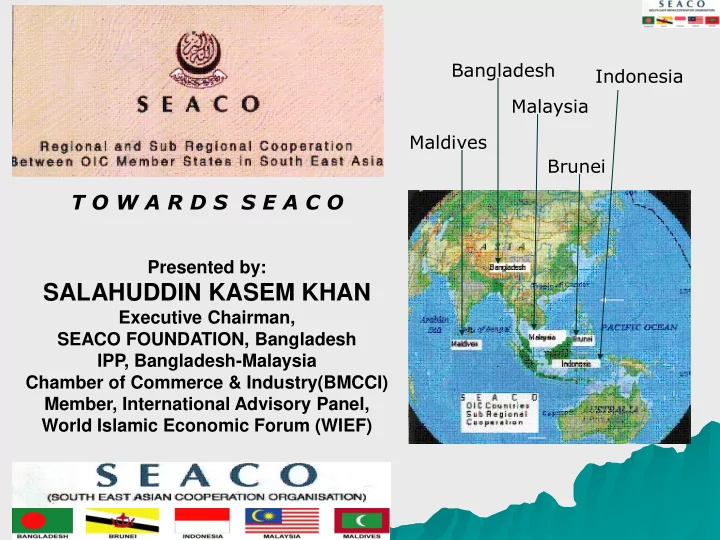
Bangladesh Indonesia Malaysia Maldives Brunei T O W A R D S S E A C O Presented by: SALAHUDDIN KASEM KHAN Executive Chairman, SEACO FOUNDATION, Bangladesh IPP, Bangladesh-Malaysia Chamber of Commerce & Industry(BMCCI) Member,
Bangladesh Maldives Malaysia Indonesia
SEACO
Brunei
that SEACO could develop as an economic link between ASEAN and SAARC. Area Million sq. miles
Population 365 million Combined GDP $ 280 billion
Average GDP growth rate
6% per anum
Total Trade $ 265 Billion
The Foreign Minister of Bangladesh in a letter on May 12, 1994, to his counterparts the Foreign Ministers of Brunei, Malaysia, Maldives and Indonesia forwarding the SEACO proposal stated: Academics policy-makers, functionaries of the Chambers leaders of trade, industry and investment networks across this vast area have articulated the idea
A resolution on SEACO, moved by Bangladesh Delegation, was endorsed by the INDO-IDB Product Seminar, Bandung 11-18 December 1992 Chaired by Dr B.J Habibie, Government
Indonesia and Co-chaired by President Islamic Development Bank Recommended by the Eleventh General Assembly of the Islamic Chamber of Commerce Industries and Commodity Exchange (ICCICE), Kuala Lumpur (6-7 December 1993) and also by the International Seminar on Islamic Common Market (ICM), Dhaka (18-20 December, 1993). “It will be appreciated if your Excellency will kindly ascertain the reaction of your Government towards holding informal consultation on the idea of forming SEACO and convey the same to us at an early date.”
Bangladesh FM letter on SEACO, dated: May 1994
The IDB President’s letter dated 10th June,2009
commended the efforts on formation of SEACO and stated: I also appreciate your proposal for formation
some Regional Economic & Trade Cooperation Arrangements among the 5 OIC Member States, namely Indonesia,Mlalaysia,Berunei,Bangladesh and Maldives located in the South and southeast Asia, I would like to suggest that such a subject to be initiated by the concerned Member
will be happy to extend its support. I also would like to take the
to refer to my letter No: 72/10/216/830 dated 15th July,1996 in which I mentioned that “IDB would seriously consider extending technical support to the intended regional meeting when the concerned Member States decide to hold the meeting. IDB looks forward to the creation of SEACO as an important initiative to the promotion of cooperation among Member States and hopes for cooperation with this organization when it is established.”
“Recalling Resolution No. 1-9-E (IS) adopted by the Ninth Session of the Islamic Summit Conference in Doha; Also recalling Resolution NO. 1/28-E adopted by the Twenty-eight Session of the Islamic Conference of Foreign Ministers; Further recalling Resolution No. 6/24-E of the 24th Session of the Islamic Conference
Foreign Ministers, in which Member States were invited to reinforce Sub-Regional and Regional Markets and relaunch the existing economic integration projects among themselves;”
Having considered the report of the Secretary General on the matter:
“1. Stresses the need to promptly take practical steps, foremost of which is to set up joint investment projects among Member States, to achieve economic complementarity between them to ensure economic integration among the OIC Member States with the ultimate objective of establishing an Islamic Common Market or any other form of economic integration, on a step –by – step basis, and commends the efforts exerted by the Arab Economic and Social Council to create a major Arab free trade zone and encourages the regional organizations in which Member States participate, especially the ECO, SEACO, ECOWAS, CEMAC and CEMAO to continue their efforts in this area.”
“Further recalling Resolution” No. 6/24-E of the 24th Session of the Islamic Conference of Foreign Ministers, in which Member States were invited to reinforce Sub-Regional and Regional Markets and relaunch the existing economic integration projects among themselves.” “1. Reiterates urgent need to take practical steps to ensure economic integration among the OIC Member States with the ultimate objective of establishing an Islamic Common Market or any other form of economic integration, on a step-by-step basis, among OIC Members States, and commends the efforts exerted by the Arab Economic and Social Council to create a major Arab free trade zone and other similar initiatives namely, the ECO, SEACO, ECOWAS, CEMAC and CEMAO”
Economic Cooperation Call upon the Member States to sign and ratify all existing OIC trade and economic agreements, and to implement the provisions of the relevant OIC Plan
Member States. Mandate COMCEC to promote measures to expand the Scope of intra OIC trade and to consider the possibility of establishing a Free Trade Area between the Member States in order to achieve greater economic integration to raise it to a percentage of 20% of the overall trade volume during the period covered by the plan. Promote endeavors for institutionalized and enhanced cooperation between OIC and regional and international institutions working in the economic and commercial fields.
H.E. The Malaysian Prime Minister and Chair of OIC Datuk Abdullah Ahmad Badawi urged the Economic and Finance Ministers of OIC at the IDB Group Meeting in K.L in 20TH June,2005
“ We should actively promote and integrate markets and reduce tariffs and non tariff
towards an Islamic Common Market. In the past trade was an important bond for Muslim Communities-today this bond has become weak. We do not trade with each other as much as we used to do during the peak
One of the biggest challenges confronting the OIC is the vast economic imbalances that exist among the Member countries of OIC. The statistics not only give cause for concern but also inform us of their potential for self help that exists within the Groupings. The Prime Minister said Intra OIC Trade was only 12% of the total trade of the OIC
60% of the World’s Natural Resources.
FDI:
In terms of FDI, the total FDI inflows into the OIC Member Countries in 2003 stood at US$ 24.1 Billion an increase of 20.8% over US $ 20 Billion in 2002. However, 561% or US$ 12.2 Billion of the total FDI inflow went to only five Member Countries namely Malaysia, Brunei, Azerbaijan , Morocco and Kazakhstan.”
Whereas the idea of an Islamic Common Market (ICM) remains the ultimate objectives of the Organization of Islamic Conference – a SEACO regional Free Trade Area, could take shape now given the political will and commitment of the proposed OIC Member States in keeping with the third Extraordinary Session of the Islamic Summit Conference, Makkah Mukharamah (7-8 December, 2005) The Conference emphasized the need to make optimal use of the human, natural and economic resources of the Muslim World in order to promote this cooperation, consider the possibilities of establishing a Free Trade Area among the member states. Therefore, the SEACO Task Force, Dhaka calls on the Governments of Bangladesh, Brunei, Indonesia, Malaysia and Maldives to set up an inter-governmental “SEACO Task Force” and to call a Preparatory Meeting of the Trade Ministers and the Private/Public Sectors of this Region, with the participation of the IDB, ICDT, COMCEC and the ICCI to give effect to the SEACO Resolutions of the 24th, 28th, 29th ICFM’s and the 9th Islamic Summit, 2002, Doha and the IDB to facilitate the holding of this technical meeting of the inter governmental “SEACO Task Force”. The setting up of SEACO Task Forces in each participating SEACO country with the Government and Private /Public Sector be mandated with the task of drawing up the “SEACO-FTA” Draft Agreement for consideration of the proposed inter-governmental SEACO Task Force within a time bound process. The SEACO Task Force, Dhaka believes that the regional “SEACO-FTA” approach can ,therefore, be the building block towards the proposed Islamic Free Trade Area (IFTA) and lay the foundation of the future edifice of the Islamic Common Market as envisioned by the Makkah Declaration. “0 Muslims you are the best Middle Nation to serve as a model for Mankind. The Messenger of Allah serves as a Model for you. "
(History, Culture, Geo-Politics, Religion and contemporary position of five Muslim countries of the region)
(R& D, planning, implementation, communication, field, event, office and assignment management )
(for English and Bahasa Malay and Bangla Bahasa )
Abstract: Against ihe global backdrop of the World's financial crisis and recession , the breakdown in WT() Talks. Climate Change ; coupled an EU-style East-Asian Economic Community, the OlC countries in South and Southeast Asia need to take step to enhance regional and sub-regional trade, investment and overall co-operation. The plan of action and the Dhaka Declaration of the sixth Islamic Summit (Olt) had also resolved to strengthen measure in this
regional co-operation arrange-ment s such as ACM, AMU. ECOWAS, CEAO, OCC, ACC, and ECO. lowever, no framework for similar institutional or socio-economic co-operation exits among OIC countries in this region. It has, therefore, been proposed that the creation of the South NISI Asian Co-operation Organi-zation (SEACO) (comprising Bangladesh, Bnmei Darussalam, Indonesia, Maldives, and Malaysia) will bring about the desired integration among the participating states with the private sector associated closely. SEACO Task Force and SEACO Foundation Bangladesh, SEACO Task Force Ma-laysia and others few organizations have been working for this purpose. SEACO Foundation Bangladesh with the Co-operation of SEACO Task Force Malaysia has recently taken an initiative to establish the SEACO University in Bangladesh to promote more educational, cultural and job market opportunities and facilities Ihr Muslim peoples and students in this region. This initiative would be an effective example and model or SEACO's main goal for regional co-operation by said five Muslim states private sectors in South East Asia. The paper will focus mainly the neces-sity, urgency and importance or a new framework for structured regional integration the South East Asian Co-operation (SEACO) and a first private sector's initiative SEACO University.
Salahuddin Kasem Khan at Proceedings of the 2'd International Conference on Islam and Higher Education
SEACO