Research Team PROFESSOR KEVIN BRAZIL: Principal Investigator, - - PDF document

research team
SMART_READER_LITE
LIVE PREVIEW

Research Team PROFESSOR KEVIN BRAZIL: Principal Investigator, - - PDF document

26/05/2016 PROVIDING END OF LIFE CARE FOR DEMENTIA TOWARDS A MODEL OF BEST PRACTICE IN PRIMARY CARE Presented by Dr Gillian Carter PhD Research Fellow in Palliative Care School of Nursing & Midwifery Queens University Belfast


slide-1
SLIDE 1

26/05/2016 1

PROVIDING END OF LIFE CARE FOR DEMENTIA – TOWARDS A MODEL OF BEST PRACTICE IN PRIMARY CARE

Presented by Dr Gillian Carter PhD Research Fellow in Palliative Care School of Nursing & Midwifery Queen’s University Belfast g.carter@qub.ac.uk 25th May 2016

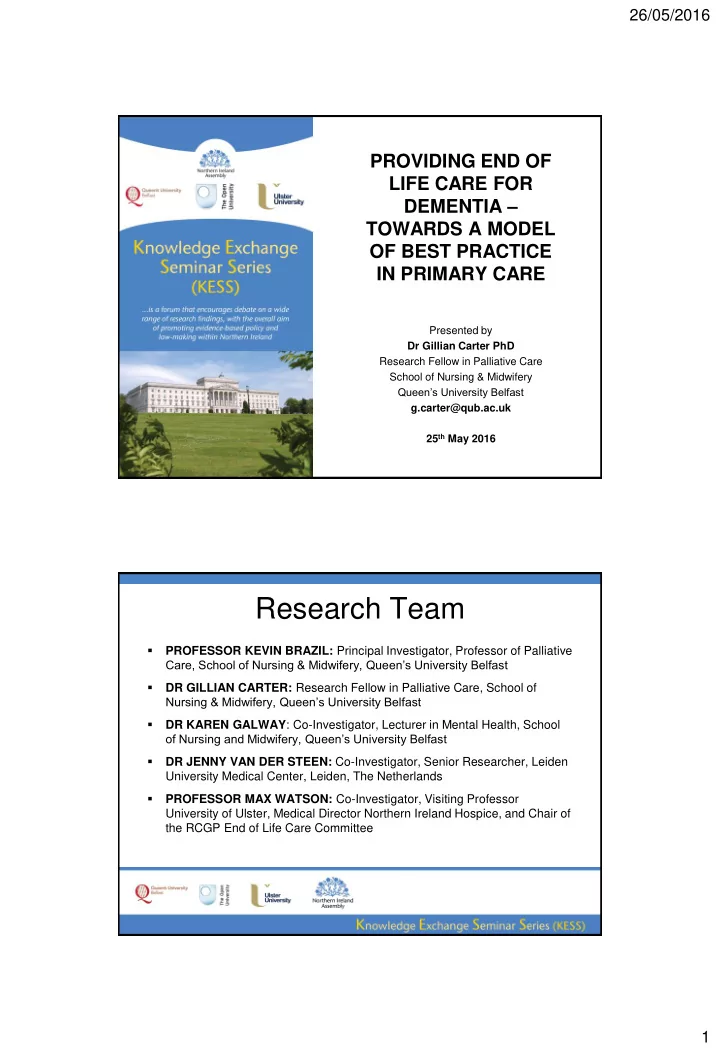
Research Team

  • PROFESSOR KEVIN BRAZIL: Principal Investigator, Professor of Palliative

Care, School of Nursing & Midwifery, Queen’s University Belfast

  • DR GILLIAN CARTER: Research Fellow in Palliative Care, School of

Nursing & Midwifery, Queen’s University Belfast

  • DR KAREN GALWAY: Co-Investigator, Lecturer in Mental Health, School
  • f Nursing and Midwifery, Queen’s University Belfast
  • DR JENNY VAN DER STEEN: Co-Investigator, Senior Researcher, Leiden

University Medical Center, Leiden, The Netherlands

  • PROFESSOR MAX WATSON: Co-Investigator, Visiting Professor

University of Ulster, Medical Director Northern Ireland Hospice, and Chair of the RCGP End of Life Care Committee

slide-2
SLIDE 2

26/05/2016 2

Background

  • Dementia is a life limiting disease without curative treatments
  • Worldwide health issue

− 35.6million cases 2010 expected to double by 2030 − 19,000 in NI (2011) − As NI population  = dementia major public health & societal issue

  • Role of GPs

− Gatekeepers to range of healthcare professionals & diagnostic tests − Early identification of dementia – ensure interventions commenced − GPs need GOOD KNOWLEDGE of dementia − Be aware importance of EARLY diagnosis − In Mental Health Services for Older People (2005) survey LESS THAN HALF of GPs surveyed felt had enough training to diagnose & manage dementia

Background

  • Palliative Care Community

− Traditionally focussed on advanced-stage cancer patients − Good quality end-of-life care should be integral part for ALL living with chronic illnesses, including dementia

  • Adopt Palliative Approach

− Has potential to promote anticipatory care planning (including ACP) 1) Early care guidance - ensure needs of individual & their families are met throughout illness trajectory 2) Adaption of palliative care knowledge & expertise by ANY healthcare professional 3) Integration within healthcare systems in which evolving end-of-life care needs are recognised & addressed

slide-3
SLIDE 3

26/05/2016 3

Background

  • Comparing disease trajectories of cancer patients with dementia

− Cancer patients: substantial decline functioning last months/weeks − Dementia patients: prolonged ‘dwindling’ & severe disability may persist for years

  • EAPC(2014):White paper defining optimal palliative care in older people with dementia
  • 1. Applicability of palliative care
  • 2. Person-centred care, communication & shared

decision making

  • 3. Setting care goals & advance planning
  • 4. Continuity of care
  • 5. Prognostication & timely recognition of dying
  • 6. Avoiding overly aggressive, burdensome or futile

treatment

  • 7. Optimal treatment of symptoms & providing comfort
  • 8. Psychosocial & spiritual support
  • 9. Family care & involvement

10.Education of the health care team 11.Societal & ethical issues Core Domains 57 Recommendations

EAPC

Figure: Dementia progression & suggested prioritizing of care goals Changing care goals & priorities throughout dementia trajectory

slide-4
SLIDE 4

26/05/2016 4

GP Survey

  • INVESTIGATE GPS’ PERCEPTIONS OF PALLIATIVE CARE FOR

INDIVIDUALS LIVING WITH DEMENTIA

  • Conducted in Northern Ireland 2013
  • Sample based on GP surgeries with more than 30 registered dementia

patients

  • Altogether sample comprised 340 GPs representing 174 practices
  • Postal questionnaire – based on EAPC core domains:

“Care for Dementia Patients at the End of Life”

GP Survey

  • A. 24 statements - perceptions of dementia as a

terminal illness, communication, ACP, & decision-making: chose strongly disagree to strongly agree.

  • B. Domains of palliative care in dementia -

perceived importance of these aspects of care, the significance of them as a barrier in practice, & the challenge of addressing the barriers

  • C. Barriers & Solutions – 3 of the most significant

barriers to the provision of palliative care in dementia, and potential solutions.

  • D. Respondent characteristics.
slide-5
SLIDE 5

26/05/2016 5

Results

  • 138 responses = response rate 40.6% (138/340); 60.9% of surveyed

practices (106/174)

  • 57.4% male; 43.6% female; ave. age 49.3yrs; ave. time in practice 24.7yrs
  • In statements describing ACP about future care at end of life for dementia:

− GPs divided on whether ACP should be initiated at diagnosis & if it should be frequently reviewed − 82.7% - GP should take initiative to introduce ACP − 90.2% - should be an agreed format for ACPs − 79.7% - GPs needed training to improve their knowledge to involve families in caring for dementia at the end of life

Results – Section C

Theme 1 Lack of knowledge & understanding

  • Level of family/carer understanding
  • Recognition that dementia is a palliative condition by HCPs,

families and the public

  • HCP understanding, education & training
  • Level of public understanding

Theme 2 Limited availability

  • f resources
  • GP resources – practice & time pressures
  • Access to community staff & resources
  • Funding

Theme 3 Mismanagement

  • f appropriate care
  • Inappropriate medical treatments, interventions &

hospitalisations

  • Difficulty of assessments, diagnosis & prognosis
  • Lack of standardised guidelines & information

Theme 4 Poor interdisciplinary team approach

  • Team communication, integration & access to specialist

support

  • Continuity of care

Theme 5 Family support & involvement

  • Family, carer & patient support
  • Family resistance & disagreements
slide-6
SLIDE 6

26/05/2016 6

Implications for Practice

  • Interventions to promote GP knowledge & skills to match complex

requirements of dementia

− Insufficient basic & post-qualifying training in dementia − Education healthcare team highlighted as core domain by EAPC

  • Need to be more knowledgeable & proactive with ACP
  • Public education essential – to improve community awareness
  • Educational strategies directed – patients & family carers to enable

shared decision-making & optimal timing ACP discussions

Theme 1. Enhanced Education

Comfort Care Booklet

  • Current care home study by QUB (Prof Kevin Brazil, PI):
  • Booklet - ‘Comfort Care at the end of life for persons with dementia’
  • Originally developed in Canada by Arcand & Caron (2005)
  • Demonstrated high level of acceptability in other countries
  • Identified as best practice instrument by World Health Organisation

European Office

  • Adapted for NI context

“Promoting Informed Decision Making & Effective Communication through Advance Care Planning for People with Dementia and their Family Carers”

slide-7
SLIDE 7

26/05/2016 7

Comfort Care Booklet

Section 1. The Natural Evolution

  • f Dementia

Section 2. Decisions About the End of Life Section 3. Relief of Symptoms Section 4. The Final Moments Section 5. After the Death

Implications for Practice

  • Substantial multidisciplinary support
  • Core good clinical practice is good interdisciplinary team work
  • Poor communication & poor integration can impinge palliative care
  • Personalised shared care plan

− Facilitate access between primary care, emergency services, secondary care and social services

  • GPs in a commanding position identify early signs of dementia & access

HCPs

  • Integrated & holistic team approach needed to improve patient
  • utcomes
  • EAPC core domain

Theme 2. A Shared Care Model

slide-8
SLIDE 8

26/05/2016 8

Key Messages

  • GPs are in a pivotal position to initiate & adapt care for an individual

living with dementia

− Gatekeepers to other health services - specialist services − GPs have expressed limited confidence in their assessment and knowledge of dementia

  • HCPs & family carers have difficulty in characterising dementia as a

terminal illness

− Palliative approach would be beneficial

  • Is there sufficient GP dementia training & HCP support?

− Perceived dementia knowledge deficit − Resource shortfalls − Conflict with and within families − Poor integrated team care

Key Messages

  • A personalised shared care & support plan of treatment goals can

facilitate holistic care

− ACP – a mechanism to facilitate communication & decision-making − Optimal timing – delivered on an individual basis − Discussions can be enhanced by educational strategies

  • Shared Care Model

− Integration - GP services & primary care, emergency services, secondary care & social services − Improve access to quality palliative care − A necessity to provide best practice end of life care for dementia − Require co-operation, communication & integration by and between allied HCPs.

slide-9
SLIDE 9

26/05/2016 9

For any further information please refer to:

Carter G, van der Steen JT, Galway K, Brazil K. (2015) General Practitioners’ perceptions of the barriers and solutions to good quality palliative care in dementia. Dementia: the International Journal of Social Research and Practice. Brazil K, Carter G, Galway K, Watson M, van der Steen JT. (2015) General practitioners perceptions on advance care planning for patients living with dementia. BMC palliative care. 14(1):1 van der Steen JT, Galway K, Carter G, Brazil K. (2016) Initiating advance care planning

  • n end-of-life issues in dementia: Ambiguity among UK and Dutch physicians.

Archives of Gerontology and Geriatrics. 65:225-230 van der Steen JT, Radbruch L, Hertogh CM, et al. (2014) White paper defining optimal palliative care in older people with dementia: A Delphi study and recommendations from the European Association for Palliative Care. Palliative Medicine. 28(3):197-209

Thank you!

For any further information please contact:

Prof Kevin Brazil School of Nursing & Midwifery Queen’s University Belfast Medical Biology Centre 97 Lisburn Road Belfast BT9 7BL Email k.brazil@qub.ac.uk Tel +44 (0)28 9097 5782 Dr Gillian Carter School of Nursing & Midwifery Queen’s University Belfast Medical Biology Centre 97 Lisburn Road Belfast BT9 7BL Email g.carter@qub.ac.uk Tel +44 (0)28 9097 5762

slide-10
SLIDE 10

26/05/2016 10