Addressing Moral Distress in What is Moral Distress? Why do we - - PDF document

addressing moral distress in
SMART_READER_LITE
LIVE PREVIEW

Addressing Moral Distress in What is Moral Distress? Why do we - - PDF document

3/3/2010 Laying the Groundwork Addressing Moral Distress in What is Moral Distress? Why do we Care? Caregiving at the End of Life Common scenarios of internal conflict Health Ethics Week What might we do to manage moral John


slide-1
SLIDE 1

3/3/2010 1

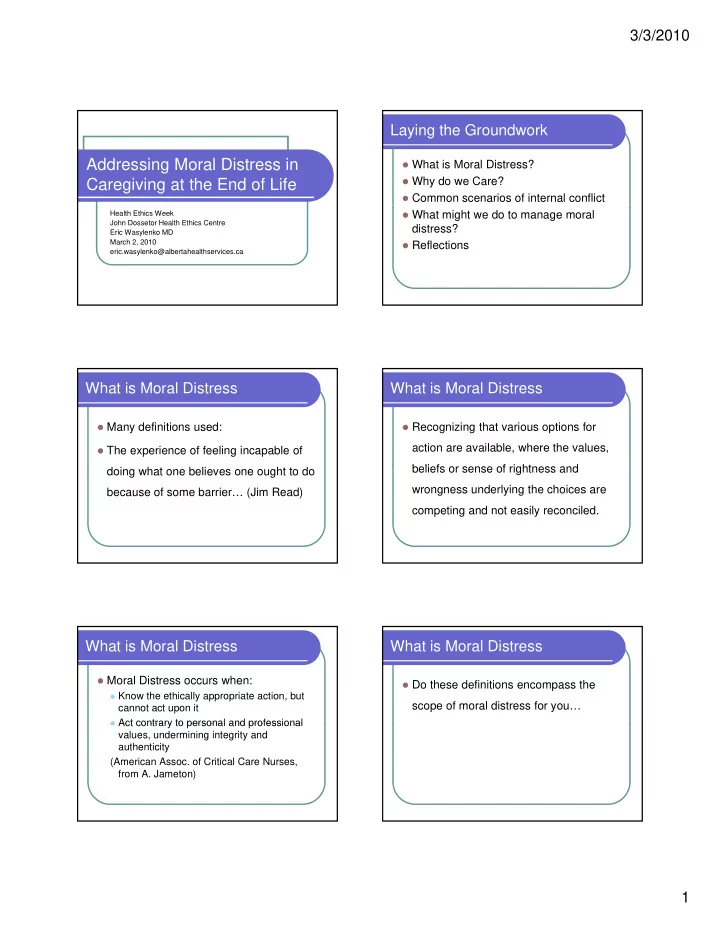
Addressing Moral Distress in Caregiving at the End of Life

Health Ethics Week John Dossetor Health Ethics Centre Eric Wasylenko MD March 2, 2010 eric.wasylenko@albertahealthservices.ca

Laying the Groundwork

What is Moral Distress? Why do we Care? Common scenarios of internal conflict What might we do to manage moral

distress?

Reflections

What is Moral Distress

Many definitions used: The experience of feeling incapable of

doing what one believes one ought to do because of some barrier… (Jim Read)

What is Moral Distress

Recognizing that various options for

action are available, where the values, b li f f i ht d beliefs or sense of rightness and wrongness underlying the choices are competing and not easily reconciled.

What is Moral Distress

Moral Distress occurs when:

Know the ethically appropriate action, but

cannot act upon it

Act contrary to personal and professional Act contrary to personal and professional

values, undermining integrity and authenticity (American Assoc. of Critical Care Nurses, from A. Jameton)

What is Moral Distress

Do these definitions encompass the

scope of moral distress for you…

slide-2
SLIDE 2

3/3/2010 2 What is Moral Distress

In some circumstances, our own

competing values make us uncertain about what the right choice is. g

In some circumstances, competing

values between persons make us uncertain about what the right choice is.

What is Moral Distress

After moral deliberation, on balance the

chosen action may seem right. But other t d l il b treasured values may necessarily be subjugated in order to carry out the action.

Scenarios of Internal Conflict

A woman asks you to approve a travel

authorization for treatment in a clinic in M i ti t d b b li f th t Mexico, motivated by a belief that a miracle may happen. You worry that she will die while there, away from her young family and support systems.

Scenarios of Internal Conflict

A person asks you to not provide food

and liquids so that she can die more i kl h k lik l quickly when you know you can likely provide reasonable quality for many months if given the opportunity.

Scenarios of Internal Conflict

A dying person’s family won’t allow you

to discuss with him what is happening because of cultural belief religious because of cultural belief, religious imperative, or personal fear.

Yet you believe firmly in the importance

  • f including him fully.

Scenarios of Internal Conflict

A person’s family demands life

prolonging interventions on behalf of their mother who cannot speak for p herself, in a situation in which you know you cannot likely prevent substantial pain.

slide-3
SLIDE 3

3/3/2010 3 Scenarios of Internal Conflict

A person’s family asks you to carry on

with life prolonging interventions for their d i t b th d it h t dying, comatose brother despite what you believe is irreversible major deterioration.

Scenarios of Internal Conflict

The resources needed to provide

reasonably safe, secure care for an ld l d i id i h h t elderly, dying widow in her home are not able to be secured, necessitating a placement in LTC, against her wishes.

Scenarios of Internal Conflict

You are a Resident. The Attending does

not want to speak openly with a person about her terminal oncologic condition f f f t ki h Y t for fear of taking away hope. Yet you are aware this person has a need to prepare her family for her inevitable death.

Scenarios of Internal Conflict

You care for a homeless person with

terminal esophageal cancer, who is gruffly appreciative of what your team has been providing in hospital but who has been providing in hospital, but who desperately seeks return to the street where he is unconfined and back with his people.

Scenarios of Internal Conflict

You care for a person at home who

requires the use of opioids for pain t l B t l f h

  • control. But you learn some of her

supply is being diverted by a nephew who lives with her.

Scenarios of Internal Conflict

You believe the direction of care and

interventions for a person you are caring for are wrong, maybe even d h i i B t ll d t

  • dehumanizing. But you are compelled to

follow the orders written into the care plan and feel you have no power to change them or question them.

slide-4
SLIDE 4

3/3/2010 4 Scenarios of Internal Conflict

You care for a person whose daughter

insists on avoidance of opioids for her mother, since she believes they make , y her confused. Yet the patient is

  • bviously in considerable pain. Her

daughter is the agent.

Scenarios of Internal Conflict

The family of a terminally ill man you are

caring for is accusing you of withdrawing lif t i i fl id d PEG f di life sustaining fluids and PEG feeding just so that he will die sooner and you can free up a bed.

Scenarios of Internal Conflict

A dying person on your unit whose family

never visits desperately needs someone to just be present with her. But you are run off your feet with meds to draw up and deliver, and the family in room 6 is very demanding of your time.

Scenarios of Internal Conflict

A person you are caring for seems to be

pleading with his eyes for you to relieve his distress. But due to the complexity of hi th l d ’t f l bl t t his pathology you don’t feel able to sort

  • ut his pain diagnosis or know how best

to assist him, and there is no one else to help.

Scenarios of Internal Conflict

Your colleague has just experienced the

death of her own brother, and is back at

  • work. Today she is caring for a similarly

y g y aged person dying of the same disease as her brother, and you don’t know how best to support her.

Commonalities

What are some common threads that run

through all these examples?

slide-5
SLIDE 5

3/3/2010 5 Scenarios of Internal Conflict

You are asked/compelled to provide or

avoid certain acts, and the compulsion runs counter to what you believe is right

You wish to minister to those who You wish to minister to those who

depend on you, but you cannot due to limitations outside of your control

Competing principles and values result in

decisional conflict for you

Limited view

Some authors categorize the range of

circumstances producing moral distress as:

Arising from a distressing situation Arising from a unit practice or behavior Arising from power imbalances

That is too constrained…

There are individual circumstances

leading to episodic moral distress

hi l li

this can resolve or linger

  • r

There can be

an accumulation of single distressing events recognition that single events will re occur recognition that single events will re-occur a sense that all we do will simply not be

enough, outside of major events

Stress versus Dis-stress

Moral stress can be seen as positive

tension, creating space for moral fl ti i di id ll t i reflection individually or as a team, in

  • rder to determine ideal care decisions

while maintaining moral balance

Stress versus Dis-stress

Moral distress, on the other hand, is

disempowering tension, that does not keep us integral, and that leads to p g , internal conflict that is not resolved, despite what may be seen by others as correct or acceptable actions.

slide-6
SLIDE 6

3/3/2010 6 Balancing

Most of our actions require a balance

between competing imperatives. When the scales on competing sides are nearly p g y balanced, we have increased the risk of doing the wrong thing.

That worries us.

Continuum

Many difficult decisions lay on points of

the continuum between being beneficent and not causing harm.

There are no universal ways to

determine if it is better to seek maximum benefit for those we serve, or to avoid major harm.

Human nature

Yet it is likely human nature that we tend

to impart more weight to what we feel we cannot ideally provide – where we feel h f il d th t h t d we have failed – than to what we do right.

This is especially true in a conflicted

situation where we have to choose.

The nature of end of life care

Reduce suffering Optimize function So that people can accomplish aims live So that people can accomplish aims, live

until they die, and prepare themselves and their loved ones.

The nature of end of life care

Pall = to cloak We feel a driving need to envelope with loving care, to

shield from suffering.

But how do we know this is what patients want

universally?

Does suffering mean the same thing to each of us as it

does to each of our patients?

Tension generators

Where do tensions arise:

Personal drive for excellence Genuine caring

Professional duty

Professional duty Fear of recrimination (professional sanction,

reputational, lawsuit, self-berating, lack of appreciation, negative response from patients and families)

Desire for moral wholeness (integrity)

slide-7
SLIDE 7

3/3/2010 7 Who we are

Expert intervenors preventing a

potentially bad death and providing a lik l d d th likely good death, or…

Who we are

A resource to fellow humans who seek

  • ur knowledge, experience and wisdom

t i t th i thi i t t t f to assist them in this important aspect of their lived existence

Profession

We profess to do our utmost to provide

for those in our care.

It is not a promise about the unattainable

Limitations

Even though we are sometimes able to

manipulate physiology in order to increase the chances of dying in various versions of what we would refer to as a versions of what we would refer to as a more desirable manner, much of the deep personhood experience of living and dying is well beyond our control as caregivers…thankfully.

We overburden ourselves

I believe we take on too much, from a felt

need to be caring, but also from a iti f b i position of benign arrogance.

So what is right

The right course of action is almost

always the course that is chosen if we have:

considered morally with others considered morally, with others

attended to our collectively determined laws addressed personhood over pure healthcare

considerations

recognized our human and professional limitations are well intentioned towards beneficence

slide-8
SLIDE 8

3/3/2010 8 Back to practicality

Moral distress will arise, so… Separate the systemic, ongoing moral

distress from acute situational moral distress and from creative moral stress

Create space to speak about it fearlessly Use a framework to address it

One framework

AACCN – the 4As to Rise above moral

distress:

Ask Affirm Assess Act

Ask

Become aware that moral distress is

present in you or in your team (AACCN)

Affirm

Affirm distress, validate the feelings and

perceptions with others, affirm an bli ti ( f i l d l) t

  • bligation (professional and personal) to

act.

(AACCN)

Assess

ID sources of distress, severity, and risks

and benefits, then commit to an action l plan.

(AACCN)

Act

Prepare, act and then maintain the

desired change so that you preserve i t it d th ti it your integrity and authenticity. (AACCN)

slide-9
SLIDE 9

3/3/2010 9 Our task

Recognizing that we do face moral

distress…

How will we build resiliency in order to

y

effectively use moral stress and buttress ourselves against inevitable moral

distress

Moral agents

Useful to remember that we are all moral

agents

We like to say that we best meet people where

they are on their journey and respecting how y j y p g they experience meaning in their lives

It is important to validate that those we serve

must also meet us where we are, and in respect of how we experience meaning as fellow humans and as professional providers

  • f care

Professional or Personal Task

We bring our minds, experience and

professional codes of conduct in order to provide care.

We accept that we cannot avoid death,

but we still work hard to control the manner, time and place of death (Somerville)

Professional or Personal Task

But the nature of health care and service

demands of us much more, and so we bring our own personhood to the task.

As moral agents we need our actions to

be in congruence with our values and beliefs and with our sense of who we are at our cores.

Care Providers & Care Givers

In end of life care, due to the intensity of

felt emotion, the stakes at play, and the recognition everyday of our own humanness and frailty our personhood humanness and frailty, our personhood is necessarily at the fore.

We give of ourselves, not simply a

personally disengaged and a professionally competent offering.

Addressing Moral Distress

We have at our disposal:

Teams Standards Precedent Understanding of good intentions Opportunities for guidance

slide-10
SLIDE 10

3/3/2010 10 Addressing Moral Distress

Most importantly we have:

Each other Huge accumulated capital of goodness and

provided service provided service

Humility regarding our real place and

acknowledgement that we are merely instruments

Forgiveness

Vanier – Becoming Human

Compassion and maturity (p 114) Fear of rejection, of judgement

My own moral distress

What is our responsibility regarding

those individuals we serve vis-à-vis the millions who do “without” at the end of their lives.

A justice and collective humanity

(communion) issue

Meaning in death

Dying is a part of our human experience The meaning of living and of dying

transcends each of us transcends each of us.

We are mere contributors to the

experience

Final thoughts

Find ways to ramp up creative moral

stress

Be gentle on yourselves in letting go of

created moral dis-stress

Final thoughts

Do not let fear of being judged, or fear of

doing harm, overwhelm your awareness f th d id

  • f the good you provide
slide-11
SLIDE 11

3/3/2010 11 Some further reading

  • Ethics in Practice for Registered Nurses (CNA) October 2003, Ethical

Distress in Health Care Environments

  • Webster,G. & Baylis, F (2000) Moral Residue. In S.B. Rubin & L. Zoloth

(Eds.), Margin of error: The ethics of mistakes in the practice of medicine (pp. 217-232)

  • American Association of Critical Care Nurses publication: The 4As to

Rise Above Moral Distress

  • Sibbald. R. et al; Perceptions of “futile care” among caregivers in

intensive care units; CMAJ, November 6, 2007; 177 (10)

  • Vanier, Jean; Becoming Human, House of Anansi Press Limited, 1998