Mill Source of Normative Claims 1 10/24/2011 Moral Idealism GHP - - PDF document

mill
SMART_READER_LITE
LIVE PREVIEW

Mill Source of Normative Claims 1 10/24/2011 Moral Idealism GHP - - PDF document

10/24/2011 Overview Moral Idealism vs Moral Naturalism Moral Idealism What it is Moral Naturalism Problems Key Terms Descriptive Ethics Normative Ethics Feminist Ethics According to Moral Naturalism Margaret Urban


slide-1
SLIDE 1

10/24/2011 1

Moral Naturalism

Feminist Ethics According to Margaret Urban Walker

Overview

Moral Idealism vs Moral Naturalism
  • Moral Idealism
– What it is – Problems
  • Key Terms
– Descriptive Ethics – Normative Ethics
  • Moral Naturalism
– What it is – How to practice it – Transparency Testing

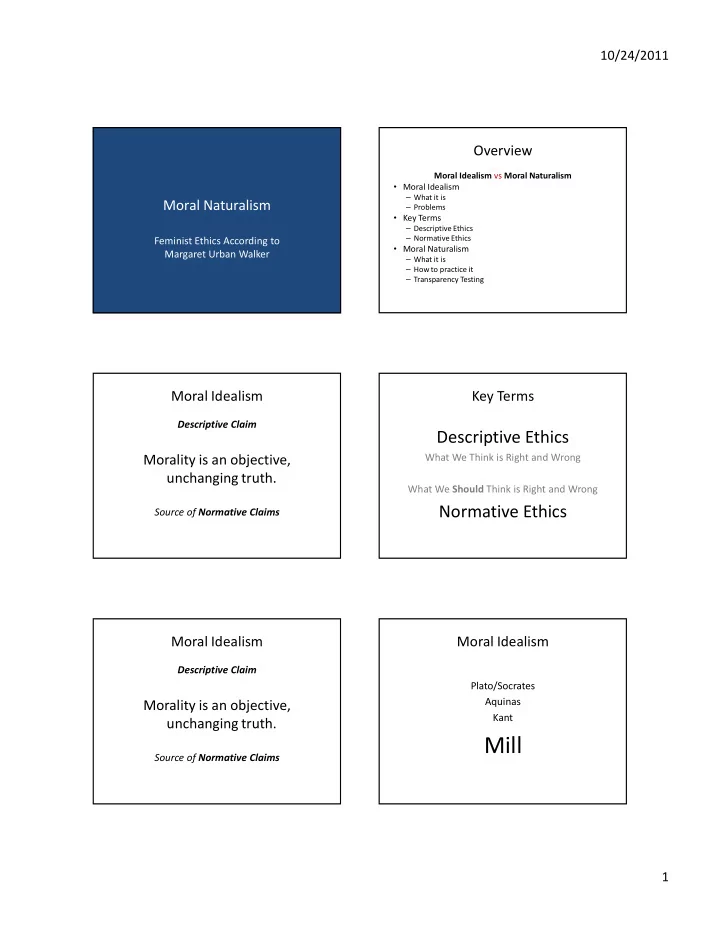
Moral Idealism

Descriptive Claim

Morality is an objective, unchanging truth.

Source of Normative Claims

Key Terms

Descriptive Ethics

What We Think is Right and Wrong What We Should Think is Right and Wrong

Normative Ethics

Moral Idealism

Descriptive Claim

Morality is an objective, unchanging truth.

Source of Normative Claims

Moral Idealism

Plato/Socrates Aquinas Kant

Mill

slide-2
SLIDE 2

10/24/2011 2

Moral Idealism

GHP

Reflect

Moral Naturalism

Descriptive Claim:

“Morality is a naturally occurring structure of all human social groups.”

Walker, pp 108

Moral Naturalism

Descriptive Claim:

Morality “is a disposition of powers through an arrangement of responsibilities.”

Walker, pp 106

Morality “is a disposition of powers through an arrangement of responsibilities.” Walker, pp 106

Give an example of a responsibility

Morality “is a disposition of powers through an arrangement of responsibilities.” Walker, pp 106

Give an example of an institution that arranges responsibilities

slide-3
SLIDE 3

10/24/2011 3

Moral Naturalism

“Moral concepts and judgments are an integral part, but only one part, of practices that attempt to organize feelings, behavior, and judgment in ways that keep people’s expectations in rough equilibrium.” Walker, pp 107

Moral Naturalism

Form of Normative Claims:

Morality makes claims about the right way to live.

Moral Naturalism

Practices of responsibility “implement and enforce understandings of

  • who may do what to whom,
  • who must do what for whom,
  • and to whom various ones of us have to

account.” Walker, pp 109

Reflect

Moral Naturalism

Normativity

“the durability of our understandings and the trust they support under the right kinds of tests.”

Walker, pp 109

What Kind of Tests?

slide-4
SLIDE 4

10/24/2011 4

Trust

  • Certain basic understandings are common
  • These common understandings are the main
  • nes that shape our way of life
  • That this way of life is worthy of allegiance,

effort, restraint, or sacrifice. Walker, pp 109

Trust

Just ways some people can make others behave

Walker, pp 109

Trust

Give an example of “Just ways some people can make others behave.”

Trust

  • Certain basic understandings are common
  • These common understandings are the main
  • nes that shape our way of life
  • That this way of life is worthy of allegiance,

effort, restraint, or sacrifice. Walker, pp 109

Activity

“. . . It is not safe to assume that people typically know much of what they are really doing, and it is certainly doubtful that they know what and all that they are collectively doing in reproducing their form of life.”

Walker, Moral Understandings, pp 250

Activity

Think about your own life Think about the life you want to have

Where are you going?

slide-5
SLIDE 5

10/24/2011 5

Activity

Think about your own life Think about the life you want to have

Why do you want to be there?

Activity

Get into your Groups
  • 1. Pass your paper to the person to your left.
  • 2. Read the paper.
  • 3. List two or more things that you think your
fellow group member values about the way of life they want.
  • 4. Compare your lists. Are they different? Similar?
  • 5. As a group, make a list of things that make a
good way of life.

Activity

Responsibility

  • 1. who may do what to whom,
  • 2. who must do what for whom,
  • 3. and to whom various ones of us have to

account. Walker, pp 109

Activity

What common understandings about life does this class have? What understandings are not common?

Transparency Testing

Normativity

Are the understandings we think are shared actually shared? Are the understandings we think we have in common actually in common?

Reflect