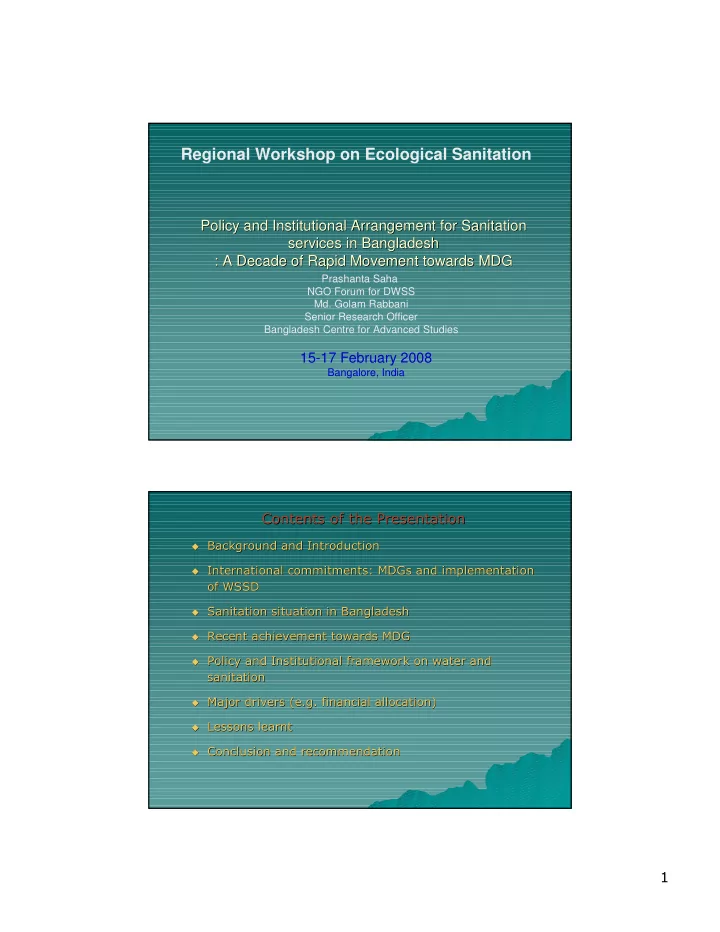
Regional Workshop on Ecological Sanitation Policy and Institutional - - PDF document

regional workshop on ecological sanitation
SMART_READER_LITE
LIVE PREVIEW

Regional Workshop on Ecological Sanitation Policy and Institutional - - PDF document

Regional Workshop on Ecological Sanitation Policy and Institutional Arrangement for Sanitation Policy and Institutional Arrangement for Sanitation services in Bangladesh services in Bangladesh : A Decade of Rapid Movement towards MDG : A


slide-1
SLIDE 1
  • Policy and Institutional Arrangement for Sanitation

Policy and Institutional Arrangement for Sanitation services in Bangladesh services in Bangladesh : A Decade of Rapid Movement towards MDG : A Decade of Rapid Movement towards MDG 15-17 February 2008

Bangalore, India

Regional Workshop on Ecological Sanitation

Prashanta Saha NGO Forum for DWSS

  • Md. Golam Rabbani

Senior Research Officer Bangladesh Centre for Advanced Studies

  • !

!

  • "!!

"!!

  • # $%%&

# $%%&

  • '

'

slide-2
SLIDE 2

(

Background Background

  • )

)

  • * +,-)

* +,-) #!) "" #!) ""

  • . )"

. )"

  • "/

"/ %%0" %%0"

  • ' "

' " "" "" ") ")

International Commitments International Commitments

  • 1 )" 23 4)"

1 )" 23 4)" )(--- )(---

  • 5! " !

5! " !

  • "

")"! )"!6 6

  • 6

6 " ! (-, " ! (-,

  • - ! )" (-(-
  • - ! )" (-(-

) )

  • 7 )"

7 )"

  • (%8

(%8 ) ! 9 ) ) ! 9 ) )"(-, )"(-,

slide-3
SLIDE 3

:

CHANGING SITUATION IN WATSAN SECTOR Of Concern

Arsenic contamination in groundwater Rapid declining of groundwater table Increasing saline-water belt and water logging Increasing urbanization Special problems in the rocky and hilly areas Recurrent natural calamities Poverty, illiteracy and ignorance of people Involvement of civil society

increasing Formulation and/or ratification of need-based sectoral policies and strategies Commitment of GOB towards sector Promotion Of Hope ----------

slide-4
SLIDE 4

8

Of Hope

GO-NGO and NGO-Private Sector cooperation improving Focus on sanitation increasing Appropriate and low-cost technologies are being developed, field tested and promoted All stakeholders facing the challenges in a coordinated way

CURRENT WATSAN SITUATION AT A GLANCE – BANGLADESH

97.6% of the population have access to improved drinking water sources (piped water, public tap, borehole/ tubewell, protected well, protected spring or rain water). About 74% people drink arsenic and

  • ther pollution free safe water.
slide-5
SLIDE 5

,

The permissible level of arsenic in drinking water for Bangladesh determined by WHO is 0.05 mg/L The International Standard of permissible level of arsenic in drinking water determi- ned by WHO is 0.01 mg/L 61 districts have been affected with arsenic so far. 322 upazilas have been affected with arsenic so far. 28-35 million people are exposed to arsenic contamination (above 50 ppb). 46-57 million people are exposed to arsenic contamination (above 10 ppb). 84.73% households have hygienic latrines. 84.47% rural households have hygienic latrines. 87.59% households in Municipality areas have hygienic latrines.

slide-6
SLIDE 6

;

84.38% households in City Corporation areas have hygienic latrines. 10,000 children under 5 die of diarrhoeal diseases in each year. On an average 342 u5 children die of diarrhoeal diseases everyday. 19.3% of the population are habituated to hand washing with soap after defecation. 40.6% of the population are habituated to hand washing with soil after defecation. 20% of the population are habituated to hand washing with ash after defection. 20% of the population are habituated to hand washing with only water after defecation. Every year Tk. 50 billion is spent for treatment of water-borne diseases in Bangladesh.

Source: National Sanitation Status, June 2007, Sanitation Secretariat, DPHE, Dhaka key Findings, Progotir Pathey 2006, BBS/UNICEF

slide-7
SLIDE 7

<

INFORMATION RELATED TO DIARRHOEA

22.5% households dispose under five (U5) children’s faeces into latrine. Mortality: 342 deaths of U5 children daily. 110,000 annual deaths of U5 children, 1 in every 4 deaths of U5 children. Morbidity: 65 million episodes annually amongst U5 children, 3-5 annual episodes per U5 child, each episode lasts from 2-3 days up to 2 weeks or more

slide-8
SLIDE 8

1

INFORMATION RELATED TO HYGIENE BEHAVIOUR Coverage in Hand Washing: After Defecation:

  • With Water & Soap 19.3%
  • With Water & Soil 40.6%
  • With Water & Ash 20%
  • With Water Only

20% Disposal of Child’s Faeces : Whose Stools are Disposed of Safely (%): National and Divisional Level

  • National 22.5%
  • Urban

43.9%

  • Rural

14.9%

slide-9
SLIDE 9

=

  • Barisal

25.8%

  • Chittagong

24%

  • Dhaka

25.8%

  • Khulna

24.1%

  • Rajshahi

15.6%

  • Sylhet

21.3%

3 ' 6666666

ACCESS TO IMPROVED DRINKING WATER SOURCES (PIPED WATER, PUBLIC TAP, BOREHOLE/ TUBEWELL, ROTECTED WELL, PROTECTED SPRING OR RAIN WATER): Disparity: Improved Water Sources for Drinking Purposes

  • National

97.6%

  • Urban

99.2%

  • Rural

97.1%

slide-10
SLIDE 10
  • Barisal

96.9%

  • Chittagong

97.2%

  • Dhaka

99.6%

  • Khulna

91.7%

  • Rajshahi

99.1%

  • Sylhet

93.5%

Source: Key Findings, Progotir Pathey 2006, BBS/UNICEF

Disparity: Improved Water Sources --------- Top 10 Arsenic Contaminated Districts

61.11 Bagerhat 10 62.80 Madaripur 9 63.60 Comilla 8 64.54 Barisal 7 67.44 Lakshmipur 6 70.75 Noakhali 5 71.41 Gopalganj 4 81.36 Brahmanbaria 3 82.38 Munshiganj 2 93.00 Chandpur 1

  • Conta. (%)

District Rank

slide-11
SLIDE 11
  • Top 10 Arsenic Contaminated Upazilas

90.37 Begumganj Noakhali 10 90.87 Bhanga Faridpur 9 90.94 Lohajang Munshiganj 8 93.25 Muradnagar Comilla 7 93.72 Gopalganj Sadar Gopalganj 6 94.77 Kalaroa Satkhira 5 97.93 Kachua Chandpur 4 98.25 Hajiganj Chandpur 3 98.53 Faridganj Chandpur 2 98.62 Shahrasti Chandpur 1

  • Conta. (%)

Upazila District Rank

Age-wise Arsenicosis Patients Sex-wise Arsenicosis Patients

100 Total 0.3 91+ 0.4 81-90 1.6 71-80 5.1 61-70 10.3 51-60 15.4 41-50 23.0 31-40 20.3 21-30 16.6 11-20 55% Female Patients 6.8 <10 Years 45% Male Patients % Age

Source : BAMWSP Newsletter, NAMIC, BAMWSP

slide-12
SLIDE 12

( Policy and Institutional Framework Policy and Institutional Framework

Policy:

The National Policy for Safe Water Supply and Sanitation 1998 National Water Policy, 1999 National Water Management Plan, 2004 Poverty Reduction Strategy Paper, 2004 National Policy for Arsenic Mitigation,2004 National Sanitation Strategy, 2005

Policy and Institutional Framework Policy and Institutional Framework

Institutional Arrangement

Ministry of Local Government Rural Development and Cooperatives Coordinates and facilitates policy decisions Sectoral allocation Funding support Project implementation process Department of Public Health Engineering Responsible for providing safe water and sanitation facilities to the urban and rural

areas except Dhaka, Chittagong and Narayanganj

Water Supply and Sewerage Authority WASA is responsible for water supply and sewage management of Dhaka,

Chittagong and Narayanganj city.

Local Government Engineering Department

Implements water supply and sanitation related project and progarmmes of the government.

slide-13
SLIDE 13

: Policy and Institutional Framework Policy and Institutional Framework

Institutional Arrangement

City Corporations Responsible for solid waste management, surface drainage management, implementation of on-site sanitation project and maintenance of water supply system provided by DPHE District Council Plans, implements and monitor water and sanitation activities Upazilla Development Coordination Committee Facilitates water supply and sanitation activities within the area Union Level Water Supply and Sanitation Committee

Union Council promote education, training and awareness on environmental sanitation among rural people UP and the committee hard-core poor for distributing tube wells and latrines Assist Upazilla committee and DPHE in relevant activities

Policy and Institutional Framework Policy and Institutional Framework

Institutional Arrangement

Non-government organizations and private sectors Are active in implementing projects and programmes on water supply and sanitation. NGO-Forum, ITN-BUET, VERC, Ahsania Mission, BRAC etc work on sanitation activities Development Partners/International Organization etc UNICEF, IDA, ADB, WHO, JICA, DANIDA, Netherlands, Wateraid etc support water supply and sanitation programmes

slide-14
SLIDE 14

8 Policy and Institutional Framework Policy and Institutional Framework

Recent Policy Decisions= Major drivers for changing the situation 100 % Sanitation by 2010 : Government Declaration The term “100% sanitation” will mean (According to National Sanitation Strategy, 2005)

  • No open defecation
  • Hygienic latrines available to all,
  • Use of hygienic latrines by all,
  • Proper maintenance of latrines for continual use, and
  • Improved hygienic practice

Policy and Institutional Framework Policy and Institutional Framework

Recent Policy Decisions= Major drivers for changing the situation Allocation of 20 % ADP grant to Upazilla for Sanitation : 400 million Taka ( $ 6 million) Targeting hardcore poor with government grant: 75 % of the ADP grant for providing hygienic latrine for the poor Funds for hygiene promotion and mobilization: 25 % of the ADP grant for community mobilization and hygiene promotion Gram Sarkers in Sanitation Campaign: 10,000 Taka was given to each ward member to increase sanitation coverage involving Gram Sarkers

slide-15
SLIDE 15

, Policy and Institutional Framework Policy and Institutional Framework

Recent Policy Decisions= Major drivers for changing the situation Recognition/awards for achieving 100 % sanitation Chairpersons of 189 Union Parishads 9 UNO received the awards 4 chairmen of pourashavas In addition, Deputy Commissioners, NGOs and Development Partners were also awarded Performance based incentives for sanitation sustainability: 200,000 Taka (3000 USD) for those Unions which have achieved 100% sanitation Sanctioning 25 Crores ($ 3.6 million) to DPHE for producing and distributing quality latrines

Lessons Learnt Lessons Learnt

National campaigns are effective in raising awareness and creating demand for accelerated growth in sanitation coverage. Commitment of local government is important for achieving the goal GO-NGO-Community partnership is essential Adequate community mobilization for motivation and sustainability increases sanitation coverage All members of the community including women, students, children, religious leaders and community leaders can play important roles for community mobilization No hardware support or subsidy is needed except for the hardcore poor.

slide-16
SLIDE 16

; Recommendation Recommendation

Effective monitoring and evaluation on sanitation programme Increase awareness programme on the benefits of sanitation on human health and economic activity Adequate hardware outlets Proper identification of hard core poor Increase allocation for sustainability issue Low cost sanitation technology options for the community Strengthening LGIs on sanitation issues Development of emergency response plan on sanitation

Hello … Any Question Hello … Any Question ? ?

slide-17
SLIDE 17

<