Ecological Services Ecological Services & Biodiversity - - PDF document

ecological services
SMART_READER_LITE
LIVE PREVIEW

Ecological Services Ecological Services & Biodiversity - - PDF document

Slide 1 / 131 Slide 2 / 131 6th Grade Biodiversity and Humans 2015-08-27 www.njctl.org Slide 3 / 131 Slide 4 / 131 Biodiversity and Humans Click on the topic to go to that section Ecological Services Ecological Services Ecological


slide-1
SLIDE 1

Slide 1 / 131 Slide 2 / 131

6th Grade

Biodiversity and Humans

2015-08-27 www.njctl.org

Slide 3 / 131 Biodiversity and Humans

· Ecological Services

Click on the topic to go to that section

· Threats to Biodiversity · Conservation and Preservation · Restoration Ecology · Ecological Services & Biodiversity · Works Cited

Slide 4 / 131

Ecological Services

Return to Table

  • f Contents

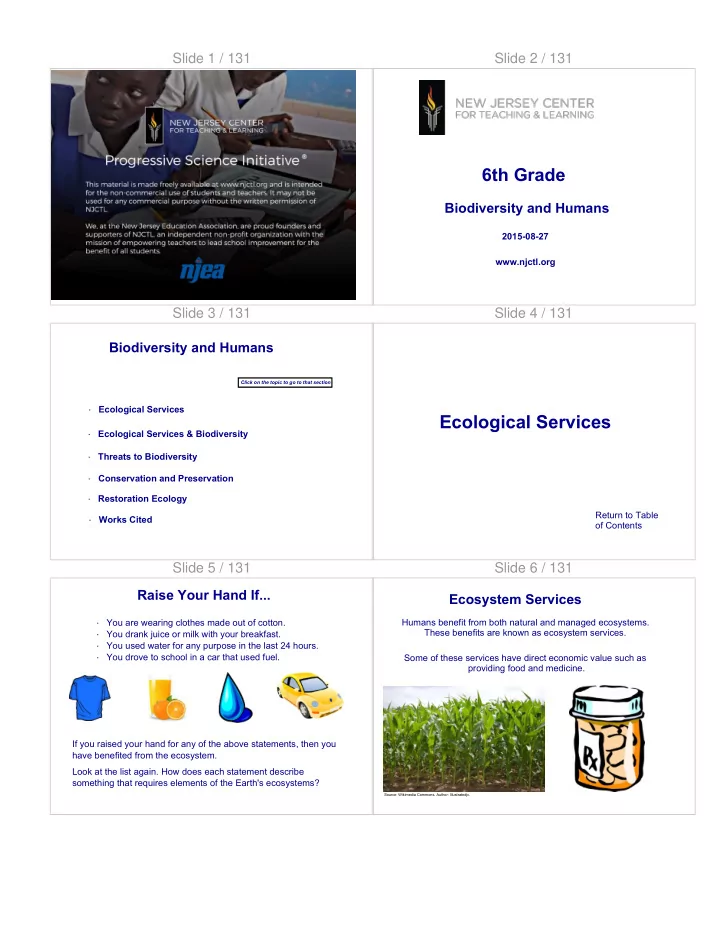
Slide 5 / 131 Raise Your Hand If...

· You are wearing clothes made out of cotton. · You drank juice or milk with your breakfast. · You used water for any purpose in the last 24 hours. · You drove to school in a car that used fuel. If you raised your hand for any of the above statements, then you have benefited from the ecosystem. Look at the list again. How does each statement describe something that requires elements of the Earth's ecosystems?

Slide 6 / 131 Ecosystem Services

Humans benefit from both natural and managed ecosystems. These benefits are known as ecosystem services. Some of these services have direct economic value such as providing food and medicine.

Source: Wikimedia Commons. Author: Illustratedjc.

slide-2
SLIDE 2

Slide 7 / 131 Ecosystem Services

We rely on ecosystem services in many facets of our lives. Consider this: of the 150 top prescription drugs used in the US, 74% are derived from plants 18% are derived from fungi 5% are derived from bacteria and 3% are derived from vertebrates

Slide 8 / 131 Ecosystem Services

The types of ecosystem services can be broken up into 4 categories: Provisioning Services Regulating Services Cultural Services Supporting Services

Source: Wikimedia Commons. Author: Payne. Source: Wikimedia Commons. Author: Petts. Source: Wikimedia Commons. Author: Alexchris. Source: Wikimedia Commons. Author: Turelio.

Slide 9 / 131 Provisioning Services

What are provisions? Click below to check your answer. Provisions are items that are provided. What kinds of provisions can the ecosystem supply to us? Write your ideas below.

Slide 10 / 131 Provisioning Services

Provisioning services include all products that are obtained from an ecosystem. Provisioning services include: · food · medicine · water · wood · fuel · fiber/fabric (made from plants) What are different uses for all of the provisioning services listed above?

Slide 11 / 131 Regulating Services

To regulate means to control something so that it operates properly. What do you think regulating services are? Write your thoughts and examples below.

Slide 12 / 131 Regulating Services

Regulating services are benefits that we receive from the regulation of ecosystem processes. Each slide that follows shows an example of a regulating service. Read about that service and then answer this question: How does this service benefit humans?

slide-3
SLIDE 3

Slide 13 / 131

Since pollination is essential for reproduction, it is critical for food production.

Pollination

A variety of animals act as pollinators for different plants. Pollination is necessary for plant reproduction. How is effective pollination beneficial to humans? Click on the bees for an example.

Source: Wikimedia Commons. Author: Eastland.

Slide 14 / 131 Vegetation and Erosion

The roots from vegetation hold soil particles in place while the leaves and branches shelter the soil from the wind. This reduces the amount of soil erosion. How does reduced erosion benefit humans? Click on the tree roots for an example. Reduced erosion increases the health of the soil. This creates healthier plants, which are used for food, wood, clothing etc.

Source: Wikipedia. Author: Escobar.

Slide 15 / 131 Water Purification

A watershed is an area of land in which all water from streams, rivers and precipitation flow into one body of water. Plants and animals affect how much water is collected in a watershed as well as the quality of water.

Source: Hawaii Association of Watershed Partnerships

Click here to watch a video describing watersheds.

Slide 16 / 131

· Wetland plants remove high levels of phosphorus, nitrogen and toxic heavy metals helping to make the water safer to use. · As water flows into a watershed, bacteria and animals help to break down harmful waste in the water. · Tree roots absorb runoff pollution.

Water Purification

How is water purification beneficial to humans? Click the wetlands for an example. Humans need clean water for drinking, growing crops and recreation.

Source: Wikimedia Commons. Author: Hillebrand.

Slide 17 / 131 Air Purification

Forests play an important role in air purification. Trees in forests absorb air pollutants, reduce carbon dioxide levels and provide

  • xygen.

All animals (including humans) need clean air to survive. How is air purification beneficial to humans? Click on the forest for an example.

Slide 18 / 131

1 Ecosystem services are products that humans provide for the ecosystem. True False

slide-4
SLIDE 4

Slide 19 / 131

2 Your uncle is a contractor who specializes in building log cabins. What type of ecosystem service does he use most directly? A Provisioning B Regulating C Cultural D Supporting

Slide 20 / 131

3 Trees help to control the extent of global warming by absorbing carbon dioxide in the atmosphere. What type of ecosystem service is this? A Provisioning B Regulating C Cultural D Supporting

Slide 21 / 131

4 Deforestation occurs when large expanses of forest area are removed. A possible consequence of deforestation may include __. A a decrease in atmospheric carbon dioxide B more air pollution C less atmospheric oxygen D B and C

Slide 22 / 131

5 The role of wetland plants in making water safe for humans is to __. A break down wastes B remove toxic metals C remove oxygen D release nitrogen

Slide 23 / 131

6 Animals and bacteria help to break down waste in water. True False

Slide 24 / 131

7 Which of the following is not a possible consequence

  • f removing trees from watersheds and other areas?

A increase in soil cohesion B more runoff pollution C higher likelihood of erosion D increase in air pollutants

slide-5
SLIDE 5

Slide 25 / 131 Case Study: Genetic Materials

The biodiversity present on Earth contains a large amount of genetic material. This genetic material is an ecosystem service. For example, genetic materials from plants can be used to modify crops to improve their: · disease resistance · insect and pest resistance ·

  • verall yield

· nutritional value

Source: Wikimedia Commons. Author: Tooony.

Slide 26 / 131 Case Study: Genetic Materials

The European corn borer is a caterpillar that destroys corn plants by boring into the stems. These insects cause over a billion dollars worth of damage to corn crops every year.

Source: Wikipedia. Author: Weller.

Using genetic material from a bacteria, scientists have inserted a protein into corn plants to enable them to make a substance that is poisonous to corn borers.

Source: Wikimedia Commons. Author: Geller-Grimm.

Slide 27 / 131 Case Study: Genetic Materials

Think about the European corn borer and corn plants. The use of genetic materials from bacteria to create genetically modified corn plants is an ecosystem service. In what category would you place this service: provisioning or regulating? Discuss as a class.

Slide 28 / 131 Case Study: Genetic Materials

How would a loss of biodiversity affect the use of genetic materials as ecosystem services? Write your thoughts below.

Slide 29 / 131

8 An ecosystem service can provide more than one type of benefit. True False

Slide 30 / 131 Cultural Services

Cultural services from an ecosystem are nonmaterial services that enhance the spiritual, intellectual and social development of humans. Can you think of any examples of when you used nature in a nonmaterial manner? Click to the next slide to see some examples.

slide-6
SLIDE 6

Slide 31 / 131 Cultural Services

Source: Dallas Museum of Art. Author: Monet. Source: Wikimedia Commons. Author: Che. Source: Wikimedia Commons. Author: Schwen.

Ecotourism

Click here to see examples of how nature has inspired art, literature, photography and even architecture.

Inspiration Recreation A source of information and scientific knowledge

Source: National Park Service. Author: Peaco.

Slide 32 / 131 Supporting Services

When you support someone, you perform a job that allows them to function fully. Supporting services are similar to this. These types of services perform jobs that allow all other ecosystem services to function. For example, the water cycle is necessary in order for water to constantly be replenished and purified on Earth.

Source: Wikimedia Commons. Author: Alexchris.

Can you think of any other supporting services?

Slide 33 / 131 Primary Production

Source: Wikimedia Commons. Author: At09kg.

Primary production (a/k/a photosynthesis) allows all life on Earth to exist. Producers are the base of all food chains. If producers did not make their own food, there would be no food source for the rest

  • f the organisms.

Slide 34 / 131 Decomposition

Decomposers break down organic matter into nutrients that create nutritious soil. Without decomposition, there would be very little vegetation. How does decomposition benefit humans? Click on the soil for an example. Decomposition creates healthy soil in which crops can grow.

Source: Wikimedia Commons. Author: Tullottes.

Slide 35 / 131 Nutrient Cycling: Nitrogen

All organisms need nitrogen to survive. Let's start with humans and see how nitrogen cycles through ecosystems. Click in each successive box to see the cycle.

We get nitrogen from the plants and animals that we eat. Where do the animals get nitrogen? How do humans get nitrogen? Animals get nitrogen from the plants they eat. Where do the plants get nitrogen? Plants get nitrogen from special bacteria that live in the soil

  • r roots. Where do the bacteria get nitrogen?

Bacteria take atmospheric nitrogen and convert it into a form that can be used by plants.

Slide 36 / 131 Nutrient Cycling: Nitrogen

Source: Wikipedia. Author: Roseramona.

Nitrogen constantly cycles through

  • ecosystems. It starts as gas in the

atmosphere and then is converted into a usable form by bacteria. This is then used by plants and passed up the food chain. When organisms die, decomposers break down the remains. Some bacteria break down nitrogen-containing molecules and release the nitrogen back into the atmosphere.

slide-7
SLIDE 7

Slide 37 / 131 Nutrient Cycling

Just as with nitrogen, there are many nutrients that cycle through

  • ecosystems. This includes nitrogen, carbon, oxygen, sulfur,

phosphorous and water. Life would not exist without nutrient cycling. It is, therefore an important supporting service of ecosystems.

Source: NOAA. Author: Deluisi.

This diagram shows the steps of the carbon cycle.

Slide 38 / 131

9 For spring break, you are planning a white water rafting trip with your family. You will be benefitting from which type of ecosystem service? A Provisioning B Regulating C Cultural D Supporting

Slide 39 / 131

10 In marine environments, as organisms die, decomposers break down the remains and release inorganic phosphorous into the water. Plants take the inorganic phosphorous and change it into

  • rganic phosphorous that all organisms need to
  • survive. This is an example of what type of

ecosystem service? A Provisioning B Regulating C Cultural D Supporting

Slide 40 / 131

Ecological Services & Biodiversity

Return to Table

  • f Contents

Slide 41 / 131 Biodiversity

Ecosystem services are closely tied to biodiversity. For example, a lot of our food source comes from plants. 10,000-15,000 plant species are edible and nearly 7,000 of them are used for food crops to feed people.

Source: Wikimedia Commons. Author: Dykinga.

How would a loss of biodiversity affect agriculture and food supply?

Slide 42 / 131 Medicines

Many medicines are derived from plants. Salicin is a natural painkiller found in the bark of willow trees. Many cancer fighting drugs are made with ingredients from rainforests.

Source: Wikimedia Commons. Author: Marlin. Source: Wikimedia Commons. Author: Hjvannes.

How would a loss of biodiversity affect medicine?

slide-8
SLIDE 8

Slide 43 / 131 Ecosystem Services & Biodiversity

Think back to the benefits that each ecosystem service. What would be the effect of a decrease in biodiversity in each of the following areas? (Chart continues on next page.) Ecosystem Service Decreased biodiversity means... Pollination Decreased pollinators would lead to decrease in plant reproduction and, thus, food supply. Air purification Decreased amount of vegetation means increased air pollution. Water purification Decreased vegetation and organisms means less filtering of water and more water pollution. Soil Erosion Decreased vegetation means increased erosion.

Slide 44 / 131

Ecosystem Service Decreased biodiversity means... Recreation/ ecotourism Decreased biodiversity means a decrease in natural places. The natural places which persist will not be as healthy. This will decrease recreation and ecotourism. Decomposition Decreased decomposers means less decomposition, leading to unhealthy soil. This, in turn, leads to unhealthy vegetation and decreased food supply. Nutrient Cycling Decreased biodiversity will decrease the

  • rganisms that are essential to cycling

nutrients through ecosystems. With decreased nutrient cycling, organisms will not receive essential nutrients. All living things will become unhealthy and possibly die.

Slide 45 / 131 Ecosystem Services & Biodiversity

Maintaining a high level of biodiversity is important on Earth for many reasons, particularly to maintain ecosystem services. All ecosystem services decline as biodiversity declines.

Biodiversity Ecosystem Services Slide 46 / 131 Case Study: Climate Change & Biodiversity

A changing biodiversity can change the climate . But a changing climate can also change biodiversity. See the following chain of events for an example. Large expanses of trees are removed resulting in deforestation. This changes the biodiversity of the ecosystem.

Source: Wikimedia Commons. Author: Karmali.

Slide 47 / 131

Greenhouse gases such as carbon dioxide increase in the atmosphere because there are less trees to absorb the carbon dioxide gases.

Source: Wikimedia Commons. Author: ArtMechanic.

Case Study: Climate Change & Biodiversity Slide 48 / 131

This leads to global warming and a changing climate.

Source: Wikimedia Commons. Author: Jackl.

Case Study: Climate Change & Biodiversity

slide-9
SLIDE 9

Slide 49 / 131

The changing climate leads to even more changes in biodiversity.

Case Study: Climate Change & Biodiversity

Ecosystems are connected in many ways. This means that even a small change can have far reaching consequences.

Source: Wikimedia Commons. Author: Kristinsson. Source: Wikimedia Commons. Author: Slawojar. Source: Wikimedia Commons. Author: Walk.

Slide 50 / 131

11 As biodiversity decreases, which of the following could occur? (Select all that apply.) A Air quality increases. B Food supply decreases. C Less nitrogen is made available to plants and animals. D Erosion decreases. E More toxins enter the waterways. F The health of natural places declines.

Slide 51 / 131

Threats to Biodiversity

Return to Table

  • f Contents

Slide 52 / 131 Current Biodiversity

We are currently experiencing a rapidly accelerating loss in biodiversity, greater than anything experienced in the past 65 million years.

Source: Wikimedia Commons. Author: Justin. Source: Wikimedia Commons. Author: # # #

Slide 53 / 131

At the current rate of biodiversity loss, 150-200 species of life become extinct nearly every day!

Current Biodiversity

Can you think of some activities that may be contributing to this

  • verwhelming loss of biodiversity?

Slide 54 / 131 Biodiversity Threats

A threat to biodiversity is anything that acts to decrease life in an ecosystem. Threats to biodiversity are

  • ften influenced

by humans and can lead to species extinction.

Source: Wikimedia Commons. Author: Jaysef.

slide-10
SLIDE 10

Slide 55 / 131 Overexploitation

Overexploitation is the excessive use of species that have economic value. The reproduction of these species is not fast enough to replace our overuse and eventually the living species becomes endangered or extinct. An example of this

  • ccured in the late

1800s when bison were

  • verused for meat

and sport causing them to become endangered.

Source: Wikimedia Commons. Author: Etsai.

Slide 56 / 131 Extinction

Extinction can occur gradually over time such as in the case

  • f the bison.

This gradual process is known as background extinction.

Source: Wikimedia Commons. Author: Inaglory.

Slide 57 / 131 Extinction

Mass extinction is an event in which most or all of a living species become extinct over a very short time. The last mass extinction was that of the dinosaurs.

Source: Wikipedia. Author: Богданов.

Slide 58 / 131 Extinction

Bees are currently in a rapid state of decline. Are they in danger of going extinct?

Click here to watch a video about bees.

Source: Wikimedia Commons. Author: Bodhisattwa.

Slide 59 / 131

12 Overexploitation of animals and plants by humans can lead to the extinction of species. True False

Slide 60 / 131

13 Mass extinction differs from background extinction in that mass extinction takes a long time for it to

  • ccur.

True False

slide-11
SLIDE 11

Slide 61 / 131 Habitat Destruction

The overexploitation of plants and land can lead to habitat destruction for different species. Every time large areas of land are cleared to build roads and buildings, plants are destroyed and animals lose their homes. How would losing their homes affect the survival of animals?

Source: Wikimedia Commons. Author: Dwyer.

This jungle in Mexico has been burned in order to make it into agricultural land.

Slide 62 / 131 Habitat Fragmentation

Human barriers such as roads or buildings can separate ecosystems into smaller areas. This is called habitat fragmentation. An example is shown below where highways have separated park lands into different fragments.

Source: Wikimedia Commons.

Can you think of other examples of how humans have fragmented habitats?

Slide 63 / 131 Habitat Fragmentation

The smaller areas of land may not provide enough food, water and other resources to ensure species survival. Animals cannot reproduce with animals outside their area due to the boundaries. As a result genetic diversity decreases which makes species prone to disease.

Source: Integration and Application Network. Author: Boicourt.

Slide 64 / 131 Edge Effects

In habitat fragmentation, animals are exposed to more changes in the environment due to increased edges around fragmented

  • habitats. This is known as edge effects.

Edge effects threaten biodiversity because species are exposed to differences in temperature, wind and other factors to which they may not be able to adapt. This outer edge of the habitat experiences edge effects.

Slide 65 / 131

Legend

Area of ecosystem affected by edge effects. Area of ecosystem not affected by edge effects.

Edge Effects

As habitats become fragmented, the proportion of habitat that is exposed to edge effects increases. The overall health of the habitat is at risk. Since the area of habitat exposed to edge effects remains the same, habitats become unhealthy as they become smaller.

Slide 66 / 131

14 All the trees, grass and other plants in a wooded area are completely cleared to make way for a new shopping center. All the species of wildlife that lived here must relocate. Of what is this an example? A habitat fragmentation B edge effects C habitat destruction D habitat relocation

slide-12
SLIDE 12

Slide 67 / 131

15 Human barriers, such as fences, can cause habitat ___________. A destruction. B disruption. C augmentation. D fragmentation.

Slide 68 / 131

16 Habitat fragmentation may increase _______. A exposure to edge effects. B genetic diversity. C resistance to disease. D access to food and water.

Slide 69 / 131

17 Edge effects become smaller as habitat areas decrease in size. True False

Slide 70 / 131 Activity: Calculating Edge Effects

Habitat fragmentation creates small patches of habitat. How does the percentage of habitat exposed to edge effects change as habitats become smaller? Calculate the answer in this activity.

Legend

Area of ecosystem affected by edge effects. Area of ecosystem not affected by edge effects.

Slide 71 / 131 Pollution

Human-made chemicals can find their way into nature and pollute the air, soil and water. Plants and animals can ingest and inhale this pollution causing them to get sick and possibly die.

Source: Wikimedia Commons. Author: Nils.

Slide 72 / 131 Great Pacific Garbage Patch

One example of human-made materials destroying habitats is the Great Pacific Garbage Patch. This accumulation of garbage and other debris is destroying the ocean habitat and is being consumed by many of the species found there.

Click for a news clip about the Great Pacific Garbage Patch Click for a short informational video about the Great Pacific Garbage Patch

Source: Wikipedia. Author: Fangz.

Great Pacific Garbage Patch

slide-13
SLIDE 13

Slide 73 / 131

When sulfur dioxide and nitrogen oxide emissions react with water in the atmosphere, the result is acid. When this acid falls to the ground as precipitation, it is called acid rain. Acid rain is the result of human activities such as burning coal and driving cars.

Acid Rain

Acid rain has caused this statue to disintegrate.

Source: Wikipedia. Author: Barbieri.

Slide 74 / 131 Acid Rain

Source: Wikimedia Commons. Author: Nipik.

Acid rain is detrimental to many organisms, as they are sensitive to changes in pH. · Many soil microbes die. · As acid rain lowers the pH

  • f waterways, many fish

and insects die. · The limestone skeletons of corals disintegrate. · Many species of vegetation die. Look at the list of adverse effects of acid rain. How does each affect biodiversity and ecosystem services?

Slide 75 / 131 Invasive Species

An invasive species is a non native species that is introduced to a new environment. Kudzu is a Japanese vine that was brought to the US for the 1876 Centennial Exposition in

  • Philadelphia. It grows quickly

and covers existing vegetation. What effect do you think kudzu has on our ecosystems? Click the picture for the answer. When a new plant or animal is introduced into an ecosystem where it previously did not exist, the new organism competes with the native organisms for available resources. Kudzu outcompetes other plants for sunlight. The

  • ther plants die.

Source: Wikimedia Commons. Author: Ehardt.

Slide 76 / 131 Lionfish

Lionfish are native to the Indo-Pacific region. It is a marine predator that was introduced to the Atlantic ocean in the 1990s.

Source: Wikimdia Commons. Author: Vasenin.

Since then, the lionfish population has exploded in the Atlantic. An aggressive predator, it has interfered with native food chains. As a result of the introduction

  • f lionfish, the diversity of

reef species has declined about 80%.

Click here to watch a CNN video about lionfish in Florida.

Slide 77 / 131 Climate Change

Human activities are causing the climate to change. This results in extreme temperatures and weather events such as floods and droughts. Certain species that have evolved to grow in a specific climate may not adapt well to these changes. What might happen to species who are unable to adapt? They may go extinct.

Source: Wikimedia Commons. Author: Nugraha. Source: Wikimedia Commons. Author: Blanc.

Slide 78 / 131

18 Human activities have no impact on the health of biodiversity in ecosystems. True False

slide-14
SLIDE 14

Slide 79 / 131

19 At your table, describe how the human activities of driving could contribute to each of the following. Be prepared to share your answer. When you are ready, click A on your responder. · acid rain · invasive species · extinction · pollution

Source: Wikimdia Commons. Author: Gago.

Slide 80 / 131

20 Sea lion populations have been declining as the food they eat have not been thriving in the ocean due to warmer temperatures. This is most likely due to _____. A habitat fragmentation B climate change C invasive species D pollution

Slide 81 / 131

21 Kudzu is a plant from Southeast Asia that can grow uncontrollably over buildings, houses and bridges in the United States. Kudzu would be classified as a(n) ___ species. A threatened B invasive C independent D endangered

Slide 82 / 131 Case Study: Salmon and the Forest

An extensive temperate forest lies off the coast of Alaska, extending down into northern California. This forest is home to extremely large trees and a large biodiversity of organisms. Rainfall is very high in this forest. When the rain falls, it washes away important nutrients, like nitrogen, from the soil. For many years, scientists were puzzled as to why the forest could exist in the absence of nitrogen. They now know that the answer lies with salmon.

Source: Wikimedia Commons. Author: Knepp.

Slide 83 / 131 Case Study: Salmon and the Forest

Salmon hatch from eggs in freshwater streams. After maturing, the salmon migrate to the ocean where they spend their adult lives. When it is time to reproduce, the salmon migrate back upriver. After spawning, the adult salmon die.

Source: Wikipedia. Author: Bergereau. Source: Wikimedia Commons. Author: U.S. Government.

Juvenile Salmon Adult Salmon Given this information, can you form a hypothesis about why the forests are dependent on the samon?

Slide 84 / 131 Case Study: Salmon and the Forest

Click here to watch a video about the Salmon and the forest.

After watching the video, answer these questions. · How do the forests benefit the salmon? · How do salmon benefit the forests? The forest canopy provide shade for the salmon eggs. The vegetation prevents erosion that would pollute the streams. Fallen trees provide pools for salmon and food for the insects they eat. Salmon is an important food source for many animals in the

  • forests. As salmon die and decompose, they are an important

source of nitrogen for the trees. · What role do bears play in this ecosystem? Bears carry salmon away from the streams where they they die and decompose, releasing nitrogen into the soil.

slide-15
SLIDE 15

Slide 85 / 131 Case Study: Salmon and the Forest

How do scientists know that salmon are responsible for the growth

  • f these forests? The answer lies in nitrogen.

Watch this video to understand the connections in this ecosystem.

After watching the video, answer these questions. · How has nitrogen-14 and nitrogen-15 helped scientists to link salmons to the growth of forests? · How many ways can you think of that salmon are connected to the terrestrial forest ecosystem? Nitrogen found on land is nitrogen-14. Nitrogen found in the

  • ceans is nitrogen-15. Since the nitrogen located in this

ecosystem is nitrogen-15, scientists know that the forest is getting its nutrients from an ocean source. Salmon!

Slide 86 / 131

· What would happen if the forests were removed to build urban cities? · What would happen if the salmon were overfished?

Case Study: Salmon and the Forest

Discussion questions: · What actions can humans take to preserve the salmons and the forest?

Slide 87 / 131

Conservation and Preservation

Return to Table

  • f Contents

Slide 88 / 131 Conservation versus Preservation

In light of the impacts that humans have had on biodiversity, it is important for us to learn to conserve our resources. Or... Is it important for us to preserve our resources? Hmm...what do you think? Is there a difference?

Source: Wikimedia Commons. Author: Hngrange.

Slide 89 / 131 Conservation versus Preservation

The Merriam-Webster dictionary lists the definitions as follows: · Conserve - (verb) to use something carefully in order to prevent loss or waste · Preserve - (verb) to keep something in its original state or in good condition Think about habitat destruction of the rain forests. What would it mean to conserve the rain forest? To preserve the rain forests? Write your thoughts below.

Slide 90 / 131 Conservation

Conservation refers to using Earth's resources (air, water, plants and animals) sustainably. This means that we use resources in such a way that humans' needs are continuously met while maintaining healthy ecosystems.

Source: U.S. National Archives and Records Administration

slide-16
SLIDE 16

Slide 91 / 131 Conservation

For example, a conservationist does not mind that trees are cut down for lumber as long as: · not all trees are cut · measures are taken to ensure more tree growth · precautions are taken to protect the wildlife and environment as much as possible

Source: Wikimedia Commons. Author: Herold.

Slide 92 / 131

A conservationist also likes the idea of recycling, reusing and reducing materials.

Conservation

Source: Wikimedia Commons. Author: Hutchinson.

Slide 93 / 131 Preservation

When people preserve food in a freezer, what is the point? What about preserving jams and jellies? What are you doing when you preserve something?

Source: Wikimedia Commons. Author: Arnaud 25.

Slide 94 / 131 Preservation

When people preserve food, they intend to keep the food exactly as it is when they preserve it. The same applies for biodiversity and ecosystem preservation.

Source: Wikimedia Commons. Author: Hillebrand.

Slide 95 / 131

A preservationist is someone who believes that ecosystems, such as rainforests, should be protected in such a way as to ensure that it remains completely in tact.

Preservation

Source: Wikimedia Commons. Author: Karduelis.

Slide 96 / 131 Preservation

Preservationists will often take measures to make sure that humans do not compromise ecosystems.

Source: The Guardian. Author: Cardy.

slide-17
SLIDE 17

Slide 97 / 131

22 When a small portion of a rainforest is cleared for agriculture, the local wildlife is safely relocated to nearby areas. What type of action is this? A preservation B conservation C both D neither

Slide 98 / 131

23 You write to your local government to prevent the building of a shopping center in a nature park. What type of action is this? A preservation B conservation C both D neither

Slide 99 / 131 Decreasing Biodiversity Loss

Thanks to the principles of conservation and preservation, we are able to decrease the loss of biodiversity that is occurring. Can you think of some ideas that are currently used? Write your thoughts below.

Slide 100 / 131 Protected Areas

One way to help decrease the threat to biodiversity is to establish protected areas where biodiversity can flourish. National parks and wildlife refuges are examples of protected areas.

Source: Wikipedia. Author: Christy747. Source: Wikipedia. Author: Highsmith.

Slide 101 / 131 Biodiversity Hot Spots

Some species of plants and animals are only found in certain specific geographic areas of the world. An example is the giant panda found only in south central China.

Source: Wikimedia Commons. Author: Jballeis.

Slide 102 / 131 Biodiversity Hot Spots

For example, orangutans are losing their tropical rainforest homes at alarming rates. Other species are losing their habitat at critical levels.

Source: Wikimedia Commons. Author: Tbachner.

Rainforest are being cut down to make way for lucrative palm plantations that produce palm oil.

Source: Wikipedia. Author: Taim. Source: Wikimedia Commons. Author: Schmidt.

slide-18
SLIDE 18

Slide 103 / 131 Biodiversity Hot Spots

If a species that is only found in a specific geographic region is ALSO losing its habitat at a critical level, the area is considered a biodiversity hot spot.

Source: Wikimedia Commons. Author: Ninjatacoshell.

Biologists have identified 34 biodiversity hot spots. Why is it important to place priority on protecting these hot spots?

Slide 104 / 131 Wildlife Corridors

Providing a corridor or passageway between areas that have undergone habitat fragmentation may lessen the threat to biodiversity. What does a passageway such as this wildlife bridge allow in terms of biodiversity?

Source: Ecological Society of America. Author: Ford.

Slide 105 / 131 Legal Protection

Another way to protect biodiversity is to pass laws that make harming certain species a crime. In 1973, the Endangered Species Act was passed along with other environmental laws to protect critical species from extinction.

Source: Wikimedia Commons. Author: Pape.

The Siberian tiger is one tiger subspecies that is an endangered

  • species. Three other tiger

subspecies have already gone extinct.

Slide 106 / 131

24 National Parks are always full of biodiversity hotspots. True False

Slide 107 / 131

25 Harming animals listed on the Endangered Species Act is a crime. True False

Slide 108 / 131

26 Corridors connecting fragmented habitats may increase ____________. (Select all that apply.) A species reproduction. B genetic diversity. C species survival. D None of the above.

slide-19
SLIDE 19

Slide 109 / 131

27 A geographic location that houses a specific type of species is a biodiversity hotspot if the species can not reproduce. True False

Slide 110 / 131

Restoration Ecology

Return to Table

  • f Contents

Slide 111 / 131 Ecosystem Restoration

Sometimes ecosystems become so destroyed by human activity that the original biodiversity that was there can no longer thrive in that area. Using different methods, these ecosystems can sometimes be restored to their original healthy state.

Source: Wikimedia Commons. Author: Carson.

This picture shows an area of wetlands being restored in Australia.

Slide 112 / 131 Bioremediation

If an area becomes so polluted that it cannot sustain life, efforts can be made to get rid of the toxic substances. Bioremediation is a restoration process that uses organisms such as fungi and bacteria to detoxify and neutralize a polluted area without adding more pollutants.

Source: Terradis Clean Solutions.

Click here to watch a video explaining bioremediation.

Slide 113 / 131 Bioaugmentation

Sometimes, the soil does not contain enough microbes for bioremediation to naturally occur. Bioaugmentation adds essential organisms back into an unhealthy ecosystem. These organisms then break down unhealthy chemicals during the process of bioremediation. Augment means "to add to".

Source: Wikimedia Commons. Author: Marine Photobank.

Bioremediation and bioaugmentation work hand-in-hand. They are often used to clean up hydrocarbons (oils).

Slide 114 / 131 Case Study: Phytoremediation

Phytoremediation is a bioremediation technique that uses plants to treat contaminated soil and water. When certain plants absorb water and nutrients (including toxins) from the surrounding soil and water, they break down or store the toxins, thereby removing the contaminants.

Source: Wikimedia Commons. Author: Hopeoflight. Source: Wikimedia Commons. Author: Lackerbeck.

The mustard plant and alpine pennycress are two plants used in phytoremediation.

slide-20
SLIDE 20

Slide 115 / 131 Case Study: Phytoremediation

During phytoremediation, plants remove or store toxins in different ways. · Some plants store toxins in the roots, stems or leaves. · Some plants convert toxins into less harmful substances. · Some plants accumulate toxins on their roots where microbes break down the toxins. · Some plants convert toxins into vapor which are released into the air as less harmful substances.

Source: Wikimedia Commons. Author: Starr.

Elephant Grass

Slide 116 / 131 Case Study: Phytoremediation

What advantages and disadvantages can you think of for phytoremediation? Discuss as a class and then click in the blue boxes for some examples. Advantages Disadvantages · It is the least harmful method as it uses natural processes and preserves the environment. · Low cost · Plants are easily monitored. · It is limited to removing toxins that are located on the surface or

  • nly as deep as the roots.

· It is a long process and requires time commitment. · Some contaminants may still leach into the groundwater. · The plants may accumulate toxins which can affect the food

  • chain. They must be disposed of

before this happens.

Slide 117 / 131

28 Restoring a badly damaged ecosystem back to health in order to support thriving biodiversity is impossible. True False

Slide 118 / 131

29 In a recent oil spill in the Gulf of Mexico, microbes were used to break down and clean up the harmful petroleum hydrocarbons. Of what is this an example? A bioremediation B biological augemtation

Slide 119 / 131

30 Biological aumentation is a process in which essential organisms are ________ an ecosystem in an attempt to restore the ecosystem to a healthy state. A taken away from B added to

Slide 120 / 131 Case Study: Water Purification

The Problem: The World Health Organization reports that 1.1 billion lack access to adequate drinking water. The Results: Over 3 billion cases per year of intestinal sickness are attributed to poor water supply. The Solution: Water Purification

Source: Wikimdia Commons. Author: Nickthestoned.

slide-21
SLIDE 21

Slide 121 / 131

Water purification is the process of removing harmful molecules from contaminated water. Even if you live in an area with plentiful clean water, water purification is an essential part of your life. This is part of a water treatment plant in Oregon.

Case Study: Water Purification

Source: Wikimedia Commons. Author: Stevens.

Slide 122 / 131

In small groups, think about all the water in your house and school that is discarded down the drain or directly into the environment. Think about what happens every time it rains. Write a list of the sources of water contamination to share with the class. How does water become contaminated? Did your list contain the following contaminants? detergents fertilizers cleaning solutions sewage pesticides gasoline/fuel

Case Study: Water Purification Slide 123 / 131 Case Study: Water Purification: A-maze-d by the Pollution Lab

How do every day actions affect water quality? Find out in this lab!

Source: Wikimedia Commons. Author: Pease.

Slide 124 / 131 Case Study: Water Purification

Now that we know where water contamination comes from, how do we remove it? Before being used, water must first be processed through a water treatment plant, which uses the following steps: · Aeration - adds air to water and allows gases to escape · Coagulation - solid particles form larger lumps for easy removal · Sedimentation - gravity pulls solid particles to the bottom · Filtration - removes remaining impurities

Source: EPA.gov

Slide 125 / 131 Case Study: Water Purification: Water Filtration Lab

Learn how to purify water for drinking in this lab.

Slide 126 / 131

Works Cited

Return to Table

  • f Contents
slide-22
SLIDE 22

Slide 127 / 131

Alexchris 2011, Water Cycle-en.png, diagram, viewed on 22 April 2015, <http://commons.wikimedia.org/wiki/File:Water_Cycle-en.png>. Ally, Nils 2010, Litter.jpg, photograph, viewed on 23 April 2015, <http://commons.wikimedia.org/wiki/File:Litter.JPG>. Arnaud 25 2013, Confitures.jpg, photograph, viewed on 24 April 2015, <http://commons.wikimedia.org/wiki/File:Confitures.jpg>. ArtMechanic 2007, Air.pollution 1.jpg, photograph, viewed on 23 April 2015, <http://commons.wikimedia.org/wiki/File:Air_.pollution_1.jpg>. At09kg 2011, Photosynthesis.gif, diagram, viewed on 22 April 2015, <http://commons.wikimedia.org/wiki/File:Photosynthesis.gif>. Barbieri, Nino 2005, Pollution – Damaged by acid rain.jpg, photograph, viewed on 23 April 2015, <http://en.wikipedia.org/wiki/File:Pollution_-_Damaged_by_acid_rain.jpg>. Bergereau, C 1869, SalmonoidsBergeau.jpg, illustration, viewed on 23 April 2015, <http://en.wikipedia.org/wiki/File:SalmonoidsBergeau.jpg>. Blanc, Samuel 2006, Manchots empereurs tobagannent.jpg, photograph, viewed on 23 April 23, 2015, <http://commons.wikimedia.org/wiki/File:Manchots_empereurs_tobogannent.JPG>. Bodhisattwa 2011, Pollinator Bee looking for honey from a grass flower.jpg, photograph, viewed on 23 April 2015, < http://commons.wikimedia.org/wiki/File:Pollinator_Bee_looking_for_honey_from_a_grass_flower.JPG>. Boicourt, Kate 2012, Habitat Degradation and Climate Change, diagram, viewed on 23 April 23, 2015, < http://ian.umces.edu/imagelibrary/displayimage-search-0-7561.html>. Cardy, Matt, Protest signs on tree, photograph, viewed on 24 April 2015, <http://www.theguardian.com/politics/2011/dec/07/forests-woodlands-enviornment-benefits>. Carson, Nick 2008, Wetland restoration in Australia.jpg, photograph, viewed on 24 April 2015, <http://commons.wikimedia.org/wiki/File:Wetland_restoration_in_Australia.jpg>. Che 2006, Rastkogel ski slope.jpg, photograph, viewed on 22 April 2015, <http://commons.wikimedia.org/wiki/File:Rastkogel_ski_slope.jpg>. Christy747 2007, DenaliParkSign.jpg, photograph, viewed on 24 April 2015, <http://en.wikipedia.org/wiki/File:DenaliParkSign.jpg>. Deluisi, Barb, The Carbon Cycle, diagram, viewed on 23 April 2015, <http://www.esrl.noaa.gov/gmd/outreach/carbon_toolkit/basics.html>. Dwyer, Jami 2005, Lacanja burn.jpg, photograph, viewed on 23 April 2015, < <http://commons.wikimedia.org/wiki/File:Lacanja_burn.JPG>.

Slide 128 / 131

Dykinga, Jack 2013, Fruits and vegetables (1).jpg, photograph, viewed on 23 April 2015, <http://commons.wikimedia.org/wiki/File:Fruits_and_vegetables_(1).jpg>. Ehardt, Scott 2006, Kudzu on trees in Atlanta, Georgia.jpg, photograph, viewed on 23 April 2015, Eastland, Jessie 2011, Creation-Via-Pollination.jpg, photograph, viewed on 22 April, 2015, <http://commons.wikimedia.org/wiki/File:Creation-Via-Pollination.jpg>. <http://commons.wikimedia.org/wiki/File:Kudzu_on_trees_in_Atlanta,_Georgia.jpg>. Escobar, Aaron 2007, Exposed mango tree roots.jpg, photograph, viewed on 22 April 2015, <http://en.wikipedia.org/wiki/File:Exposed_mango_tree_roots.jpg>. Etsai 2005, Earth Day @ Golden Gate Park.jpg, photograph, viewed on 23 April 2015, <http://commons.wikimedia.org/wiki/File:Earth_Day_@_Golden_Gate_Park.jpg>. Fangz 2008, North Pacific Gyre World Map.png, diagram, viewed on 23 April 2015, <http://commons.wikimedia.org/wiki/File:North_Pacific_Gyre_World_Map.png>. Ford, Adam, Wildlife Overpass, photograph, viewed on 24 April 2015, <http://www.esa.org/esablog/research/landscape-connectivity-corridors-and-more-in-issues-in-ecology-16/>. Gago, Osvaldo 2005, Auto stoped highway.jpg, photograph, viewed on 23 April 2015, <http://commons.wikimedia.org/wiki/File:Auto_stoped_highway.JPG>. Geller-Grimm, Fritz 2005, Mais fg01.jpg, photograph, viewed on 22 April 2015, <http://commons.wikimedia.org/wiki/File:Mais_fg01.jpg>. Hawaii Association of Watershed Partnerships 2015, A Watershed, diagram, viewed on 22 April 2015, <http://hawp.org/what-is-a-watershed/>. Herold, Oliver 2007, Mixed-forest.jpg, photograph, viewed on 24 April 2015, <http://commons.wikimedia.org/wiki/File:Mixed-forest.jpg>. Highsmith, Carol M 2008, Denali-alpine-lakes-forest-Highsmith.jpeg, photograph, viewed on 24 April 24, 2015, <http://en.wikipedia.org/wiki/File:Denali-alpine-lakes-forest-Highsmith.jpeg>. Hillebrand, Steve 2013, Crystal river national wildlife refuge visitor center sign.jpg, photograph, viewed on 24 April 2015, <http://commons.wikimedia.org/wiki/File:Crystal_river_national_wildlife_refuge_visitor_center_sign.jpg>. Hillebrand, Steve 2013, Fireweed and spruce highlight this bog.jpg, photograph, viewed on 22 April 2015, <http://commons.wikimedia.org/wiki/File:Fireweed_and_spruce_highlight_this_bog.jpg>. Hjvannes 2007, Cloud forest Ecuador.jpg, photograph, viewed on 23 April 2015, <http://commons.wikimedia.org/wiki/File:Cloud_forest_Ecuador.jpg>. Hngrange 2009, Midtown Pan1 PS.jpg, photograph, viewed on 24 April 2015, <http://commons.wikimedia.org/wiki/File:Midtown_Pan1_PS.JPG>.

Slide 129 / 131

Hopeoflight 2013, Mustard plant bangladesh.jpg, photograph, viewed on 24 April 2015, <http://commons.wikimedia.org/wiki/File:Mustard_plant_bangladesh.jpg>. Hutchinson, Calum 2006, Aber Recycling.jpg, photograph, viewed on 24 April 2015, <http://commons.wikimedia.org/wiki/File:Aber_Recycling.jpg>. Illustratedjc 2013, Ontario-Corn-Field 03.jpg, photograph, viewed on 22 April 2015, <http://commons.wikimedia.org/wiki/File:Ontario-Corn-field_03.jpg>. Inaglory, Brocken 2008, A bird is riding at a bison back.jpg, photograph, viewed on 23 April 2015, <http://commons.wikimedia.org/wiki/File:A_bird_is_riding_at_a_bison_back.jpg>. Jackl 2007, Global Warming ubx.png, diagram, viewed on 23 April 2015, <http://commons.wikimedia.org/wiki/File:Global_warming_ubx.png>. Jaysef 2005, Schaufelradbagger Welzow 1404.jpg, photograph, viewed on 23 April 2015, <http://commons.wikimedia.org/wiki/File:Schaufelradbagger_Welzow_1404.jpg>. Jballeis 2013, Xiao Liwu im San Diego Zoo – Foto 3.jpeg, photograph, viewed on 24 April 2015, <http://commons.wikimedia.org/wiki/File:Xiao_Liwu_im_San_Diego_Zoo_-_Foto_3.jpeg>. Justin 2007, Animal Diversity October 2007.jpg, photograph, viewed on 23 April 2015, <http://commons.wikimedia.org/wiki/File:Animal_diversity_October_2007.jpg>. Karduelis 2005, Rain forest.jpg, photograph, viewed on 24 April 2015, <http://commons.wikimedia.org/wiki/File:Rain_forest.jpg>. Karmali, Mohsin 2006, Lushoto.jpg, photograph, viewed on 23 April 2015, <http://commons.wikimedia.org/wiki/File:Lushoto.jpg>. Knepp, Timothy 2012, Oncorhynchus nerka.flipped.jpg, illustration, viewed on 23 April 2015, <http://commons.wikimedia.org/wiki/File:Oncorhynchus_nerka.flipped.jpg>. Kristinsson, Axel 2008, Craquelure (2650813995).jpg, photograph, viewed on 23 April 2015, <http://commons.wikimedia.org/wiki/File:Craquelure_(2650813995).jpg>. Lackerbeck, Konrad 2007, Gebirgs-Hellerkraut.jpg, photograph, viewed on 24 April 2015, <http://commons.wikimedia.org/wiki/File:Gebirgs-Hellerkraut.jpg>. Marine Photobank 2007, Oiled Bird – Black Sea Oil Spill 111207.jpg, photograph, viewed on 24 April 2015, <http://commons.wikimedia.org/wiki/File:Oiled_Bird_-_Black_Sea_Oil_Spill_111207.jpg>. Marlin, Bruce 2008, Salix alba Morton.jpg, photograph, viewed on 23 April 2015, <http://commons.wikimedia.org/wiki/File:Salix_alba_Morton.jpg>. Monet, Claude 1908, Dallas Museum of Art, Claude Monet Water Lilies 1908, painting, viewed on 22 April 2015, <http://commons.wikimedia.org/wiki/File:Claude_Monet_Water_Lilies_1908.jpg>.

Slide 130 / 131

Nickthestoned 2009, Aerated tap water.jpg, photograph, viewed on 24 April 2015, <http://commons.wikimedia.org/wiki/File:Aerated_tap_water.jpg>. Ninjatacoshell 2010, Biodiversity Hotspots.svg, diagram, viewed on 24 April 2015, <http://commons.wikimedia.org/wiki/File:Biodiversity_Hotspots.svg>. Nipik 2006, Acid rain woods1.jpg, photograph, viewed on 23 April 2015, <http://commons.wikimedia.org/wiki/File:Acid_rain_woods1.JPG>. No Author Information 2003, Indiana Dunes Habitat Fragmentation.jpg, photograph, viewed on 23 April 2015, <http://commons.wikimedia.org/wiki/File:Indiana_Dunes_Habitat_Fragmentation.jpg>. Nugraha, Riza 2008, Colorful Parrots Couple.jpg, photograph, viewed on 23 April 2015, <http://commons.wikimedia.org/wiki/File:Colorful_Parrots_Couple.jpg>. Pape, Dave 2008, Panthera tigris altaica 13 – Buffalo Zoo.jpg, photograph, viewed on 24 April 2015, <http://commons.wikimedia.org/wiki/File:Panthera_tigris_altaica_13_-_Buffalo_Zoo.jpg>. Payne, Dana 2004, Artichoke flower and veggies.jpg, photograph, viewed on 22 April 2015, <http://commons.wikimedia.org/wiki/File:Artichoke_flower_and_veggies.jpg>. Peaco, Jim 1992, Yellowstone National Park sign at the North Entrance, photograph, viewed on 22 April 2015, <http://www.nps.gov/features/yell/slidefile/graphics/signs/Images/14566.jpg>. Pease, James M. 2006, Runoff.jpg, photograph, viewed on 24 April 2015, <http://commons.wikimedia.org/wiki/File:Runoff.jpg>. Petts, James 2013, Bee on flower, photograph, viewed on 22 April 2015, <http://commons.wikimedia.org/wiki/File:Bee_on_flower_(9527705578).jpg>. Roseramona 2013, The Nitrogen Cycle.png, diagram, viewed on 23 April 2015, <http://en.wikipedia.org/wiki/File:The_Nitrogen_Cycle.png>. Saharadesertfox 2005, Mischwald.jpg, photograph, viewed on 22 April 2015, <http://commons.wikimedia.org/wiki/File:Mischwald.jpg>. Schmidt, Marco 2007, Elaeis guineensis MS 3467.jpg, photograph, viewed on 24 April 2015, <http://commons.wikimedia.org/wiki/File:Elaeis_guineensis_MS_3467.jpg>. Schwen, Daniel 2008, Birdwatching.jpg, photograph, viewed on 22 April 2015, <http://commons.wikimedia.org/wiki/File:Birdwatching.jpg>. Slawojar 2005, Skawa River, Poland, flood 2001.jpg, photograph, viewed on 23 April 2015, <http://commons.wikimedia.org/wiki/File:Skawa_River,_Poland,_flood_2001.jpg>. Starr, Forest & Kim 2006, Starr 061211-2254 Pennisetum purpureum.jpg, photograph, viewed on 24 April 2015, <http://commons.wikimedia.org/wiki/File:Starr_061211-2254_Pennisetum_purpureum.jpg>.

Slide 131 / 131

Stevens, M.O. 2009, Willamette Water Treatment Plant equipment.jpg, photograph, viewed on 24 April 2015, <http://commons.wikimedia.org/wiki/File:Willamette_Water_Treatment_Plant_equipment.JPG>. Taim, Achmad Rabin 2008, Oil palm plantation in Cigudeg-03.jpg, photograph, viewed on 24 April 2015, <http://en.wikipedia.org/wiki/File:Oil_palm_plantation_in_Cigudeg-03.jpg>. Tbachner 2006, Orang-utan bukit lawang 2006.jpg, photograph, viewed on 24 April 2015, <http://commons.wikimedia.org/wiki/File:Orang-utan_bukit_lawang_2006.jpg>. Terradis Clean Solutions 2015, Oil Spill from Floods and 43 Days After Treatment, photograph, viewed on 24 April 2015, <http://www.terradis.com/bioremediation-products/>. Tooony 2006, Fruit3.jpg, photograph, viewed on 22 April 2015, <http://commons.wikimedia.org/wiki/File:Fruit3.JPG>. Tullottes, M 2009, HandsInSoil.jpg, photograph, viewed on 23 April 2015, <http://commons.wikimedia.org/wiki/File:HandsInSoil.jpg>. Turelio 2005, KayakAnDerMaas.jpg, photograph, viewed on 22 April 2015, <http://commons.wikimedia.org/wiki/File:KajakAnDerMaas.jpg>. U.S. Government 1996, Lake Washington Ship Canal fish ladder pamphlet – ocean phase sockeye.jpg, illustration, viewed on 23 April 2015, <http://commons.wikimedia.org/wiki/File:Lake_Washington_Ship_Canal_Fish_Ladder_pamphlet_-_ocean_phase_Sockeye.jpg>. U.S. National Archives and Records Administration 1972, Young People Filling Bags with Litter, photograph, viewed on 24 April 2015, <http://commons.wikimedia.org/wiki/File:YOUNG_PEOPLE_FILLING_BAGS_WITH_LITTER._ (FROM_THE_DOCUMERICA-1_EXHIBITION._FOR_OTHER_IMAGES_IN_THIS_ASSIGNMENT,_SEE..._-_NARA_-_552948.jpg>. Vasenin, Alexander 2010, Common lionfish at Shaab El Erg reef (landscape crop).jpg, photograph, viewed on 23 April 2015, <http://commons.wikimedia.org/wiki/File:Common_lionfish_at_Shaab_El_Erg_reef_(landscape_crop).JPG>. Walk, Ansgar 1996, Eisbar 1996-07-23.jpg, photograph, viewed on 23 April 2015, <http://commons.wikimedia.org/wiki/File:Eisb%C3%A4r_1996-07-23.jpg>. Weller, Keith 2013, Corn borer.jpg, photograph, viewed on 22 April 2015, <http://en.wikipedia.org/wiki/File:Corn_borer.jpg>. Богданов 2008, Macronaria scrubbed enh.jpg, illustration, viewed on 23 April 2015, <http://en.wikipedia.org/wiki/File:Macronaria_scrubbed_enh.jpg>. # # # 2007, Plants diversity.jpg, photograph, viewed on 23 April 2015, <http://commons.wikimedia.org/wiki/File:Plants_diversity.jpg>.