
SLIDE 1
What is a word?
(I’ll bet you thought you knew)
() Ngày 2 tháng 10 năm 2011 1 / 114
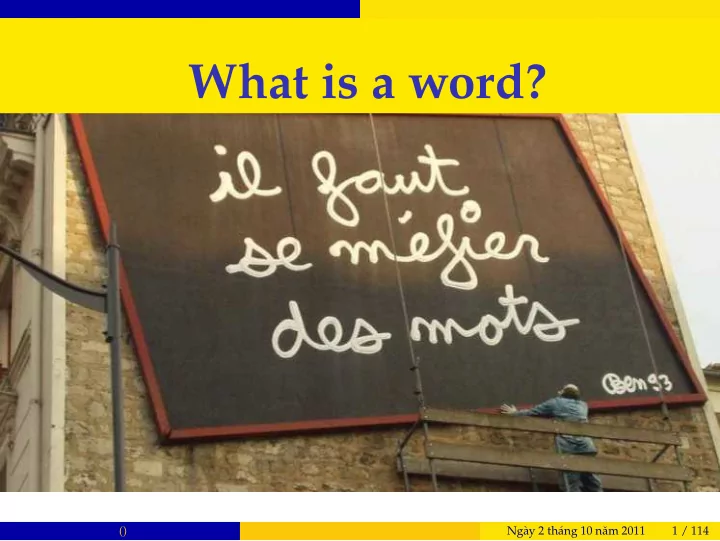
What is a word? () Ngy 2 thng 10 nm 2011 1 / 114 (Ill bet you - - PowerPoint PPT Presentation
What is a word? () Ngy 2 thng 10 nm 2011 1 / 114 (Ill bet you thought you knew) Outline What is a word? 1 Morphemes 2 Derivation and inflection 3 Morphological typology 4 Innovation 5 () Ngy 2 thng 10 nm 2011 2 / 114
(I’ll bet you thought you knew)
() Ngày 2 tháng 10 năm 2011 1 / 114
Outline
1
What is a word?
2
Morphemes
3
Derivation and inflection
4
Morphological typology
5
Innovation
() Ngày 2 tháng 10 năm 2011 2 / 114
Main points We begin with a familiar object: the written word. Zipf’s Law. What is the basis for our dividing the stream of sounds (or letters) as we do? The lexeme: how well do we know how to organize a dictionary of
Morphology is the (study of the) structure of words: internal and external (=relational) structure Internal analysis of words External analysis: inflectional morphology and derivational morphology Productivity
() Ngày 2 tháng 10 năm 2011 3 / 114
Rank OE Corpus word Tom Warren lemmas forms Sawyer Commission 1 the the the the 2 be
and
3 to and a to 4
a to and 5 and to
in 6 a in he a 7 in is was that 8 that you it he 9 have that in was 10 I it that his 11 it he his
12 for was I Oswald 13 not for you had 14
Tom at 15 with are with for
() Ngày 2 tháng 10 năm 2011 4 / 114
Television/movies you 1,222,421 I 1,052,546 to 823,661 the 770,161 a 563,578 and 480,214 that 413,389 it 388,320
332,038 me 312,326 Project Gutenberg the 56,271,872
33,950,064 and 29,944,184 to 25,956,096 in 17,420,636 I 11,764,797 that 11,073,318 was 10,078,245 his 8,799,755 he 8,397,205 it 8,058,110 with 7,725,512 is 7,557,477 for 7,097,981 as 7,037,543 had 6,139,336
() Ngày 2 tháng 10 năm 2011 5 / 114
Zipf’s Law The product of a word’s rank and its frequency is a constant across a large corpus. rank(w) × freq(w) = Z where Z is a constant for a given language.
() Ngày 2 tháng 10 năm 2011 6 / 114
Zipf’s Law: Wikipedia graphic
() Ngày 2 tháng 10 năm 2011 7 / 114
Zipf’s Law From AI and Social Science website, Brendan O’Connor.
() Ngày 2 tháng 10 năm 2011 8 / 114
What is a word?
Idea the First: Orthography A first try: Definition A word is a written sequence which has a white space at each end but no white space in the middle. Problem the First: this begs the question.
() Ngày 2 tháng 10 năm 2011 9 / 114
What is a word?
Begging the question
() Ngày 2 tháng 10 năm 2011 10 / 114
What is a word?
Idea the First: Orthography Definition A word is a written sequence which has a white space at each end but no white space in the middle. Problem the First: this begs the question. Problem the Second: not everyone uses spaces.
() Ngày 2 tháng 10 năm 2011 11 / 114
What is a word?
Before there were spaces
() Ngày 2 tháng 10 năm 2011 12 / 114
What is a word?
There continue to not be spaces
() Ngày 2 tháng 10 năm 2011 13 / 114
What is a word?
There continue to not be spaces
() Ngày 2 tháng 10 năm 2011 14 / 114
What is a word?
There continue to not be spaces
() Ngày 2 tháng 10 năm 2011 15 / 114
What is a word?
Idea the First: Orthography
each end but no white space in the middle.
Problem the First: this begs the question. Problem the Second: not everyone uses spaces. Problem the Third: compounds.
() Ngày 2 tháng 10 năm 2011 16 / 114
What is a word?
Google “land holder" (incl. land-holder): 91,300 hits “landholder": 486,000 hits Is one in more dictionaries than the other? Does it matter?
() Ngày 2 tháng 10 năm 2011 17 / 114
What is a word?
Compounds die Herzkreislaufwiederbelebung Herz ‘heart’ Kreis ‘circle’ laufen ‘to run’ (> Lauf ‘a run, circuit’) wieder ‘again’ beleben ‘to revive, animate’ (> Belebung ‘revival’)
() Ngày 2 tháng 10 năm 2011 18 / 114
What is a word?
Compounds das Rindfleischetikettierungs- ¨ uberwachungsaufgaben¨ ubertragungsgesetz Rind ‘beef, cattle’ Fleisch ‘meat, flesh’ Etikett ‘label’ Etikettierung ‘labelling’ ¨ uber ‘over’ wach ‘awake’ ¨ Uberwachung ‘control, monitoring’ Aufgaben ‘responsibilities’ tragen ‘to carry’ ¨ Ubertragung ‘transfer’ Gesetz ‘law’ Is the corresponding English form a word, or a phrase?
() Ngày 2 tháng 10 năm 2011 19 / 114
What is a word?
Compounds and worse
French (Romance, Indo-European)
porte- clé carry key key holder je- m’en- fout- isme I myself-of-it shove nominalization I-don’t-care-ism He had one of those I-know-something-you-don’t-know looks.
() Ngày 2 tháng 10 năm 2011 20 / 114
What is a word?
Lexical entries Here’s another tack: Definition A word is what precedes a dictionary entry.
() Ngày 2 tháng 10 năm 2011 21 / 114
What is a word?
Dictionary forms aka citation form or lemma Computational linguists use lemma to mean something a bit broader.
() Ngày 2 tháng 10 năm 2011 22 / 114
What is a word?
What’s in the dictionary? bi•as (b¯ ı"@s) n. 1. A line cutting diagonally across the grain of fabric. 2. Preference or inclination that inhibits impartiality; prejudice. –adv. On a diagonal; aslant. –v. –ased or –assed, –as•ing or as•sing. To cause to have a bias; prejudice. [< OFr. biais, oblique.
() Ngày 2 tháng 10 năm 2011 23 / 114
What is a word?
Dictionary forms Verbs tend to have just one dictionary entry Ditto singular and plural forms of nouns Forms of a lexeme share (some common element of) meaning.
() Ngày 2 tháng 10 năm 2011 24 / 114
What is a word?
So can we just use the dictionary? Not everything is in the dictionary Dictionaries are made by graduate students in linguistics and their supervisors, after reading a lot of older dictionaries. People love to make up new words This process is called neologism ...which itself only recently became a word:
() Ngày 2 tháng 10 năm 2011 25 / 114
What is a word?
Thomas Jefferson, amateur philologist
Letter to John Adams, 1820
“But if Dictionaries are to be the Arbiters of language, in which of them shall we find neologism? No matter. It is a good word, well sounding, obvious, and expresses an idea which would otherwise require circumlocution... I am a friend to neology. It is the only way to give to a language copiousness and euphony. Without it we should still be held to the vocabulary of Alfred or of Ulphilas; and held to their state of science also: for I am sure they had no words which could have conveyed the ideas of oxygen, cotyledons, zoophytes, magnetism, electricity, hyaline, and thousands of others expressing ideas not then existing, nor of possible communication in the state of their language.”
() Ngày 2 tháng 10 năm 2011 26 / 114
What is a word?
Thomas Jefferson, amateur philologist
Letter to John Adams, 1820
“What a language has the French become since the date of their revolution, by the free introduction of new words! The most copious and eloquent in the living world; and equal to the Greek, had not that been regularly modifiable almost ad infinitum. Their rule was that whenever their language furnished or adopted a root, all its branches, in every part of speech were legitimated by giving them their appropriate terminations: adelphos “brother", adelphe “sister", adelphidion “little brother", adelphotes "brotherly affection", adelphixis “brotherhood", adelphidoys “nephew", adelphikos “brotherly," adj., adelphizo “to adopt as a brother", adelphikos “brotherly," adv. And this should be the law of every language.”
() Ngày 2 tháng 10 năm 2011 27 / 114
What is a word?
Thomas Jefferson, amateur philologist
Letter to John Adams, 1820
“Thus, having adopted the adjective fraternal, it is a root, which should legitimate fraternity, fraternation, fraternisation, fraternism, to fraternate, fraternise, fraternally. And give the word neologism to our language, as a root, and it should give us its fellow substantives, neology, neologist, neologisation; its adjectives neologous, neological, neologistical, its verb neologise, and adverb neologically.”
() Ngày 2 tháng 10 năm 2011 28 / 114
What is a word?
Thomas Jefferson, amateur philologist
Letter to John Adams, 1820
“Dictionaries are but the depositories of words already legitimated by usage. Society is the work-shop in which new ones are elaborated. When an individual uses a new word, if illformed it is rejected in society, if wellformed, adopted, and, after due time, laid up in the depository of dictionaries. And if, in this process of sound neologisation, our transatlantic brethren shall not choose to accompany us, we may furnish, after the Ionians, a second example of a colonial dialect improving on its primitive.”
() Ngày 2 tháng 10 năm 2011 29 / 114
What is a word?
What’s right about deferring to the dictionary? This inclination recognizes implicitly that in most languages, words cluster into groups that only deserve to be mentioned once, as a clan, in the dictionary. The words in the clan divide up their usage among themsleves in a very regimented way: the lexeme.
() Ngày 2 tháng 10 năm 2011 30 / 114
What is a word?
More problems with dictionaries avoir (to have) speak (fut.) 1st ai parlerai Sg 2nd as parleras 3rd a parlera 1st avons parlerons Pl 2nd avez parlerez 3rd
parleront The future forms all derived from an earlier stage of the language in which one said something like, “to speak have” to mark the future. These forms have now become suffixes.
() Ngày 2 tháng 10 năm 2011 31 / 114
What is a word?
Semantic domains Yet another try: Definition A word is the smallest unit of meaning. The phoneme is too small...
Any phoneme can appear in a word with any meaning
The sentence is too big....
Sentences are semantically compositional (more on this later)
Maybe the word is just right?
() Ngày 2 tháng 10 năm 2011 32 / 114
What is a word?
Idioms
What about idioms?
kick the bucket: this has nothing to do with kicking buckets. *It was the bucket that Uncle Goober kicked last Thursday. tighten your belt: this sort of has something to do with tightening
After years of wretched excess, the studios’ free-spending fat cats are only now learning to tighten their Gucci belts.
() Ngày 2 tháng 10 năm 2011 33 / 114
Morphemes
Morphemes Definition The morpheme is the smallest unit of language that carries meaning or function. The meaning of words is often predictable: it is composed in a regular way of the meaning of its parts. We will be discussing morphemes a lot. We will even consider the case where we want to posit morphemes independent of whether we can assign meaning to htem. But for now: morphemes carry meaning in a regular fashion. So words cannot be characterized as the smallest meaning-bearing units.
() Ngày 2 tháng 10 năm 2011 34 / 114
Morphemes
Morphemes
two three more than three and couple couple+s hunt hunt+er hunt+er+s act act+ive act+iv+ate re+act+ive+ate
() Ngày 2 tháng 10 năm 2011 35 / 114
Morphemes
Pop quiz 1: spot the morpheme Identify the morphemes in the following English words:
() Ngày 2 tháng 10 năm 2011 36 / 114
Morphemes
Free vs. bound morphemes Free morphemes can occur as separate words: car, yes Bound morphemes cannot occur ‘on their own’:
dog
dogs de- toxify detoxify create
creation cran- berry cranberry
*I saw three s dog. *John ate two apples and four crans. *Alice had to de the water toxify.
() Ngày 2 tháng 10 năm 2011 37 / 114
Morphemes
Free vs. bound morphemes What’s free in one language may be bound in another. In Hare (Athabaskan), body parts must be possessed: without a possessor with a possessor *fí ‘head’ sefí ‘my head’ *bé ‘belly’ nebé ‘my belly’ *dzé ‘heart’ Pedzé ‘someone’s heart/a heart’
() Ngày 2 tháng 10 năm 2011 38 / 114
Morphemes
Form a review of Solar (2010), by Ian McEwan: Michael is a 50-something former Nobel laureate, resting on his fleshy laurels from twenty-two years ago, where he stood on the shoulders of Einstein and proposed a scientific “Conflation Theory” that was trailblazing at the time. Now, he tours around the globe giving lectures and consults for a large fee, and he sits idly as a member of a board at a center for renewable energy in the UK. His main pursuit is women, and he pursues them with -aholic depravity. As the novel opens, his fifth marriage is falling apart due to his infidelities. But this time, his wife got the last word by having some side dishes for herself and leaving him labeled as the cuckold.
() Ngày 2 tháng 10 năm 2011 39 / 114
Morphemes
Why is this funny?
() Ngày 2 tháng 10 năm 2011 40 / 114
Morphemes
Backformation
http://www.gruntledemployees.com
() Ngày 2 tháng 10 năm 2011 41 / 114
Morphemes
Content vs. function morphemes Content morphemes are not tied to grammatical function They can denote things: sand, truck, Leslie They can denote actions: throw, kiss, live They can denote states: green, vile, open You can make up new ones: Smurf, nuke, grok, hoinh
() Ngày 2 tháng 10 năm 2011 42 / 114
Morphemes
Content vs. function morphemes Function morphemes tend to be tied to specific uses Prepositions: to, by, with Pronouns: he, she, it Articles: a, the Affixes: -ness, sub-, -s Generally, you can’t make up new ones (ever tried?)
() Ngày 2 tháng 10 năm 2011 43 / 114
Morphemes
Pop quiz 2: Farsi xar means ‘buy’ and -id indicates past tense.
xaridam ‘I bought’ xaridi ‘you bought’ xarid ‘(he) bought’ naxaridam ‘I did not buy’ mixarid ‘(he) was buying’ mixaridid ‘you (pl.) were buying’ I you (pl.) not you (sg.) was/were + ing
How do you say... I was buying. You (sg.) did not buy. You (sg.) were buying.
() Ngày 2 tháng 10 năm 2011 44 / 114
Morphemes
Allomorphy It turns out morphemes don’t always map onto phonemes in the same
an
a basketball an accent a cash register an idea a hospital an eel a girl What is the generalization governing the behavior of the indefinite article in English? Is it based on pronunciation, or spelling? Other examples?
() Ngày 2 tháng 10 năm 2011 45 / 114
Morphemes
Hungarian
ad fej ¨
hoz vés f˝
give milk kill bring chisel cook 1st adom fejem ¨
hozom vésem f˝
Sg 2nd adod fejed ¨
hozod vésed f˝
3rd adja feji ¨
hozza vési f˝
1st adjuk fejj¨ uk ¨
uk hozzuk véss¨ uk f˝
uk Pl 2nd adjátok fejitek ¨
hozzátok vésitek f˝
3rd adják fejik ¨
hozzák vésik f˝
() Ngày 2 tháng 10 năm 2011 46 / 114
Morphemes
Hungarian: present definite
ad fej ¨
hoz vés f˝
give milk kill bring chisel cook 1st adom fejem ¨
hozom vésem f˝
Sg 2nd adod fejed ¨
hozod vésed f˝
3rd adja feji ¨
hozza vési f˝
1st adjuk fejj¨ uk ¨
uk hozzuk véss¨ uk f˝
uk Pl 2nd adjátok fejitek ¨
hozzátok vésitek f˝
3rd adják fejik ¨
hozzák vésik f˝
‘I give’, ‘you milk’, ‘s/he kills’, ‘we bring’, ‘they cook’...
() Ngày 2 tháng 10 năm 2011 47 / 114
Morphemes
Hungarian pad fej s¨
bot bench head beer stick 1st padom fejem s¨
botom Sg 2nd padod fejed s¨
botod 3rd padja feje s¨
botja 1st padunk fej¨ unk s¨
unk botunk Pl 2nd padotok fejetek s¨
bototok 3rd padjuk fej¨ uk s¨
uk botjuk
() Ngày 2 tháng 10 năm 2011 48 / 114
Morphemes
Hungarian: nominal possessive pad fej s¨
bot bench head beer stick 1st padom fejem s¨
botom Sg 2nd padod fejed s¨
botod 3rd padja feje s¨
botja 1st padunk fej¨ unk s¨
unk botunk Pl 2nd padotok fejetek s¨
bototok 3rd padjuk fej¨ uk s¨
uk botjuk ‘my book’, ‘your head’, ‘his/her beer’, ‘our stick’...
() Ngày 2 tháng 10 năm 2011 49 / 114
Morphemes
Analyzing word structure Simple words are unanalyzable: the, trim, nine Complex words consist of a root plus one or more affixes N Af er V teach A A kind Af un V Af ed V Af en A black
() Ngày 2 tháng 10 năm 2011 50 / 114
Morphemes
German superfix gloss infinitive past participle film film-en ge-film-t ask frag-en ge-frag-t praise lob-en ge-lob-t show zeig-en ge-zeig-t
() Ngày 2 tháng 10 năm 2011 51 / 114
Morphemes
Roots and affixes Roots tend to belong to a lexical category: noun, verb, preposition, adverb, etc. Affixes include both prefixes and suffixes
prefixes suffixes de-active faith-ful re-play govern-ment il-legal hunt-er in-accurate kind-ness
() Ngày 2 tháng 10 năm 2011 52 / 114
Morphemes
Different strokes In Hungarian, ‘prepositions’ are either case endings... case form gloss
NOMINATIVE
ház ‘house’
INESSIVE
házban ‘in a house’
ILLATIVE
házba ‘into a house’
ADESSIVE
háznál ‘at a house’
ELATIVE
házból ‘out of a house’
ALLATIVE
házhóz ‘to a house’
() Ngày 2 tháng 10 năm 2011 53 / 114
Morphemes
For different folks ...or postpositions: el˝
in front of a ház el˝
‘in front of the house’ m¨
behind a ház m¨
‘behind the house’ k¨
between, among a fák k¨
‘among the trees’ alatt beneath a kert alatt ‘beneath the garden’
() Ngày 2 tháng 10 năm 2011 54 / 114
Morphemes
More postpositions Hindi/Urdu uses postpositions almost exclusively: (1) m¯ aliy¯ at finance k¯ a
mahekma department ‘Department of Finance’ (2) ´ s¯ ahid Shahid n¯ e
AGENT
apn¯ I
POS
v¯ alida mother k¯
t¯ ar telegram bh¯ ej¯ a send ‘Shahid sent a telegram to his mother.’ (3) lar ˙ k¯ a boy d¯
m friend.OBL.PL k¯ e s¯ ath with kh¯ el play rah¯ a hai is-doing ‘The boy is playing with friends.’
() Ngày 2 tháng 10 năm 2011 55 / 114
Morphemes
Infixes Affixes may also occur within another morpheme This is known as infixation, and such affixes are called infixes Infixation in Tagalog: base infix bili ‘buy’ b-in-ili ‘bought’ basa ‘read’ b-in-asa ‘read’ sulat ‘write’ s-in-ulat ‘wrote’
() Ngày 2 tháng 10 năm 2011 56 / 114
Morphemes
Infixes Nominalizing -ni- in Leti (Austronesian; data from Blevins 1999): base infixed form kaati ‘to carve’ k-ni-aati ‘carving’ polu ‘to call’ p-ni-olu ‘act of calling, call’ kini ‘to kiss’ k-n-ini ‘act of kissing, kiss’ tutu ‘to support’ t-n-utu ‘act of supporting, support’ Is there infixation in English?
() Ngày 2 tháng 10 năm 2011 57 / 114
Morphemes
Expletive infixation English expletive infixation (McCarthy 1982):
togéther to-bloody-gether enóugh e-bloody-nough Kalamazóo Kalama-goddam-zoo absolútely abso-goddam-lutely fantástic fan-friggin-tastic unbelíevable un-friggin-believable
Note that this has something to do with phonology...
() Ngày 2 tháng 10 năm 2011 58 / 114
Morphemes
Homeric infixation (Yu 2004)
tuba tuba-ma-ba violin vio-ma-lin Alabama Ala-ma-bama educate edu-ma-cate complicated compli-ma-cated
(cf. ‘diddly’ infixation: Elfner & Wimpner 2008)
() Ngày 2 tháng 10 năm 2011 59 / 114
Morphemes
More English infixation? What about words like sleeplessly, boyishness? What is the status of -less-, -ish-? Adv Af ly Adj Af less V sleep N Af ness Adj Af ish N boy
() Ngày 2 tháng 10 năm 2011 60 / 114
Morphemes
The relationship between words and morphemes
A morpheme is the minimal unit of meaning
bound morphemes cannot occur in isolation: cran-, -ness free morphemes can stand alone: blue, teach allomorphs are functionally equivalent forms of the same morpheme used in distinct contexts: a, an
A word is a minimal free form that can occur in isolation and/or whose position with respect to neighboring elements is not entirely fixed
simple words cannot be broken down further: the, kayak complex words have multiple parts: himself = him + self
() Ngày 2 tháng 10 năm 2011 61 / 114
Morphemes
The relationship between words and morphemes
() Ngày 2 tháng 10 năm 2011 62 / 114
Morphemes
The relationship between words and morphemes
() Ngày 2 tháng 10 năm 2011 63 / 114
Morphemes
The relationship between words and morphemes
() Ngày 2 tháng 10 năm 2011 64 / 114
Morphemes
The relationship between words and morphemes
() Ngày 2 tháng 10 năm 2011 65 / 114
Morphemes
The relationship between words and morphemes
() Ngày 2 tháng 10 năm 2011 66 / 114
Morphemes
Putting morphemes together In English (and Indo-European languages), morphemes are largely put together in a sequence, or concatenated This is not the only way to do things Semitic languages (especially) are non-concatenative: they form words using a special type of infixation sometimes called templatic morphology
() Ngày 2 tháng 10 năm 2011 67 / 114
Morphemes
Putting morphemes together
affix
✂ ✂ ✂ ✂ ✂ ❇ ❇ ❇ ❇ ❇
k i t a b
❅ ❅ ❅
kataba kutib aktub ‘wrote’ ‘has been written’ ‘am writing’
() Ngày 2 tháng 10 năm 2011 68 / 114
Derivation and inflection
Derivational versus inflectional morphology Linguists struggle to find a simple account of the difference between inflectional morphology and derivational morphology. But anyone who studies the relations between words of a language knows that this distinction is real. Content words (nouns, verbs, adjectives) very often are organized into families of words organized along a set of (nearly) independent dimensions, as far as linguistic function is concerned; we call these paradigms. Present tense of the verb aller ‘to go’ person singular plural 1st vais allons 2nd vas allez 3rd va vont
() Ngày 2 tháng 10 năm 2011 69 / 114
Derivation and inflection
3 dimensions... Present tense of the verb aller ‘to go’ person singular plural 1st vais allons 2nd vas allez 3rd va vont imperfect of verb aller 1st allais allion 2nd allais alliez 3rd allait allaient
() Ngày 2 tháng 10 năm 2011 70 / 114
Derivation and inflection
Inflectional morphology Inflectional affixes indicate grammatical information (tense, number, person...) but don’t change category. When we linguists say that, we mean that our statements about syntax will remain the same regardless of which particular choice of the inflectional paradigms is used in a sentence. We find the verb in the same place in a French sentence regardless of what person, number, or aspect it is in; this is what we mean when we say that inflectional morphology does not change part of speech. form 1 form 2 lexical category dog dogs noun run runs verb tall taller adjective
adjective
() Ngày 2 tháng 10 năm 2011 71 / 114
Derivation and inflection
Inflectional morphology English has pretty anemic inflectional morphology: affix function example
3rd sing. pres. He talks.
past tense He talked.
progressive He’s talking.
past participle He talked.
plural (of noun) The cats are sleeping.
possessive The cat’s food is ready.
comparative John is taller than Mary.
superlative John is Bob’s oldest son.
() Ngày 2 tháng 10 năm 2011 72 / 114
Derivation and inflection
Inflectional morphology There are also a few other ways to mark inflectional contrast: ablaut (quasi-predictable vowel change) suppletion (substituting one form for another) present past go went am was come came fall fell eat ate singular plural foot feet moose moose
() Ngày 2 tháng 10 năm 2011 73 / 114
Derivation and inflection
When a rule of syntax (grammar) involves agreement between two words in a sentence for some grammatical feature, the realization of that feature by each of the words is part of inflectional morphology. Examples: subject-verb agreement; noun-adjective agreement. gender Number:singular Number:plural masculine peque˜ no peque˜ nos feminine peque˜ na peque˜ nas peque˜ n
∅ s
Ngày 2 tháng 10 năm 2011 74 / 114
Derivation and inflection
French adjectives gender
masc.plural
small p@ti p@ti p@tit p@tit large grã grã grãd grãd normal normal normo normal normal green ver ver vert vert red KuZ KuZ KuZ KuZ good bõ bõ bOn bOn gray gKi gKi gKiz gKiz long lõ lõ lõg lõg hot So So Sod Sod white blã blã blãS blãS fresh fKe fKe fKES fKES false fo fo fos fos Subtractive morphology in the formation of the masculine form.
() Ngày 2 tháng 10 năm 2011 75 / 114
Derivation and inflection
Estonian (Blevins 2006)
() Ngày 2 tháng 10 năm 2011 76 / 114
Derivation and inflection
Estonian (Blevins 2006)
() Ngày 2 tháng 10 năm 2011 77 / 114
Derivation and inflection
Derivational morphology Derivational morphology deals with the relationship between separate lexemes, typically in different parts of speech, and typically in a way that is both semantically irregular, and limited in its range of application. As a consequence, a derivationally derived form can always be replaced by a non-derived form — something that is rarely the case for inflectionally complex forms. verbal base derived noun sell sell-er write writ-er teach teach-er sing sing-er discover discover-er How many derivational affixes does English have? ...
() Ngày 2 tháng 10 năm 2011 78 / 114
Derivation and inflection
English derivational affixes affix root derived form
is added to a verb to give a noun finalize finalization confirm confirmation un- is added to a verb to give a verb tie untie wind unwind un- is added to an adjective to give an adjective happy unhappy wise unwise
is added to a noun to give an adjective institution institutional universe universal
() Ngày 2 tháng 10 năm 2011 79 / 114
Derivation and inflection
Idiosyncracy in the derivational lexicon –ist –ism –ize baptist baptism baptize exorcist exorcism exorcize terrorist terrorism terrorize
() Ngày 2 tháng 10 năm 2011 80 / 114
Derivation and inflection
Idiosyncracy in the derivational lexicon –ist –ism –ize baptist baptism baptize exorcist exorcism exorcize terrorist terrorism terrorize violinist *violinism *violinize
() Ngày 2 tháng 10 năm 2011 81 / 114
Derivation and inflection
Idiosyncracy in the derivational lexicon –ist –ism –ize baptist baptism baptize exorcist exorcism exorcize terrorist terrorism terrorize violinist *violinism *violinize
!organism !organize publicist *publicism publicize
() Ngày 2 tháng 10 năm 2011 82 / 114
Derivation and inflection
Idiosyncracy in the derivational lexicon –ist –ism –ize baptist baptism baptize exorcist exorcism exorcize terrorist terrorism terrorize violinist *violinism *violinize
!organism !organize publicist *publicism publicize womanist *womanism womanize materialist materialism !materialize
() Ngày 2 tháng 10 năm 2011 83 / 114
Derivation and inflection
Idiosyncracy in the derivational lexicon –ist –ism –ize baptist baptism baptize exorcist exorcism exorcize terrorist terrorism terrorize violinist *violinism *violinize
!organism !organize publicist *publicism publicize womanist *womanism womanize materialist materialism !materialize atheist (1568) aetheism !atheize linguist (1588) *linguism *linguize
() Ngày 2 tháng 10 năm 2011 84 / 114
Derivation and inflection
Idiosyncracy in the derivational lexicon –ist –ism –ize baptist baptism baptize exorcist exorcism exorcize terrorist terrorism terrorize violinist *violinism *violinize
!organism !organize publicist *publicism publicize womanist *womanism womanize materialist materialism !materialize atheist (1568) aetheism !atheize linguist (1588) *linguism *linguize humanist (1589) humanism ?humanize rationalist (1627) rationalism !rationalize
() Ngày 2 tháng 10 năm 2011 85 / 114
Derivation and inflection
More idiosyncracy in the derivational lexicon Bhutanese, Chinese, Vietnamese –ese Japanese, Lebanese, Maltese Taiwanese, Portuguese African, Alaskan, American –an Angolan, Cuban, Jamaican Mexican, Nicaraguan Argentinian, Armenian, Canadian –ian Ethiopian, Bolivian, Serbian Jordanian, Palestinian Scottish, British, Flemish –ish Swedish, Polish, Danish Irish –i Iraqi, Israeli, Pakistani –? French, German, Greek, Thai
() Ngày 2 tháng 10 năm 2011 86 / 114
Derivation and inflection
What’s going on here? Brazil::Brazilians, Australia::Australians... So why not East Timor::East Timorians? Why not regularize?
() Ngày 2 tháng 10 năm 2011 87 / 114
Derivation and inflection
Pop quiz 3: inflectional vs. derivation Are the following affixes inflectional or derivational? soften (Heating the cheese will soften it.) pollution (The pollution of the forest was tragic.) reading (I am reading a book.) reading (The reading of the poem was beautifully done.) kingdom (The knight rode across the kingdom.) happier (My friend is happier than I am.) (are both the ings the same? are there others?)
() Ngày 2 tháng 10 năm 2011 88 / 114
Derivation and inflection
Interesting excercise for you
1
Estimate the number of words you know.
2
Specifically:
Estimate the number of words in your active vocabulary (those words or word forms you have used or would use in spoken or written language), and Estimate the number of words in your passive vocabulary (those words whose meanings you recognize and would understand when they are used in an appropriate context, but which you have never used yourself).
() Ngày 2 tháng 10 năm 2011 89 / 114
Derivation and inflection
Interesting exercise (cont.)
1
Method: Take an unabridged dictionary of English. Open to a random page: count the number of entries (lemmata) on that page. Ask yourself for each entry whether you 1. would understand the word if you heard it in the context of a sentence (call the total such forms on the page p), and 2. whether you have ever yourself used the word in speech or writing (=a). Multiply p and a separately by (1) the number of pages in the dictionary that have entries (ne) and then by (2) the total number of claimed entries in the dictionary [found on the cover or in the introduction] (nc) divided by the total number of entries on the page you looked at (np). I.e., A = p · ne C = p · (nc/np) B = a · ne D = a · (nc/np)
() Ngày 2 tháng 10 năm 2011 90 / 114
Derivation and inflection
Interesting exercise (cont.)
1
Repeat, but now counting every form of every word on the page (for nouns: plural and singular; for adjectives: comparative, superlative; for verbs: all parts); also use any sublemmata (typically found when affixation gives rise to new forms that are entirely derivative or transparent). Feel free to note if the dictionary does not indicate all the possible forms (especially for derivational affixation).
2
Take results with large grain of salt.
() Ngày 2 tháng 10 năm 2011 91 / 114
Derivation and inflection
What is the meaning of an affix?
un- untie con- constitution unshackle confess unharness connect unhappy contract untimely contend unthinkable conspire unmentionable complete
() Ngày 2 tháng 10 năm 2011 92 / 114
Derivation and inflection
Some out-s from Merriam-Webster
() Ngày 2 tháng 10 năm 2011 93 / 114
Derivation and inflection
Compare with:
() Ngày 2 tháng 10 năm 2011 94 / 114
Morphological typology
Morphological typology The standard terminology goes back to Edward Sapir Language (1921): In an isolating language, words are (all) composed of single morphemes: low morpheme/word ratio. In a synthetic language, words tend to consist of multiple morphemes. A distinction is often drawn between (in)flectional and agglutinative
French with an imaginary agglutinative language: French Agglu person singular plural singular plural 1st vais allons skip skips 2nd vas allez skipo skipso 3rd va vont skipum skipsum
() Ngày 2 tháng 10 năm 2011 95 / 114
Morphological typology
One word/one morpheme?
() Ngày 2 tháng 10 năm 2011 96 / 114
Morphological typology
Polysynthetic languages Greenlandic (and other Eskimo-Aleut languages) make extensive use of postbases: multiple, recursively addable derivational suffixes Given a root, you can create a ‘word’ of alarming length Thus the potential number of ‘words’ is arguably limitless...
() Ngày 2 tháng 10 năm 2011 97 / 114
Morphological typology
Greenlandic qani- ‘snow’
() Ngày 2 tháng 10 năm 2011 98 / 114
Morphological typology
Greenlandic oqaq- ‘tongue’
‘says’
‘word’
‘speaks’
‘linguist’
‘grammar’
‘author’
‘speaks badly about him’
() Ngày 2 tháng 10 năm 2011 99 / 114
Innovation
New words Back to Jefferson: neologism Another way that morphology is markedly different from other areas of grammar (Seemingly) arbitrary innovations aren’t allowed in syntax, or phonology... But people add new words all the time (and change the meaning
() Ngày 2 tháng 10 năm 2011 100 / 114
Innovation
climb down Can Santa really climb down the chimney?
http://christmas.howstuffworks.com/traditions/santa-chimney.htm
You’ll find a ladder to climb down into the ship’s hold.
http://www.gamespot.com/features/2871423/p-9.html
Boys climbing down to the water
http://www.eveandersson.com/photo-display/large/france/south/ cassis-calanque-de-port-miou-boys.html
() Ngày 2 tháng 10 năm 2011 101 / 114
Innovation
silly
1556 in W. H. Turner Select Rec. Oxford 246 ‘The fire raging upon the silly Carcase.’
1591 SHAKES. Two Gent. IV. i. 72 ‘Prouided that you do no outrages On silly women, or poore passengers.’
1866 M. ARNOLD Thyrsis v, ‘He could not keep..Here with the shepherds and the silly sheep.’
() Ngày 2 tháng 10 năm 2011 102 / 114
Innovation
silly
1767 SIR R. COLVILLE in Dossie Mem. Agric. (1768) I. 412 ‘Marsh land, of a light, silly, hungry soil.’
1577-87 HOLINSHED Chron. II. 96 ‘He was shot thorough with an arrow amongst his men by a sillie footman.’
1840 DICKENS Barn. Rudge iii, “Heaven help this silly fellow,’ murmured the perplexed locksmith.’
() Ngày 2 tháng 10 năm 2011 103 / 114
Innovation
1991
() Ngày 2 tháng 10 năm 2011 104 / 114
Innovation
1992
() Ngày 2 tháng 10 năm 2011 105 / 114
Innovation
1993
() Ngày 2 tháng 10 năm 2011 106 / 114
Innovation
1994
This spawned all sorts of children...
() Ngày 2 tháng 10 năm 2011 107 / 114
Innovation
1995
(‘act aggressively as a newcomer’)
() Ngày 2 tháng 10 năm 2011 108 / 114
Innovation
1998
(i- hadn’t been invented yet...)
() Ngày 2 tháng 10 năm 2011 109 / 114
Innovation
2003
heterosexual male, or, as coiner Mark Simpson put it, a man who "has clearly taken himself as his own love object." a portmanteau (or blend):
smog brunch spork Brangelina ...etc.
() Ngày 2 tháng 10 năm 2011 110 / 114
Innovation
2005
1 : “truth that comes from the gut, not books” (Stephen Colbert, Comedy
Central’s "The Colbert Report," October 2005)
2 : “the quality of preferring concepts or facts one wishes to be true, rather than concepts or facts known to be true” (American Dialect
Society, January 2006)
() Ngày 2 tháng 10 năm 2011 111 / 114
Innovation
2009
Twitter.com service
message.
() Ngày 2 tháng 10 năm 2011 112 / 114
Innovation
Word of the Decade
(‘to search the internet’. Cf. Xerox, Kleenex, etc.)
() Ngày 2 tháng 10 năm 2011 113 / 114
Innovation
A century earlier... The sun is setting – Can’t you hear A something in the distance Howl!!? I wonder if it’s – Yes!! it is That horrid Google On the prowl!!!
http://blogoscoped.com/googlebook/
() Ngày 2 tháng 10 năm 2011 114 / 114