Quark Imaging at JLab 12 GeV and beyond (2) Compton Scattering - - PowerPoint PPT Presentation

quark imaging at jlab 12 gev and beyond 2
SMART_READER_LITE
LIVE PREVIEW

Quark Imaging at JLab 12 GeV and beyond (2) Compton Scattering - - PowerPoint PPT Presentation

Quark Imaging at JLab 12 GeV and beyond (2) Compton Scattering Tanja Horn , K, etc. Jefferson Lab Known , process K, GP etc. D ~ ~ H H E E HUGS, Newport News, VA 11 June 2009 Tanja Horn, Quark imaging at JLab 12 GeV and


slide-1
SLIDE 1

Quark Imaging at JLab 12 GeV and beyond (2)

Tanja Horn Jefferson Lab

HUGS, Newport News, VA

11 June 2009

1 Tanja Horn, CUA Colloquium Tanja Horn, Quark imaging at JLab 12 GeV and beyond, HUGS 2009

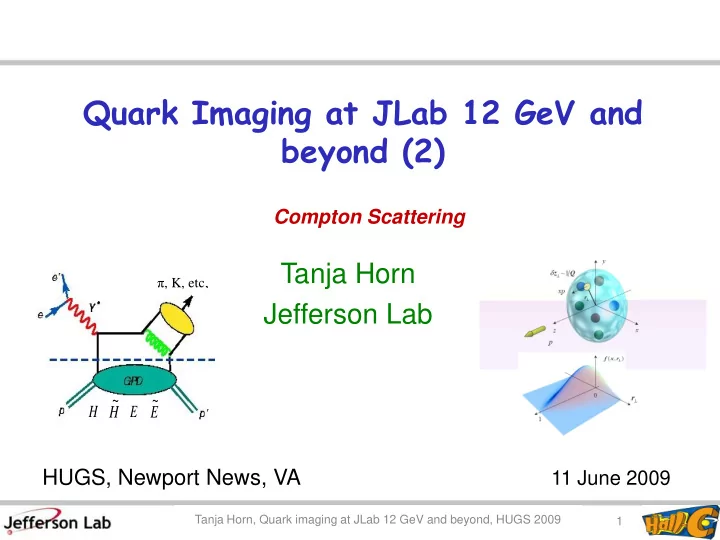
Compton Scattering

π, K, etc.

GP D

Known process

H H

~

E E ~ π, K, etc.

slide-2
SLIDE 2

Interference pattern x = 0.01 x = 0.40 x = 0.70

Quark Imaging

  • Wigner quantum phase space distributions provide a simultaneous, correlated,

3-dimensional description of both the position and momentum. Wigner distributions provide the language for the Generalized Parton Distributions (GPDs), which allow us to create a complete map of the behaviour of partons (quarks and gluons) inside of the nucleon.

2 Tanja Horn, CUA Colloquium

  • They are the closest analogue to a classical phase space density allowed by the

uncertainty principle.

Tanja Horn, Quark imaging at JLab 12 GeV and beyond, HUGS 2009

Pictures show transverse plane for different quark momentum fractions x

slide-3
SLIDE 3

Probing GPDs in the Nucleon

  • We need to find a process, which we can describe by factorizing it into:

– a known part that we can calculate, and –

  • ne that contains the information we are after
  • For some reactions it has been proven that such

factorization is possible, but only under very extreme conditions

– In order to use them, one needs to show that they are applicable in “real life”

  • A decisive test is to look at the scaling of the cross section (interaction

probability) as a function of Q2, and see if it follows the QCD prediction for scattering from a cluster of point-like objects

k' * p p' e

GPD

Known process

3 Tanja Horn, Quark imaging at JLab 12 GeV and beyond, HUGS 2009

slide-4
SLIDE 4

Feasibility ↔ Measurement

  • Exclusive meson production adds flavor to

quark imaging studies

– But one needs to test various pre-requisites – Demonstrate that, e.g., QCD factorization applies

Tanja Horn, Quark imaging at JLab 12 GeV and beyond, HUGS 2009

π, K, etc.

GP D

Known process

H H

~

E E ~ π, K, etc.

  • What about other exclusive processes like

Compton scattering?

– Factorization easier to achieve – But cannot learn about flavor

4

slide-5
SLIDE 5

Compton Scattering and Factorization

  • Beam-spin-dependent BH-DVCS interference cross sections are

independent of Q2 consistent with an early approach to Q2 scaling

Tanja Horn, Quark imaging at JLab 12 GeV and beyond, HUGS 2009 5

Leading twist QCD factorization may be applicable already at low Q2 of a few GeV2

Q2 independent

  • t
slide-6
SLIDE 6

Compton Scattering

  • Real Compton Scattering

– Both photons are real

  • Deeply Virtual Compton Scattering (DVCS)

– Outgoing photon is real – Simplest and cleanest process probing GPDs

  • Timelike Compton Scattering (TCS)

– Incoming photon is real – Complementary to DVCS. Allows more reliable GPD extraction, and interesting model comparisons.

  • Double DVCS

– Both photons are virtual – The general Compton process can provide most information – Experimentally challenging

γ γ*

DVCS TCS

p p * *

Tanja Horn, Quark imaging at JLab 12 GeV and beyond, HUGS 2009 6

slide-7
SLIDE 7

Experimental Access to GPDs: DVCS

4 2 2 2 4 4 2 2 2

2 Im 2 Re

DVC BH BH DVCS B BH DVCS DVCS DVCS B S

d T T T dx dQ dtd d d T T T dx dQ T t T d d

  • Using a polarized beam on an unpolarized target, two observables can be

measured: p p *

  • γ* has a large

spacelike virtuality

  • t is small

2 2 p 2 l 2 B

)] M

  • m
  • /y(s

[Q x

ep

) /( ) ( p k p q y

slide-8
SLIDE 8

Timelike Compton Scattering

, e l TCS Bethe-Heitler (BH)

+ +

2

l l p p

  • The main TCS observable is the angular distribution of a photoproduced lepton pair
  • The hard scale of the process is given by its invariant mass
  • Access to the Compton amplitude is possible through interference with BH
  • GPDs may be extracted from the Compton amplitude

– The restrictions on t are like in DVCS

Tanja Horn, Quark imaging at JLab 12 GeV and beyond, HUGS 2009 8

slide-9
SLIDE 9

DVCS Cross Section Challenges

  • C. Munoz Camacho et al., PRL 97 (2006)
  • Relative Beam Spin Asymmetry (BSA=d4Σ/d4σ) is not simply the imaginary part of

BH-DVCS interference divided by BH cross section

– Does DVCS2 term contribute more than expected?

2 2 2 4 4

| T | | T | ) Im(T 2T dtd φ dQ dx σ d σ d

DVCS DVCS DVCS BH

B

 

  • dσ is much larger than the BH contribution

9 Tanja Horn, Quark imaging at JLab 12 GeV and beyond, HUGS 2009 Assume this is small

Φγγ (deg)

slide-10
SLIDE 10

DVCS Cross Section Puzzles

  • Coupling to vector meson

production channels may give the dominant contribution to DVCS

– Explains the unexpected large DVCS unpolarized cross section, spin and charge asymmetries without explicitly invoking GPDs

Suggests that partonic description may not yet be applicable

  • Compton scattering is related to

vector meson production by unitarity

J.M. Laget, Phys. Rev. C 76: 052201 (2007) 10 Tanja Horn, Quark imaging at JLab 12 GeV and beyond, HUGS 2009

slide-11
SLIDE 11

Tanja Horn, Quark imaging at JLab 12 GeV and beyond, HUGS 2009

Why TCS in addition to DVCS?

Pros

  • Real part of amplitude can be measured with better

systematics

Cons

  • Cross section smaller than for DVCS

– enhancement through interference with Bethe-Heitler always needed

  • TCS and DVCS amplitudes are equivalent only to leading order

– at finite Q2, data on both reduces model dependence of GPD extraction

  • TCS asymmetries are easy to compare directly with GPD

models

– Polyakov-Weiss D-term

  • Resonances in timelike final state limit Q'2 coverage

11

slide-12
SLIDE 12

Spatial Imaging through Elastic Form Factors

2 2

| ) F(Q | dΩ dσ dΩ dσ

  • bject

point

  • The spatial distribution (form factor) is a Fourier

transform of the charge distribution

  • Spin 0 mesons (π+, K+) have electric charge form factor only

– Spin ½ nucleons have electric and magnetic form factors

  • The elastic scattering cross section can be factorized into that of a point object

and a part that gives information about the spatial distribution of the constituents r d ρ(r)e ) F(Q

3

r/ iq 2 

12 Tanja Horn, Quark imaging at JLab 12 GeV and beyond, HUGS 2009

slide-13
SLIDE 13

Momentum Imaging through Deep Inelastic Scattering

  • Cross section can be factorized into that of a point object and a part that gives

information about the momentum distribution of the constituents in the nucleon

  • By measuring quark distribution functions, one cannot say anything about the

momentum fraction perpendicular to the direction of motion

  • The longitudinal momentum distribution is

given by the quark distribution functions

) (x) q (x) (q e x (x) F F

i i i 2 i 2 2

) Q R(x, 2(1 /E Q y 2E Mxy y 1 x ) Q (x, F Q 4ππ dx dQ σ d

2 2 2 2 2 2 4 2 2 2

u u d u u d γ* e (E,p) e’ (E’,p’) (ν,Q2) 13 Tanja Horn, Quark imaging at JLab 12 GeV and beyond, HUGS 2009

p

1 2 3
slide-14
SLIDE 14

Form Factors

Spatial size of the nucleon

Parton Distributions (PDFs)

Longitudinal momentum distribution

Mapping Nucleon Structure

14 Tanja Horn, Quark imaging at JLab 12 GeV and beyond, HUGS 2009

  • How can we learn about the transverse spatial

distribution of partons?

  • Processes for this other than elastic and

inclusive scattering?

slide-15
SLIDE 15

GPDs “unify” form factors and parton distributions Form Factors

Spatial size of the nucleon

Parton Distributions (PDFs)

Longitudinal momentum distribution

Generalized Parton Distributions (GPDs)

Transverse spatial distribution of quarks with longitudinal momentum fraction x

Mapping Nucleon Structure

15 Tanja Horn, Quark imaging at JLab 12 GeV and beyond, HUGS 2009

slide-16
SLIDE 16

Q2

t

x x

Form Factors PDFs ) ( ) , , (

,

x q t x H

g q

) ( ) , , ( ~

,

x q t x H

g q

E E ~ ,

: nucleon helicity flip: don’t appear in DIS

(t) F t) ξ, (x, H dx

q 1 1 1 q

(t) F t) ξ, (x, E dx

q 2 1 1 q

(t) g t) ξ, (x, H ~ dx

q A 1 1 q

(t) h t) ξ, (x, E ~ dx

q A 1 1 q

Limits of GPDs

Bj

x ~

A good determination of the form factors is essential for modeling GPDs, in particular their t-dependence

16 Tanja Horn, Quark imaging at JLab 12 GeV and beyond, HUGS 2009

slide-17
SLIDE 17

Tanja Horn, Quark imaging at JLab 12 GeV and beyond, HUGS 2009

Tomography of the Nucleon

Challenge: observables contain convolution integrals over x,

17

Fourier transform

γ* γ xP xP

Deep Inelastic Scattering

γ* γ (x+ξ)P (x-ξ)P

H H

~

E

E ~

Compton

slide-18
SLIDE 18

Tanja Horn, Quark imaging at JLab 12 GeV and beyond, HUGS 2009 18

Convolutions of GPDs

  • Summed over quark flavor and electric charge
slide-19
SLIDE 19

Tanja Horn, Quark imaging at JLab 12 GeV and beyond, HUGS 2009

Probing GPDs through Compton scattering

(Im, x= ) DVCS: spin asymmetries HERMES, CLAS, Hall A (|Re|2) DVCS: cross sections H1, Hall A (Im, x ≠ ξ, x < |ξ| ) DDVCS, CLAS12 ? (|Re|) TCS: azimuthal asymmetry CLAS DVCS: charge asymmetry HERMES DIS: PDFs at ξ = 0

19

slide-20
SLIDE 20

Revealing GPDs

t

x ~

  • Extraction of GPDs from experimental data requires:

– Extensive experimental program – Phenomenological parameterizations of GPDs

  • Commonly used parameterizations use a factorized Ansatz for

the t-dependence

– Regge parameterizations

20 Tanja Horn, Quark imaging at JLab 12 GeV and beyond, HUGS 2009

slide-21
SLIDE 21

Tanja Horn, Quark imaging at JLab 12 GeV and beyond, HUGS 2009

Extracting GPDs

Global fit to the DVCS data, using models of GPDs [M. Guidal, Eur.Phys.J.

A37, p319 (2008)]

E Η E Η E Η E Η ~ Re ; ~ Re ; Re ; Re ~ Im ; ~ Im ; Im ; Im

using 9 independent observables

; ; ; ; ; ; ; ; ;

c zz zy zx z y x z

Assumption:

~ ImE

8 independent quantities to be fitted

21

slide-22
SLIDE 22

Conclusions from the fits

~

  • In general, with enough observables the fit can constrain 7 GPDs
  • There might be possibilities to reduce the number of independent

parameters using dispersion relations or a model motivated Ansatz

  • Imaginary part of CCFs H and H can be reliably extracted from σ,

Δσz0 and Δσ0z

  • Real parts of the GPDs has to be reconstructed

– From BCA measurements – requires lepton beams of both charges – From BCA in the combined analysis of several (at least 6) beam and/or target spin asymmetry measurements – will potentially have large systematic uncertainties and requires huge amount of data and/or

22 Tanja Horn, Quark imaging at JLab 12 GeV and beyond, HUGS 2009

slide-23
SLIDE 23

Photoproduction of lepton pairs

2

p p t

2

p q s

  • TCS cross section is small compared with Bethe-Heitler for all

kinematics

– cannot be accessed directly

  • The interference term is, however, larger and easy to isolate

Tanja Horn, Quark imaging at JLab 12 GeV and beyond, HUGS 2009 23

  • Information on the real (and imaginary) parts of the Compton

amplitude can be obtained from photoproduction of lepton pairs

l l p p

slide-24
SLIDE 24

x-ξ x+ξ

Space-like: DVCS

GPD 2 2 p 2 l 2 B

)] M

  • m
  • /y(s

[Q x

ep

) 2 /(

B B

x x

2 2 ' p M s Q

2

p p *

  • γ* has a large spacelike virtuality
  • t is small

p p *

  • γ* has a large timelike virtuality
  • t is small
  • Accessing physics contained in GPDs requires hard-soft factorization to apply
  • In TCS, the hard scale is given by the mass of the final state photon (Q'2)

– experimentally accessed as the invariant mass of the produced lepton pair

Factorization scale in Compton scattering

x-η x+η GPD

Time-like: TCS Tanja Horn, Quark imaging at JLab 12 GeV and beyond, HUGS 2009 24

slide-25
SLIDE 25

Tanja Horn, Quark imaging at JLab 12 GeV and beyond, HUGS 2009

TCS Bethe-Heitler (BH)

+

2 2 2 4

| | ) Re( 2 | |

VCS VCS BH BH

T T T T dtd dQ dx d

B

TCS-BH Interference

  • Under reversal of the lepton charge:

– Compton and BH amplitudes are even – Interference term is odd – Observables that change sign project out only the interference term

  • Example: azimuthal angular distribution of the lepton pair

25

γ q p p’ l+ l-

k k’

slide-26
SLIDE 26

Tanja Horn, Quark imaging at JLab 12 GeV and beyond, HUGS 2009

+

2 2 2 4

| | ) Re( 2 | |

VCS VCS BH BH

T T T T dtd dQ dx d

B

TCS-BH Interference

26 Symmetry

slide-27
SLIDE 27

Tanja Horn, Quark imaging at JLab 12 GeV and beyond, HUGS 2009

Interference term - amplitudes and GPDs

circular polarization of incoming photon

To leading order, in terms of helicity amplitudes:

27

slide-28
SLIDE 28
  • p,p’ = momentum of the incoming and scattered proton
  • q,q’=momentum of the incoming and scattered photon
  • k,k’=momentum of e-, e+
  • θ = angle between the scattered proton and the electron
  • φ = angle between lepton scattering and reaction plane

TCS kinematics

Tanja Horn, Quark imaging at JLab 12 GeV and beyond, HUGS 2009 28

slide-29
SLIDE 29

TCS and BH Cross Sections

Eγ = 13 GeV Q’2 = 5 GeV2

Relevant for 12 GeV experiments

  • E. Berger et al., hep-ph/0110062
  • The TCS cross section is small and cannot be studied directly
  • The amplitude is accessed through the interference term,

which is enhanced by a sizeable BH

Eγ = 5 GeV Q’2 = 3 GeV2

Θγγ (deg)

TCS BH

  • A. Psaker, hep-ph/0511283

Relevant for 6 GeV experiments

29 Tanja Horn, Quark imaging at JLab 12 GeV and beyond, HUGS 2009

TCS BH

slide-30
SLIDE 30

TCS Interference Signal

  • E. Berger et al., hep-ph/0110062

Weighted by ratio of lepton propagators

BH is “flat”

  • The interference term dominates the weighted angular dependence

– a cut on θ has been applied

  • A corresponding asymmetry in DVCS would require

– precise and consistent cross section measurements using – both electron and positron beams

Eγ = 13 GeV Q’2 = 5 GeV2

30 Tanja Horn, Quark imaging at JLab 12 GeV and beyond, HUGS 2009

slide-31
SLIDE 31

Tanja Horn, Quark imaging at JLab 12 GeV and beyond, HUGS 2009

Azimuthal e+e- asymmetries in TCS

  • Example:
  • E. Berger et al., Eur. Phys. J. C23, 675 (2002)

Eγ=13 GeV

2 2 2 2

cos 2 dtd Q d dS d dtd Q d dS d R

  • Numerator is proportional to M- -

Weighted by ratio of lepton propagators

  • R can be compared directly with GPD

models

  • Sensitive to Polyakov-Weiss D-term

in the ERBL region (-η<x<η), where the γ* is formed from a qq-bar pair

31

slide-32
SLIDE 32
  • Studies of the three (valence) quarks in the nucleon at JLab

To the point: how do we do all of this practically?

Put a cat in a quantum box?

32 Tanja Horn, Quark imaging at JLab 12 GeV and beyond, HUGS 2009

slide-33
SLIDE 33

Jefferson Lab Today

  • 2000 member international user

community

33 Tanja Horn, CUA Colloquium

First beam delivered in 1994

  • Superconducting accelerator provides

100% duty factor beams with energies up to 6 GeV

  • CEBAF’s design allows delivery of

beams with unique properties to all three experimental halls simultaneously

Newport News

Tanja Horn, Quark imaging at JLab 12 GeV and beyond, HUGS 2009

slide-34
SLIDE 34

Experimental Hall B

34 Tanja Horn, CUA Colloquium Tanja Horn, Quark imaging at JLab 12 GeV and beyond, HUGS 2009

  • Physics highlights:

– First 3D images of the nucleon from Compton scattering – Baryon spectroscopy – Hadrons in the nuclear medium

  • Cebaf Large Acceptance Spectrometer (CLAS)

is built around a large toroidal magnet

– Various detectors allow for measurements of events with many different outgoing particles

electron γ p p’ positron?

CLAS

First real photon Timelike Compton Scattering Experiment Event from g12:

slide-35
SLIDE 35

Tanja Horn, Quark imaging at JLab 12 GeV and beyond, HUGS 2009

Cebaf Large Acceptance Spectrometer (CLAS)

The CLAS g12 experiment

  • Carried out between March 29 and June 8, 2008.
  • Tagged real photons with energies of 3.6 – 5.4 GeV on LH2 target.
  • CLAS Cerenkovs and calorimeter allow good pion rejection

– 10-7 with two leptons detected, 10-4 with one lepton detected

  • 25 billion two- and three-track events collected (mostly hadron triggers)
  • Calibrations are almost ready!

35

Event from g12: electron γ p p’ positron?

CLAS

slide-36
SLIDE 36

Tanja Horn, Quark imaging at JLab 12 GeV and beyond, HUGS 2009

Production of lepton pairs with quasi-real photons

Analysis of e1-6 and e1f data are underway

36

φ meson Analysis of e1-6 data

Photon Mass (GeV)

TCS e+e- pairs(?) Analysis of e1-6 data φ meson ω meson

p e e p p

*

e+e-

Photon Mass (GeV)

  • Several CLAS data sets

with 6 GeV electron beams available

  • Circular photon polarization
slide-37
SLIDE 37

Tanja Horn, Quark imaging at JLab 12 GeV and beyond, HUGS 2009

Quasi-real photoproduction of e+e- in CLAS

Missing momentum analysis of final state

pX e e ep

x – is identified as an electron scattered at 0 degrees, Q2<0.01 (GeV/c)2 and |MX

2|<0.1 (GeV)2

37

slide-38
SLIDE 38

Tanja Horn, Quark imaging at JLab 12 GeV and beyond, HUGS 2009

Selection of events for e1-6 TCS analysis

Q2

Quasi-real photoproduction Q2~0, consistent with detector resolution

0 e+e-

For TCS analysis,

GeV s 8 . 1

38

slide-39
SLIDE 39

Tanja Horn, Quark imaging at JLab 12 GeV and beyond, HUGS 2009

TCS at 12 GeV

CLAS12 in Hall B GlueX in Hall D

  • TCS with tagged real photons?
  • Linear photon polarization
  • Can be run in parallel with other experiments
  • Several years of beam time potentially available
  • TCS with quasi-real photons
  • Circular photon polarization

39

slide-40
SLIDE 40

Tanja Horn, Quark imaging at JLab 12 GeV and beyond, HUGS 2009

Review of this talk

40

  • TCS has the potential to be an important complement to the JLab

DVCS program for nucleon tomography:

– Real part of amplitude with good systematics – Corrections at finite Q2 – Direct comparison with GPD models

  • First experiments completed in Hall B at Jefferson Lab

– g12 with tagged real photons – analysis to begin soon – several data sets using electron beams – analysis in progress

  • Natural extension to 12 GeV (in two Halls?)

– Can share several years of beam time with approved experiments

slide-41
SLIDE 41

Summary

Tanja Horn, CUA Colloquium Tanja Horn, CUA Colloquium

  • Next-generation facility (lecture 1)

– Aimed at exploring the sea inside the proton

Tanja Horn, Quark imaging at JLab 12 GeV and beyond, HUGS 2009

  • Timelike Compton Scattering (lecture 2)

– Taking a different approach to the amplitude

  • Meson production data play an important role in our understanding of

nucleon structure (lecture 1)

– Quark imaging with added flavor at JLab 6 GeV and 12 GeV

41