Shallow trade cumulus: BOMEX Barbados Oceanographic and - - PowerPoint PPT Presentation

shallow trade cumulus bomex
SMART_READER_LITE
LIVE PREVIEW

Shallow trade cumulus: BOMEX Barbados Oceanographic and - - PowerPoint PPT Presentation

Shallow trade cumulus: BOMEX Barbados Oceanographic and Meteorological Experiment (1969) Lecture 17 Slide 1 LES of nonprecipitating BOMEX trade cumulus Lecture 17 Slide 2 BOMEX LES profiles Lecture 17 Slide 3 Shallow Cu buoyancy/ flux:

slide-1
SLIDE 1

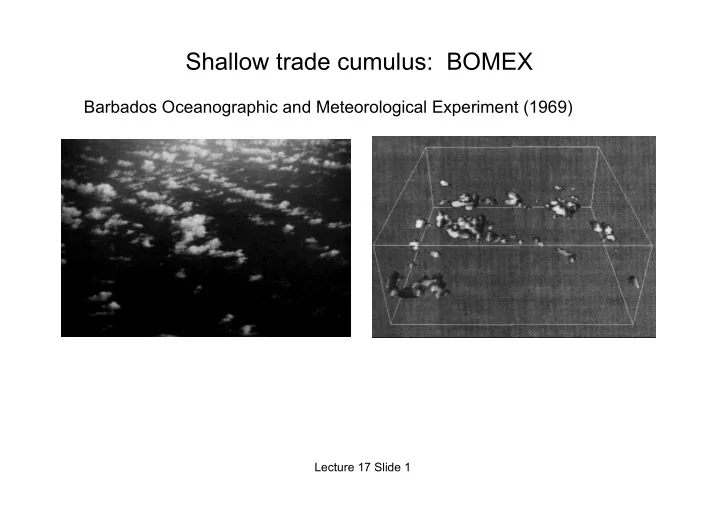
Shallow trade cumulus: BOMEX

Barbados Oceanographic and Meteorological Experiment (1969)

Lecture 17 Slide 1

slide-2
SLIDE 2

LES of nonprecipitating BOMEX trade cumulus

Lecture 17 Slide 2

slide-3
SLIDE 3

BOMEX LES profiles

Lecture 17 Slide 3

slide-4
SLIDE 4

Shallow Cu buoyancy/ flux: entrainment dilution reduces b’ and w’

Lecture 17 Slide 4

slide-5
SLIDE 5

BOMEX LES profiles

Lecture 17 Slide 5

  • Humidity is fluxed up into the inversion where Cu mix with FT air
  • Cu flux momentum downshear, but not as efficiently as dry convection.
slide-6
SLIDE 6

BOMEX LES profiles

Lecture 17 Slide 6

slide-7
SLIDE 7

Estimating Cu lateral entrainment rate

Lecture 17 Slide 7

εq = −dqtu dz qtu − qt

  • Lots of entrainment dilution
  • Shallow Cu updrafts are far

from moist-adiabatic

slide-8
SLIDE 8

Mass flux and detrainment rate

Lecture 17 Slide 8

1 M dM dz = ε −δ

Many Cu don’t ever reach the inversion

slide-9
SLIDE 9

Lecture 17 Slide 9

Sc to Cu transition

Sc Cu Randall 1980 Net cloud radiative effect

  • A fundamental

feature of the Hadley circulation.

  • Important to global

radiation balance

  • A challenge for

climate models, because it involves cloud-turbulence interaction that must be parameterized.

slide-10
SLIDE 10

Lecture 17 Slide 10

LES of Sc to Cu transition

  • 2D, 4x3 km, Δx = 50 m, Δz = 25 m, 8 days
  • SST = 285 + 1.5 K d-1, D = 3x10⁻⁶ s-1, Vg = 7.1 ms-1
  • Diurnally-averaged insolation for 30 N.

Wyant et al. 1997

slide-11
SLIDE 11

Lecture 17 Slide 11

Horizontal-mean statistics

Sc Sc over Cu Cu

slide-12
SLIDE 12

Lecture 17 Slide 12

Sc breakup, decoupling and DIDECUPE

DIDECUPE = Deepening-Induced Decoupling and Cumulus Penetrative Entrainment (Wyant et al. 1997) 1. Deeper Sc-capped boundary layers with weaker inversions

  • ver warmer water favor

persistent decoupling. 2. Decoupling leads to development of a Cu layer, which takes over the entrainment, mixing in enough dry air to evaporate the Sc below the inversion.

(Wyant et al. 1997)