The inert doublet model of dark matter revisited H 0 W m h = 120 - - PowerPoint PPT Presentation

the inert doublet model of dark matter revisited
SMART_READER_LITE
LIVE PREVIEW

The inert doublet model of dark matter revisited H 0 W m h = 120 - - PowerPoint PPT Presentation

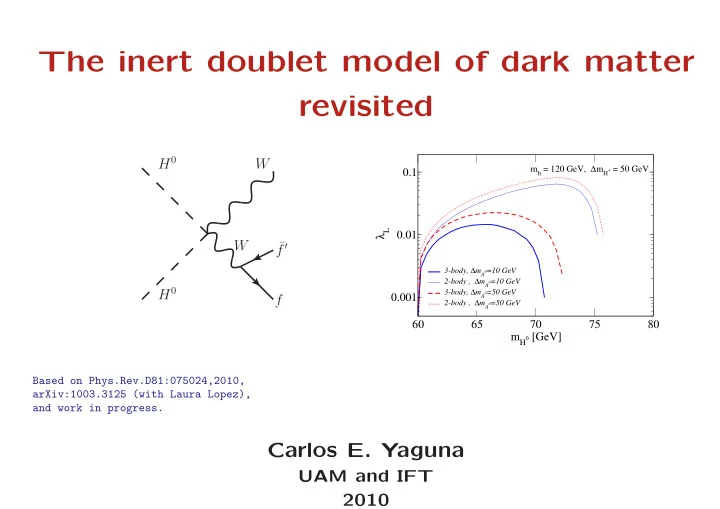
The inert doublet model of dark matter revisited H 0 W m h = 120 GeV, m H + = 50 GeV 0.1 0.01 L W f 3-body, m A 0 =10 GeV 2-body , m A 0 =10 GeV 3-body, m A H 0 0 =50 GeV 0.001 f 2-body , m A 0 =50 GeV 60 65


slide-1
SLIDE 1

H0 H0 W W f ¯ f ′

60 65 70 75 80 mH

0 [GeV]

0.001 0.01 0.1 λL

3-body, ∆mA

0=10 GeV

2-body , ∆mA

0=10 GeV

3-body, ∆mA

0=50 GeV

2-body , ∆mA

0=50 GeV

mh = 120 GeV, ∆mH

+ = 50 GeV

The inert doublet model of dark matter revisited

Based on Phys.Rev.D81:075024,2010, arXiv:1003.3125 (with Laura Lopez), and work in progress.

Carlos E. Yaguna

UAM and IFT 2010

slide-2
SLIDE 2

No coupling to fermions Lightest component is stable

H2 =

  • H+

(H0 + iA0)/ √ 2

  • Barbieri, Bergstrom, Gustaffson,

Ma, Tytgat, etc

In the inert doublet model (IDM) the SM is extended with a second higgs doublet

The idm contains 3 new scalars

H2 is odd under a new Z2 symmetry

This model features a rich phenomenology

slide-3
SLIDE 3

V = µ2

1|H1|2 + µ2 2|H2 2| + λ1|H1|4 + λ2|H2|4

+λ3|H1|2|H2|2 + λ4|H†

1H2|2

+λ5

2

  • (H†

1H2)2 + h.c.

  • The lightest odd particle: H0

mH0, mA0, mH± λL ≡ 1

2(λ3 + λ4 + λ5)

The inert doublet model can account for the dark matter of the Universe

It includes a viable dm candidate

H0 has gauge and

scalar interactions The parameter space is rather simple

slide-4
SLIDE 4

parameter space modifying the viable

Yaguna (2010), Kamionkowski (1998) nor in DarkSUSY or micrOMEGAs

for mH0 < MW

Dark matter annihilations might be dominated by three-body final states such as W W ∗ or t¯

t∗

A new effect not included in most analysis They affect Ωdm and the dm detection prospects

H0H0 may annihilate into W W ∗ in the IDM

slide-5
SLIDE 5

∝ g2

  • r mH0 > 500 GeV

In the IDM the viable parameter space coincides with the region where H0H0 → W W ∗ is important

H0H0 → W +W − has a

purely gauge contribution The viable parameter space is mH0 < MW In that region, b¯

b is the

dominant 2-b final state

slide-6
SLIDE 6

H0 H0 W W f ¯ f ′ H0 H0 W W f ¯ f ′ H±

∝ g3 ∝ g2λL

H0 H0 h W W f ¯ f ′

Three different diagrams contribute to

H0H0 → W W ∗ → W f ¯ f′ in the IDM

There are two gauge diagrams And a higgs mediated diagram Coannihilations may also affect Ω

slide-7
SLIDE 7

50 60 70 80

mH

0 (GeV)

0.01 1 100 10000

σ(WW

*)/σ(2-body) mh = 120 GeV mh = 150 GeV mh = 200 GeV

∆mA

0 = ∆mH + = 50 GeV

λL = 1e-2

In the IDM, the three-body annihilation rate can be much larger than the two-body one

This effect depends on the higgs mass The correct σ could be

100 times larger σ(3-body) > σ(2-body) over

a wide mH0 range

slide-8
SLIDE 8

50 60 70 80

mH

0 (GeV)

0.2 0.4 0.6 0.8 1

Ω(2- +3-body)/Ω(2-body)

mh = 120 GeV mh = 150 GeV mh = 200 GeV λL = 1e-2 ∆mH

+ = 50 GeV

The H0 relic density is strongly reduced by annihilations into W W ∗

A significant effect independently of mh

Ω could be more than 10 times smaller

This is a generic feature

  • f the IDM
slide-9
SLIDE 9

60 65 70 75 80 mH

0 [GeV]

0.001 0.01 0.1 λL

3-body, ∆mA

0=10 GeV

2-body , ∆mA

0=10 GeV

3-body, ∆mA

0=50 GeV

2-body , ∆mA

0=50 GeV

mh = 120 GeV, ∆mH

+ = 50 GeV

Due to 3-body final states, the viable parameter space of the IDM is substantially modified

The required value of λL may be much smaller The maximum allowed

mH0 decreases

Similar results for other parameters

slide-10
SLIDE 10

60 65 70 75 80 mH

0 [GeV]

1e-11 1e-10 1e-09 1e-08 1e-07 σH

0-N [pb]

3-body, ∆mA

0 = 10 GeV

2-body, ∆mA

0 = 10 GeV

3-body, ∆mA

0=50 GeV

2-body, ∆mA

0 = 50 GeV

mh= 120 GeV , ∆mH

+= 50 GeV

CDMS 2009

The inert higgs direct detection cross section is much smaller than previously believed

The dd cross section is proportional to λ2

L

The new σH0-N is up to 100 times smaller Indirect detection signals are also affected

slide-11
SLIDE 11

H0 H0 W W f ¯ f ′

60 65 70 75 80 mH

0 [GeV]

0.001 0.01 0.1 λL

3-body, ∆mA

0=10 GeV

2-body , ∆mA

0=10 GeV

3-body, ∆mA

0=50 GeV

2-body , ∆mA

0=50 GeV

mh = 120 GeV, ∆mH

+ = 50 GeV

50 60 70 80

mH

0 (GeV)

0.01 1 100 10000

σ(WW

*)/σ(2-body) mh = 120 GeV mh = 150 GeV mh = 200 GeV ∆mA

0 = ∆mH + = 50 GeV

λL = 1e-2

The 3-body final state W W ∗ plays a major role in the dm phenomenology of the IDM

They modify the viable parameter space They alter the dm detection prospects They induce large corrections