Providence Integrative Medicine Our approach : focus on evidence - - PDF document

providence integrative medicine
SMART_READER_LITE
LIVE PREVIEW

Providence Integrative Medicine Our approach : focus on evidence - - PDF document

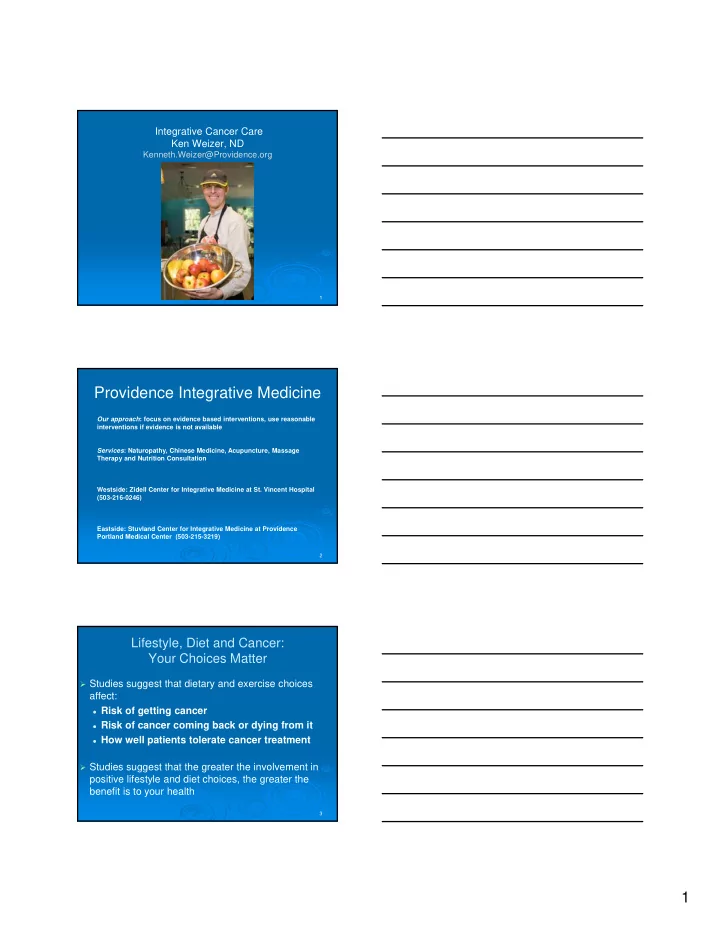
Integrative Cancer Care Ken Weizer, ND Kenneth.Weizer@Providence.org 1 Providence Integrative Medicine Our approach : focus on evidence based interventions, use reasonable interventions if evidence is not available Services : Naturopathy,


slide-1
SLIDE 1

1

1

Integrative Cancer Care Ken Weizer, ND

Kenneth.Weizer@Providence.org

Providence Integrative Medicine

2

Our approach: focus on evidence based interventions, use reasonable interventions if evidence is not available Services: Naturopathy, Chinese Medicine, Acupuncture, Massage Therapy and Nutrition Consultation Westside: Zidell Center for Integrative Medicine at St. Vincent Hospital (503-216-0246) Eastside: Stuvland Center for Integrative Medicine at Providence Portland Medical Center (503-215-3219)

3

Lifestyle, Diet and Cancer: Your Choices Matter

  • Studies suggest that dietary and exercise choices

affect:

 Risk of getting cancer  Risk of cancer coming back or dying from it  How well patients tolerate cancer treatment

  • Studies suggest that the greater the involvement in

positive lifestyle and diet choices, the greater the benefit is to your health

slide-2
SLIDE 2

2

4

Few cancer survivors do lifestyle modification

  • Only 5% of cancer survivors implement dietary

changes and physical activity and non-smoking

  • Dietary Changes – 5 a Day fruits and veggies
  • Physical Activity – 150 minutes of moderate to

strenuous or 60 minutes of strenuous physical activity per week.

ACS SCS-II, J Clin Oncol 2008;13:2198-2204 J Clin Oncol, 2007 Jun 10;25(17):2345-51.

5

What You Eat Matters When You Have Cancer

Prospective Observational Study: Looked at food habits

  • f 1009 people with Stage III colon cancer, undergoing

chemotherapy, followed 5+ years “Western Diet” – More meat, fat, desserts, sweets, refined grains “Prudent Diet” – Similar to Mediterranean diet: more fruit, vegetables, fish, poultry Outcome: Greater intake of “Western” foods associated with 3x the risk of recurrence and death from colon cancer

p = <0.001 Meyerhardt JAMA 2007;298(7):757-764

Diet and Breast Cancer

PREDIMED Study Randomized 4282 women to either an olive oil enhanced Mediterranean diet or a low fat diet, Med diet group 68% less likely to develop breast cancer

  • ver 4.8 years.

JAMA Intern Med, 2015 Nov;175(11):1752-60

6

slide-3
SLIDE 3

3

7

Looked at adding lower-fat diet (20% of calories as fat) to usual breast cancer treatment Findings with addition of low-fat diet:

 Significant (6 lb) weight loss  Lower breast cancer recurrence rate: after 3

years, 24% less recurrence overall, 40% less ER- tumor recurrence rate

Chlebowski JNCI 2006;98:1767-76

Diet and Breast Cancer

WINS Study - Women’s Intervention Nutrition Study

8

Other studies haven’t shown a link between breast cancer and total fat intake.

Other aspects of diet change (less processed foods, less bad fats, weight loss) in this study may contributed to the positive outcome seen in this low-fat study.

Chlebowski JNCI 2006;98:1767-76

Fat

9

The Mediterranean-Style Diet

 Vegetables, legumes, fruit, nuts, unrefined (whole)

grains, extra-virgin olive oil, fish

 Traditional dairy - cheese and yogurt

The benefits:

  • Studies on this eating pattern show many benefits: less
  • besity, heart disease and a reduced risk of cancer.
slide-4
SLIDE 4

4

10

Lyon Heart Study

  • 4 year study comparing Mediterranean Diet to

standard diet

  • 60% reduction of all cancers, 70% less cardiac

events, 45% less deaths

  • 50% less deaths from all causes! 4 year follow up.

deLorgeril Arch Int Med 1998;158:1181-87 Knoops JAMA 2004;292:1433

DIANA 1 & 2

  • Lowers weight, cholesterol and insulin

resistance, improves hormones linked to breast cancer risk

Berrino Cancer Epid Bio Prev 2001;10:25-33 Berrino Int J Ca 2005;113:499-502

Mediterranean Diet Studies

11

Foods and Breast Cancer

Probably Influence Breast Cancer

 Refined grains & sugar (increases risk)  Beans, whole grains (decrease risk)  Flax seed, but probably not flax oil (decreases)

Probably Do Not Influence Breast Cancer

 Soy  Dairy products  Meat  Total fat intake

Probably Influence Breast Cancer

 Fruit & Vegetables

12

  • Data conflicting van Gils JAMA 2005;293:183-93, AICR 2007
  • Probably need to eat at least 600g/day – a

little over a pound - for benefit

  • Type consumed may be important (e.g. more

cruciferous vegetables – cabbage, broccoli etc)

  • Higher blood levels of carotenoids (indicating greater

fruit and vegetable intake) associated with better recurrence-free survival

WHEL Rock J Clin Oncol 2005;23:6631-38

Vegetables and Fruit

slide-5
SLIDE 5

5

13

Eat 9 servings every day - about 1 pound Serving sizes:

  • 1 medium piece of fruit
  • 1/2 cup chopped fruit
  • 1 cup raw leafy vegetables
  • 1/2 cup chopped vegetables
  • Choose raw, cooked and frozen over dried or
  • canned. Check ingredient labels for salt and sugar
  • Juices are less beneficial: more calories, less fiber,

less total nutritional content, lead to weight gain

14

Whole Grains

  • 100% whole wheat, brown rice, corn, oats, rye,

brown (unpearled) barley, millet, quinoia

  • Contain more minerals, vitamins, antioxidants,

and fiber than refined grains

  • Associated with lower risk of constipation, breast

and colon cancer, heart disease and type 2 diabetes

15

Refined Flours and Sugars

  • Includes enriched flour, most breads, pastries,

pasta, bagels, cold cereals, white rice

  • Refined sugars include: white and brown sugars,

dextrose, glucose, high fructose corn syrup, juice, agave, cane juice, fruit juice concentrates

  • Little nutrition, LOTS of calories
  • Worsens insulin resistance, obesity
  • May increase breast cancer risk

Int J Cancer 2005;114:653-58

  • May increase breast cancer mortality

Borugian Cancer Epid Biomarkers Prev 2004;13:1163-72

slide-6
SLIDE 6

6

16

The Hard News About Soft Drinks

Soft drinks (regular and diet, one or more daily) worsen:

 Insulin resistance (which raises risk of breast

cancer)

 Increases obesity (which raises risk of breast

cancer)

 Cholesterol and triglycerides; raises blood

pressure and blood sugar

Framingham, 4 yrs, n=6039, Dhingra Circulation 2007;116:480-88

  • Artificial sweeteners seem to increase total calorie

intake through increased appetite

Swithers, S. Behavioral Neuroscience 2008;122:161-73

17

  • Women who ate 25 gm (4 tablespoons or ¼

cup) ground flaxseed in a muffin research study had reduced tumor growth at 39 days.

Significant reduction in Ki67 and Cerb-B2 labeling index, increased apoptosis N=47 thompson, Goss, Clin Cancer Res 2005;11:3828-3835

  • Flaxseed lignans reduce breast cancer cell

adhesion, invasion and migration in in vitro and animal studies.

ER- cell lines Chen & Thompson Br Ca Res Treatment 2003;80:163-170

Flax Seed

18

  • Buy whole flaxseed, store in fridge or freezer
  • Time saver: grind a week’s worth; store in a flip-top

jar in the fridge

  • Ground flax has a mild nutty flavor, put in hot cereal,

salad, yogurt, cottage cheese, smoothies. Can also take mixed in 4-6 oz water.

  • Use in baking only if you can track the amount in

each serving

  • Sesame seeds may have similar benefit

Nutrition and Cancer 2005:52:156-65

Using Flax Seed

slide-7
SLIDE 7

7

19

Beans and Legumes

  • Rich in healthful plant chemicals, antioxidants,

fiber and minerals

  • Examples: split peas, lentils, dried peas (black-

eyed, chickpeas) and beans of all kinds (black, pinto, navy, white, red, kidney, etc).

  • Eat 5 or more servings per week

Manios, Mediterranean Diet as Nutrition Education and Dietary Guide, Forum Nutr 2006

20

Soy

  • Soy foods appear most protective against

breast cancer if eaten in childhood and the early teen years.

  • Avoid soy protein powders, isoflavones

and large quantities of soy milk until more is known about their safety.

  • Acceptable choices (3-5 servings a week):

whole soybeans, tofu, miso, tempeh and green soybeans (edamame).

  • Boyapati. Breast Ca Res Treatment 2005;92:11-17; J Nutr 2001;131:3095S-3108S

21

Meat

  • Red meat appears to be safe up to about

18oz (raw weight) weekly. Fish may have some protective properties. AICR 2007

  • Of all the types of meat, processed and

preserved meats are more strongly associated with increased breast cancer risk than other forms of animal proteins. (23-64% increased risk)

Egeberg, R. Eur J Cancer Prevention 2008;17:39-47 Taylor E.F. British J Cancer 2007;96:1139-46

slide-8
SLIDE 8

8

22

Alcohol

  • Alcohol consumption >7 servings/week seems to

significantly increase the risk of breast cancer

  • Risk most increased at 2 drinks a day, but probably

begins increasing around one drink daily

  • The choice to drink alcohol should be based on

individualized medical history - talk to your physician.

CA Cancer J Clin 2006;56:323-353

23

Dietary Fat

  • Total energy (calorie) intake more

important for risk than total fat intake

  • Total fat intake not related to risk or

prognosis in most (not all) studies

  • (for discussion, see Mc Eligot 2006)
  • Certain fats may be more beneficial:

 Olive oil associated with less breast cancer

Sieri Ca Epid Bio Prev 2004;13:567-572 Lancet Oncology 2005;6:69 Conflicting: McEligot Nutr Cancer 2006; 55:132-40

 Omega 3 fats may be protective Menedez, J. et al Clin Transl Oncol 2006; 8:812-20

24

High Fat or Low Fat Diets?

  • Randomized trials consistently show better

results for health outcomes with higher fat diets (typically Mediterranean or Atkins) compared to low fat diets.

 However, low fat whole food low-processed-carb

diet probably work for some people, but there is very little good data.

 Mediterranean and Atkins superior to low fat diet

for weight loss, glucose and insulin levels, and cholesterol levels. Shai, I. NEJM 2008;359:229-41

slide-9
SLIDE 9

9

25

Mediterranean Diet Beats Low Fat Diet for Weight Loss

  • Comparison study: 35% fat Mediterranean

diet (more nuts, olive oil, vegetables) vs. 20% (low fat) diet

  • Both groups lost weight by 6 months
  • At 18 months, 35% fat group had better

participation, weight loss, waist

  • circumference. Low fat group gained weight

at 18 months

101 men and women followed for 18 months McManus. Into J Obesity 2001;25:1503-11.

26

  • EPA and DHA found in oily fish such as wild salmon,

trout, mackerel, herring, sardines, ‘light’ tuna

  • ALA in flaxseed oil or meal, some green vegetables,

and tree nuts, particularly walnuts. Other good nuts: raw almonds, filberts, pecans, Brazil nuts

  • Improves immune function, reduces inflammation

Omega 3 Fats

27

  • Avoid all hydrogenated and partially hydrogenated
  • ils
  • Avoid corn, sunflower and safflower oils due to their

high levels of omega 6 fatty acids and lack of useful nutrients Sonestedt, E. Int J Cancer 2008;123:1637-43

  • Use extra virgin olive oil as your main fat
  • Second choice oil: peanut, coconut, sesame
  • Raw nuts and fatty fish are good fats too
  • Butter is better

Fats

slide-10
SLIDE 10

10

28

  • 60 -100% higher breast cancer risk in obese

postmenopausal women compared to thin women Nurses Health study. McTiernan, A. BMJ 2000;321:624-28

  • >50 lb weight gain after 18 years old doubles

risk McTeirnan, ‘Breast Fitness’ St. Martins 2000

  • Postmenopausal weight loss lowers risk

Eliassen JAMA 2006;296:193-201

  • Better survival in thin postmenopausal

women with breast cancer versus obese

Am J Epid 2003;158:963-68 Jain, Int.J Obesity 2005; 29:792-797

Obesity

29

Other Risks of Obesity

  • More cancer
  • Heart disease, stroke
  • Diabetes
  • Dementia
  • High blood pressure
  • Joint disease
  • Asthma
  • Chronic pain

30

  • EAT SMALLER PORTIONS
  • The extras add up: snacks, coffee drinks,

chocolate, wine, juice

  • Reduce or eliminate refined carbohydrates

(sugar, white flour, white rice)

  • DAILY intentional exercise: include

walking (10,000 steps), cardio, strength, stretching/balance

Losing Weight, Maintaining Loss

slide-11
SLIDE 11

11

31

  • Eat more vegetables and whole fruits,

maintain protein and healthy fat

  • Eat breakfast every day
  • Keep healthy snack food on hand
  • Restaurant foods and ‘energy bars’ are

“junk” until proven otherwise

  • Minimize screen time (TV and Computer)

Weight Loss

32

The 200 Calorie Rule

  • Eating 200 calories a day more than you need leads to

20 lbs weight gain in a year Examples of foods with about 200 calories:

 Jamba Juice Strawberry Smoothie 12 oz (212 calories)  Starbucks Grande Vanilla Latté (250 calories)  Orange Juice, 12 oz (170 calories)  M & Ms, small bag (290 calories)  Red wine, 8 oz (200 calories)  Hershey’s Kisses, 9 (230 calories)

33

Breakfast

  • Regularly eating breakfast associated with

37-55% lower risk of obesity and type 2 diabetes For white men and women, black men. CARDIA. Pereira AHA 3/03 Abstract

  • Other benefits of daily healthy breakfast:

 More alert, more productive  More endurance, less irritable  Less likely to make unwise choices later

slide-12
SLIDE 12

12

34

Breakfast - Good Choices

  • Coarse whole grain hot cereals
  • Whole grain breads, toast, muffins with nut

butters

  • Real eggs (including yolk) - not egg substitutes
  • Plain yogurt or kefir
  • Beans (pintos, lentils, anasazi) & cheese
  • Leftovers from previous day’s lunch or dinner

35

Breakfast – Not-So-Good Choices

  • Refined carbohydrates (like bagels,

muffins, pastries, biscuits, white flour pancakes and waffles, etc)

  • ‘Cold’ cereals
  • Preserved meat (bacon, sausage, ham)
  • Fruit juice
  • Eating too late in the morning

36

Benefits Of Exercise

Reduces

 Heart disease  Cancer (especially breast, colon, prostate)  Stroke, dementia  Diabetes  Osteoporosis and fractures

Improves

 Survival from some cancers (including breast)  Tolerance of cancer therapies  Immunity  Mood

slide-13
SLIDE 13

13

37

 Improves function, mood, sense of well-being;

decreases fatigue in women with breast cancer

McNeely CMAJ 2006;175:32-41 Mutrie BMJ 2007 doi 10.1136/bmj.39094.648553.AE

 Improves sleep, menopausal symptoms, nausea  Risk of dying 25-50% lower in women with

breast cancer who exercise

Nurses Health Study Holmes JAMA 2005;293:2479-2486 Lancet Oncology 2006;7:1017-26

Exercise

38

  • Start low intensity, slow pace and

shorter time. Work up to 30-45 minutes

  • f vigorous activity most days.
  • Work up to 10,000 steps daily
  • The world is your gym. Look for ways to

sneak in activity: take the stairs, walk at lunch, park farther away, walk after dinner

Exercise

39

  • It may be more important to be to

be fit than to be your correct weight…but even better to be both

Wessel JAMA 2004;292:1179-87

  • Being unfit and overweight

accounts for 30% of all premature deaths

Hu JAMA 2004;351:2694-703

Exercise

slide-14
SLIDE 14

14

40

Food First!

  • Whole foods are associated with better cancer
  • utcomes – it’s your best choice!
  • Supplements can’t replace good food!
  • Nutritional supplements have shown hints of both

benefit and harm

  • Our supplement advice is individualized
  • Individual patients may have an important reason to

use supplements. These cautions are only for general use.

AICR Global Perspective 2007

41

Supplements

  • Multivitamins typically associated with no

benefit, or hints of harm Lawson, K. JNCI 2007;99:754-64

  • Most nutritional supplements have not

been subject to rigorous studies. When studied, there is often no clinically important benefit.

  • There is something unique about food

42

Vitamin D

  • Higher self-reported vitamin D intake associated with

lower risk of breast cancer Holick Mayo Clin Proc

  • 2006;81:353-73
  • Women with breast cancer usually low in D

Neuhauser, M. Am J Clin Nutr 2008;88:133-9

  • In women with breast cancer, low vitamin D levels

associated with worse outcome

Goodwin, P. ASCO 2008

  • Vitamin D supplements associated with:

 Lower risk of cancer in randomized trial n= 1179, 4y. Lappe, J. Am J Clin Nutr 2007;85:1586-9  Lower total death rate in general population Randomized placebo controlled trials. Arch Int Med 2007;167:1730-37  Better bone density when on AI treatment Journal of Clinical Oncology, 2011 ASCO Annual Meeting Proceedings

slide-15
SLIDE 15

15

43

  • Eat 100% whole grains
  • Eliminate refined grains, flours and

sugar

  • Drink juice rarely
  • Eat beans several times weekly
  • Eat 5 servings or more of whole fruit

and vegetables daily

Summary

44

  • Eat extra virgin olive oil, fatty fish, raw nuts
  • Decrease processed meats
  • Eat modest amounts of poultry, fish and red

meat

  • Flaxseed meal, vitamin D
  • Reduce portions and eat less overall if you

need to lose weight

Summary

45

Be as lean as you can in your range of normal weight Do daily intentional exercise:

  • At least 30+ minutes walking,

15 minutes on stairs, or 10,000 steps a day

  • Eventually add in stretching and

strengthening (weight training)

Summary

slide-16
SLIDE 16

16

46

 Eating and exercise challenges  Neuropathy  Radiation skin injury  Taste changes  Lymphedema  Menopausal symptoms like hot flashes  Stress  Insomnia

Integrative Medicine Can Help

 Diarrhea, constipation  Nausea, vomiting  Hot flashes  Fatigue  Mouth sores  Loss of appetite  Weight loss, weight gain  Bone support  Other health concerns and issues

47 48

  • Good Food, Great Medicine (Hassell & Hassell)
  • Food Rules: An Eaters Manifesto (Michael Pollen)
  • Anti-Cancer (David Servan-Schreiber)
  • Mediterranean Diet Cookbook (Harmon-Jenkins)
  • Eat, Drink and Be Healthy (Walter Willett)
  • Fat Fallacy (Will Clower)
  • The Schwarzbein Principle (Schwarzbein)
  • The New American Plate, (American Institute for Cancer

Research) www.aicr.com

Books