Integrative Medicine Integrative medicine and health reaffirms and - - PDF document

integrative medicine
SMART_READER_LITE
LIVE PREVIEW

Integrative Medicine Integrative medicine and health reaffirms and - - PDF document

3/9/18 Integrative Medicine Integrative medicine and health reaffirms and Health the importance of the relationship between practitioner and patient, focuses on the whole person, is informed by evidence, and makes use of all appropriate


slide-1
SLIDE 1

3/9/18 1

Integrative Medicine and Health

Kimberly Washington, MD, DC Assistant Clinical Professor, Orthopaedic Surgery Osher Center for Integrative Medicine University of California, San Francisco March 9, 2018 Disclosures: None

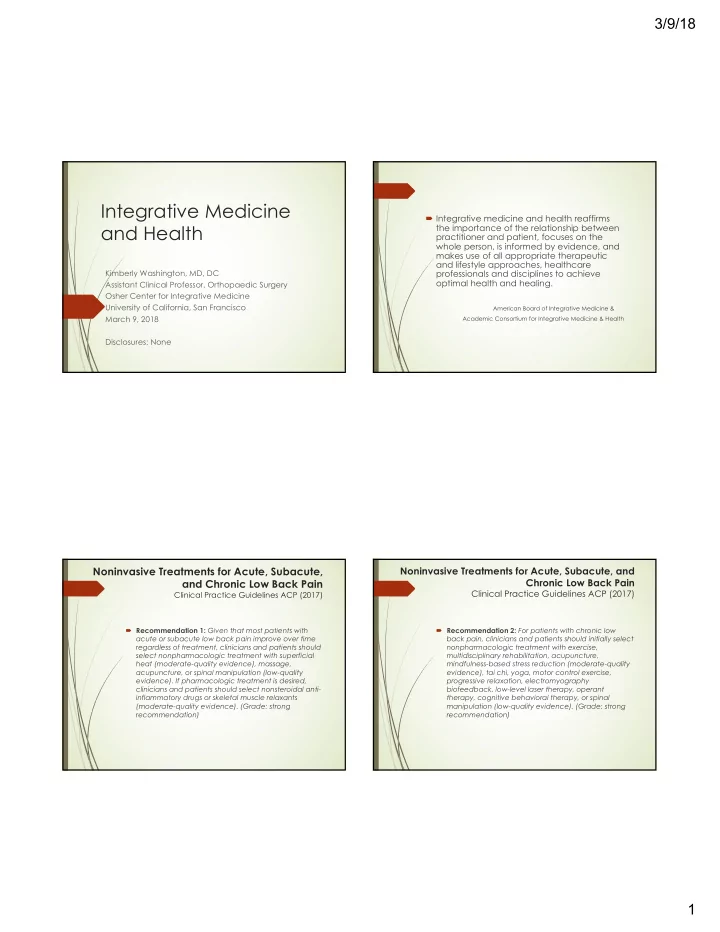
´ Integrative medicine and health reaffirms the importance of the relationship between practitioner and patient, focuses on the whole person, is informed by evidence, and makes use of all appropriate therapeutic and lifestyle approaches, healthcare professionals and disciplines to achieve

  • ptimal health and healing.

American Board of Integrative Medicine & Academic Consortium for Integrative Medicine & Health

Noninvasive Treatments for Acute, Subacute, and Chronic Low Back Pain

Clinical Practice Guidelines ACP (2017)

´ Recommendation 1: Given that most patients with acute or subacute low back pain improve over time regardless of treatment, clinicians and patients should select nonpharmacologic treatment with superficial heat (moderate-quality evidence), massage, acupuncture, or spinal manipulation (low-quality evidence). If pharmacologic treatment is desired, clinicians and patients should select nonsteroidal anti- inflammatory drugs or skeletal muscle relaxants (moderate-quality evidence). (Grade: strong recommendation)

Noninvasive Treatments for Acute, Subacute, and Chronic Low Back Pain

Clinical Practice Guidelines ACP (2017)

´ Recommendation 2: For patients with chronic low back pain, clinicians and patients should initially select nonpharmacologic treatment with exercise, multidisciplinary rehabilitation, acupuncture, mindfulness-based stress reduction (moderate-quality evidence), tai chi, yoga, motor control exercise, progressive relaxation, electromyography biofeedback, low-level laser therapy, operant therapy, cognitive behavioral therapy, or spinal manipulation (low-quality evidence). (Grade: strong recommendation)

slide-2
SLIDE 2

3/9/18 2

´ 2012 National Health Interview Survey ´ One-third of US adults use ´Natural products (17.7%) ´Yoga, Tai Chi, Qi Gong (9.5%) ´Chiropractic and Osteopathic manipulation (8.4%) ´Meditation (8%) ´ $30 billion out-of-pocket ´ Pain management ´ Prevention and health maintenance

“Yoga teaches us how to infuse our movements with intelligence, transforming them into action.” BKS Iyengar

´ Integration of body, mind, and breath ´ various styles of yoga typically combine physical postures, breathing techniques, and meditation or relaxation ´ Current research suggests that a carefully adapted set

  • f yoga poses may reduce low-back pain and

improve function. Other studies also suggest that practicing yoga (as well as other forms of regular exercise) might improve quality of life; reduce stress; lower heart rate and blood pressure; help relieve anxiety, depression, and insomnia; and improve

  • verall physical fitness, strength, and flexibility.
slide-3
SLIDE 3

3/9/18 3

“We are the knowing, not the conditions known.” Eckhart Tolle

´ Meditation is a mind and body practice that has a long history of use for increasing calmness and physical relaxation, improving psychological balance, coping with illness, and enhancing overall health and well-being. ´ Quiet location ´ Specific, comfortable posture (sitting, lying down, walking, or in other positions) ´ Focus of attention (a specially chosen word or set of words, an object, or the sensations of the breath) ´ Open attitude, non-reactive (letting distractions come and go naturally without judging them)

Evaluating and Treating Pain

Imperative to be aware of behavioral and functional disruption requiring more comprehensive treatment options to reduce disability.

Acute

´ Usually response to noxious event ´ Time limited ´ Adaptive function ´ Goal to remove or minimize underlying injurious process ´ Failure to adequately treat risks development of chronic pain

Chronic

´ May not be associated with

  • ngoing noxious event

´ Lasts longer than typically expected for healing ´ Maladaptive ´ More dynamic interplay of psychologic and behavioral mechanisms

It’s Not Magic Dust

“You treat a disease, you win, you lose. You treat a person, I guarantee you, you'll win, no matter what the outcome.”

Hunter Doherty “Patch” Adams, MD

´ Apply foundational health principles allowing patients to re- inhabit their bodies and minds, to understand and resolve many

  • f the distressing symptoms by addressing their sleep and rest,

good nutrition, focused activity, relaxation, creativity.

slide-4
SLIDE 4

3/9/18 4

NIH Pain Consortium

´ Self Management - actions taken by the patient to manage

  • r minimize the impact of a chronic condition on everyday life

´ Treatment of the whole person ´ Empowerment of the patient ´ Active participation by the patient ´ Get back to life even while in pain

´ Pain medication management ´ Coping skills ´ Relaxation techniques ´ Problem solving ´ Enhancement of the patient’s social network ´ Goal setting ´ Managing emotions ´ Exercise

slide-5
SLIDE 5

3/9/18 5

Resources

´ Academic Consortium for Integrative Medicine & Health ´ University of Wisconsin-Madison Integrative Health Program ´ National Center for Complementary and Integrative Health (NCCIH) ´ NIH Pain Consortium ´ Agency for healthcare research and quality (AHRQ) ´ PubMed

  • 1. A maladaptive behavior observed with

chronic pain is:

´ A. Fear avoidance ´ B. A clear understanding that mood is never influenced by pain ´ C. Functional activity is rarely impaired ´ D. Increased generosity

  • 2. Mind body medicine involves:

´ A. Intentionally deceiving a patient ´ B. Promoting self-care practices such as exercise, adequate sleep, and attention to diet ´ C. Skills that are beyond the scope of a practicing physician ´ D. Using a placebo

slide-6
SLIDE 6

3/9/18 6

  • 3. Contemplative practices such as

meditation:

´ A. Support non-judgmental self evaluation ´ B. Might encourage an attitude of approaching rather than avoiding pain ´ C. Are being studied for their effects on brain activity in the default mode network ´ D. All of the above

ABPM answer key

´ Question #1 – A. Fear avoidance is a maladaptive behavior observed in patients with chronic pain ´ Question #2 – B. Mind body medicine involves promotion

  • f self care practices such as exercise, adequate sleep,

and attention to diet. ´ Question #3 – D. All of the above (Contemplative practices such as meditation support A. non-judgmental self evaluation, B. might encourage and attitude of approaching rather than avoiding pain, C. are being studied for their effects on brain activity in the default mode network.