Project management Project Management A project is a temporary - - PowerPoint PPT Presentation

project management project management
SMART_READER_LITE
LIVE PREVIEW

Project management Project Management A project is a temporary - - PowerPoint PPT Presentation

Project management Project Management A project is a temporary endeavour to produce a unique product, service, or result (PMI 2004). Project management (PM) techniques were originally developed Dr. James A. Bednar for engineering


slide-1
SLIDE 1

Project Management

  • Dr. James A. Bednar

jbednar@inf.ed.ac.uk http://homepages.inf.ed.ac.uk/jbednar

SAPM Spring 2012: Project Management 1

Project management

A project is ‘a temporary endeavour to produce a unique product, service, or result’ (PMI 2004). Project management (PM) techniques were originally developed for engineering projects like building construction. PM focuses on planning, scheduling, monitoring, and controlling the complex interdependencies among subtasks. PM techniques are most relevant when considering the entire project in which software development is embedded, which includes other activities such as documentation, training, hardware, etc.

SAPM Spring 2012: Project Management 2

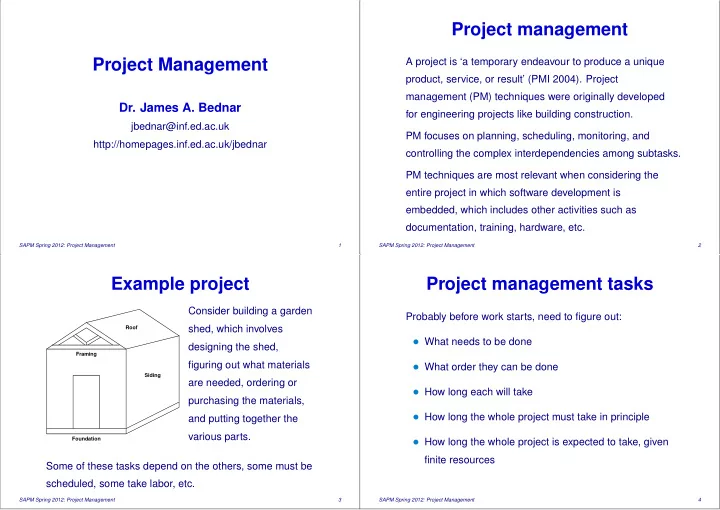
Example project

Siding Roof Foundation Framing

Consider building a garden shed, which involves designing the shed, figuring out what materials are needed, ordering or purchasing the materials, and putting together the various parts. Some of these tasks depend on the others, some must be scheduled, some take labor, etc.

SAPM Spring 2012: Project Management 3

Project management tasks

Probably before work starts, need to figure out:

  • What needs to be done
  • What order they can be done
  • How long each will take
  • How long the whole project must take in principle
  • How long the whole project is expected to take, given

finite resources

SAPM Spring 2012: Project Management 4

slide-2
SLIDE 2

Project scope statement

In order to make any decisions about the project, it needs to be made concrete (no pun intended). This is done by writing a scope statement, such as:

  • We will build a garden shed capable of holding 2

bicycles, a lawn mower, and a small workbench

  • Planning permission will not be needed
  • We will not connect it to electric or water mains
  • It cannot cost more than 1000 pounds or take longer

than 1 month (may be a constraint rather than scope) Note that the scope statement includes not only what it will do, but what will not be included.

SAPM Spring 2012: Project Management 5

Work breakdown structure

A WBS is a diagram showing the major subtasks of the project:

Constructing Build Shed Planning Obtaining Materials Pour foundation Build frame Install siding Install roof Finish (door, etc.)

Rule of thumb: break things down as far as necessary to estimate and schedule them, and no further.

SAPM Spring 2012: Project Management 6

Network diagram

1 day Design Materials list 1 day Order materials 1 day Deliver materials 7 days Build frame 2 days Finish 1 day Pour foundation 1 day Install siding 1 day Install roof 2 days

Network diagrams can be constructed from the WBS, adding dependencies and estimated durations. Note that you can have different network diagrams for the same project, depending on your assumptions and approach.

SAPM Spring 2012: Project Management 7

Critical path

1 day Design Materials list 1 day Order materials 1 day Deliver materials 7 days Build frame 2 days Finish 1 day Pour foundation 1 day Install siding 1 day Install roof 2 days

The critical path is the longest path through the network diagram – it is the minimum duration of the project if there are infinite resources (so that tasks can occur in parallel) and accurate estimates. Here, everything but putting up the siding is on the critical path, and must happen in the order specified.

SAPM Spring 2012: Project Management 8

slide-3
SLIDE 3

Slack

1 day Design Materials list 1 day Order materials 1 day Deliver materials 7 days Build frame 2 days Finish 1 day Pour foundation 1 day Install siding 1 day Install roof 2 days

Tasks not on the critical path have slack – the duration by which they can be late without making the project later than the critical path duration. Here, putting up the siding has one day of slack: one day longer than estimated is ok, but if it takes longer it will be the new critical path, and delay the project.

SAPM Spring 2012: Project Management 9

PERT/CPM Charts

Network diagrams come in a variety of flavors with different names: A Program Evaluation and Review Technique (PERT) chart shows dependencies and time estimates, using 3-point estimates. The Critical Path Method (CPM) chart is a related alternative, using single estimates. Both show similar information, but use different methods for calculating the critical path and slack.

SAPM Spring 2012: Project Management 10

Gantt Chart

A Gantt chart shows the tasks and their durations graphically, in calendar form, with one bar per activity. The bar shows the earliest start date and expected duration.

SAPM Spring 2012: Project Management 11

Gantt Chart extras

Gantt charts can also show summary activities (see ‘Planning’ entry), dependencies (arrows), and milestones (diamonds). The dependencies make slack clear (see “Siding” entry).

SAPM Spring 2012: Project Management 12

slide-4
SLIDE 4

Resources

All these charts assume infinite resources – things that can logically happen in parallel, are assumed to happen in parallel. In reality, there are limited resources, so there are often many dependencies not shown in the charts. E.g. if only one person is available to work on the shed project, the siding and roofing tasks must be done in serial, due to the resource constraint.

SAPM Spring 2012: Project Management 13

Crashing/Fast tracking

If the critical path is still not fast enough, it’s possible to shorten the duration by changing some assumptions. E.g.: Crashing: Change the duration of some critical task, e.g., if it is possible to parallelize it by assigning more people to it. Fast tracking: Allow tasks to be done in parallel by changing the logic in the network diagram. If tasks can be parallelized (as in building construction) these allow total duration to be greatly reduced.

SAPM Spring 2012: Project Management 14

For more info

Project Management Institute (PMI): Largest international PM organization; US-based (pmi.org) International Project Management Association (IPMA): Oldest international PM organization (www.ipma.ch) Association for Project Management (APM): UK-based national organization (www.apm.org.uk) PM Glossary:

www.maxwideman.com/pmglossary/

SAPM Spring 2012: Project Management 15

Use PM for your software project?

Why? SW is just a project like any other, with tasks, interdependencies, resources, etc. Right? Why not? The vast majority of SW development tasks cannot be estimated up front – doing so requires knowing the requirements and the design, plus how long debugging will take, and after those three tasks there’s very little work left. Clear win for PM: SW projects embedded into larger projects. Here, the SW must be delivered on time for the rest of the project to succeed, and depends on the other parts. In such cases, PM is very useful. Within the SW-only portion, perhaps not.

SAPM Spring 2012: Project Management 16

slide-5
SLIDE 5

Summary

  • Project management charts and techniques are useful

for scheduling tasks with complex dependencies

  • WBS: main tasks
  • Network diagram: dependencies, durations
  • Gantt: calendar
  • Be careful not to trust the charts just because they

look fancy; e.g., many constraints are not shown

  • See website for required and optional readings

SAPM Spring 2012: Project Management 17

References

PMI (2004). A Guide to the Project Management Body of Knowledge (3rd Ed.). Project Management Institute.

SAPM Spring 2012: Project Management 17